
 [1]
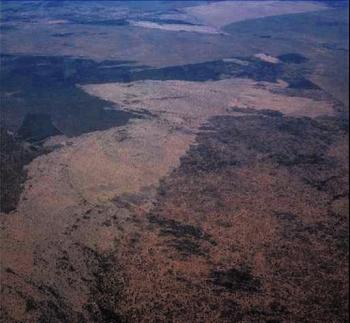
Figure 19.11 Mosaic of hummock grassland located about 300 km north-west of Alice Springs in the Tanami Desert of central Australia. Spinifex vegetation consisting of Trioldia pungens, T. bitextura and Acacia spp. is found across the site, with fires having formed distinct vegetation mosaics. The lightest central swathe burnt about a year earlier, leaving little remaining biomass. Darker zones to the right and left of this most recently burnt region were burnt about five and more than seven years earlier, respectively. (Photograph courtesy G. Griffin)
All floras, including those of Australia and New Zealand, are dynamic. Global climate change throughout prehistory has selected broadly for different vegetation admixtures and specifically for adaptive traits within individual species. While some genetic modifications to plants are considered highly specific responses to a particular environmental factor such as drought, poor nutrition or extremes of temperature, others probably reflect simultaneous changes in several environmental factors. For example, during the Last Glacial Maximum about 20 000 years ago, vegetation was exposed to drier, colder, windier atmospheres strongly depleted in CO2 (180 to 190 ppm) compared to the present day (c. 360 ppm; Chapter 13). Charcoal deposited during these glacial periods is evidence that woody plants had to survive fires as well as extremes in atmospheric conditions. These complex regimes bring into question claims that vegetation has become adapted to a single adverse factor.
Interspersed with major shifts in climate have been periods of changed fire frequency. Palynological evidence presented in Section 19.4.2 shows that fire has been an ‘ecosystem sculptor’ in the Australian landscape for most of the past 15 million years. On the Canterbury Plain of New Zealand’s South Island, by contrast, the Maori transformed Nothofagus and gymnosperm forests into fire-prone grasslands in only about 700 years through burning and cutting (Ogden et al. 1998). Such different time scales of exposure to fire have implications for the flora we see today throughout Australasia. Species of a number of major Australian plant families (e.g. Proteaceae, Myrtaceae) have genetically encoded characters that confer tolerance to the fire regimes described in Sections 19.2 and 19.3, as do plants from other fire-affected parts of the world. These species have evolved over millions of years when fire and climate change consorted to select Australia’s vegetation types. The gymnosperms that grew across the Canterbury Plain also have sclerophyllous leaves but are readily killed by fire, in contrast to the major Australian families. Several important vegetation types in Australia are also severely affected by fire (Figure 19.11). Alpine flora, rainforest species and chenopods from dry rangelands are suppressed or killed by burning.
Pollen is an enduring signature of vegetation type and is therefore a vital tool in analysis of climate change. As pollen and charcoal from fires wash into swamps and lakes, they are deposited in a time sequence that can be analysed by palynologists using cores drilled into the sediments. Fossil leaves recovered largely from surface outcrops are used to supplement these pollen data.
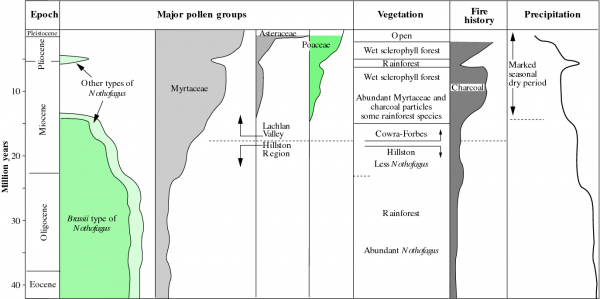
Figure 19.12 illustrates stark shifts in vegetation in central and western New South Wales particularly throughout the second half of the Tertiary. Increasing abundance of pollen from the families Myrtaceae, Poaceae (grasses) and Asteraceae reflect the increasing aridity and oceanic cooling which began about 15 million years ago during the Mid to Late Miocene. ‘Wet’ rainforests, dominated by Nothofagus, gave way to
myrtaceous woodlands and forests dominated by eucalypts. A relatively brief wet period about five million years ago (Late Miocene to Early Pliocene) saw the Nothofagus forests return temporarily at the expense of sclerophyllous species. These broad alignments of climatic events and vegetation mix support the view that climatic factors have driven evolution of major vegetation types throughout Australia, largely through variations in water supply and temperature.
 [2]
Figure 19.12 Summary of major changes in vegetation, fire history and precipitation over the past 40 million years in central and western New South Wales. Major pollen groups show there was a steep decline of Nothofagus forests around 15 million years ago with species of Myrtaceae (especially Eucalyptus spp.) taking their place as the dominant woody species. The wet sclerophyll forests that developed after the Mid Miocene were associated with an increasing abundance of grasses and herbs (families Poaceae and Asteraceae). Charcoal deposits became more prolific as the myrtaceous species expanded, demonstrating that fire was now a feature in the environment. A drier climate that prevailed after the Mid Miocene is believed to be responsible for a rise of sclerophylly. Note the brief return of Nothofagus forest about five million years ago during a brief wet period (Based on Martin 1986, 1998; reproduced with permission of the Linnean Society of NSW)
 [3]
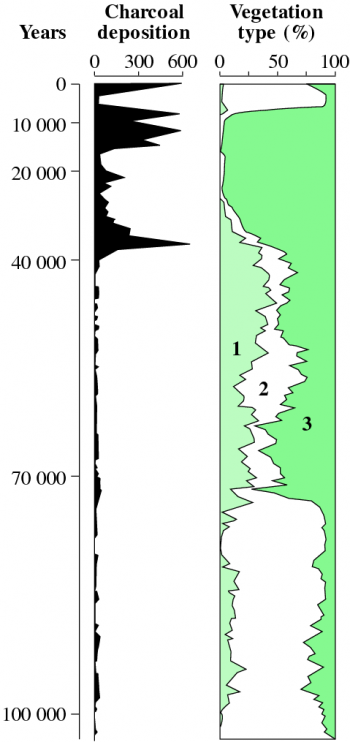
Figure 19.13 Summarised palynological and charcoal data from Lynch's Crater in North Queensland showing major changes in vegetation types over the last 140 000 years, with a dramatic increase in charcoal deposition (thousands of particles per cubic centimetre) around 38 000 years ago. Vegetation types are: (1) rainforest conifers (e.g. araucarias); (2) other rainforest plants and (3) plants from sclerophyll forests. The arrival of Aboriginal people in the area has been cited as a reason for increased burning and development of sclerophyllous forests. Wetter rainforest returned 7000 years ago in spite of a long history of fires, possibly through climate change as the Last Glacial Maximum receded. (Based on Kershaw 1976; reproduced with permission of New Phytologist)
Other parts of the continent underwent the same broad trend towards sclerophylly during the Tertiary. However, climatically induced changes to flora within individual regions of Australia varied distinctly depending on the pre-existing vegetation mix and climatic range. For example, at different times until 120 000 years ago, northeast Queensland supported casuarinaceous forest (either Gymnostoma, a rainforest taxon, or species of the sclerophyllous family Casuarinaceae), araucarian rainforest (family Araucariaceae) and sclerophyllous woodland. The characteristically high rainfall of this region enabled ‘dry’ rainforest, dominated by araucarias, to persist after they vanished in drier regions and indeed sustains tropical rainforest to the present day. On the contrary, north-west Australia has been persistently drier than the northeast throughout the past 40 million years and has pollen records that reflect this history. Early Tertiary rainforests were replaced by casuarinaceous forests by the Late Miocene and more recently by grasslands and Acacia shrublands. The rarity of eucalypts throughout the past 40 million years in this part of the continent endures to the present day, with sclerophyllous shrublands rather than eucalypt woodlands dominating the arid landscape of northwest Australia. In central Australia, too, rainforest succumbed early in the Tertiary period to aridity, leading to sclerophyllous woodlands and finally in the Pleistocene to open shrubland with abundant daisies, grasses and chenopods (saltbush and bluebush).
Data relating to a more recent epoch have been collected from a number of sites in Australia including Lake George in New South Wales, Lashmar’s Lagoon in South Australia and Lynch’s Crater in Queensland (full details in Singh et al. 1981).
At Lynch’s Crater in North Queensland (Figure 19.13), conifers (e.g. araucarias and podocarps) and rainforest angiosperms became much less dominant about 40 000 years ago and were replaced by sclerophyll forests of eucalypts and casuarinas for almost 30 000 years. A return to rainforest species, this time predominantly angiosperms rather than gymnosperms, began about 10 000 years ago after the passing of the Last Glacial Maximum. Indeed, rainforests re-established on wet, fertile sites throughout southeastern Australia during this period of climate change (e.g. Tasmania, Barrington Tops in New South Wales). Pollen data also indicate increasing predominance of eucalypts in drier regions during the Holocene (see Dodson 1991), driven by climate change and associated fire regimes.
Increasing sclerophylly at Lynch’s Crater over tens of thousands of years (Figure 19.13) and in western New South Wales over tens of millions of years (Figure 19.12) both correspond with abundant deposition of charcoal. Water and temperature were certain contributors to vegetation change in both time scales but fire also played a role.
Rapid increases in charcoal deposition coinciding with sclerophylly are a conjunction of cause and effect. Many sclerophyllous species resist the devastating effects of fire through features such as epicormic shoots and fire-protected seeds (Sections 19.2 and 19.3). One outcome of fire regimes is therefore strong selection for sclerophylly. However, drought and herbivory in the absence of fire can also select for sclerophylly. Once sclerophylly is an established feature of a vegetation type, characterised in much of Australia by flammable dryland species such as eucalypts, the likelihood of fire (and therefore charcoal deposition) rises (Section 19.1).
Palynological evidence reveals the complexity of fire and climate change as selective joint forces for vegetation mix. For example, grasses at Lake George were abundant 250 000 to 300 000 years ago, when charcoal was uncommon, and returned to prominence 8000 years ago when fire had become common. While grasslands must have been burnt by occasional fires and therefore contributed to charcoal deposition, most charcoal is believed to have come from more intense fires as woodlands established in wetter periods were burnt. Thus, the return of grasses 8000 years ago cannot be easily ascribed to fire regimes — more likely, grasses were a secondary outcome of the shift from tall to low open-eucalypt forests allowing light to penetrate the canopy. Fire, therefore, probably provides a selective pressure for the evolution of characters that conspicuously confer tolerance to burning (e.g. fire-induced flowering, epicormic sprouting) but also alters landscapes through more general shifts in vegetation mosaics (e.g. from rainforest to sclerophyll forest).
While climate change is an overarching selective force in determining vegetation types, fire interacts with climate to affect a local flora profoundly over both short and long time periods (decades to millennia). It is therefore not surprising that fire has been used sporadically by humans to alter the landscape and hence food supply in Australasia over thousands of years. The subtlety of this manipulation is difficult to gauge because charcoal deposits reflect large intense fires but tell little about local ‘cool’ burns. None the less, data such as those from Lynch’s Crater show a rapid rise in charcoal deposition in the past 40 000 years, supporting the assertion that local groups of Aboriginal Australians burnt the vegetation consistently to suppress rainforest species and promote open woodland (Kershaw 1986). Over the past 7000 years, fire-sensitive rainforests of Araucaria have been restricted to locales that are protected from fire, allowing angiosperms to emerge as the dominant rainforest group. Imposed fire regimes are likely to have had the greatest impact in wetter regions of Australia (northeast Queensland and southwest Tasmania) where large natural fires are less common than in dry areas (Clark 1981).
During at least part of the 40 000 years since Aboriginal Australians arrived, local burning practices have altered vegetation types and prevented rainforest and tall open-woodland from encroaching on adjacent grasslands that sustained wildlife. In this way, mosaics representing several vegetation types were generated, maximising biological productivity. Eucalypt-dominated grasslands have not been an inevitable outcome of fire regimes imposed by humans, with charcoal evidence showing that under favourable climatic conditions woodlands of Casuarina spp. coexist with controlled burning (Clark 1981).
Fires lit naturally also generate mosaics and demonstrate graphically the interaction of distinct plant communities and fire regimes. Hummock grasslands in arid central Australia illustrate distinct mosaic patterns according to the period elapsed since the last fire was lit by lightning or human activity (Figure 19.11). At the other extreme, the large standing biomass of rainforest and eucalypt forest in tropical North Queensland also produces mosaics defined by sharp transitions between plant communities (Unwin 1989). These transitional zones generally reflect the extent of previous fires, with each subsequent fire re-establishing boundaries according to fire frequency and intensity.
On the Herberton Highland in Queensland, evidence of the dynamic nature of forest boundaries is seen in the distribution of large, old Eucalyptus grandis trees. Tall trees between 100 and 400 years old are found scattered along the margins of open eucalypt forest and occasionally within the adjacent rainforest. Because it is well documented that E. grandis seedlings can only establish in open grassy woodland after fire and cannot establish under rainforest, the presence of E. grandis tens to hundreds of metres within the young rainforest is evidence that rainforest has encroached on open woodland within the life of these trees.
Boundaries are still undergoing continual change through the influence of fire. As grasses are burnt up to the transitional zone, E. grandis and the dominant species of the open woodland, Eucalyptus intermedia, take hold. Where fires have not burnt to the rainforest margins for decades, rainforest species become established, leaving open woodland species surrounded by dense, moist canopies. The advance of rainforest in much of this region is a result of a temporary decline in frequency of fires.
 [4]
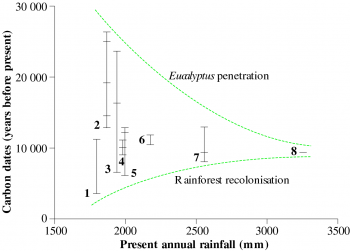
Figure 19.14 Range of radiocarbon dates recorded in soil charcoal at eight locations in northeast Queensland in relation to annual rainfall. Vertical bars show the range of time that charcoal was deposited beneath the forest, where it has remained. Charcoal deposited over a long time is found beneath today's rainforests that receive an annual rainfall of less than 2000 mm, indicating frequent presence of eucalypts for more than 20 000 years. Rainforest on these drier sites probably established during recent recolonisation. Wetter sites have supported rainforest for almost 10 000 years. (Based on Ecos, 1997; reproduced with permission of Ecos)
Carbon dating of charcoal deposits dug from beneath rainforest on the Windsor Tableland in North Queensland has been used to corroborate findings based on species distribution. Eucalypts burnt in the areas that now support lush rainforest left carbon deposits dating back 13 000 to 26 000 years. Apparently all but the wettest regions of rainforest have at some time been colonised by sclerophyllous species capable of supporting fires (Figure 19.14). Some rainforests in northeast Queensland receive less than 1800 mm annual rainfall and are unlikely to be more than 1400 years old. Similar encroachment of rainforests on eucalypt woodland has been observed in rainforests from northern New South Wales.
Many assemblages of plant species in the Australian landscape are the product of fires burning the vegetation throughout millennia, re-ordering the extent and abundance of species. During this time, climate change (Chapter 13) and human impact (Section 19.4) have altered fire regimes, resulting in long-term shifts in boundaries between plant communities and imposing selection pressure that has given rise to wide-spread, but not universal, fire tolerance in Australian flora.
Fire regimes have altered again since European settlement with the fragmentation of original plant communities as a result of grazing, agriculture and forestry. Fire has been used aggressively in the past 200 years of agriculture as a means of suppressing and eliminating native vegetation, including those species able to withstand cyclical fires caused by natural events like lightning. In contrast, burning has been restricted in native forests to maximise resource yields, causing shifts in vegetation mix and age through low fire frequencies and occasional high fire intensities.
Links:
[1] http://plantsinaction.science.uq.edu.au/edition1//?q=figure_view/917
[2] http://plantsinaction.science.uq.edu.au/edition1//?q=figure_view/918
[3] http://plantsinaction.science.uq.edu.au/edition1//?q=figure_view/919
[4] http://plantsinaction.science.uq.edu.au/edition1//?q=figure_view/920