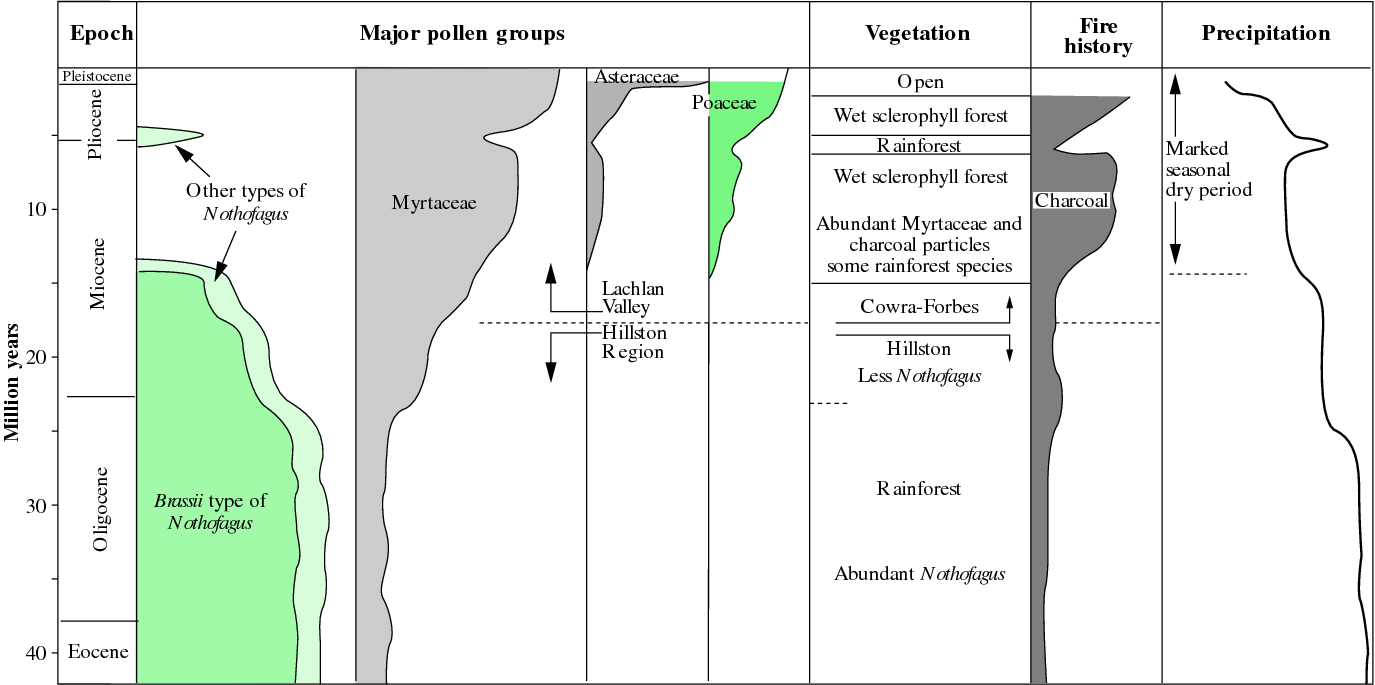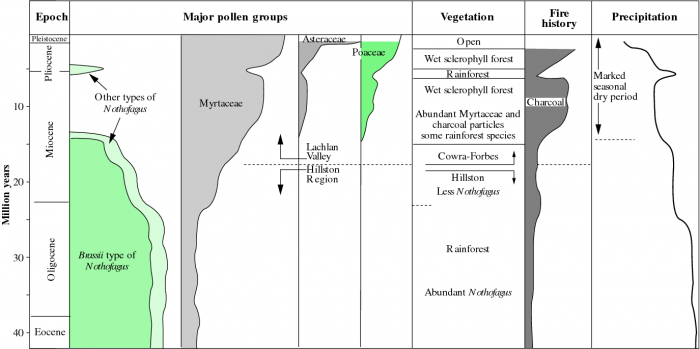
Figure 19.12 Summary of major changes in vegetation, fire history and precipitation over the past 40 million years in central and western New South Wales. Major pollen groups show there was a steep decline of Nothofagus forests around 15 million years ago with species of Myrtaceae (especially Eucalyptus spp.) taking their place as the dominant woody species. The wet sclerophyll forests that developed after the Mid Miocene were associated with an increasing abundance of grasses and herbs (families Poaceae and Asteraceae). Charcoal deposits became more prolific as the myrtaceous species expanded, demonstrating that fire was now a feature in the environment. A drier climate that prevailed after the Mid Miocene is believed to be responsible for a rise of sclerophylly. Note the brief return of Nothofagus forest about five million years ago during a brief wet period (Based on Martin 1986, 1998; reproduced with permission of the Linnean Society of NSW)