
 [1]
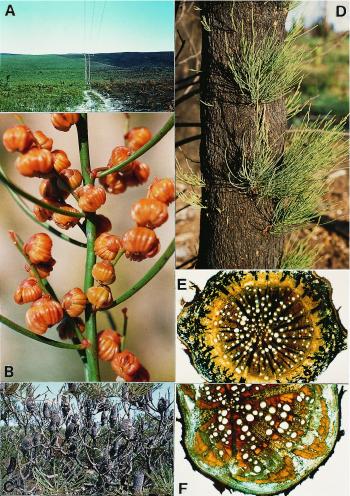
Figure 19.8 (A) A typical burnt habitat (right side) in heathlands of the northern sandplains of southwestern Australia. Note that grass trees (Xanthorrhoea spp.) are the only species whose above-ground biomass has survived fire. (B) Example of a fire weed (Gyrostemon ramulosus) in full fruit. (C) A seeder species of Banksia showing mature unburnt individuals with seed reserves carried in woody cones. Seed release occurs mostly after fire and a cohort of seedlings then establishes to replace the adults killed by the fire. (D) Typical resprouter tree species (Allocasuarina fraserina) showing new shoots developing from epicormic buds under the bark of the burnt trunk. Only a few of these shoots will survive to reconstitute the branching profile of the tree. (E) Transverse section through the root of a typical resprouter (Conospermum stoechadis) showing storage of starch (stained black with iodine) in the cortex, rays and interray xylem parenchyma of the root. (F) Transverse section through the root of a typical seeder (Banksia prionotes) showing virtual absence of starch. (Photographs courtesy J.S. Pate)
Much of the Australian flora recovers rapidly after fire, in spite of many individuals perishing through heat and combustion (Section 19.1). Plant communities that regenerate post-fire capitalise on reduced competition for nutrients, water and light, therefore environmental changes imposed by fire (see fire regimes outlined in Section 19.1) are a potent selective force in many Australian plant communities. However, it is still debatable whether the range of genetically programmed responses that we see in fire-tolerant species represents adaptations to burning or arises incidentally in response to features of fire regimes such as drought and nutrient release through an ash-bed effect (Section 19.2). Evidence below demonstrates that nutrient and carbon economies of many species are modified according to fire regimes. Life cycles of species able to tolerate fire contrast dramatically, depending on investment of resources in the parent storage organs relative to seed stocks. Intervention of fire in the Australian landscape, especially in sclerophyllous heathlands (Figure 19.8A), has therefore selected directly or indirectly for a suite of genetic changes.
Fire ephemerals, sometimes referred to as fire weeds (e.g. the grass Stipa compressa, native hibiscus Allyogyne spp. and members of the family Gyrostemonaceae (Figure 19.8B), form conspicuous components of the early post-fire floras of many ecosystems. Their seeds germinate only after intense fires from seed banks in the soil that are both extensive and very long lived. Even in the absence of human intervention when intervals between fires can be many years, such seed can survive to exploit a post-fire regime. Some species of fire ephemerals (e.g. Stipa) are monocarpic; that is, they complete a growth cycle and return seed effectively to the soil within six to nine months of a fire. Others (e.g. Gyrostemon spp.) are polycarpic; they commence flowering in the second season after fire and then reproduce over the following two or three seasons before dying. Since it is unlikely that sufficient fuel will accumulate in a habitat to sustain two fires in close succession, most fire ephemerals complete their life cycles by ‘avoiding fire in time’. During these brief lives, fire ephemerals play a critical role in resource capture. Important inorganic nutrients released by fires are retrieved and assimilated into the organic biomass of a new generation of parent plants. Absence of fire ephemerals could allow large-scale losses of nutrient capital through leaching.
All fire ephemerals are characterised by extremely high rates of seedling growth in comparison with other classes of species recruiting in the same ash bed. They also exhibit extreme plasticity in adult size, depending on: (1) how densely they germinate, (2) competition between new seedlings and (3) patchiness of nutrient distribution in ash and decomposing plant material within their rooting catchments. Thus, in a small area of habitat where ash has been deposited unevenly, the largest individuals of a fire ephemeral such as the grass Stipa compressa might be 500 to 1000 times heavier than the smallest. Despite such plasticity in size, there is remarkably little variation in the proportion of dry matter committed by individuals to flowers and seeds just prior to their death. This proportionality ensures that the size of a seed bank is geared to resource availability across a habitat.
 [2]
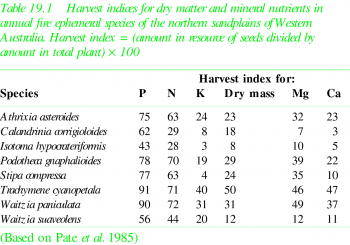
Table 19.1
Harvest index (the proportion of a specific plant resource (e.g. dry matter, potassium) invested in seed at maturity) has been used to compare relative reproductive effort of a range of fire ephemeral species from southwestern Australian. That is, harvest index quantifies how effectively each species passes
its dry matter or specific nutrients on to seeds of the next generation (Pate et al. 1985). Table 19.1 illustrates strong sequestering of phosphorus in each of the listed fire ephemerals, followed broadly by nitrogen, potassium, dry matter, magnesium and calcium. Because parent ecosystems of these species are considered to be limited primarily by availability of phosphorus, channelling of up to 90% of a plant’s phosphorus pools into seeds enhances survival of seedlings after fire. Little is known of the regulatory processes of senescence at a cellular level that release nutrients from vegetative parts for retranslocation to seeds (Chapter 16).
Abundant seed production by many species that are fire ephemerals points to selection for high numbers of relatively small seeds, each well stocked with long-term energy reserves of oil or starch but less well endowed with mineral reserves. These features enhance seed longevity and ensure that dense populations become established effectively after hot fires. Modest reserves of some nutrients in seeds are likely to be well compensated for by high availability of nutrients in the ash bed in which the seed germinates (Section 19.2). Supporting evidence shows that fire ephemerals flourish particularly well in burnt habitats but grow very poorly if transplanted into unburnt habitats of poorer mineral resource availability.
Cryptophytes (literally hidden plants) comprise major components of the understorey of nutrient-poor habitats such as the sandplains of southwestern Australia (Figure 19.8). Most are ‘wet-season active’, forming leafy shoots and reproductive organs during the assimilatory phase. With the advent of the following dry season they die back to a deeply buried corm, bulb or tuber. As with fire ephemerals (Section 19.3.2), limited nutrient resources are conserved extremely effectively, but in this case are withdrawn at the end of each growing season into newly formed storage organs rather than into seeds. Since fires are likely to occur only in the dry season, cryptophytes complete their life cyles by ‘avoiding fire in time and space’. As with fire ephemerals, cryptophytes benefit from the improved availability of light, moisture and nutrients in the seasons immediately following fire; indeed, some orchids and sundews flower predominantly after fire. Other cryptophytes reproduce vegetatively by forming tubers, corms or bulbs. In these species, prolific growth and rapid nutrient acquisition in the period following a fire provides bountiful reserves to be stored in below-ground organs.
In many ecosystems on impoverished soils (Chapter 16), a large proportion of total species are cryptophytes and other herbaceous perennials, with relatively few annual species present. Annuals have to establish from seed each season, often producing flower and setting seed only after a long juvenile phase. Productivity can be curtailed by short seasons and the imperative of absorbing sufficient nutrients from the soil over a short growing season. Cryptophytes, by contrast, carry over virtually complete stocks of nutrients and large amounts of energy-rich reserves from one season to the next through the agency of their underground storage organs, thus enabling leafy shoots, and in some cases flowers, to emerge almost immediately after rain opens a new season. Cryptophytes are also highly resilient to adverse seasons: in drought years, for example, individuals deplete reserves of dry matter and nutrients, and sometimes fail to reproduce effectively. Even in these cases, sufficient resources are carried over to the next season to allow a population to survive. If more favourable conditions then prevail, nutrient and energy stores are replenished to earlier levels.
Obligate seeders consist of plants which are either killed out-right by fire and recruit thereafter from banks of seed buried in soil or encapsulated in woody fruits in the above-ground canopy (Figures 19.2b and 19.8C). Resprouters employ a sharply contrasting strategy whereby rootstocks (e.g. eucalypts in Figure 19.4 and banksias in Figure 19.5), thick trunks (Figure 19.6) and branches (e.g. casuarinas in Figure 19.8D) survive fire and replace entire shoot canopies by sprouting from heat-resistant buds. These illustrations show that such heat-resistant buds can be below ground or in trunks and branches.
 [3]
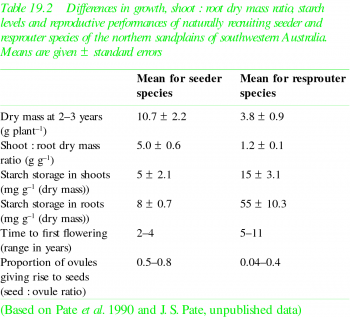
Table 19.2
 [4]
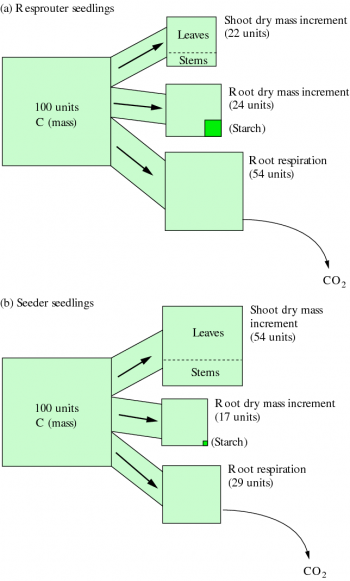
Figure 19.9 Scheme showing the relative sinks for assimilated carbon in seedlings of (a) resprouter and (b) seeder species from the family Proteaceae over an 18-month period after recruiting from seed germinated following a fire at Yanchep, Western Australia. Percentage allocation (units) of carbon to leaf, stem and root biomass is shown and carbon lost in root respiration indicated for each plant type. Note much larger allocation of carbon to starch storage (square in dark green) in roots of the resprouters than the seeders. (Based on Bowen and Pate 1991)
Seeders and resprouters are likely to be encountered in the same habitat but resprouters are normally predominant in habitats that are frequently burnt whereas seeders flourish where fires are rarer events. Often a seeder and resprouter species of the same genus coexist in more or less equal densities at the same site, such ‘congeneric’ partners providing useful comparisons of how closely related species with contrasting fire responses perform when sharing the same climate and fire regime. Moreover, since new recruits to these seeder and resprouter populations are likely to germinate and establish prolifically in the season following a fire, comparisons can be made between cohorts of the same age over a number of subsequent seasons to compare biomass production, time to flowering and attributes such as longevity. For example, recruits of the seeder species in Table 19.2 were three times larger two to three years after germination than their resprouter counter-parts. By this time, shoots of a typical seeder are likely to weigh five times more than the roots, while shoots and roots of a recruiting resprouter of the same age would weigh about the same (Table 19.2).
Disparities in distribution of dry matter between shoot and root indicate radically different patterns of allocation of photoassimilates and nutrient resources in the two fire response types. Resprouters partition approximately three-quarters of new photoassimilates to roots (Figure 19.9a). Two-thirds of this carbon directed below ground is respired CO2 with the remainder committed to establishing a starch-rich tap root or lignotuber capable of subsequently resisting fire. With only a small proportion being invested into new leaf area, aerial growth of resprouter species proceeds slowly, as shown in Table 19.2. Seeders, on the other hand, commit less than half of new photoassimilates to roots and proportionately more to developing a leafy canopy (Figure 19.9b).
A major difference between seeders and resprouters relates to storage of starch, sugars and other carbon-based energy stores. While starch levels in shoots are lower than those in roots, significantly more starch is invariably present in tissues of the resprouter species than in those of the seeder (Table 19.2), thereby reflecting the role of starch as a carbohydrate store for new growth. Starch deposits can be seen histo-chemically in stems of resprouters as darkly stained tissues comprising broad rays, abundant xylem parenchyma and thick cortical cell layers in roots (Figure 19.8E). Dense granules of starch within these resprouter roots account for the staining intensity. Seeders have almost none of the dark stain characteristic of starch (Figure 19.8F).
Similar measurements of levels of essential nutrients (e.g. nitrogen, phosphorus and potassium) in root dry matter show that nutrients are not accumulated in particular cell types in the manner observed for starch in resprouter species. Resprouters exploit stored carbon reserves to refoliate and produce new feeding roots immediately after fire. Resumption of photosynthesis, transpiration and nutrient uptake follow, sustaining a new period of nutrient acquisition and storage. In this manner, established individuals of a resprouter species can generate biomass in a post-fire ecosystem well in advance of adjacent obligate seeders.
Recruiting individuals of seeders and resprouters also exhibit contrasting reproductive capacities (Table 19.2). Obligate seeders commence reproduction in the second or third season after germination, and seed production escalates annually thereafter for several years. By the time of the next fire a large replacement seed bank is likely to have been accumulated. By contrast seedling recruits of resprouters might not start flowering for six to eight years and typically produce fewer flowers and smaller seed:ovule ratios (Table 19.2) than corresponding seeder species. That is, resprouters invest little in reproductive organs relative to the storage functions that help them re-establish quickly after fire.
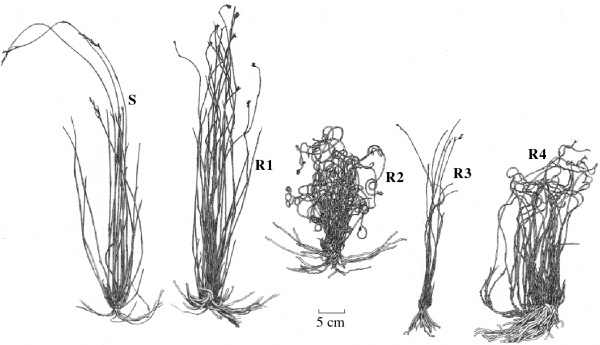
Congeneric partners, reflecting a balance between seeding and resprouting individuals, can thus be considered as alternative and more or less equally successful end points to evolutionary processes shaping responses of species to fire. In evolutionary terms, intermediate types between seeders and resprouters would clearly embody an uneasy compromise between the two contrasting strategies, and, as might be expected, are not commonly encountered in present-day ecosystems. However, in certain exceptional taxa a continuum of response types can be discerned, as shown, for example, in the morphotypes of Lyginia barbata (Bell and Pate 1993), illustrated in Figure 19.10. Morphotypes range from a prolific seed-producing, short-lived tufted seeder to resprouter forms that are long lived and produce few seeds. The resprouter forms reproduce vegetatively with clones arising from rhizomes of the parent plant. This spectrum of responses within L. barbata provides an ideal tool for study of evolutionary responses to fire within a single taxon.
 [5]
Figure 19.10 Fifth-year juveniles of morphotypes of Lyginia barbata R. Br. (Restionaceae) showing five contrasting growth forms of the same species. One is an obligate seeder (S) while the others are all resprouter forms (R1-R4). S is densely tufted and produces prolific seeds that germinate after fire has killed the parent plant. R1 and R2 are tufted resprouters but are short lived like S and able to recruit some new individuals from seed. R3 and R4 are long lived and strongly clonal, resprouting from adult rhizomes after fire to produce new juveniles vegetatively. (Reproduced courtesy Bell and Pate 1993)
Links:
[1] http://plantsinaction.science.uq.edu.au/edition1//?q=figure_view/910
[2] http://plantsinaction.science.uq.edu.au/edition1//?q=figure_view/911
[3] http://plantsinaction.science.uq.edu.au/edition1//?q=figure_view/912
[4] http://plantsinaction.science.uq.edu.au/edition1//?q=figure_view/913
[5] http://plantsinaction.science.uq.edu.au/edition1//?q=figure_view/915