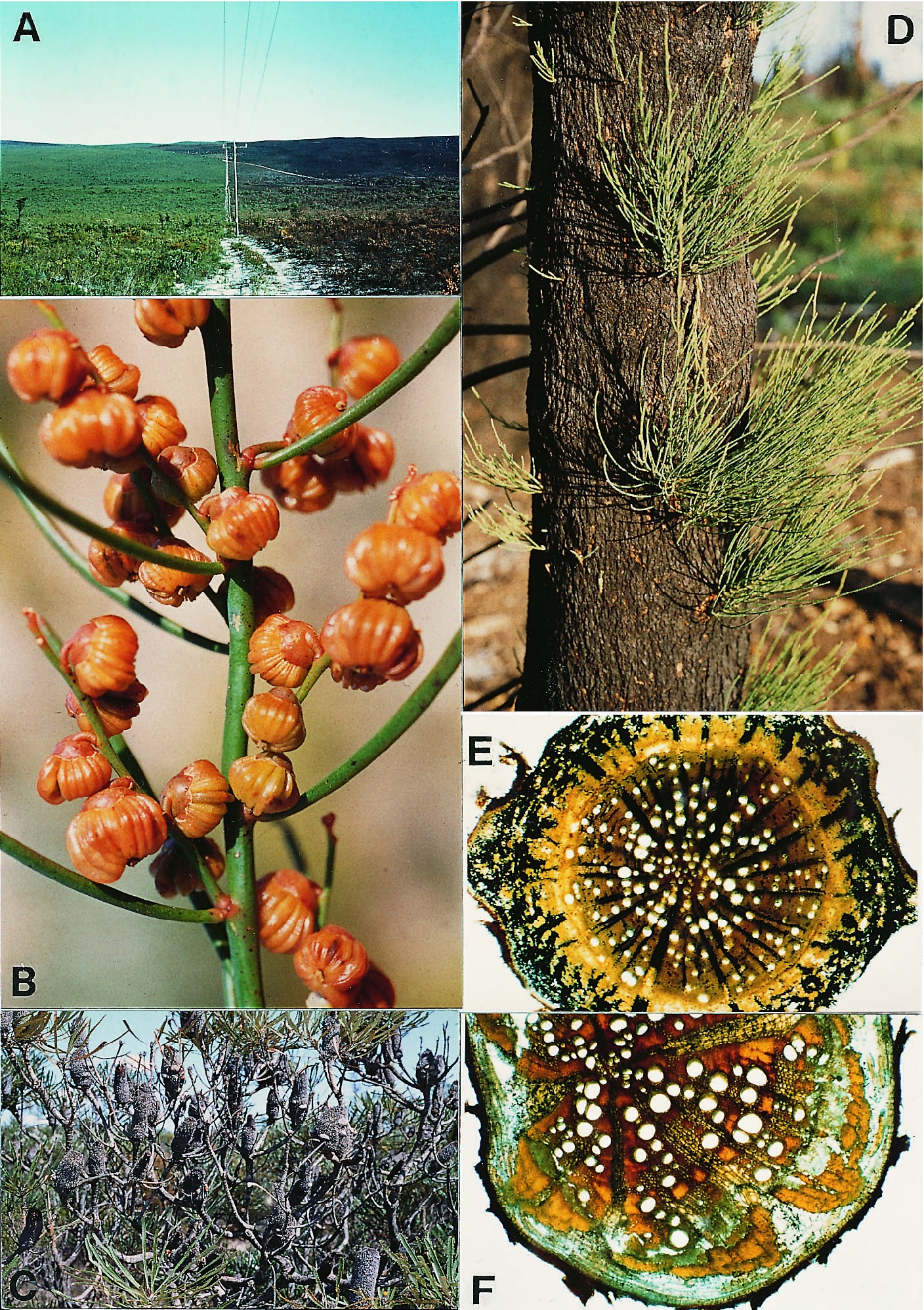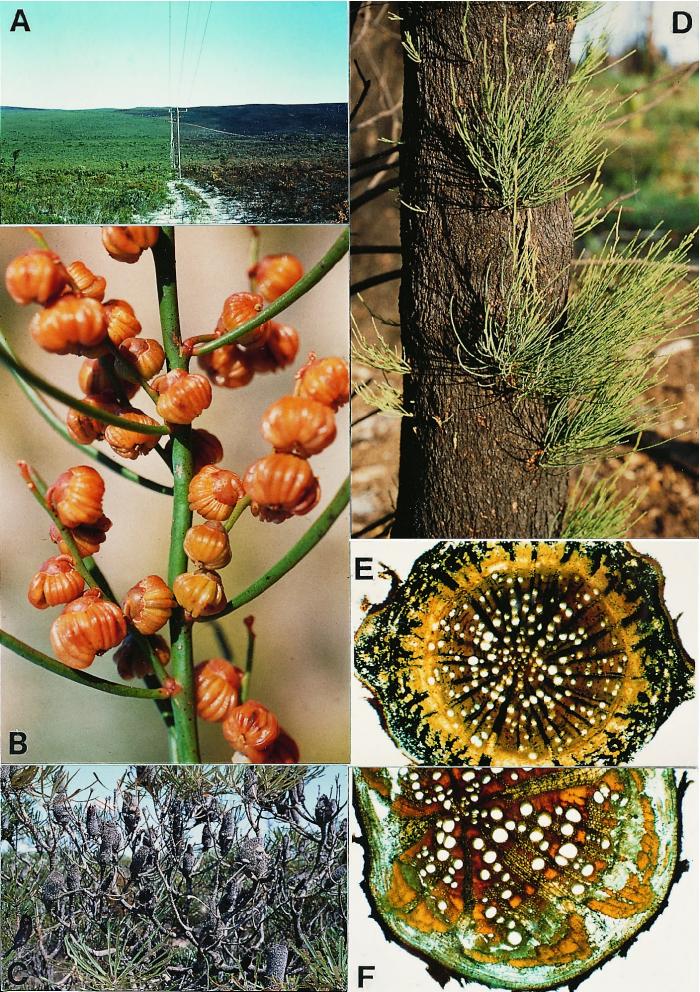
Figure 19.8 (A) A typical burnt habitat (right side) in heathlands of the northern sandplains of southwestern Australia. Note that grass trees (Xanthorrhoea spp.) are the only species whose above-ground biomass has survived fire. (B) Example of a fire weed (Gyrostemon ramulosus) in full fruit. (C) A seeder species of Banksia showing mature unburnt individuals with seed reserves carried in woody cones. Seed release occurs mostly after fire and a cohort of seedlings then establishes to replace the adults killed by the fire. (D) Typical resprouter tree species (Allocasuarina fraserina) showing new shoots developing from epicormic buds under the bark of the burnt trunk. Only a few of these shoots will survive to reconstitute the branching profile of the tree. (E) Transverse section through the root of a typical resprouter (Conospermum stoechadis) showing storage of starch (stained black with iodine) in the cortex, rays and interray xylem parenchyma of the root. (F) Transverse section through the root of a typical seeder (Banksia prionotes) showing virtual absence of starch. (Photographs courtesy J.S. Pate)