
Worldwide, plants evolve on depauperate sites with adaptive devices that enhance both acquisition and internal utilisation of soil nutrients. For example, impoverished soils of coastal areas in eastern, southern and southwestern Australia support natural communities of ‘heath’ vegetation that comprise dense stands of seasonal herbs plus perennial sclerophyllous shrubs and small trees. These communities had attained an equilib-rium with meagre soil nutrient resources during their evo-lutionary history, remaining sustainable for millennia. By contrast, crop plants introduced into those areas require extensive supplements, and especially additional supplies of N, P, K, Ca, Cu, S, Mo and Zn. What nutritional features distinguish these two plant categories?
Grundon (1972) addressed this issue in southeast Queensland by comparing the nutritional physiology of three crop plants with representative ‘Wallum’ species (an Aboriginal word for Banksia aemula, a small shrubby tree endemic to a coastal region of extremely infertile sandy soils north of Brisbane). Six Wallum species were grown simultaneously in nutrient culture (coarse sand medium) with sorghum, tomato and white clover. Growth responses to N, P, K and Ca were compared.
Wallum plants grew optimally at P and Ca levels that resulted in severe deficiency symptoms on crop plants. Growth response to N and K was masked by P toxicity in Wallum plants, and especially those cultured on low N or K. Crop plants were not so affected by P toxicity, but appeared to use plant P with less efficiency than Wallum plants. Grundon’s ‘P utilisation quotient’ for this experiment (g dry mass formed per mg of plant P) was 0.83 units for tomato on low P compared with 3.18 in Banksia robur, but these values were both decreased and reversed on high P, 0.31 for tomato compared with 0.10 for B. robur.
P toxicity in native plants on nutrient-rich media described by Grundon (1972) was also noted by Groves and Keraitis (1976) for three sclerophyllous species, Banksia serrata, Acacia suaveolens and Eucalyptus pilularis, findings with implications for revegetation of disturbed sites where supplementary nutrients are commonly included in management strategies. These same three species varied in their sensitivity to N and P combinations. B. serrata died on high P plus high N; A. suaveolens died when supplied with high P irrespective of accompanying N, while E. pilularis failed to survive either high P or high N. By contrast, failure to exclude luxury P by Wallum species was linked to imbalance in either the N:P or K:P ratio of solution cultures (Grundon 1972). By inference from both sets of experiments, a predisposition to luxury uptake and consequent P toxicity in these native species may well be a corollary to their low-nutrient adaptation.
A distinctive nutritional physiology in plants so adapted is complemented in nature by an enhanced acquisition of sparse nutrients due to a broad range of features. These include root morphologies (cluster roots in Section 3.1), biotic associations with soil microorganisms (mycorrhizas) and even highly specialised lifestyles such as parasitism and carnivory. These adaptations have been reviewed comprehensively by Lamont (1982) with particular reference to South Africa and those parts of southwest Western Australia subject to highly seasonal winter and spring rain (Mediterranean-type climates). In both cases, soils are highly infertile, and plant communities are subject to low winter temperature at times of abundant soil moisture, followed by hot and dry summers. Such edaphic and seasonal restrictions on root physiology are offset by highly developed adaptations that enable plants to tap novel sources of nutrients as outlined below.
Plants in nature always grow amidst soil microorganisms, and some become intimately associated with plants to form mutualistic symbioses. Examples of such symbiotic micro-organisms include mycorrhizal fungi of various types and N2-fixing prokaryotes, especially rhizobia. Looser symbiotic associations involve bacteria and soil microfauna within the rhizosphere. Their metabolic activities increase nutrient availability (Sections 3.4, 3.5).
All of these symbioses may affect rates of growth and eventually reproduction of plants compared with growth in the absence of such associations. A symbiotic association is therefore a potential selection pressure that can influence the evolutionary success of vascular plants and hence the com-position of plant communities.
Mycorrhizas (sometimes called mycorrhizae or mycorrhizal associations) are by far the most common mutualistic symbioses involving vascular plants, and about 90% of higher plant families (both gymnosperms and angiosperms) contain species that can form mycorrhizal associations. Roots of most ferns also form mycorrhizas and similar structures occur in the absorbing organs of many bryophytes (Harley and Smith 1983; Smith and Read 1997). Fossil mycorrhizas occur in rocks formed in the Devonian era, about 400 million years ago, and present-day mycorrhizas are the result of a very long period of worldwide co-evolution between plants and soil fungi.
Mycorrhizas fall into distinct classes, depending on the types of fungi and plant, and on the anatomy of the mycorrhizas themselves (Section 3.4). Each main class shows wide specificity where a given species of mycorrhizal fungus can colonise different host species and one plant species can be colonised by different fungal species. This situation contrasts sharply with the extremely narrow specificity of N2-fixing symbioses (Section 3.5).
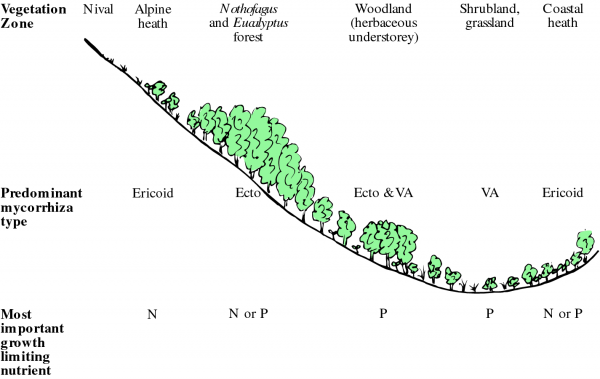
There are broad differences between the dominant classes of mycorrhizas that are found in different ecosystems, depending on vegetation type, soil characteristics and growth-limiting nutrients. A walk up a mountain can pass through different mycorrhizal ‘zones’ (Figure 16.11). Ectomycorrhizas (with their distinct external fungal sheath and with fungi penetrating intercellular spaces of the root cortex) occur on forest trees including eucalypts, beech (Fagus and Nothofagus), birch, oak and most conifers such as pine and spruce. Ericoid mycorrhizas (where fungi penetrate root cells) occur in plants of heathlands. They are also common in plants growing on peaty soils (those containing large quantities of organic matter) as on the Siberian tundra.
 [1]
Figure 16.11 Representative vertical distribution of mycorrhizal classes on a mountain, showing major types of vegetation and important growth-limiting nutrients. (Based on Read 1984)
Overall, the most common mycorrhizal associations are vesicular-arbuscular (VA) mycorrhizas, where fungi again penetrate root cells and form finely branched arbuscules within those cells. Fungal storage bodies (vesicles) can form as either intercellular or intracellular structures. VA mycorrhizas predominate in understorey plants of woods and forests of all types, in temperate and tropical grasslands, in plants of scrub and desert and in many tropical forests.
Some classes of mycorrhizal fungi can grow in soil in the absence of a host plant and in pure culture, but VA mycorrhizal fungi cannot. A vast but unsuccessful research effort has gone into attempts to culture these fungi. Instant fame will be accorded whoever discovers the right medium!
The broad ecological zonations for different classes of mycorrhizas should not be overemphasised because the different classes can often be found very close together. For example, many trees of tropical rainforests form VA mycorrhizas but there are exceptions. Dipterocarps, which dominate many tropical rainforests, form ectomycorrhizas, while the other plants in the same forest will nearly all have VA mycorrhizas. Mediterranean-type vegetation — which is quite common worldwide — contains very mixed mycorrhizal associations, including ericoid, ecto- and VA mycorrhizas. Only in very inhospitable soils (e.g. saline, anaerobic and highly disturbed soils and those in very cold environments) are plants mostly non-mycorrhizal.
Since mycorrhizal symbioses are so common, research into the growth and nutrition of plants in the field should always take into account their probable occurrence as a
factor that can influence plant growth and competition, especially in soils where levels of essential inorganic nutrients are low. For example, research done in Western Australia has shown that disturbance of soils during surface mining can reduce the levels of mycorrhizal fungi, but survival in stored topsoil is still sufficient to help re-establish native vegetation when the topsoil is replaced after mining operations cease (Jasper 1994).
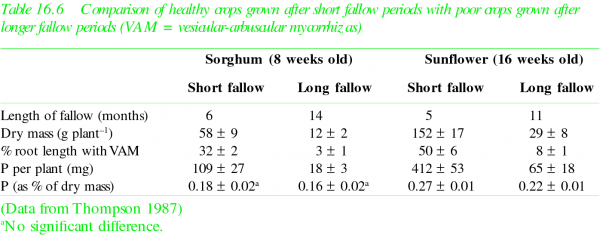
Mycorrhizas can also improve productivity in cultivated plants even when levels of applied fertilisers are high. An important example in parts of Australia is the ‘long fallow disorder’ that reduces the growth of a wide range of crops when soils are left fallow for long periods (Table 16.6). This effect with sorghum and sunflower grown in Queensland (Thompson 1987) is due to a massive decline in populations of VA mycorrhizal fungi. Better growth of both plants on soils left fallow for shorter periods was associated with greater colonisation of roots by VA mycorrhizal fungi. There were higher levels of P per plant grown after short fallow and in sunflower P was higher even when expressed on the basis of % of dry weight; these effects reflected uptake of soil P via mycorrhizal fungi.
 [2]
Table 16.6
Improved growth of forest trees after inoculation with specific ectomycorrhizal fungi has been demonstrated in a wide range of sites, including eucalyptus forests in Australia and elsewhere (Grove and Malajczuk 1994). These examples confirm an extensive interest in establishing and managing populations of mycorrhizal fungi in soils to increase plant productivity in agricultural and forest ecosystems (Robson et al. 1994).
Physiological benefits to a mycorrhizal plant include improved absorption of nutrients such as P and Zn via external fungal hyphae. Plant–water relations might also be improved, which would be important in arid conditions, but this is still a controversial area of research (Smith and Read 1997). Mycorrhizal fungi do not fix atmospheric N2 but can facilitate uptake of both inorganic and organic N and can broaden the range of sources of soil N that are available to plants (Case study 16.3). As shown in Queensland, mycorrhizal seedlings of Eucalyptus species can utilise sources of organic N that cannot be assimilated by non-mycorrhizal seedlings (Turnbull et al. 1995). In addition, external hyphae of mycorrhizal fungi can link plants of the same or (within limits) different species and can allow transfer of inorganic and organic compounds between plants.
The idea that mycorrhizal plants can form linked and mutually beneficial communities is an attractive one but it is not yet established if the amounts of solutes transferred from donor to recipient plants are always physiologically important. Transfer of organic C between linked plants is greatest when the recipient is shaded so that its photosynthesis is reduced. Accordingly, transfer of carbohydrate from parent plants might well assist seedlings to grow in deep shade as on a forest floor before they become exposed to bright sunlight (Smith and Read 1997; Smith and Smith 1996).
Mycorrhizas in heterotrophic angiosperms such as some orchids lacking chlorophyll are physiologically distinctive. Even when mature, the plant drains the fungus of organic C derived from other sources (such as soil or donor plants that are autotrophic). This type of mycorrhizal fungus can also supply inorganic nutrients to the plant, but whether the fungi gain any nutritional benefit remains to be established, so that such symbioses may not be truly mutualistic.
Where mycorrhizal fungi colonise autotrophic (photosynthetic) plants the fungus derives its organic C from the plant (Figure 3.17). This is a physiological cost to the plant but one which is usually not excessive, since mycorrhizal plants often grow faster than non-mycorrhizal plants of the same species under the same conditions. These positive growth effects are largest in shoots. Mycorrhizal plants sometimes grow root systems no larger or even smaller than those in non-mycorrhizal plants, diverting organic C to the fungus. However, there are some physiological conditions in which total growth of mycorrhizal plants is the same as or even slower than that of non-mycorrhizal plants of the same type. One of these conditions is low light intensity and here the cause of the effect is obvious: low light means that photoassimilate may be in short supply and the drain to the fungus may be deleterious to the plant.
The second condition resulting in slower growth of mycorrhizal plants is where levels of available soil P are high. The simplest explanation here is that the supply of soil P is adequate even for non-mycorrhizal plants and the C drain to the fungus (where present) then becomes a limitation on plant growth. Under these last conditions some plants reduce or prevent formation of mycorrhizas in a way that is analogous to the absence of N2 fixation where legumes grow in soils high in nitrate or ammonium.
Finally, some mycorrhizal fungi even ‘cheat’ their hosts by obtaining organic C without supplying P or other inorganic nutrients to their host. Why a plant tolerates being cheated in this way is not known (Smith and Smith 1996). Lack of positive growth responses to colonisation is also sometimes found under a variety of field conditions which are less easy to explain and are the subject of much research.
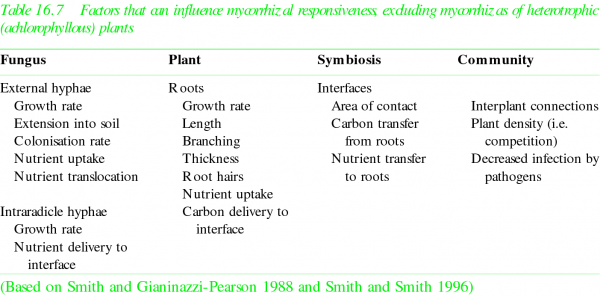
‘Mycorrhizal responsiveness’ (Table 16.7) summarises the most important factors which influence the extent to which a plant benefits from the symbiosis by improved nutrition and growth. These factors include developmental and anatomical properties of the fungi, including their growth rates in soil, their ability to colonise plants and subsequent growth within roots, and their efficiency in absorbing nutrients from soil and transferring them to the plant. Plants such as some cereals which have long, highly branched roots with long root hairs often show small mycorrhizal responses because the roots themselves are well structured for exploring large volumes of soil. Here, mycorrhizal hyphae confer relatively little extra advantage.
 [3]
Table 16.7
The interface between fungus and plant is obviously crucial in determining mycorrhizal responsiveness, a principle that applies equally to both intercellular and intracellular inter-faces. If there is a sufficiently large area of contact between the symbionts, as in a VA mycorrhiza with many arbuscules, then there is the capacity for operation of a large number of transport proteins that catalyse selective transfer of nutrients. However, the rates of transfer are subject to regulation that can determine the relative amounts of C transferred to the fungus per amounts of P (or other essential nutrients) transferred to the plant and hence the nutritional costs and benefits to the partners.
 [4]
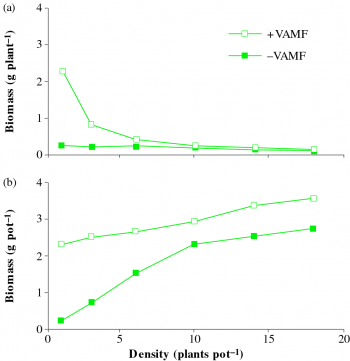
Figure 16.12 Effects of plant density on growth of mycorrhizal and non-mycorrhizal Trifolium subterraneum. Plants were grown for eight weeks under controlled conditions in pots containing 0.5 kg of soil. The upper diagram (a) shows that growth stimulation of individual plants by VA mycorrhizas is greatest at low plant density. The lower diagram (b) shows that as the density of plants increases, total biomass per pot becomes more similar in mycorrhizal and non-mycorrhizal treatments due to limitations imposed by soil nutrient supply. (Based on unpublished data; E. Facelli, Department of Soil Science, University of Adelaide)
Table 16.7 also shows effects within plant communities that influence mycorrhizal responsiveness. Positive mycorrhizal growth responses decrease as the density of plants increases and competition for soil nutrients intensifies (Sanders et al. 1995). Put another way, where large numbers of roots and mycorrhizal fungal hyphae are close together, mycorrhizal roots appear to compete with each other and with any non-mycorrhizal roots, so that growth of all the individual plants is reduced compared to growth of plants spaced well apart. This effect is shown in Figure 16.12 and may be one reason why intensive mycorrhizal colonisation fails to benefit field growth.
Hyphal links between plants of the same or different species complicates the issue of competition enormously. If nutrients or organic C are transferred via the hyphae between plants growing under similar conditions, what determines whether a plant is a donor or recipient of resources? This important issue awaits resolution.
Finally, mycorrhizal fungi can suppress infection by some pathogenic organisms — an obvious extra benefit of a symbiotic association. Not surprisingly, responses of field plants are more complicated and difficult to understand than in experiments with potted plants under controlled conditions!
A successful mycorrhizal symbiosis can act as a selection pressure. Such symbioses can affect growth and reproduction compared to non-mycorrhizal plants under equivalent conditions. This selection pressure can act within a population of a single plant species if the mycorrhizal fungus is present irregularly in the soil. Consider, for example, the potentially faster growth of an individual plant that becomes mycorrhizal compared to one that cannot or can do so only more slowly. The selection pressure can also act within a community of mixed species. Compare here the potentially faster growth of individuals of a species that forms mycorrhizas compared to individuals of a species that cannot. The subtle and complex nature of the selection pressures arises from the various features that can determine mycorrhizal responsiveness (Table 16.7), which is why ‘potentially’ was emphasised. Nutritional benefits in VA mycorrhizal plants can extend from increased vegetative growth to reproductive effects including earlier flower production, increased production of flower buds and increased seed production. In addition to improving plant fecundity, formation of mycorrhizas can improve the quality of plant offspring, for example their weight and nutrient content, and even the nutrient content of their seeds. These
persistent effects are good evidence that formation of mycorrhizas can bring about strong effects on plant populations and on the structure of plant communities (Sanders et al. 1995).
Some terrestrial plants never form mycorrhizas even under growth conditions where colonisation would be expected. These plants belong to diverse families that are not closely related but include many chenopods and most brassicas (unfortunately including Arabidopsis). There are also individual ‘non-mycorrhizal’ genera within families that otherwise form mycorrhizas. One good example is the legume Lupinus (lupin). In such cases, an absence of these symbioses cannot be construed as disadvantage in evolutionary terms, so that mycorrhizal associations are not necessarily a universal advantage to terrestrial plants. A different range of adaptive features allows these plants to grow and reproduce successfully in the absence of mycorrhizas. These include excretion of organic acids that aid solubilisation of P and production of long, relatively fine roots with long root hairs, which exploit soil P and other immobile nutrients in much the same way as do the external hyphae of mycorrhizal fungi, where present. (Such root properties often reduce mycorrhizal responsiveness as mentioned above.)
Notwithstanding alternative adaptations, an important question remains. What prevents colonisation by mycorrhizal fungi in non-mycorrhizal species? The answer is probably not the same for the different families and is still not known for many plants. In some cases, including brassicas, there is production of chemical defences against colonisation by mycorrhizal fungi. This response has similarities to chemical defence reactions in plant roots against pathogenic organisms (Smith and Read 1997).
When considering effects of mycorrhizas on plant growth and the selective advantages of those associations, all levels of organisation from molecular to ecological are relevant.
A molecular aspect as yet unknown is how plants distinguish between a mycorrhizal fungus that is usually beneficial and a fungus which is harmful (pathogenic). Pathogenic organisms can elicit expression of chemical defences by resistant plants, but what exactly is the sequence of recognition signals for a symbiotic association that results in such chemical defence reactions being turned off? Research into this aspect of mycorrhizal associations lags behind work on N2-fixing symbioses.
At an ecological level, mycorrhizal fungi also have beneficial effects on important soil properties — they improve soil structure by binding together soil particles to form water-stable aggregates, and in so doing contribute further to the sustainability of managed ecosystems in agriculture, forestry and horticulture.
Nitrogen (N) is a key limiting nutrient in natural ecosystems, partly because plants have a high requirement, but mostly because readily available forms are often in short supply (Case study 16.2). Foliage commonly contains high concentrations of N (1–5% of dry mass) and meeting this need is a major energy-requiring process because N uptake by plants and N assimilation within plants are both metabolically expensive (Chapin et al. 1987).
Energy requirement is especially high if nitrate is the sole source of N because biological reduction of nitrate ions and subsequent incorporation into plant N metabolism has a higher requirement for both ATP and reductant than does direct use of ammonium compounds. Much of this energy comes via energy transduction from sunlight, and under light conditions which limit growth (e.g. forest understorey) nitrate assimilation in leaves must compete with other synthetic events for biological forms of energy derived from chloroplasts.
In high light environments, excess ATP and reductant from photosynthetic energy transduction (Section 1.2) can be used in leaves for photoreduction of the nitrate that reaches transpiring leaves via xylem flow. Light-dependent reduction of nitrate in leaves is less costly in energy terms than nitrate reduction in roots (Raven 1985), so that some selective advantage is derived from a leaf-based system for nitrate reduction provided solar radiation is abundant.
 [5]
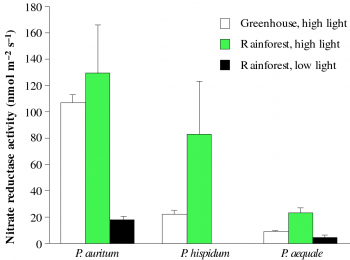
Figure 1 Nitrate reductase activity in leaves of three Mexican species of Piper varies according to their sun/shade adaptation and cultural conditions. Piper auritum colonises disturbance gaps in rainforest at Los Tuxtlas and shows the highest levels; P. aequale is a shade-tolerant species adapted to understorey habitats, and shows the lowest levels of nitrate reductase; P. hispidum is a generalist species and shows an intermediate level of nitrate reductase activity. (Based on Fredeen and Field 1996)
Accordingly, pioneer and gap species that are sunloving (Section 12.1.3) express levels of nitrate reductase activity that are 5–20 times those of understorey species in both Australian rainforests (Stewart et al. 1988) and Mexican communities (Figure 1; Fredeen and Field 1992).
Nitrate reductase activity of pioneer species is located primarily in leaves, and in line with sun/shade adaptation this prime site appears to be genetically set rather than environmentally driven. Leaf activity is none the less modulated by light because nitrate reductase activity in shoots becomes even more pronounced compared with roots with increased photon irradiance, and especially in conditions where photosynthesis is light saturated. By implication, nitrate reduction is an energy-effective mechanism for N assimilation by sunloving plants in strong light on open areas or in major disturbance gaps of forests.
As a consequence of their high leaf nitrate reductase activities, early-successional (pioneer) species are well placed to take advantage of soil nitrate from disturbed sites such as large gaps or along forest edges. Warm soils in those places could also favour nitrification via temperature-driven microbial activity. An important implication of the very low nitrate reductase activities in species of later-successional stages of forest development is that these species are likely to be using a source of N other than nitrate such as ammonium and complex organic N compounds.
One further advantage of a nutritional strategy involving leaf nitrate reduction at high photon irradiance in pioneer/gap species comes from dissipation of excess photochemical energy that might otherwise contribute to photoinhibition (Smirnoff and Stewart 1985; Section 12.1.2).
Nitrate N is widely recognised as a key source for sunloving (early-successional) plants on disturbed sites, but soil nitrate is less abundant during later-successional stages of rainforest dynamics or in long-established and undisturbed communities. However, complex organic forms of N together with unmineralised ammonium compounds do abound, raising a question as to their availability for plant growth. Some plants are long known to show a distinct preference for ammonium over nitrate ions as an N source; less known is the ability of mycorrhizal associations to extend the nutrient base of their host plants even further to include organic forms of N.
 [6]
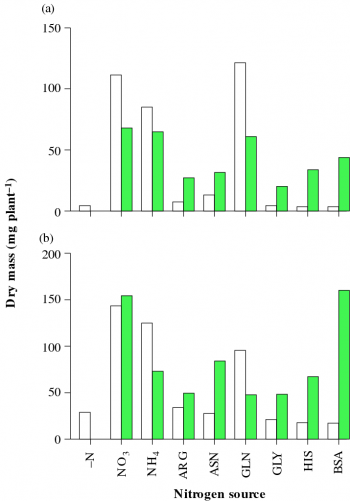
Figure 2 Seedlings of Eucalyptus grandis (a) and E. maculata (b) benefit greatly from ectomycorrhizal association when dependent on organic N as a sole source of external N. Growth on nitrate N or ammonium N was not enhanced by fungal infection. Open bars refer to non-mycorrhizal seedlings, solid bars refer to seedlings grown in association with Elaphomyces sp. Abbreviations beneath histograms refer to N sources where -N denotes a nitrogen-free medium; NO3 = nitrate; NH4 = ammonium; ARG = arginine; ASN = asparagine; GLN = glutamine; HIS = histidine; BSA = bovine serum albumen. (Based on Turnbull et al. 1995)
Mycorrhizal fungi feature prominently in the P nutrition of their host plants, and especially on impoverished sites (Sections 5.3.4 and 16.4.1) but their significance for N nutrition is less clear. In growth experiments with seedlings of Eucalyptus spp. (Botany Department, University of Queensland) non-mycorrhizal plants in sterile culture grew poorly on organic N. By contrast, ectomycorrhizal infection enabled seedlings to use organic sources of N and they grew much faster. Infected plants grew well on a range of amino acids and even on protein N (Figure 2). This capacity to use a broad spectrum of organic sources has important implications for tree seedling nutrition. In field situations, a number of N sources might thus be available despite their low concentrations. This presumed ability to access a diversity of N sources might confer distinct nutritional advantages on mycorrhizal plants in forest ecosystems.
When mycorrhizal seedlings of Eucalyptus grandis were offered a mixed source of N in the growth medium, they derived 50% of total N from the amino acid asparagine and 40% from albumen protein (Turnbull et al. 1996). Organic sources of N may thus be significant to mycorrhizal plants even in the presence of readily assimilable inorganic ions, especially where plants must scavenge for sparse resources. However, it would be misleading to suggest that only those plants with a fungal compatibility are able to utilise organic sources of nitrogen directly. We now know that obligately non-mycorrhizal species such as Hakea sp. from coastal heathland in Australia (Turnbull et al. 1996) and Eriophorum vaginatum from arctic tundra (Chapin et al. 1993) can also incorporate labelled amino acid sources. Clearly, some plants are able to short-circuit the mineralisation cycle commonly viewed as the sole source of usable N, either directly or via symbiotic association.
Taken overall, flexibility in N nutrition ensures that a selective advantage during colonisation on a disturbed site where nitrate N predominates is not lost as forests mature and nitrate N is replaced by ammonium N and more complex forms of organic N.
Chapin, F.S., III, Bloom, A.J., Field, C.B. and Waring, R.H. (1987). ‘Plant responses to multiple environmental factors’, BioScience, 37, 49–57.
Chapin F.S, III, Moilanen, L. and Kielland, K. (1993). ‘Preferential use of organic nitrogen for growth by a non-mycorrhizal arctic sedge’, Nature, 361, 150–153.
Fredeen, A.L. and Field, C.B. (1992). ‘Ammonium and nitrate uptake in gap, generalist, and understorey species of the genus Piper’, Oecologia, 92, 207–214.
Fredeen, A.L. and Field, C.B. (1996) ‘Ecophysiological constraints on the distribution of Piper species’, in Tropical Forest Plant Ecophysiology, eds S.S. Mulkey, R.L. Chazdon and A.P. Smith, 597–618, Chapman and Hall: New York.
Raven, J.A. (1985). ‘Regulation of pH and osmolarity generation in vascular land plants: costs and benefits in relation to efficiency of use of water, energy and nitrogen’, New Phytologist, 101, 25–77.
Smirnoff, N. and Stewart, G.R. (1985). ‘Nitrate assimilation and translocation by higher plants: comparative physiology and ecological consequences’, Physiologia Plantarum, 64, 133–140.
Stewart, G.R., Hegarty, E. and Specht, R.L. (1988). ‘Inorganic nitrogen assimilation in plants of Australian rainforest communities’, Physiologia Plantarum, 74, 26–33.
Turnbull, M.H., Goodall, R. and Stewart, G.R. (1995). ‘The impact of mycorrhizal colonisation upon nitrogen source acquisition and metabolism in seedlings of Eucalyptus grandis Hill ex Maiden and Eucalyptus maculata Hook’, Plant, Cell and Environment, 18, 1386–1394.
Turnbull, M.H., Schmidt, S., Erskine, P.D., Richards, S. and Stewart, G.R. (1996). ‘Root adaptation and nitrogen source acquisition in natural ecosystems’, Tree Physiology, 16, 941–948.
Many families of vascular plants have representatives which exhibit either parasitism and carnivory and, given the wide taxonomic separation between such species, various forms of these remark-able adaptive features must have evolved independently, and on numerous occasions over their evolutionary history.
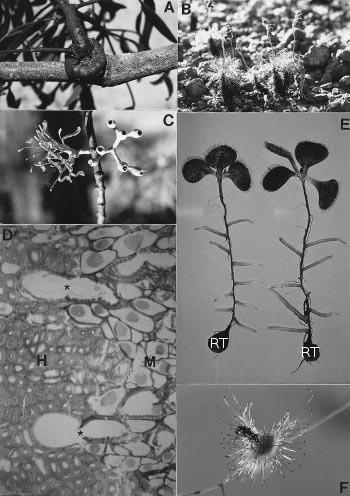
Two examples will be considered. The first concerns mistletoes (Amyema spp.), hemiparasitic flowering plants which acquire water, nutrients and certain organic compounds by tapping the xylem stream of branches of their tree hosts by means of specialised feeding organs (haustoria; Figure 16.13A). The second concerns carnivorous plants (Drosera spp.; Figure 16.13B) which trap insects with mucilage-producing glands on their leaves. The same glandular tissue that secretes mucilage then produces extracellular hydrolytic enzymes (proteases, peptidases and esterases) which digest the protein and other degradable materials of the insect carcasses. The resulting solutes (e.g. amino acids, sugars, phosphorus compounds) are then absorbed. Each case offers distinctive patterns of plant nutrition.
 [7]
Figure 16.13 (A) Mistletoe (Amyema miquelii) attached to a eucalypt host. Note swollen haustorium which forms a graft-like union with the host branch. (B) A carnivorous plant (Drosera barbigera) showing glandular leaves capable of capturing and digesting insects. (C) Flowers and young fruits of the mistletoe Amyema linophyllum. Note staggered reproduction, whereby fruits ripen sequentially over a long period and thus offer an almost continuous supply of food for the principal dispersal agenst, the mistletoe bird. (D) Photomicrograph of part of the haustrial interface between a mistletoe (M) and its host (H). A lumen-lumen bridge between a xylem vessel of the host and the xylem elements of the mistletoe is marked with an asterisk. (E) A stem-tuberous carnivorous species Drosera erythrorhiza collected near the end of a good growing season. This plant grew from a parent tuber that is now replaced in situ by a replacement tuber (RT). Extra nutrient capital that is acquired each season is deposited in daughter tubers that form at the ends of rhizomes (R). (F) The hemipteran Cyrtopeltis sp. that walks with impunity across sticky leaves of carnivorous plants to feed on insect carcasses the plants have captured. The host plant is Drosera gigantea. (Photographs courtesy J.S. Pate)
 [8]
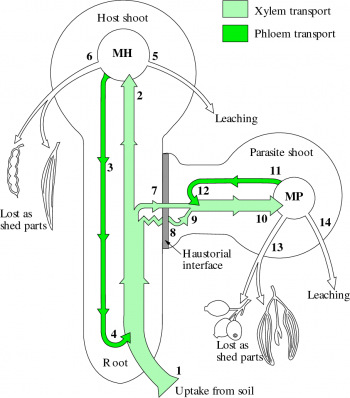
Figure 16.14 Representation of uptake, transport and partitioning of the phloem-mobile and xylem-tapping nutrient potassium (K+) between a tree host and a xylem-tapping mistletoe. K taken up from soil (1) moves to the host shoot (2) and across the lumen-to-lumen xylem continuities (7) and parenchyma (8) of the haustorial interface and thence into the mistletoe (10). K in the host shoot is then pictured as being retained in host biomass (MH), lost through leaching by rain (5), in organ shedding (5) or cycled back to the root via phloem (4). Similar accumulation (MP) and cycling (items 11-14) are depicted for the mistletoe but with no backflow to the host. The mistletoe runs at an 'excess' of K due to a higher rate of transpiration and markedly active absorption of K by parenchyma of the hasutorial interface. Foliage shed by mistletoes is still fully loaded with K. (Based on Pate 1995)
Mistletoes are essentially rootless plants whose mature shoots attach directly to their woody hosts by means of graft-like junctions (Figure 16.13A). Flowering of Australian mistletoes occurs over a long period and their fruits ripen sequentially (Figure 16.13C). Fleshy fruits are eaten and seeds distributed almost entirely by the Australian mistletoe bird (Dicaeum hirundinaceum). Defecating birds wipe the extremely sticky seed masses, only recently ingested, onto adjacent branches of the host tree. Birds obtain only a small nutritional reward from these seeds. They eat large quantities of mistletoe seeds which take less than an hour to pass through. Seeds germinate immediately and, if branch contact is successful, a root-like haustorial structure digests its way into the host’s xylem stream. Once established, a complex ever-enlarging graft union then forms with the host. Secondary growth of the mistletoe haustorium is closely aligned laterally and becomes fully integrated with that of the host branch. Lumen-to-lumen con-tinuities are eventually established at the haustorial interface between tracheary (xylem) conducting elements of the parasite and exposed xylem vessels of the host (Figure 16.13D). It is through these connections that bulk mass flow of xylem vessel fluids takes place from host to parasite. However, most of the haustorial interface consists of parenchyma cells which are apparently involved in selective, metabolically controlled uptake of host nutrients (Figure 16.14).
Growth and survival of xylem-tapping mistletoes depend upon maintenance of a negative gradient in leaf water potential across the haustorial junction between host and parasite. This gradient is maintained day and night in favour of the mistletoe essentially by the mistletoe transpiring faster than its host. This feature, combined with the higher osmotic pressure of mistletoe compared to the host, results in a mistletoe being able to obtain water even when its host is severely water stressed (Case study 15.4).
Rates of photosynthesis of mistletoes are generally less than those of their hosts and this attribute, combined with high transpiration rates, results in the parasite usually exhibiting poorer water use efficiencies than its host (fewer millimoles of CO2 fixed per mole H2O transpired). One consequence of this high intake of xylem fluid is that mistletoes become progressively much more enriched than their hosts with respect to certain nutrients, especially K (Figure 16.14). Studies of mineral balance of a mistletoe throughout a season (Pate et al. 1991a) have shown that mistletoes abstract more than sufficient nutrients to meet requirements for growth and reproduction. Running at such an excess, mistletoes drop their leaves when still fully loaded with nutrients, whereas the host is likely to show the reverse of this and engage in most efficient pre-senescence retrieval of key limiting elements such as N, P and K. Mechanisms underlying these very different mineral economies of mistletoe and host have been defined (Figure 16.14).
As a further corollary to fast transpiration and direct intake of xylem fluid, mistletoes derive significant amounts of C in the form of organic acids, sugars, amino acids and other organic solutes absorbed from the xylem of their hosts. This heterotrophic intake of organic solutes may meet from 10% to 62% of a mistletoe’s daily requirement for C, and thereby compensate considerably for their relatively poor photosynthetic performance. Such inputs of C may be especially important where mistletoes are sited in poorly illuminated positions well inside their host tree canopies.
Leaves of Australian mistletoes are generally soft and fleshy in contrast to the tough sclerophyllous foliage of most host tree species. Being potentially attractive sources of food for a range of insects and grazing vertebrates, mistletoes have developed a range of anti-nutritional defence systems rendering them unpalatable or even poisonous to all but a few co-adapted predators. For example, mistletoes of the genera Amyema and Lysiana contain high concentrations of toxic amino compounds such as tyramine and djenkolic acid. In some cases the poisonous compound in question is obtained already synthesised from the host xylem and merely becomes concentrated in tissues of the mistletoe (Pate et al. 1991b). In other cases biosynthesis of the protective compound takes place within the parasite, using raw materials imported from the host.
Sundews of the genus Drosera are found in every major land mass of the world, but almost three-quarters of the several hundred known species are found in Australia. They typically inhabit nutrient-poor acidic habitats where their ability to capture insects or other arthropod prey confers advantage by supplementing sparse sources of soil nutrients. N supplied by digestion of insect protein is the most important benefit to be derived from a carnivorous habit, especially where a habitat is markedly deficient in N. Insects are, of course, also concentrated sources of other important nutrient elements including P, S and micronutrients. Nevertheless, a carnivorous habit is not obligatory because many insectivorous species grow successfully and reproduce in artificial culture when fed exclusively with inorganic sources of nutrients.
Studies on species of Drosera growing in natural habitats such as the highly impoverished sand plain soils of Western Australia have shown that artificial feeding of leaves with small prey organisms such as spring tails (Collembola sp.) or fruit flies (Drosophila sp.) promotes a measurable improvement in plant growth and reproduction, giving rise to concomitant increases in tissue concentrations of N, P and other key nutrients in plant dry matter (Karlsson and Pate 1992). Growth in nature may therefore be limited by availability of prey.
While proving that benefit does result from this carnivorous habit, a question remains as to how dependent these plants are on insect prey in their natural habitats. A direct way to test this would be to record each item of prey caught by a carnivorous plant over a whole growing season, total up the amount of N in the seasonal catch and then compare this amount of N with the total increment in biomass N made by the plant over the season. A study of this kind, conducted by Dixon et al. (1980), used clonal populations of the southwestern Australian tuberous sundew Drosera erythrorhiza (Figure 16.13E) and included an 15N-labelling pot culture study to determine the efficiency with which insect N was consumed by leaves. Over three-quarters (76%) of N from the 15N applied as labelled fruit flies was absorbed. Using this information, and corresponding data on the total N of the catch and of the total N increment of the clones in natural habitat, about one-sixth (16%) of N gained by the clone must have come from native prey.
Such an investigation is not only time consuming but unfortunately provides only one value for dependence on insect N in a single population of only one species in a specific season and at one restricted locality. A much more powerful approach, also applied to southwestern Australian carnivorous plants, is to utilise differences in natural abundance ratios for the two stable isotopes of N (14N and 15N; Section 3.5.5). Data for insects caught by a carnivorous species are compared with natural abundance ratios for N in dry matter of that species and in cohabiting non-carnivorous species.
Natural abundance ratios for 15N:14N are usually expressed on a relative delta scale (δ15N as ‰) where a δ value of zero represents the ratio of isotopes found in atmospheric N. Positive δ values for a sample then denote enrichment in 15N relative to 14N, negative values the reverse. To explain this application, suppose that N within an insect caught by a carnivorous species showed a δ value of +5‰, while that of the N in dry matter of the carnivorous species was +4‰ and that for non-carnivorous reference species growing purely on soil N in the same habitat was +3‰. Your conclusion, based on simple arithmetic, would then be that the carnivorous species had gained half of its N from insects and the remaining half from available sources of N in the soil. Soil δ15N value of the latter was assumed to have been monitored effectively using the neighbouring non-carnivorous reference species. Values obtained in such a study (Schulze et al. 1991), encompassing a range of different growth and life forms of southwestern Australian sundews, indicated values for dependence on insect N of approximately 50% across all species studies, but lower values for rosette than for erect and climbing species.
In a special segment of the above study δ15N values were assessed for (1) normal plants of Drosera erythrorhiza carrying fully glandular leaves and visibly active in catching insects, and (2) certain mutant plants which completely lacked glands and would therefore have been totally dependent on soil N. These mutants provided perfect reference material to compare with normal prey-capturing representatives of the species. The resulting comparison of δ15N values for three matched adjacent clones of glandular and non-glandular plants indicated proportional dependence on insects of 12.2%, 14.3% and 32.3% (Schulze et al. 1991). These values are in reasonable agreement with the earlier value of 16% for the same species in the prey-inventory study.
Finally, a particularly interesting bug, the hemipteran Cyrtopeltis sp. (Figure 16.13F), lives on a number of species of carnivorous plants native to southwestern Western Australia. This bug has the unusual ability to traverse glandular leaves of a carnivorous plant without becoming caught in that plant’s ‘fly paper’ surfaces. The bugs forage among fresh carcasses on leaves at night, hiding during the daytime in lower non-glandular parts of the shoot. Does such scavenging comprise the major source of nutrition for Cyrtopeltis sp., or, like many other hemipterans, does it feed principally on plant sap? Again, using natural abundance δ15N values, J.S. Pate and co-workers in Western Australia solved the problem by comparing δ15N values for freshly collected carcasses, the insectivorous plant (Byblis sp.) on which the insects had been caught, and adults of Cyrtopeltis sp. that were inhabiting the Byblis. Cyrtopeltis sp. showed δ15N values in the range +4 to +6‰ (i.e. very close to that of the insect prey range 3–6‰) but several δ units more positive than that of the plant (+2 to +3‰). These δ15N values imply that Cyrtopeltis sp. is a carcass-scavenging non-vegetarian species, and only indirectly harmful to carnivorous plants by robbing them of nutritional substances from their insect catches, rather than drawing directly on plant sap.
Links:
[1] http://plantsinaction.science.uq.edu.au/edition1//?q=figure_view/734
[2] http://plantsinaction.science.uq.edu.au/edition1//?q=figure_view/739
[3] http://plantsinaction.science.uq.edu.au/edition1//?q=figure_view/735
[4] http://plantsinaction.science.uq.edu.au/edition1//?q=figure_view/738
[5] http://plantsinaction.science.uq.edu.au/edition1//?q=figure_view/741
[6] http://plantsinaction.science.uq.edu.au/edition1//?q=figure_view/742
[7] http://plantsinaction.science.uq.edu.au/edition1//?q=figure_view/743
[8] http://plantsinaction.science.uq.edu.au/edition1//?q=figure_view/744