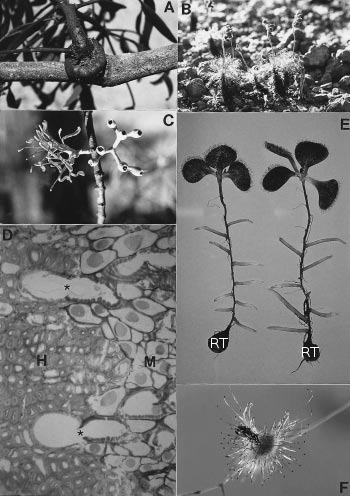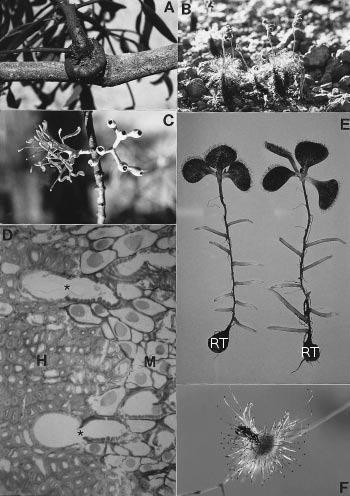
Figure 16.13 (A) Mistletoe (Amyema miquelii) attached to a eucalypt host. Note swollen haustorium which forms a graft-like union with the host branch. (B) A carnivorous plant (Drosera barbigera) showing glandular leaves capable of capturing and digesting insects. (C) Flowers and young fruits of the mistletoe Amyema linophyllum. Note staggered reproduction, whereby fruits ripen sequentially over a long period and thus offer an almost continuous supply of food for the principal dispersal agenst, the mistletoe bird. (D) Photomicrograph of part of the haustrial interface between a mistletoe (M) and its host (H). A lumen-lumen bridge between a xylem vessel of the host and the xylem elements of the mistletoe is marked with an asterisk. (E) A stem-tuberous carnivorous species Drosera erythrorhiza collected near the end of a good growing season. This plant grew from a parent tuber that is now replaced in situ by a replacement tuber (RT). Extra nutrient capital that is acquired each season is deposited in daughter tubers that form at the ends of rhizomes (R). (F) The hemipteran Cyrtopeltis sp. that walks with impunity across sticky leaves of carnivorous plants to feed on insect carcasses the plants have captured. The host plant is Drosera gigantea. (Photographs courtesy J.S. Pate)