
 [1]
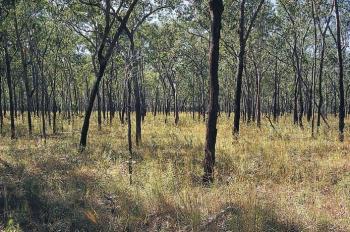
Figure 15.21 A typical savanna woodland at the wetter end of its distribution near Darwin, Northern Territory. Annual rainfall is between 1600 and 1800 mm, trees are tall (12 – 16 m) and stand density is high. (Photograph courtesy G. Duff, school of Biological Sciences, Northern Territory University, Darwin)
Savannas cover 30% of mainland Australia and are charac-terised by a continuous grassy understorey with a discon-tinuous canopy of trees and shrubs (Figure 15.21). Grasses are either annual or perennial, but almost invariably C4 plants. The woody component is dominated by eucalypts and/or acacias, although in some regions (for example, on clay soils in the Barkly and Victoria River Districts) other genera such as Terminalia dominate. Tree cover can vary from a few scattered trees and shrubs to more than 50% cover. The basal area of woody species ranges from 0.25 m2 ha–1 to at least 10 m2 ha–1.
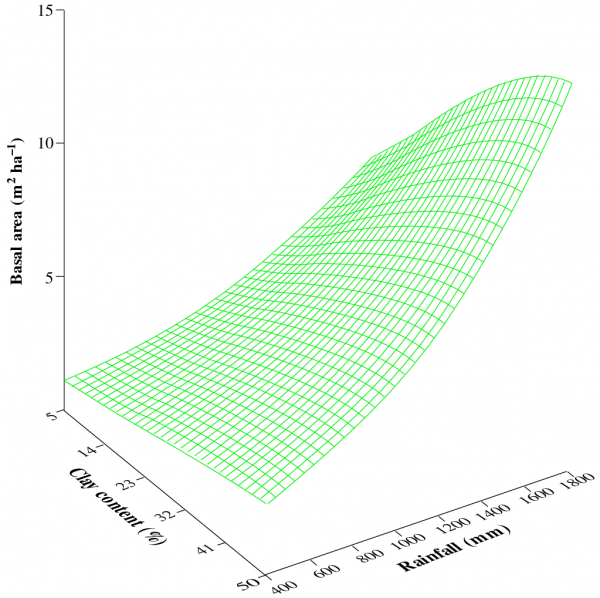
Standing biomass and species composition of savanna woodlands between 11°S and 18°S within the Northern Territory vary according to plant-available moisture and soil type (Figure 15.22). Over this latitudinal range, mean annual rainfall declines from approximately 1600 mm to 400 mm. Temperature extremes also increase inland. In parts of the more arid interior (e.g. Tennant Creek, at the southern extent of the savannas), temperatures range from below 0ºC to above 40°C.
 [2]
Figure 15.22 Tree basal area increases according to annual rainfall and soil clay content (taken here as a surrogate for soil nutrient resources). (Based on unpublished data compiled by D. Eamus and G. Duff)
Plant-available moisture and nutrients are acknowledged as the primary determinants of savanna structure and function (i.e. physiological and phenological behaviour). Secondary determinants are fire (Chapter 19) and grazing. Fires are frequent, annual in many areas, and cover more than 50% of the northern end of the savannas in any one year. However, these fires are of much lower intensity than those which occur in southern Australia (typically 1000 W m–2 compared with 100000 W m–2 in an ‘Ash Wednesday’ episode). In these low-intensity savanna fires only the grassy understorey is burnt. In the relatively tiny area of savanna which escapes fire for prolonged periods (decades), vegetation structure changes. Grass density is significantly reduced and mid-storey shrub layer density increases.
Scattered within the matrix of the savanna are pockets of fire-sensitive vegetation such as monsoon rainforests. In the Northern Territory alone there are approximately 15000 such patches, typically only a few hectares in extent.
Savannas are tropical ecosystems and occur where climate is strongly seasonal, with pronounced wet and dry seasons. In the Top End of the Northern Territory, for example, more than 90% of the average annual rainfall occurs between November and April. At least six months of any year will be rainless. Temperatures are uniformly high with daily maxima generally above 30°C. Atmospheric vapour pressure deficit (VPD) shows a seasonal cycle, with minimum VPD occurring from December to March and afternoon maxima of 5 kPa between July and September.
 [3]
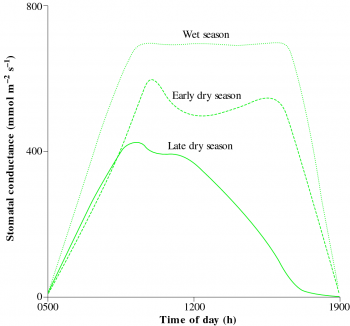
Figure 15.23 In a typical year on a savanna woodland, rainfall is confined to six months. During the wet season, the vapour pressure deficit (VPD) is) low and soil water availability is high. During the dry season, rainfall is essentially absent,VPD is higher and soil water availability declines to a minimum. Throughout the year mean daily temperature varies only by 2-4°C. During the wet season, stomatal conductance (gs) is high during day-time, with little variation between morning and afternoon. By contrast, in the dry season, gs peaks to a lower value compared to the wet season and shows a marked decline each afternoon. Virtually all savanna tree species in northern Australia follow this pattern. (Based on various sources compiled by D. Eamus and G, Duff)
 [4]
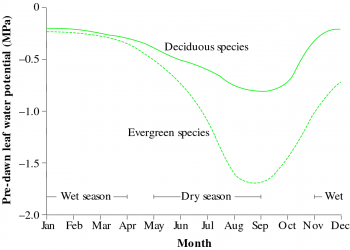
Figure 15.24 Pre-dawn leaf water potential is a good indicator of soil water availability because leaf water potential continues to increase at night-time until the gradient between soil and leaf water potential is zero. In the wet season when soils are at or above field capacity, pre-dawn leaf water potential remains close to zero, declining gradually during the dry season as soil water availability diminishes. Evergreen trees continue to transpire through-out the dry season and experience lower pre-dawn water potentials than deciduous trees, which because of their loss of canopy can maintain a higher water potential than evergreen species (Based on various sources compiled by D. Eamus and G. Duff)
 [5]
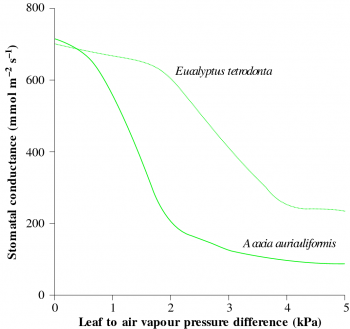
Figure 15.25 Stomata close in response to increased leaf to air vapour pressure difference, and all trees examined so far in the wet-dry tropics show such behaviour. Starting with comparably high stomatal conductance gs) under mild conditions, Acacia auriculiformis is hypersensitive to increasing leaf to air vapour difference compared to Eucalyptus tetrodonta, so that carbon gain per day per unit leaf area will diminish earlier in A. auriculiformis as the dry season advances. Differences in canopy volume per tree can, however, vary in the opposite direction to gs sensitivity, so that carbon fixed per unit tree will be comparable, and results in co-dominance on given sites (Based on original data in Cole 1994, and redrawn by D. Eamus and G. Duff from Berryman et al. 1994)
The wet season is characterised by high soil water availability and low VPD. The dry season is characterised by low soil water availability and high VPD. These differences are reflected in diurnal patterns of stomatal conductance (gs) (Figure 15.23), which in turn relate to seasonal patterns of pre-dawn leaf water potential (Ψleaf) (Figure 15.24). Data were obtained in a study at Solar Village, an unburnt savanna woodland 20 km south of Darwin. Two features can be discerned: the wet season gs is approximately double the value measured in dry season and stomata remain fully open for much of the day during the wet season. In the dry season, however, gs peaks mid-morning and declines approximately linearly from midday through to the evening. Both features typify savanna species.
An overall decline in gs between wet and dry seasons (Figure 15.23) reflects declining soil water availability. Pre-dawn leaf water potential is a useful indicator of plant-available soil moisture, and is correlated with daily maximal gs. As soil water potential declines, pre-dawn leaf water potential declines and daily maximum gs declines. In addition the leaf to air vapour pressure difference (LAVPD) increases in the dry season, but also increases between morning and afternoon in both wet and dry season. During the wet season when soil water availability is high and the increase in LAVPD between morning and afternoon is small, gs remains high because water uptake by the roots is able to meet the demands of transpiration. In contrast, in the dry season when soil water availability is low and the increase in LAVPD during the day is considerably larger, gs peaks in the morning, when evapo-transpirational demand is lower and soil water content higher compared to the afternoon.
Sensitivity of gs to LAVPD is a common feature of savanna species, as shown in Figure 15.25 for Eucalyptus tetrodonta and Acacia auriculiformis. The form of the relationship and the sensitivity of gs to LAVPD differs between species, as does a threshold LAVPD above which a rapid decline in gs occurs.
Changes in leaf water potential are not a primary cause of differences in gs between seasons, since identical leaf water potential can be measured in the wet season and early dry season, but gs is substantially lower in the early dry season than the wet season. Furthermore, Cole (1994) was able to show on relatively wet sites occupied by A. auriculiformis that pre-dawn and minimum leaf water potential differences between seasons were small, but significant declines in gs between morning and afternoon or between wet and dry seasons nevertheless occurred. This reduction in gs was associated with increased VPD.
Seasonal decline in plant-available moisture is also reflected in measurements of pre-dawn leaf water potential (Figure 15.24) and diurnal changes in leaf water potential. Pre-dawn water potential shows little change during the wet season when soils are saturated and values range between -0.1 and -0.4 MPa. However, during the dry season, substantial declines occur as soil water content decreases and extraction of water occurs from deeper soil.
Close inspection of savannas reveals four main phenological groups. These are species which are (1) evergreen, (2) partly deciduous, (3) semi-deciduous and (4) fully deciduous. Ever-green species retain a full canopy throughout the year (e.g. Eucalyptus miniata); partly deciduous species exhibit a decline in canopy cover only briefly and to levels not below 50% of their full canopy (e.g. Eucalyptus bleeseri); semi-deciduous species lose more than 50% of their canopy during the dry season (e.g. Erythrophleum chlorostachys); and fully deciduous species are leafless for at least two months during the dry season (e.g. Terminalia ferdinandiana). Species in Top End savannas are more or less evenly distributed between these four cat-egories. The fact that there is no one optimum or dominant strategy indicates that a variety of factors interact to determine deciduous behaviour, and different species respond to these factors to differing degrees.
Being evergreen is costly. Efficiency of water and nutrient use is lower than in deciduous species. So why be evergreen?
The benefit of maintaining a canopy throughout the year is the maintenance of a positive carbon balance for every month of the year. Thus evergreen species fix carbon during the dry season, and they also have a canopy which can take advantage of improved conditions (early rain and decreased VPD) at the end of the dry season without the lag associated with developing new leaves. Furthermore, the ratio of costs to ‘payback’ is positively correlated with leaf longevity. Thus, if a leaf is costly in terms of construction and maintenance, and the return on investment (assimilation of carbon) is low per unit time (the cost/benefit ratio is large), then leaf lifespan must be longer (evergreen) so that the leaf lives long enough to pay back (in carbon fixation) the investment of carbon and other nutrients made.
Deciduousness also has costs, principally the loss of carbon and other nutrients associated with leaf fall and the loss of ability to fix carbon for six months of every year. The benefits of deciduousness include avoidance of extreme foliar drought and hence a reduced need to develop and maintain more extensive root systems, and avoidance of sustained herbivory.
In evergreen species, leaves either live longer or are turned over continually. Longer lived leaves need greater protection against herbivory and consequently invest more resources in secondary compounds which serve to make foliage less palatable due to fibre and tannins, or even poison-ous due to secondary metabolites such as cyanogenic glycosides. There would be less pressure for protection in deciduous species.
Evergreen and deciduous species thus differ in phenology but coexist in nature due to comparable outcomes for carbon balance from expensive but long-lived leaves of evergreens and short-lived, less expensive leaves of deciduous species that fix carbon for about six months each year. All four pheno-logical groups recognised in the wet–dry tropics of Australia (Williams et al. 1997) are equally represented, confirming that no single strategy confers a unique advantage.
Open forests are commonly dominated by eucalypts with a canopy cover of between 30–70%. They occur in both tropical and temperate zones, and most frequently in wetter coastal areas. In tropical open forests the understorey is most frequently dominated by grasses (Section 15.4.1); in temperate zones the understorey can range from dense shrub to grasses. Canopy height and canopy cover increase with increasing plant-available moisture.
Growth of any plant community and thus its structure, productivity and biodiversity depends on the relationship between soil water and evaporative demand. More leaves means greater transpiration and more water required to maintain that community. In any canopy, upper exposed foliage is the most critical determinant of transpiration and experiences the strongest leaf to air vapour pressure difference. Community dynamics are thus governed by evaporative conditions and the amount of foliage in direct contact with the atmosphere (foliage projective cover, FPC %, of the community; sensu Winkworth and Goodall 1962).
Potential water loss from a plant community is driven by the gradient of water potential in the soil–plant–atmosphere continuum (from soil to atmosphere, ΔΨSPAC). Actual water loss is modified by canopy resistance (canopy boundary layer, rbl) plus canopy leaf resistance (rl × FPC). Thus, water flux through the soil–plant–atmosphere continuum (represented here by actual evapotranspiration (ETa) over time t becomes:

where ΔΨSPAC = overall decrease in water potential within the soil–plant–atmosphere continuum (mean over time t);
rbl = boundary-layer resistance (mean over time t);
rl = leaf resistance (mean over time t);
FPC = foliage projective cover (scale 0 to 1).
Annual flow of water through the soil–plant–atmosphere continuum is represented by ETa (Specht and Specht 1989). ETa approaches potential evaporation, Epan (evaporation of water from a class A pan), in humid environments during the wettest months of the year (Epan is considered the maximum for any area and is taken as an annual constant within a particular location). The ratio between actual evapotrans-piration and potential evaporation (ETa/Epan) can be ex-pressed as the product of the available water (Wavail) and an evaporative coefficient (ke). Moisture index (MI) as defined by Specht (1972) and Specht and Specht (1989) then becomes ETa/Epan, thus:

The evaporative coefficient, ke, therefore represents the rate at which actual evapotranspiration is able to approach potential evaporation under the conditions of available water. Values for ke generally range between 0.0 and 0.1.
| Climate type | Evaporative coefficient (ke) |
| Perhumid climate | >0.075 |
| Humid climate | 0.055–0.075 |
| Subhumid climate | 0.045–0.055 |
| Semi-arid climate | 0.035–0.045 |
| Arid climate | <0.035 |
 [6]
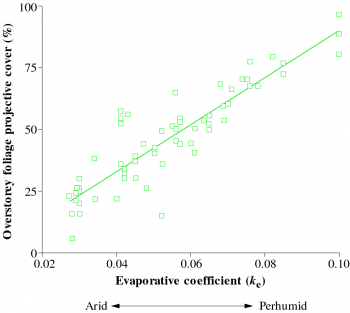
Figure 15.26 Foliage projective cover (%) recorded for the overstorey of 56 Australian plant communities plotted against the evaporative coefficient (ke), an inverse measure of evaporative demand. Mesic condition favour canopy development, and that relationship is apparent here as a highly significant correlation (n = 63, r2 = 0.80) between ke and foliage projective cover. (Based on original data compiled by A. Specht)
 [7]
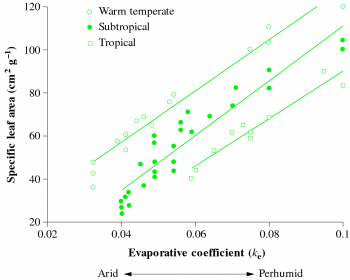
Figure 15.27 Specific leaf area (SLA, cm-2 g-1 dry mass) of discs punched from the lamina of dominant Eucalyptus spp. Is related to the evaporative coefficient (ke) of the sampling site. Slopes are consistent across species groups, implying a coming mechanism underlying SLA:ke relationships, but intercepts differ according to tropical, subtropical and temperate climatic zones. As the atmosphere gets drier, average SLA declines because average leaves get thicker.
Tropical SLA = 1183.2 × ke + 9.8 (n = 15, r2 = 0.96)
Subtropical SLA = 1257.8 × ke – 15.3 (n = 27, r2 = 0.93)
Temperate SLA = 1087.1 × ke – 19.25 (n = 15, r2 = 0.93)
(Based on original data compiled by A. Specht)
 [8]
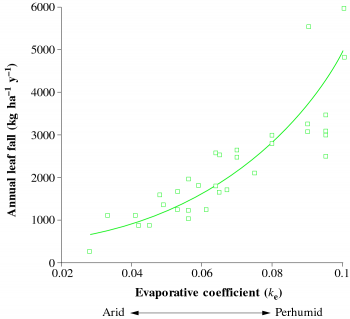
Figure 15.28 Annual leaf litter fall (kg ha-1 year-1, oven dry mass) from the overstorey of mature evergreen plant communities shows a curvilinear relationship with the evaporative coefficient (ke). Leaf litter is an indicator of canopy mass and turnover, and thus productivity. This index declines with atmospheric dryness. Annual leaf litter fall = 295.6 × 1012.2ke (n = 35, r2 = 0.80)
Values for ke are directly correlated with FPC % of the overstorey trees or shrubs (Figure 15.26). This clearly expresses the first effect of water availability and balance on a plant community; without an adequate water supply, leaf development is restricted.
Sclerophylly is also directly related to water flux through the soil–plant–atmosphere continuum. Overstorey species of eucalypt forests become more mesophytic with increased water flux as expressed by the evaporative coefficient (ke) (Figure 15.27). This effect is temperature dependent, with more mesophytic leaves in the tropics than in the temperate zone.
Interception of sunlight determines annual canopy pro-duction (Section 12.3) so that annual leaf litter fall increases exponentially with an increasing flux of water through the plant community (Figure 15.28). Production of canopy biomass is clearly related to the foliage projective cover of the overstorey and hence total photosynthetic production. Interestingly, the increase in production with increasing foliage projective cover (linearly related to evaporative coefficient (ke) in Figure 15.26) is exponential rather than linear (Specht and Specht 1989).
In a forest, photoassimilate is distributed between many individuals. The number of individuals, their stand density and their species richness can all be related to the amount of water flowing through the plant community. Just as annual canopy productivity is exponentially related to the flux of water through the plant community and hence foliage projective cover, so the number of stems per unit area, and potentially biodiversity, is also related. In moist environments, stem density is highest, while in drier environments fewer stems survive (cf. Figure 15.22). This effect intensifies with annual temperature regime as the growing season is prolonged (Specht and Specht 1993, 1994). This is reflected in the species diversity of the community; wetter and warmer conditions (and a long growing season) predispose towards more ‘niches’ (sensu Grime 1979).
Paul Kriedemann
(Based on material provided by Neil Davidson, Department of Plant Science, University of Tasmania, and Beth Byrne, School of Biological Sciences, Flinders University of South Australia)
Vascular plant parasitism is a worldwide phenomenon with a long evolutionary history. This adaptation has evolved independently in unrelated families, and on numerous occasions. About 3000 species in 13 families of terrestrial plants have representative species that exploit other species in that same family, or in closely related families. These parasitic plants draw water, nutrients and sometimes even photo-assimilate from their hosts. Such adaptation is common in Australia, and is mainly represented by three life forms, mistletoes, dodders and root hemiparasites.
In all cases, parasitic plants rely on their development of an haustorium, that is, an outgrowth of modified root tissue that penetrates host phloem and forms plate-like contact with host xylem. Mistletoes develop a single haustorium on host branches, while root hemiparasites produce many haustoria on roots of other plants. Dodders are leafless aerial parasites with long thread-like stems that produce haustoria at each node. They ramify throughout host-plant canopies and can parasitise a wide range of species, even themselves!
 [9]
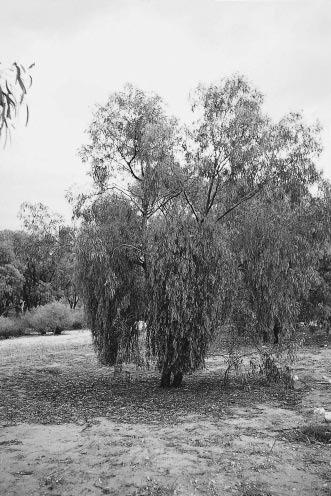
Figure 1 Well-established mistletoes on a 'struggling' black box (Eucalyptus largiflorens) growing on the upper edge of the Murray River floodplain near Mildura, Victoria (photograph courtesy P.E. Kriedemann)
Mistletoes (Figure 1) grow on branches of eucalypts, acacias and casuarinas throughout mainland Australia (curiously, not in Tasmania). Mistletoe–host relationships are highly specific with a given mistletoe restricted to only a few host species within a given genus. Mistletoe foliage commonly mimics host foliage. This form of mimicry probably confuses herbivores who would otherwise benefit from feeding on mistletoe foliage by virtue of higher nutrient content, and carries an obvious selective advantage.
 [10]
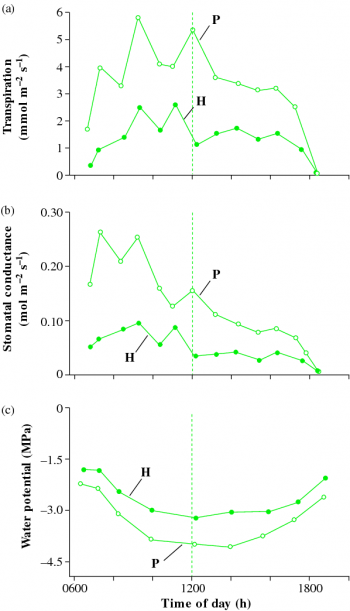
Figure 2 Changes in (a) transpiration, (b) stomatal conductance and (c) leaf water potential, of the mistletoe Amyema linophyllum and its host Casuarina obsea at Gingin, Western Australia. Curves are marked 'P' for parasite, and 'H' for host. (Based on Davidson et al. 1989)
Following early studies on mistletoes, Wood (1924) suggested their water use was profligate and subject to little control. Subsequent observations have countered this view, showing that stomatal conductance decreases in response to low humidity and falling leaf moisture content. Furthermore, diurnal patterns of stomatal conductance suggest a co-ordination between host and parasite in response to changing environmental conditions (Ullman et al. 1985). During daytime, mistletoes transpire faster than their host (Figure 2a) due to higher stomatal conductance (Figure 2b). This high stomatal conductance, coupled with a substantial hydraulic resistance to water flow through the haustorium, results in a much lower leaf water potential in parasite compared to that of the host (Figure 2c).
Surprisingly, host–parasite differences in leaf water potential at night-time change little from daytime values despite a 300-fold difference in transpiration rate (Davidson and Pate 1992) and this implies a large increase in haustorial resistance to water flow from day to night. According to Kuo et al. (1989), the haustorial junction of a root hemiparasite (Olax phyllanthi) hydrates at night to a sufficient extent that turgid cells partially close the principal apoplasmic pathway of water movement, forcing water to move through cells rather than between cells (that is, to a symplasmic rather than an apoplasmic pathway). Such a shift in pathway would increase hydraulic resistance and a similar mechanism might apply to mistletoes.
 [11]
Table 1
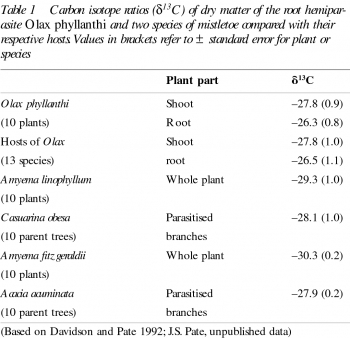
Although mistletoes transpire faster than their hosts, rates of carbon assimilation are about the same. Water use efficiency is therefore lower (Davidson and Pate 1992), and in this respect confirms Wood’s early (1924) assertion. Host–parasite differences in water use efficiency are reflected in carbon isotope signature (Table 1) for Amyema fitzgeraldii growing on Acacia acuminata near Geraldton in Western Australia. Numerically larger values imply lower water use efficiency (Case study 15.3).
Even in xeric environments, mistletoes are more succulent than their hosts, and this succulence confers a greater water-holding capacity on the parasite. Foliage on Amyema linophyllum has more than three times the water-holding capacity of Casuarina obesa, and in this parasite–host relation-ship daytime transpiration draws on parasite water reserves that are recharged during subsequent nights (Whittington and Sinclair 1988). Night-time recharge, combined with lower threshold of leaf water potential for stomatal closure in parasite compared to host, has important implications for diurnal partitioning of water between partners, and especially during water stress.
Water relations of dodders present a different set of issues. Their morphology implies a xerophytic nature and a distinctive hydraulic architecture. Leaves have been reduced to scales, and photosynthetic stems have a thick cuticle with sunken stomata in longitudinal groups of three to seven (McLuckie 1924). These constraints on water loss are complemented by a high concentration of hydrophilic mucilage in vascular conduits that would increase osmotic pressure and contribute towards drought resistance.
Although water can move in either direction along dodder stems, there is a limit on distance travelled. Stems seldom grow longer than about 50 cm beyond a given haustorium and may reflect a maximum distance for cost-effective transport of water and nutrients within their thread-like stems. Extension growth to new hosts then depends upon an anastomosing network of stems, aided by autoparasitism.
Root hemiparasites such as Olax spp., Exocarpos spp. and Leptomeria spp., in contrast to dodder and mistletoes, are equipped with many haustoria and are able to parasitise a large number of different individuals or host species in their vicinity. Moreover, they express very different water relations from those of mistletoes which have just one haustorium per plant. These more generalist root parasites enjoy the luxury of making ephemeral haustorial contact with hosts, and then severing those links if host water relations are unfavourable to themselves. For example, Olax phyllanthi (Table 1) may have as many as 1000 active haustoria attached to a wide range of host species, but these organs of extraction senesce during periods of low rainfall (Pate et al. 1990). Senescence probably occurs for those haustoria attached to a host whose water potentials are out of range (more negative than the parasite). Root hemiparasites thereby avoid a scenario where water potential gradients are reversed, and water moves from parasite to host.
Unlike mistletoes, both transpiration and CO2 assimilation by Olax phyllanthi are lower than corresponding rates by host plants. Host and parasite return similar values for carbon isotope signature (Table 1), but water use efficiency is not necessarily comparable because a large proportion of carbon present in Olax is derived heterotrophically from its host plants and would dilute any 13C enrichment due to Olax itself. Indeed, d13C and C:N ratio studies indicated as much as 51–63% heterotrophic acquisition of carbon by Olax under field conditions (Tennakoon and Pate 1996).
Striga, an herbaceous root hemiparasite of annual crops, provides an even more extreme case of host exploitation. One species, Striga hermonthica, transpires 10 times faster than the annuals it parasitises. Photosynthetic pigments are present at about 40% of host levels, and stomata are insensitive to either light or water stress. This extraordinarily low water use efficiency impacts severely on host water relations and reduces yield dramatically. A second species, S. gesnerioides, transpires more slowly but is almost devoid of chlorophyll and is thus heavily dependent on host-plant photoassimilate. In this case, almost 70% of imported carbon is expended on haustorium respiration which in turn sustains uptake of carbon, nitrogen and mineral nutrients. Diversion of such large quantities of resources from the host plant (Vigna unguiculata, cowpea) reduces host plant growth by 75% (Graves et al. 1992).
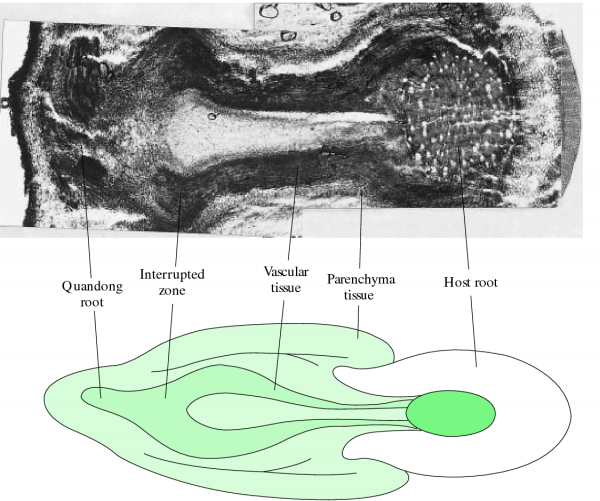
In a reversal of host–parasite relations more equitable for horticulture where parasite rather than host plant is put to human use, quandong (Santalum acuminatum) operates as a root hemiparasite on a wide range of host species. Quandong is native to southern Australia with potential for commercial cropping in arid areas with poor-quality water (Sedgley 1984). Mainly recognised as an indigenous arid-zone plant, quandong can access water from host plants via a fleshy haustorium rich in starch (Figure 3). Reminiscent of the high resistance to hydraulic flow in mistletoe haustoria discussed above, an interrupted zone in quandong–host connections (Figure 3) is characteristic in members of the Santalaceae family and would increase resistance to flow between host and parasite because vascular connections are reduced to a few xylem elements.
 [12]
Figure 3 A hand section and schematic drawing of a qauandong (Santalum acuminatum) haustorium showing (left to right) quandong root, interrupted zone, vascular tissue, parenchyma tissue and host root in cross-section. Scale bar = 250 µm. (Original illustration courtesy B.R. Byrne)
 [13]
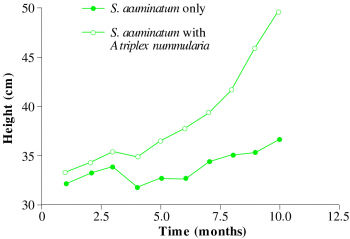
Figure 4 Quandong (Santalum acuminatum) grows much faster in association with a compatible host plant such as Atriplex nummularia. Present data come from container plants in a greenhouse experiment at Flinders University of South Australia. Similar responses occur under field conditions where quandong can access a wide range of host plants. (Original data courtesy B.R. Byrne)
In greenhouse trials at Flinders University (Byrne et al. 1997) height growth in quandong was greatly enhanced by a parasitic association with Atriplex nummularia (Figure 4). Other host species such as Templetonia retusa, Myoporum parvifolium and Acacia cyclops proved less effective.
In field trials at Aldinga and Middleback (South Australia) gradients in water potential and osmotic potential between host and parasite ensure a flow of xylem contents from host to parasite. Leaf extracts from quandong averaged total solute concentrations of around 1315 mM compared with host plants at only 735 mM. While chloride, sodium and potassium ions all contributed to this host–parasite difference, an unusual organic solute was largely responsible, namely mannitol. Leaf extracts from quandong growing at Middle-back contained up to 366 mM mannitol, and contributed to generation of leaf osmotic pressures of between 3.5 and 4 MPa, compared with host tree osmotic pressures of around 2 MPa. Host tree foliage was devoid of mannitol.
Xylem–xylem connections exist (Figure 3) and would enable movement between host and parasite, but phloem connections have not been observed. A meagre translocation of 14C-labelled assimilates from host plant to parasite reported by Byrne et al. (1997) presumably takes an indirect route. Because quandong is photosynthetically competent, host plant dependence is largely confined to water and inorganic nutrients, although secondary metabolites with insecticidal value have been detected in quandong fruit from plants growing in association with Melia azedarach, a known source of the natural insecticide azadirachtin.
Plant parasites do not exploit their hosts in an uncontrolled fashion. Instead, parasite physiology is beautifully adapted for coordination with nutrient and water relations of the host plant. For example, water potential differences between host and parasite are remarkably constant over a wide range of environmental conditions, and are maintained by a transpiration-driven reduction in parasite water potential coupled with a high fluid phase resistance in the haustorium. This difference is maintained at night-time via adjustments in haustorium resistance. A high moisture capacitance of succulent parasite foliage provides a buffer against desiccation when host plants are water stressed.
Water and nutrients are both critical currencies in host–parasite relations, but carbon acquisition may well prove more pervasive in sustaining parasitic habits as discussed here. In particular, perennial parasites need to retain a healthy host for their own survival as individuals, so that parasites with a low capacity for autotrophic carbon gain must also adapt with failsafe mechanisms for reproduction and species preservation in the event of their host dying prematurely. Such parasites impose greatest demand on host plants and include dwarf mistletoes that infect pine plantations, dodders in the genus Cuscata that act as vectors for viruses in pasture and grain crops, and herbaceous root hemiparasitic weeds such as Striga spp. that commonly parasitise legume and grain crops. Host responses to virulent parasites include loss of photosynthetic capacity, reduced fecundity and bizzare growth patterns such as ‘witches broom’ as observed on conifers. Evolution of such highly successful life forms once again emphasises adaptive plasticity in vascular plants and they offer rich ground for research into mechanisms responsible for host–parasite interactions on growth and reproductive development.
Byrne, B.R., Tyerman, S.D. and Loveys, B.R. (1997). ‘The transfer of compounds from host plants to the hemiparasite Santalum acuminatum’, Proceedings 41st Annual ASBMB and 37th Annual ASPP Conferences, Melbourne, 29 September–
2 October 1997, Abstract P1–44.
Davidson, N.J. and Pate, J.S. (1992). ‘Water relations of the mistletoe Amyema fitzgeraldii and its host Acacia acuminata’, Journal of Experimental Botany, 43, 1549–1555.
Davidson, N.J., True, K.C. and Pate, J.S. (1989). ‘Water relations of the parasite:host relationship between the mistletoe Amyema linophyllum (Fenzl) Tieghem and Casuarina obesa Miq.’, Oecologia, 80, 321–330.
Graves, J.D., Press, M.C., Smith, S. and Stewart, G.R. (1992). ‘The carbon economy of the association between cowpea and the parasitic angiosperm Striga gesnerioides’, Plant, Cell and Environment, 15, 283–288.
Kuo, J., Pate, J.S. and Davidson, N.J. (1989). ‘Ultrastructure of the haustorial interface and apoplastic continuum between host and the root hemiparasite Olax phyllanthi (Labill.) R. Br. (Olacaceae)’, Protoplasma, 150, 27–39.
McLuckie, J. (1924). ‘Studies in parasitism. I. A contribution to the physiology of the genus Cassytha’, Proceedings of the Linnean Society of New South Wales, 49, 55–78.
Pate, J.S., Davidson, N.J., Kuo, J. and Milburn, J.A.M. (1990). ‘Water relations of the root hemiparasite Olax phyllanthi (Libill) R. Br. (Olacaceae) and its multiple hosts’, Oecologia, 84, 186–193.
Sedgley, M. (1984). ‘Australia’s first commercial fruit?’, Australian Horticulture, 82, 52–59.
Tennakoon, K.U. and Pate, J.S. (1996). ‘Heterotrophic gain of carbon from hosts by the xylem tapping root hemiparasite Olax phyllanthi (Olacaceae)’, Oecologia, 105, 369–376.
Ullman, I., Lange, O.L., Ziegler, H., Ehleringer, J., Schulze, E.-D. and Cowan, I.R. (1985). ‘Diurnal course in leaf conductance and transpiration of mistletoes and their hosts in Central Australia’, Oecologia, 67, 577–587.
Whittington, J. and Sinclair, R. (1988). ‘Water relations of the mistletoe Amyema miquelii and its host Eucalyptus fasciculosa’, Australian Journal of Botany, 36, 329–356.
Wood, J.G. (1924). ‘The relationship between distribution, structure, and transpiration of arid South Australian plants’, Transactions of the Royal Society of South Australia, 48, 226–235.
Small plants have a problem in dense forests. So little light reaches ground level that photosynthesis may only be possible at a very slow rate, or in short bursts when a sunfleck penetrates through the canopy overhead. One possible solution is to leave the forest floor altogether and grow high in the canopy on the trunks or branches of tall forest trees where light is available. Epiphytes are a specialised group of plants that employ this strategy and have adapted accordingly.
While light is more plentiful in this niche, access to water and nutrients can be limited. Epiphytes have no contact with the soil, and, importantly, do not penetrate the living tissues of their hosts, unlike parasitic mistletoes (see Case study 15.4). Although rainfall may be high, when the rain stops epiphytes may quickly be exposed to a very harsh, dry environment.
Epiphytes are a diverse group including plants from many families. The most common vascular epiphytes are orchids, ferns and in the New World tropics (i.e. central America) bromeliads. Different solutions to the problems of the epiphytic niche have evolved in different taxa. The question of water supply may be considered in three parts: trapping water, storing water and minimising water loss.
Epiphytic orchids and some other taxa often have very unusual aerial roots growing along the surface to which they are attached or freely into the air. Can these roots absorb water and, if so, how? Also, can water loss from these roots be controlled, since roots do not have stomata?
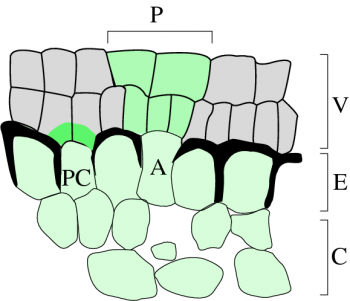
A typical aerial root consists of a specialised outer epi-dermis of several cell layers called the velamen. When mature, these cells are dead and filled with air. Beneath this layer lies the cortex, with the outermost layer specialised into an exodermis and the innermost layer an endodermis (as found in most roots). Within the endodermis is a central stele containing vascular tissues. The specialised outer layers are particularly adapted to an epiphytic way of life.
 [14]
Figure 15.29 A schematic transverse section through part of an orchid root, showing specialised outer tissues. V, velamen; E, exodermis; C, cortex; A, a thin-walled aeration cell, empty and filled with air; P, a wedge of air-filled cells; PC, a living thin-walled passage cell surmounted by a fibrous body. A mature velamen is dead and filled with air, but acts like a sponge when wetted. A wedge of water-repellent cells (P) provides a path for gaseous diffusion (Based upon an original sketch by R. Sinclair)
When an orchid root is wetted the velamen takes up water rapidly, like a sponge. However, wedge-shaped masses of cells are water repellent and remain air filled, forming permanent gaseous passageways from the surface down to the exodermis (Figure 15.29). A break in the exodermis at this point allows a pathway for gas exchange between the inner cortex and the air even when the velamen is filled with water. Other living thin-walled cells in the exodermis, called passage cells, provide a pathway for water and nutrients from the water-filled velamen to the inner tissues, while the rest of the exodermis is impervious to water. These cells are capped by an unusual mass of fibrous strands.
The velamen acts as a site for temporary water storage. During rain the velamen wets and holds water in contact with underlying living tissues, greatly extending the time for water absorption through passage cells. This allows an orchid to make the most of intermittent showers. In addition to direct precipitation, the first water to run along a branch or drip through the canopy carries the most nutrients. The velamen is thus important for both water and nutrient uptake.
When the velamen dries out it forms a protective layer which slows water loss from inner living root tissues. Fibrous caps above passage cells may also help to restrict water loss when velamen cells are empty.
 [15]
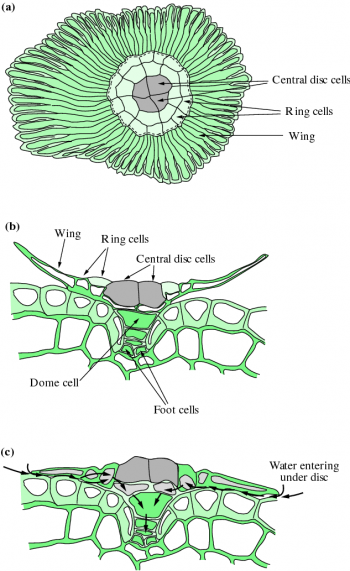
Figure 15.30 A trichome on the leaf surface of a tillandsioid bromeliad (such as Spanish moss). Their succulent leaves are covered with specialised hairs (trichomes) which are specially adapted for absorption of water. (a) View from above the trichome disc; (b) transverse section of disc in a dry state; (c) transverse section of disc in a wet state. Arrows in (c) indicate the pathway of water movement. Flexing of wing cells according to moisture status enables these trichomes to act as one-way valves for trapping and retaining water (Based on Benzing et al. 1976)
Among the bromeliads of the Americas, two different anatomical adaptations have evolved. Tank bromeliads have a rosette form and swollen leaf bases which trap up to a litre of water. These built-in reservoirs collect not only water but nutrients from litter and other sources, and are home to insect larvae, frogs and a whole community of organisms. These organisms probably contribute nutrients to the bromeliad by way of their faeces, which are trapped in the ‘water tank’. The epidermis of leaf bases is also modified to allow water absorption from the tank. Roots may thus function purely as an anchor that holds the epiphyte to the tree branch. Although this strategy works well where rainfall is evenly distributed throughout the year, it would not enable plants to survive long dry spells, and tank bromeliads are restricted to areas of high and sustained annual rainfall (1000–1500 mm; Benzing 1973).
In drier habitats the Bromeliaceae have another adaptation. The subfamily Tillandsioideae, which includes Spanish moss and the so-called ‘air-plants’, does not have tanks. Instead it has succulent leaves covered with specialised hairs, or trichomes, adapted to absorb water. Each trichome consists of a non-living shield or disc one cell thick (Figure 15.30a). At the centre, empty thick-walled cells are connected to a column of living cells arising from a pit in the epidermal surface (Figure 15.30b). The outer surfaces of shield and stalk cells are covered with cutin. When a leaf is wetted, empty shield cells fill rapidly through their lower surfaces. These cells flex as they fill, bending the outer edges of the shield downwards onto the leaf surface and creating a small cavity underneath (Figure 15.30c). Water is drawn into this cavity by capillary action and down into the living stalk cells, so reaching internal leaf tissue. When the leaf surface dries the shield cells empty, flexing the edges of the disc upwards. The central disc shrinks and lowers to its former position, sealing down tightly and preventing water loss from the stalk cells or underlying mesophyll. These hairs are efficient one-way valves, and their mechanism is so effective that many of these plants have almost no roots at all and take up all their water and nutrients via their leaves (Benzing 1986).
Epiphytes from several other families have adapted a rosette form to trap litter and form ‘aerial compost heaps’ of humus which then act as sites for water and nutrient storage. The birds-nest fern (Asplenium spp.) is one example (Madison 1977). A small Asplenium is represented as species No. 8 in Figure 15.33, but some grow to more than 1 m across.
Water storage within plant tissues implies succulence, and many epiphytes, but by no means all, show succulence of some parts, usually leaves or stems. Some orchids and ferns have thick, succulent leaves and many orchids have specially thickened stems called pseudobulbs which may be of many shapes and up to 10 cm or more in diameter. Succulence is associated with crassulacean acid metabolism (CAM), and many epiphytes, including the thick-leaved orchids and a few ferns, are CAM plants (Section 2.1). The pattern of stomatal opening at night and closing by day which characterises CAM is a very important mechanism for reducing water loss in epiphytes, and it is interesting that some epiphytic ferns show CAM, a very unusual attribute for ferns in general.
 [16]
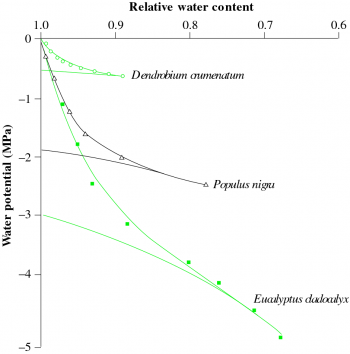
Figure 15.31 Water potential (with data points) and osmotic potential (negative values for osmotic pressure; calculated curves) plotted against relative water content for the trees Eucalyptus cladnoalyx and Populus nigra and an orchid, Dendrobium crumenatum. Eucalypt and poplar trees experience gradual development of drought and can maintain positive turgor to low values of relative water content. In contrast, the orchid experiences periods of either copious water supply or drought. Water uptake is rapid when available but the onset of drought results in a rapid cessation of gas exchange and a quiescent phase (Based on Sinclair 1990)
It might seem to be an advantage for epiphytes to have very concentrated cell contents in order to maintain a steep gradient of water potential between their tissues and their environment to increase water uptake or reduce losses. Surprisingly, this is not so. All studies of epiphyte water relations have shown that epiphyte sap is very dilute, usually more so than their host trees and far more dilute than plants from other arid habitats (Sinclair 1983, 1990). Figure 15.31 shows water potential and osmotic potential plotted against relative water content for leaves of the epiphytic pigeon orchid Dendrobium crumenatum compared with a deciduous tree, Populus nigra, and a eucalypt, Eucalyptus cladocalyx. The curves represent the range between full turgor where R = 1 at the origin and the turgor loss point for each species where its two curves meet. The eucalypt, with the most concentrated sap, can maintain positive turgor down to 68% relative water content, the poplar to 78%, while the orchid, with much more dilute sap, reaches turgor loss at 89% relative water content. Whereas a plant adapted to a long dry season may maintain its turgor and active growth by generating very negative water potentials, an epiphyte has to withstand periods of short but sudden and severe drought, with only limited storage. The external water potential is likely to be either very high, when it is raining, or extremely low, when the branch dries out perhaps a few hours later. In this situation the epiphyte relies on a means of taking up water rapidly when it is available, but also sensing the onset of water stress efficiently and responding by closing down gas exchange rapidly, to lie quiescent until the next rain.
Tillandsioid bromeliads have dispensed with roots, but among orchids some have evolved in the reverse direction and dispensed with leaves! These extraordinary plants consist of a root system arising from a short stem which usually bears only tiny vestigial leaves. The roots are green and photosynthetic. Here the paradox of aerial roots is raised in extreme form. How can these organs absorb water and nutrients, minimise water loss, but allow gas exchange for a net gain of carbon in photosynthesis when they have no stomata?
The answer lies in roots that show CAM photosynthesis! Roots are very slow growing and allow gas exchange against a resistance that is always high. By night, CO2 is stored as organic acid, recycling that lost by respiration and allowing more to diffuse inwards. By day, CO2 fixed the previous night is released for photosynthesis, but in such a way that the concentration in the airspaces of the root never rises above ambient levels. Hence there is no concentration gradient causing CO2 efflux, so none diffuses out. In this case, CAM photosynthesis is less about water and more about con-servation of carbon (Cockburn et al. 1985; Winter et al. 1985).
 [17]
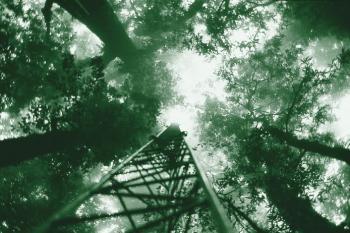
Figure 15.32 A ‘fog forest’ at the base of Mount Superbus (1381 m) where irregular plateaux support a notophyll vine forest as part of forest formations along the crest of the Great Dividing Range and plateaux of the MacPherson Range (Queensland-New South Wales border). Shown here are two superb specimens of yellow carabeen (Sloanea woolsii) which absorbs considerable amounts of water from fog droplets that impact on leaves. By analogy with epiphytic growth, absorption of leaf surface water aids survival of these trees during extended rainless periods (Photograph courtesy LB. Hutley. Interpretation of tree-fog relations based on Yates and Hutley 1995)
 [18]
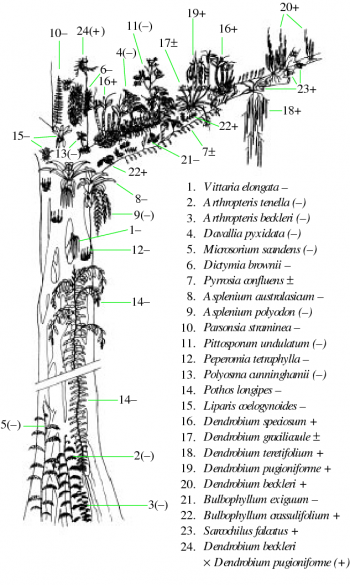
Figure 15.33 Summary of epiphyte distribution on a 40 m emergent Ficus watkinisiana tree in a subtropical rainforest in Dorrigo National Park, New South Wales. Photosynthetic mode for each species listed is indicated thus: ‘+’ = pronounced CAM photosynthesis, ‘±’ = weak CAM, and ‘-’ = C3 photosynthesis. Signs in parentheses mean that the suggested mode has been inferred from leaf succulence (Based on Winter et al. 1983)
Epiphyte distribution is strongly influenced by regional climate and microclimate within a single tree. In general, epiphytes are most numerous and diverse in the tropics, becoming scarcer towards cooler regions. In eastern Australia, Queensland has approximately 100 known species of epiphytes, New South Wales 52, Victoria 5, Tasmania only 2 (Rupp 1969). Epiphyte requirements are different from terrestrial plants. For example, a foggy climate with very little precipitation may supply little water to plants with roots in the soil, but may be enough to support an epiphyte flora that receives its water from condensing fog. On the other hand, high monsoonal rainfall followed by a long dry season may support few epiphytes (Sandford 1968). Epiphytes thus reach their greatest diversity in the humid tropics, particularly in the ‘mist zone’ between about 1000–1500 m elevation (Valmayor and Baldovino 1984).
Within a single tree there may be a wide variation in microclimate (Figure 15.32) and a corresponding variation in epiphytic species from the cool humid but low light environ-ment of the lower trunk to the highly exposed outer branches and twigs. Figure 15.33 shows the distribution of epiphytes on a 40 m fig tree in Dorrigo National Park, New South Wales (Winter et al. 1983). Many species in more exposed sites are CAM plants.
Habitats of extreme epiphytes are not only deficient in water and nutrients but also patchy and temporary. Branches may fall, winds may tear away plants. There is a need to minimise vegetative growth and invest heavily in repro-duction and propagation. Orchids, for example, produce large numbers of flowers and huge numbers of tiny wind-dispersed seed.
Adaptations shown by epiphytes are quite different from those in resurrection plants (Feature essay 15.1). A resurrection plant subjected to drought dries completely and goes dormant. It can then survive for months or years, but will take up water and resume metabolism within 12–24 h of being rewetted. By contrast, epiphytes typically experience rapid changes from wet to dry conditions and endure short droughts rather than long droughts. They have evolved with adaptations that allow rapid intake of water and nutrients when available, retention against loss during short dry spells, and a big investment in reproduction and seed dispersal rather than vegetative growth.
Links:
[1] http://plantsinaction.science.uq.edu.au/edition1//?q=figure_view/796
[2] http://plantsinaction.science.uq.edu.au/edition1//?q=figure_view/799
[3] http://plantsinaction.science.uq.edu.au/edition1//?q=figure_view/797
[4] http://plantsinaction.science.uq.edu.au/edition1//?q=figure_view/798
[5] http://plantsinaction.science.uq.edu.au/edition1//?q=figure_view/803
[6] http://plantsinaction.science.uq.edu.au/edition1//?q=figure_view/804
[7] http://plantsinaction.science.uq.edu.au/edition1//?q=figure_view/805
[8] http://plantsinaction.science.uq.edu.au/edition1//?q=figure_view/806
[9] http://plantsinaction.science.uq.edu.au/edition1//?q=figure_view/807
[10] http://plantsinaction.science.uq.edu.au/edition1//?q=figure_view/809
[11] http://plantsinaction.science.uq.edu.au/edition1//?q=figure_view/808
[12] http://plantsinaction.science.uq.edu.au/edition1//?q=figure_view/810
[13] http://plantsinaction.science.uq.edu.au/edition1//?q=figure_view/811
[14] http://plantsinaction.science.uq.edu.au/edition1//?q=figure_view/815
[15] http://plantsinaction.science.uq.edu.au/edition1//?q=figure_view/814
[16] http://plantsinaction.science.uq.edu.au/edition1//?q=figure_view/816
[17] http://plantsinaction.science.uq.edu.au/edition1//?q=figure_view/813
[18] http://plantsinaction.science.uq.edu.au/edition1//?q=figure_view/812