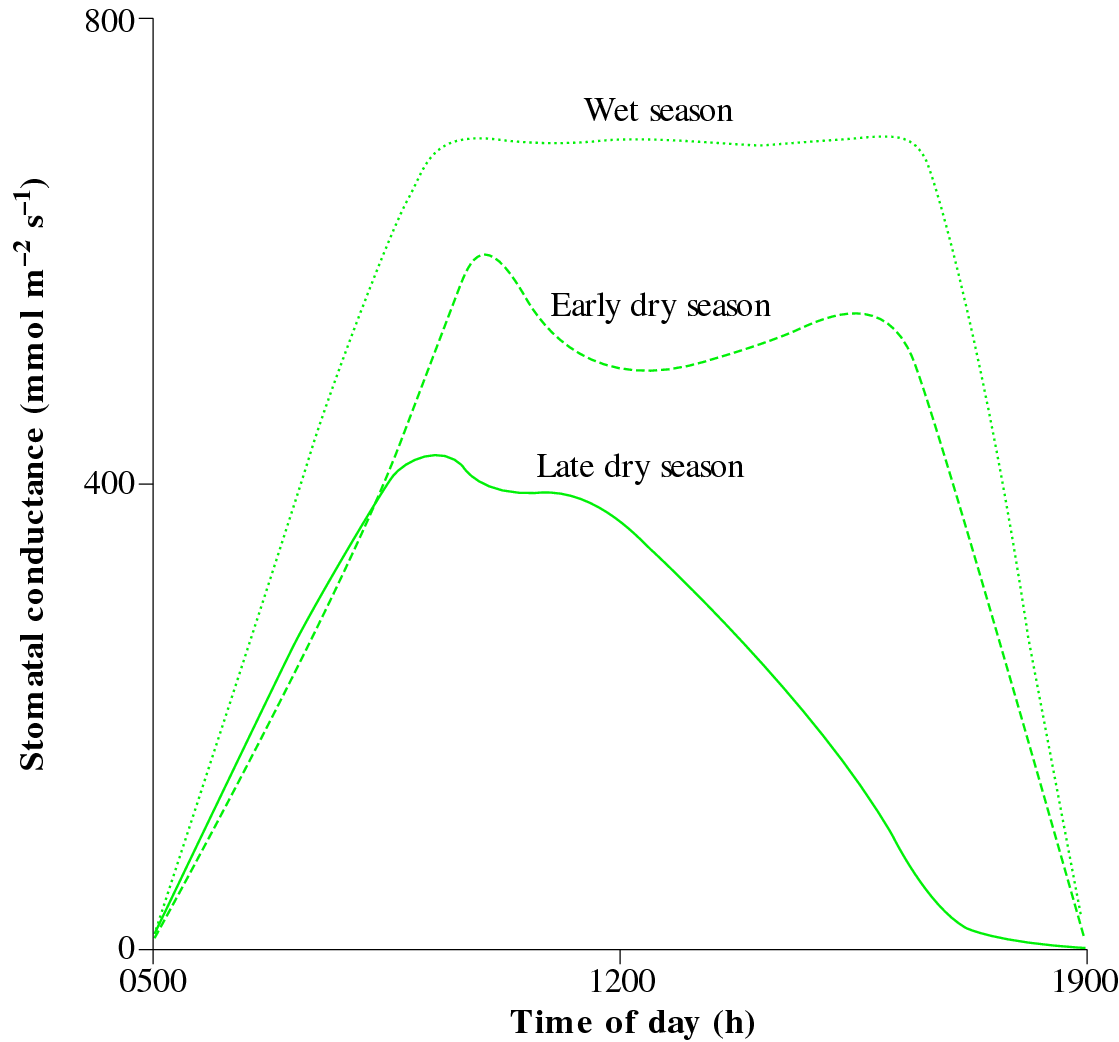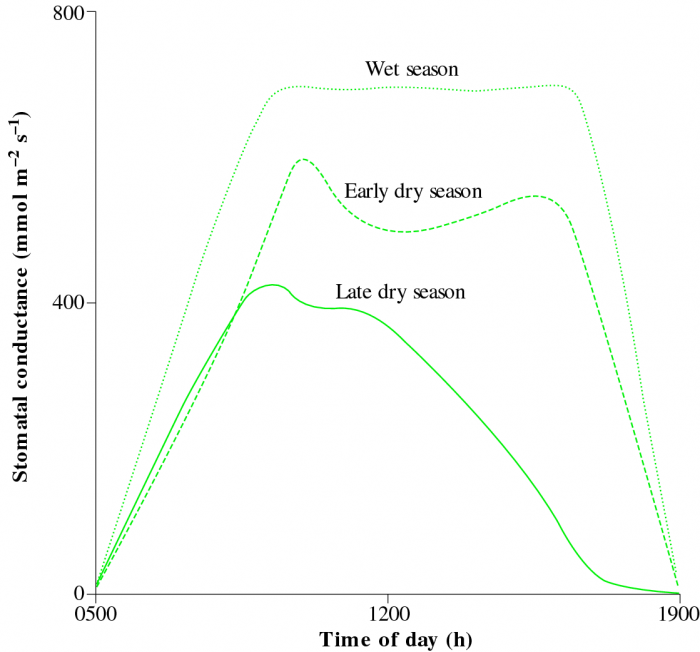
Figure 15.23 In a typical year on a savanna woodland, rainfall is confined to six months. During the wet season, the vapour pressure deficit (VPD) is) low and soil water availability is high. During the dry season, rainfall is essentially absent,VPD is higher and soil water availability declines to a minimum. Throughout the year mean daily temperature varies only by 2-4°C. During the wet season, stomatal conductance (gs) is high during day-time, with little variation between morning and afternoon. By contrast, in the dry season, gs peaks to a lower value compared to the wet season and shows a marked decline each afternoon. Virtually all savanna tree species in northern Australia follow this pattern. (Based on various sources compiled by D. Eamus and G, Duff)