Visiting Fellow, Research School of Biological Sciences, ANU, Canberra
 [1]
Professor Ralph Slayter, AC, FAA, FRS, FTSE
Green plants provide the biological energy for a dynamic biosphere. All organisms depend upon green plants for their livelihood.
Nowhere is this dependence more evident than with human beings since nearly half the products of global photosynthesis are channeled directly through human populations or used indirectly by us for the myriad of activities that we undertake.
Our overall impact on the environment is the product of the total number of people and the average impact of each person. Continued growth in population, and in the demands of individual people, are not only increasing the overall impact but are resulting in a reduction in the area of arable land and in land degradation, thereby reducing the scope to provide for human needs.
In many regions of the world, particularly those already overpopulated in terms of rural productivity and the carrying capacity of their land, these factors are resulting in political, economic and social upheaval.
Clearly this increasing overall impact must be reined in. But for the next few decades at least, global population will inevitably continue to grow, by which time it may be double the present level. There is therefore a pressing need to reduce the impact per person and this applies more to agriculture than to many other human activities.
To provide for future generations agricultural ecosystems will have to be ecologically sustainable and the total sustainable production must be adequate for our increased numbers. It follows that sustainable yields from existing agricultural eco-systems will need to increase, and soils and climates now regarded as marginal or unsuitable for agricultural production may need to be brought into cultivation.
Climate change is an additional issue. On the positive side it may lead to more favorable climatic conditions and increased yields in some existing agricultural areas and may result in some areas now regarded as climatically marginal for agriculture being brought into cultivation. On the negative side it may result in the climate of some existing arable areas becoming marginal or unsuitable for agriculture. Furthermore, climate change may shift favourable climatic zones into areas of less fertile soils.
Conservation of biodiversity is an essential requirement for ensuring ecosystem function at a local, regional and global level. Biodiversity is threatened by habitat destruction and modification, and by fragmentation of areas of natural habitat. Gene pool erosion and species extinction can occur as a direct result of these changes and indirectly as fragmentation and isolation of previously intact areas reduce habitat requirements below the minimum needed for population and species viability.
Climate change exacerbates this situation since habitat modification and fragmentation hinder, and may prevent, natural migrations which have been a primary mechanism by which species have adapted to altered environments and gene pools have evolved.
These complex issues present a major challenge to plant scientists, particularly since the solutions must endure not just for one or two generations but indefinitely if human beings are to live on earth in peace and harmony.
The title and subtitle of this book, Plants in Action: Adaptation in Nature, Performance in Cultivation, succinctly summarise the challenge to plant scientists for the future. For plant scientists to respond to this challenge and to play a role in improved rural production and biological conservation, we need to understand better the mechanisms by which changes in the physical environment affect physiological processes, the manner in which genetic control over physiological processes is exercised, and the means by which genomes can be modified to produce cultivars which can be successful in modified environments.
And for ecological sustainability, it will also be necessary to understand better the mechanisms by which changes in the physical environment affect the interactions between species and determine the range and limits of species distribution.
There is a wealth of genetic material in the world’s biodiversity to draw upon in modifying the genomes of existing and future cultivars, thus providing a basis for better adapted cultivars and sustainable agricultural ecosystems in climates and on soils at present regarded as unsuitable for agriculture. There is also the prospect of modifying the genomes of native species with a view to ameliorating the effects of fragmentation and degraded habitats on gene pool erosion.
Can the plant science community meet these challenges? There is clearly much to be done and much to be learned, but already there have been substantial achievements. Among these are the success stories in nutritional physiology associated with the discovery of trace elements. Research into salinity tolerance and the development of forest and crop cultivars which can tolerate saline substrates has shown the potential for addressing what were thought to be intractable environmental conditions.
There also continue to be major advances in the portability and accuracy of instruments used for physiological research so that experiments and observations previously restricted to laboratories can now be conducted directly in the field. This is enriching the whole field of ecophysiology and is opening the way for physiological information to be applied more directly to agricultural and ecological problems.
On the other hand, major challenges remain. Much remains to be learned about morphogenesis and the effect of water and heat stress and enhanced CO2 levels on plant growth and development. The control of floral initiation remains elusive yet has enormous consequences for the development of cultivars with different times to maturity. Such developments would open the possibility of multiple cropping in favourable environments with obvious implications for yield improvement.
Stomatal function is a vital factor in mediating the response of plants to water stress and to high CO2 environments and offering scope for enhanced water use efficiency. Yet our present understanding of stomatal function is not adequate to explore the possibilities of utilising genetic variation as a tool in modifying the stomatal characteristics of cultivars. Even our understanding of the effect of environmental factors on photosynthesis and respiration, probably the most studied and best understood of all physiological processes, requires strengthening.
This book will be of particular value to students, and to the plant science community generally, because genotype × environment interaction is a pervasive theme and it gives special emphasis to plant responses to environmental conditions and to stress environments generally. Its Australasian roots will ensure that it is relevant not just to the problems of developed countries but also to those of developing countries.
CSIRO, Division of Plant Industry, Canberra
Plants are wet inside, and with rare exceptions will die if they do not remain so. But this is not to say that their outside surfaces are necessarily wet. On the contrary, they are usually dry to your touch. If a drop of water is placed on a leaf it will usually sit there, precariously, roughly in the form of a hemisphere, because the external leaf surface is hydrophobic. It is essential that the surface be hydrophobic and poorly permeable to water, for a free water surface can lose water at rates approaching 1 mm per hour on a hot day. An unprotected leaf would lose its entire water content within a few minutes at these rates of evaporation unless it had a prodigious ability to replace the lost water.
Plants originated in the sea and there faced little risk of drying out. They could not grow on land until they had evolved facilities both to control and to make good the evaporative losses from their leaves. Control is achieved partly by means of a cuticle, a poorly permeable layer that covers photosynthetic surfaces of plants, and partly by means of the stomata, variable pores in these surfaces, which largely prevent evaporation when shut and allow CO2 assimilation to proceed rapidly when open. Evaporative losses from leaves are made good by roots, which can extract water from the soil, sometimes, if necessary, from very great depths, and by the vascular system, which contains conduits that carry the water from roots to transpiring leaves.
This book, Plants in Action, has much to say about leaves and their stomata, roots and vascular system, but it is worthwhile trying to imagine what other paths evolution might have taken in enabling plants to grow on land. Development of roots and a vascular system seems unavoidable, at least in higher plants, whose internal milieu must be much more strongly buffered against environmental changes than that of, say, lichens, or resurrection plants, those oddities that can dehydrate completely without losing the integrity of their cells and which can respond to rewatering so rapidly that they can be photosynthesising again within hours. But what of stomata? Why have them at all? Do plants really need to transpire? This question has several aspects to it, some of which have vexed plant physiologists for a long time. One aspect is this: plants grow by assimilating CO2 from the air and fixing it in organic form with the help of sunlight, that is, they photosynthesise. Evolution has not (yet?) provided them with a membrane that is permeable to CO2 but impermeable to water vapour; there-fore the outer covering of the leaves, which must be largely impermeable to water vapour, must have valves to let CO2 in. Transpiration is an unavoidable accompaniment of the uptake of CO2. Unavoidable if plants are to photosynthesise rapidly and thus keep up with their neighbours during evolution. However, there is one species, Stylites andicola, that has taken an alternative route. This plant has no stomata. CO2 is taken up by its roots and is transported to leaves through continuous air passages in its roots and stems. This species grows in the Peruvian desert on an average annual rainfall of 30 mm with an interval between rains that often lasts for years. As might be expected, it grows very slowly, even when conditions are good (Keeley, Osmond and Raven 1984).
The point of this preamble is that active cells must be well hydrated and that evolution has produced various structures that enable higher plants to keep their cells wet enough to function — to divide, to grow, to photosynthesise, to transport, to respire, to excrete, to defend, to communicate — even though most of these cells are in the shoots of plants and so are not only remote from their supply of water, but are also exposed to a very drying environment.
This book uses many different conceptual frameworks for discussing how plants work. The reason for using many frame-works derives from the way that our minds comprehend the complex world around us by dividing it into a hierarchy of conceptual layers, each one nested within the one above like Matruschka dolls (consider, for example: subatomic particles, atoms, molecules, grains, bricks, walls, buildings, cities). Each of these conceptual layers has its own terms, ideas and principles, and much of what we call ‘understanding’ involves translating the terms and ideas of one layer into those of the adjacent layers. We can pour some concrete into this rather abstract mould by taking as an example the relationship between the ideal gas laws and the kinetic theory of gases.
The pressure, P, volume, V, absolute temperature, T, and number of moles, n, of an enclosed ideal gas are related thus: PV = nRT, where R is the universal gas constant. This relationship is useful in that it helps explain many everyday phenomena such as the behaviour of a bicycle pump and the leavening of baked bread. Moreover, this law can itself be explained, and the simplest vehicle for doing so is the kinetic theory of gases: we imagine that the gas consists of myriad molecules (n × Avogadro’s Number), each of given mass but of negligible volume, moving randomly in an enclosed space, each with its own velocity which is changed only by perfectly elastic collisions with other molecules or with the enclosing wall.
The interesting thing about these two descriptions of a gas, one phenomenological and the other particulate, is that they appear, at first sight, to have little connection with each other. The ideas of volume and number are common to both descriptions, but not those of pressure, temperature and velocity. A molecule does not have a pressure or a temperature, and PV = nRT does not embrace velocity. The two descriptions are examples of different conceptual layers, and each has terms and ideas that are peculiar to it. Yet the two layers are connected and the apparently disparate terms are related. The connection comes by considering the average properties of a large number of molecules because P is proportional to T and both are in turn proportional to the mean square velocity of the molecules.
This example of a connection between conceptual layers comes from classical physics, but note that the phenomeno-logical discovery (gas laws) was made long before the par-ticulate explanation (kinetic theory) was available. Indeed, this sequence is universal in any scientific exploration of natural hierarchically organised systems and the subsystems that comprise them. In effect, we need to know collective behaviour (e.g. PV = nRT) before we can ask pertinent questions about the parts (e.g. how can we best summarise the behaviour of a legion of elastically colliding molecules). The reason that we first need to appreciate integral behaviour of the whole system is that the problem of summarising the behaviour of the parts is underspecified. We need to specify at least two constraints when considering the general kinetic behaviour of gas molecules before we can derive the gas laws, namely, (1) there is a fixed number of molecules, and (2) they are enclosed within a bounding wall. The kinetic theory applies as well to the earth’s atmosphere as it does to an enclosed gas, but then we need to consider different constraints. We replace the constraint of an enclosed space with that of an infinite space bounded internally by the earth’s surface, and subject to a gravitational field. History has shown that in practice we do not become aware of the extra information we need, that is, constraints on the behaviour of a subsystem (e.g. a molecule or a cell), until we have considered the behaviour of the system as a whole (e.g. a gas or a tissue). This is a crucial principle that highlights the importance of exploring plant behaviour at all levels of organisation. Only by articulating connections be-tween all the layers can we hope to have a comprehensive understanding of how plants work.
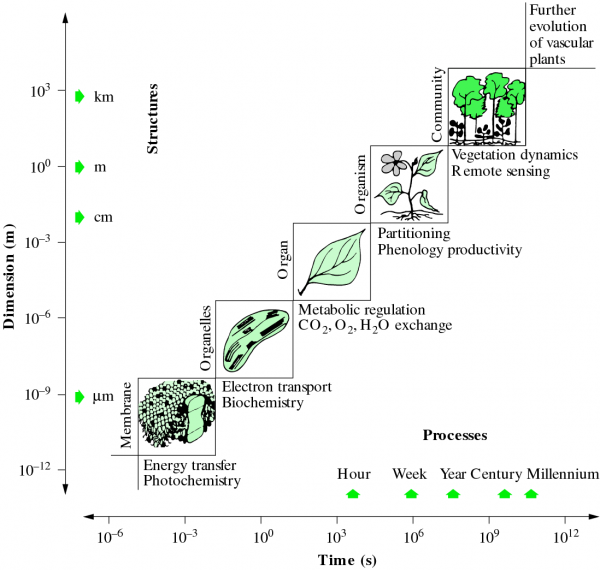
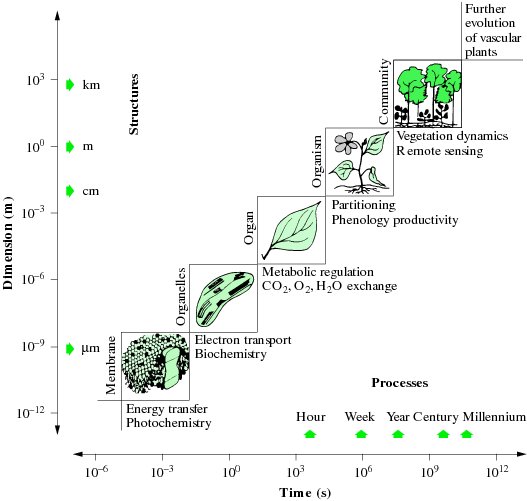
What then are the conceptual layers into which we divide plant science? To some extent these are arbitrary, but are commonly as follows: community, whole plant, organ, tissue, cell, organelle, membrane, molecule (polymer, monomer, gene) (some of which are shown in Figure 1). These layers are essentially structural, but implied in them are processes occurring at a range of time scales, from geological, for evolutionary processes such as those that led to the facilities that are essential for plants to grow on land, through hours for cell division, to microseconds for conversion of radiant energy to chemical energy within chloroplasts.
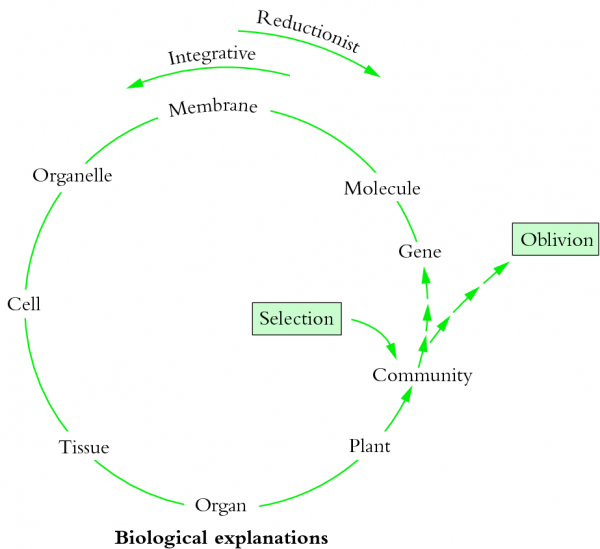
In discussing how plants work it is useful to invoke the concept of function. This concept most clearly distinguishes biology from physics and chemistry, although ‘function’ is held to be indecorous by many biologists, for they see it as imbuing evolution with a sense of purpose that they deny exists. Whether or not evolution has a purpose is a philosophical question that is beyond the concern of this book, but there is no great difficulty with the concept of function in normal biological usage. It is simply a way of recognising that unlike simple physico-chemical systems that can be adequately studied using a linear train of thought, biological systems, when viewed at a long enough time scale, are recursive, as illustrated by the loop in Figure 2. If the loop was not complete, the structures that comprise it would not exist. Clockwise flow around the loop represents analysis at progressively finer levels in the manner of physics and chemistry, but the loop is open for clockwise flow, and stops at ‘Gene (frequency)’. Anticlockwise flow represents a process-based explanation of integral functions, and in terms of biological events is essential for closing this loop by producing the next generation. Functional explanations are ideas about the influence of given structures or processes on the ability of a plant to transmit its genes into the next generation.
 [3]
Figure 2 A reductionist approach in plant science generates new knowledge at progressively finer levels of organisation. This sequence is shown here by progress in a clockwise direction from community via component parts to molecule and eventually gene. In principle, a knowledge of genotype × environment interactions at these various levels of organisation enables integration of process-based concepts. That sequence is shown here as progress in an anti-clockwise direction from gene to community, and thence to the next generation; for without this loop being closed none of the structures within it would exist. (Original diagram courtesy J.B. Passioura)
Debates often occur between proponents of process and integrative explanations, and are generally specious. To under-stand biological phenomena thoroughly, and apply basic principles to commonplace situations, we need to analyse in the reductionist sense (clockwise in Figure 2), as well as extrapolate from component processes in an integrative sense (anticlockwise in Figure 2).
Accordingly, Plants in Action has adopted genotype x environment interactions as a fundamental theme for processes and adaptation in higher plants which leads to integrative explanations: processes in the sense that physiologists attempt to define the genetically determined workings of plants that have fitted them to a given niche in nature; adaptation in the sense that ever-changing environmental conditions impose an unrelenting selection pressure for genotypes with traits better suited to new conditions. A thorough knowledge of such processes can then underpin explanations of adaptation in nature and performance in cultivation.
Passioura, J.B. (1979). ‘Accountability, philosophy and plant physiology’, Search, 10, 347–350.
School of Biological Sciences, Macquarie University, Sydney
 [4]
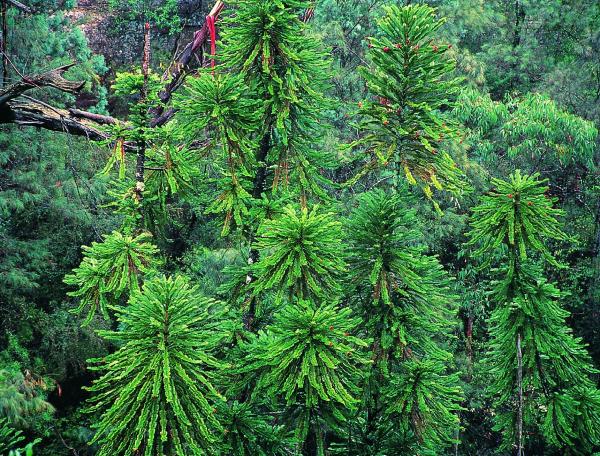
A relic population of Wollemi pine (Wollemia nobilis) in a steep-sided canyon northwest of Sydney. Discovery of these large trees (35 m high, 1 m diameter) in August 1994 caused great excitement because this species had been considered extinct for 150 million years. Their continued existence was attributed to a habitat which offered protection from fires common on platueax in that region. "Pine" is something of a misnomer; they are taxonomically closer to species of Aracaria than to true pines (genus Pinus).
Original photograph by Jaine Plaza, an supplied courtesy Royal Botanical Gardens, Sydney)
Australia and New Zealand once formed part of a huge southern land mass now referred to as Gondwanaland, whereas northern hemisphere continents were once aggregated into Laurasia. Gondwanaland and Laurasia began to disaggregate about 160 million years ago. Prior to this time, the southern hemisphere land masses and India were connected into Gondwanaland, while North America, Europe and much of Asia formed Laurasia. South Africa, Madagascar, India, South America, New Caledonia, New Zealand, Australia and various other fragments broke away and drifted northwards, leaving Antarctica behind. Australia and South America were the last major land masses to separate from Antarctica, Australia beginning slowly about 90 to 100 million years ago and establishing a deep ocean passage some 30 to 40 million years ago. Opening of the Drake Passage between South America and Antarctica completed an ocean connection around Antarctica, allowing development of circumglobal cold currents in the Southern Ocean and the thermal isolation of Antarctica from warm tropical water and air.
Before this cooling there was a continuity of vegetation which only became fragmented as Gondwanaland broke up into separate land masses. Angiosperms were already established worldwide as a major successful group of plants. The climate was warm, moist and conducive to plant growth even at high latitudes where daylength in winter would have been the same as that in the Arctic today. Forests were widespread, diverse and dominated by gymnosperms and angiosperms (presumably deciduous). As a result of the break up of Gondwanaland, entire plant communities containing representatives of the major types of plants now alive were carried northwards. A legacy of these events can be seen today in many plants of southern hemisphere lands and is well illustrated by the distribution of major plant families such as the Proteaceae (banksias, grevilleas, waratahs) and Myrtaceae (eucalypts, bottlebrushes, titrees, lillipillis). Despite subsequent colonisation by long-distance dispersal of propagules and/or merger with northern lands (South America with North America, Africa with Europe, India and Australia with Asia), the floras of the continents and islands of the southern hemisphere remain more closely related to each other than they are to northern hemisphere floras derived from fragments of Laurasia.
As Australia drifted northwards from Antarctica about 40 million years ago it moved into warmer climatic zones. Cool temperate forests, abundant over most of Australia, became confined to wetter areas. The vegetation as a whole became more open and in places heathlike.
Until about 15 million years ago one of the most abundant and widely distributed angiosperms in Australia was Nothofagus (southern beech). Evidence from a site in the Lachlan region of central New South Wales indicates that the decline in abundance of Nothofagus was accompanied by a corresponding increase in pollen from eucalypts and other mainly rainforest species from the same family (Myrtaceae). Somewhere between 15 and 8 million years ago the amount of charcoal relative to pollen at the same site also increased. Most likely, communities of eucalypts and related genera were subject to more frequent burning than the Nothofagus-dominated forests that preceded them. Similar evidence from pollen profiles from Lake George near Canberra reveals an abrupt change from a mixed forest of Nothofagus and gymnosperms to an open shrubland with grasses and daisies about three million years ago.
From the Gondwanan stock, and by evolution of new life forms, plants adapted to match emerging conditions of low and unpredictable water supply, strong sunlight, higher temperatures and frequent burning. The new combinations of environmental conditions produced the vegetation types which now dominate the Australian continent. Genes for many of the adaptive attributes were presumably already present, scattered through the Gondwanan flora as a consequence of prior exposure of ancestral stock to environmental stress associated with life on land.
During its drift northwards Australia was subject to only relatively minor geological disturbance although some volcanic activity occurred on the eastern side of Australia and large parts were inundated by shallow seas which for long times isolated southwestern Australia from eastern Australia. Such isolation aided evolution of a remarkably rich endemic flora in southwestern Western Australia. The sea retreated, and limestone soils may have sustained the isolation; developing aridity certainly did so.
By contrast, New Zealand after its separation from Antarctica and Australia some 60 million years ago has had a tumultuous history of geological disruption involving partial or possibly complete inundation by the sea, severe volcanic activity and glaciation. New Zealand vegetation, like that of Australia and other southern continents, also changed in response to climatic change and environmental stress. As New Zealand broke away and moved north conifers became less abundant and a mixed evergreen angiosperm and gymnosperm flora developed. A change from Nothofagus-dominated rainforest to drier vegetation occurred in the Miocene around about the same time as there was clear evidence of drying in Australia. Today, conifers are again abundant in rainforest communities and the climate is wetter due to New Zealand’s present location across the path of moist oceanic winds.
Because of global position and stable geological history, Australia is dry and intensely weathered. In addition, large areas are covered by sedimentary rocks whose minerals have already been through at least one cycle of weathering. There has also been negligible glacial activity to grind rock and expose unweathered minerals. As a result, most of Australia offers plants with a poor supply of both water and nutrients. Moreover, plant communities are also subject to burning by fires ignited by electrical storms.
In exploring the question of adaptation of plants to aridity, fire and mineral deficiency, note that only two genera (Eucalyptus and Acacia) dominate the top stratum of vegetation over three-quarters of Australia. Eucalypts occur in open forests and woodland. Acacias occur in nearly all plant formations but are particularly prominent in semi-arid and arid regions. Both genera are obviously very well adapted to present-day conditions; both are of ancient Australian origin; both are sclerophyllous (i.e. have leathery/rigid leaves); both could be described as scleromorphic (extremely woody). The same could be said of many other typically Australian plants.
Water shortage is such an obvious limitation to plant growth in Australia that it is easy to conclude that specialised plant structures and behaviours are adaptations to conserving water or surviving under water stress. Scleromorphy in the Australian flora can be interpreted as an adaptive response to an increase in aridity and/or low nutrient supply.
Scleromorphy is also important for fire ecology. Scleromorphic vegetation provides a mass of dry woody fuel that is very slow to decay. Decay of lignin by microorganisms occurs much more slowly than decay of most other plant products. Consequently lignin-rich plant litter (dead leaves, branches, fruit and bark) accumulates faster than it decays. Fire therefore becomes inevitable and increasingly severe as litter accumulates. Many plants, such as eucalypts, paperbacks, titrees and boronias, also accumulate large amounts of volatile flammable oils in their leaves. During hot fires the canopy produces an explosive mixture of vapourised oil. Scleromorphic vegetation promotes its own burning. Consequently only plant species that have developed characteristics that allow their individuals or their seeds to survive fire will survive. Not only does scleromorphic vegetation promote fire, but some species are so coupled to a fire-prone environment that they would probably become extinct without periodic burning.
Charcoal in ancient sediments implies that fire has been a feature of the Australian landscape for a very long time. However, the fire regime of the whole continent must have begun to change when humans first occupied Australia at least 50 to 60 thousand years ago. Fire was used for purposes of hunting, safety and access to the countryside. Fire is a frequent event across all woodlands, shrublands and grasslands of Australia and all plants beyond rainforests are adapted to cope. Replacement of the leafy canopy after fire by sprouting of dormant buds is one of the main adaptations which allow well-insulated plants to survive in a fire-prone environment.
The history of Australian vegetation since the break up of Gondwanaland provides some insight into the magnitude of the changes that have occurred in relative isolation from the rest of the world and the nature of the selection pressures that have operated. Over millions of years, cool temperate forests that covered much of the continent when it was 60°S were replaced by open forest, woodland, shrubland and grassland. Those communities were better suited to the warmer and drier conditions of its present location.
In stark contrast to geological events, and on a time scale of only decades since European settlement, 70% of Australia has been turned over to agriculture and forestry. Almost all potentially productive and marginal farming and grazing land has been cleared. Soil degradation, including wind and water erosion, acidification and salinisation have become severe national problems. Large numbers of pest species, both plant and animal, have emerged from the huge numbers of newly introduced organisms while many indigenous plants and animals are extinct or endangered. Much of the Australian landscape is not sustainably productive after almost 200 years of exploitation. Such ‘mining’ of vegetation and soil continues unabated despite wide recognition of precious ‘capital’ that is irretrievably lost in the process.
New Zealand faces its own set of severe problems including plant and animal extinctions, rapid spread and dominance of pest species ranging from European gorse to Australian brush-tailed possums which, by selective browsing, are threatening extinction of some native plant species. New Zealand has been severely over-cleared of native vegetation even on marginally productive land. Steep slopes have been destabilised and some types of vegetation have been lost.
Southern hemisphere plants are worth preserving as a heritage from the distant past, as vegetation for the future, and for numerous practical present-day purposes ranging from erosion control to sources of useful chemicals. In Australia and New Zealand substantial areas have been set aside for the protection of vegetation but in both countries some types have disappeared entirely and others are unrepresented in the reserves. However, compared to many countries which have much less of their original vegetation to conserve, Australia and New Zealand are well off.
The basic tenet of Plants in Action is that every facet of a plant’s existence is an outcome of genotype × environment interactions. In present times, as distinct from geologic past, humans must now be included as a significant environmental factor for that interaction.
Adamson, D.A. and Fox, M.D. (1982). ‘Change in Australasian vegetation since European settlement’, in History of Australasian Vegetation, ed. J.M.B. Smith, 109–146, McGraw-Hill: Sydney.
Flannery, T.F. (1994). The Future Eaters: An Ecological History of the Australasian Lands and People, Reed Books: Melbourne.
Groves, R.H. (ed.) (1981). Australian Vegetation, Cambridge University Press: Cambridge.
Ladiges, P.Y., Humphries, C.J. and Martinelli, L.W. (eds) (1991). Austral Biogeography, Australian Systematic Botany, 4(1), CSIRO: Melbourne.
Pole, M. (1993). ‘Keeping in touch: vegetation prehistory on both sides of the Tasman’, Australian Systematic Botany, 6, 387–397.
Truswell, E.M. (1993). ‘Vegetation changes in the Australian Tertiary in response to climatic and phytogeographic forcing factors’, Australian Systematic Botany, 6, 533–557.
CSIRO, Division of Plant Industry, Canberra
 [5]
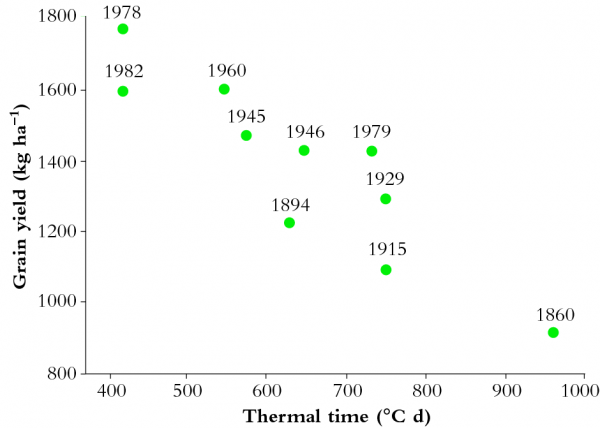
A practical consequence of early flowering. Selection of Western Australian wheat varieties of higher yield over the past century has been highly successful, and associated with a reduction in thermal time (in degree-days, °C d) to the first stage of the flowering process. (Redrawn from Richards 1991)
When European settlement came to Australia late in the eighteenth century, it was the only continent without any agriculture and lacking indigenous crop plants. The Aboriginal hunters and gatherers knew well which plants could be gathered for food, fibre or medicine, and when and where. They also practised some agronomic management such as broadcasting millet seed, replanting yam tubers or burning off yam or macrozamia tops. However, when the first fleet arrived in early 1788, they brought a variety of plants, fruits and seeds either from Britain or acquired in Rio or Capetown along the way. A few acres of barley were sown near the site of the Botanical Gardens soon after arrival but they gave a pitiful crop barely returning the amount of seed sown. The next attempts to grow wheat, barley and other cereals were shifted to better soil at Parramatta. Even there, returns were poor. Governor Phillip saw the problem as lack of agricultural expertise among the convicts: ‘If fifty farmers were sent out … they would do more in one year in rendering this colony independent of the mother country … than a thousand convicts’. However, the low yields persisted even after the farmers arrived in 1793, and a botanist in 1800. The real need was adaptation by introduced crops to Australian environments.
In New Zealand the initial problems were less severe, partly because the Maori had already introduced and cultivated several crops and because the soils were more fertile and the climate more suited, at least in some areas, to European crops and pastures. The Canterbury Plains were more readily converted to agriculture, and British grasses such as cocksfoot (Dactylis glomerata), timothy (Phleum pratense), perennial ryegrass (Lolium perenne) as well as white and red clovers (Trifolium repens and T. pratense) flourished widely. Their adaptation has of course been improved since then by regional selection, but some English cereal varieties were still in use in the 1930s.
Not all domesticated plants from Europe required adaptation to Australian conditions. Blackberry (Rubus fruticosus) spread quickly in Victoria (with some help from Baron von Mueller) while Lantana camara (possibly introduced by Phillip) soon became a nuisance in warmer areas. Many serious weeds were introduced unwittingly such as Bathurst and Noogoora burrs (Xanthium spinosum and X. pungens) as were several useful grasses, clovers and Townsville stylo (Stylosanthes humilis). Given the ready adaptation of these and many other introduced plants to Australian conditions, why were there problems with many of the temperate cereals and seed legumes?
By and large, temperate cereals and seed legumes grew well enough. One farmer wrote of his crop: ‘On the 21st of October (1803) a more beautiful appearance of a successful harvest never flattered the expectations of a farmer …’ But in the end the crop was not worth reaping. In this case the cause was rust, but as often it was water stress. Even when autumn sown, the predominantly British varieties tended to flower too late, with the result that seed development occurred in the hottest and driest months. Governor Phillip’s first sowings of wheat in May 1789 were harvested in December, and his barley sown in August was harvested in January. Had Australia been colonised by a Mediterranean country, with Mediterranean cereals and legumes, the problems of crop adaptation would have been less acute.
Nevertheless, early Australian agriculturists persisted with English varieties of wheat that normally ripened in late July, and coinciding with harvest festival in Britain; varieties which, as Farrer said, ‘yielded more of disappointment than of profit. Too late in ripening for our climate, their ears are blasted and their grain pinched by the hot winds of our summers.’
From the 1860s to the 1890s the most widely grown wheat variety was Purple Straw. Previously thought to be a selection from an English variety, Wrigley and Rathjen have now shown it to have been selected from a Tuscan wheat sent from Italy to Scotland and thence to a South Australian farmer. Similarly, the varieties which replaced Purple Straw in the 1890s derived from farmers’ selections in South Australia from non-English varieties. Ward selected rust-free plants from a South African variety to give Ward’s Prolific, from which another grower selected the earlier-flowering Gluyas Early. At about the same time Steinweidel selected tall, early-maturing off-types of an American variety to establish the wheat bearing his name.
Although A.B. Robin of South Australia began wheat hybridisation in Australia, it was the purposeful and comprehensive crossing program begun in 1889 by William Farrer of Lambrigg, now almost enclosed by the expansion of Canberra, that transformed crop adaptation in Australia.
The two crucial elements in Farrer’s success were his explicit formulation of his goals as a plant breeder, and the international scope of the wheat varieties used in his breeding program. The clarity and comprehensiveness of his objectives were sharpened in a scathing series of exchanges he had in 1882 with two newspapers, The Queenslander and The Australasian. By the time he discussed them at the Australasian Association for the Advancement of Science in 1898, they had become a well-honed list which included not only resistance to the various rust diseases and high baking quality but also such physiological features as earlier ripening, shorter, stronger straw, upright narrow leaves, reduced tillering and better grain retention. Farrer was also the first to draw on the wheat gene pools of the world to attain his aims. As the great Russian plant geographer Nicolai Vavilov acknowledged in referring to Farrer’s breeding program in 1935: ‘There is probably no region where intraspecific and interspecific hybridization of wheat has been so extensive as in Australia’.
Well before Mendel’s paper was rediscovered, Farrer had stated that he selected the combinations of characteristics he sought from ‘the variable generation’ (i.e. the first selfed generation from his initial crosses), particularly for ‘that delicate and obscure but most important quality … which we include in the inconvenient term of constitutional fitness for the locality’. Early ripening was a crucial component of such fitness, which Farrer derived from Indian varieties, and which helped his wheats to escape rust. Farrer suggested in 1898 that earlier ripening was also drought-escaping and ‘might be the means of extending some of our cultural industries, and certainly that of wheat-growing, appreciably further inland’, and that much could ‘be done by means of artificial selection to expedite the work of acclimatization’.
Indeed, wheat breeding since Farrer’s time has continued many of the trends he initiated. Progressively earlier flowering in more recent wheat varieties continues to be apparent in several states as illustrated for Western Australia (opening figure to this section; see Figure 5 in Richards 1991). In trials at any one site there is often a sharp optimum ‘time to ear emergence’ in relation to yield, which has become shorter as plant breeding and crop management has improved. This optimum time is strongly influenced by seasonal incidence of drought and heat in each locality, but also by other factors such as frost injury. To date, much genetic manipulation has been empirical, involving the inherent earliness of varieties and their responses to vernalisation by low temperatures and to seasonal changes in daylength. These are ‘the delicate and obscure’ adaptive processes to which Farrer referred, and there is still much to be learned about their compensating interactions in the determination of yield (Section 6.4). Moreover, as economic and agronomic conditions change, earlier trends in adaptation may even be reversed. For example, in breeding feed wheats for higher rainfall zones, emphasis is being placed not only on red grains but also on later-flowering winter varieties with an English background of the kind rejected by Farrer. Crop adaptation is a continually shifting process.
This account of the early adaptation of wheat to the more Mediterranean and lower rainfall environments of southern Australia is illustrative of the adaptation of other crops and pasture plants in these regions. With a pasture grass such as Phalaris tuberosa, which probably entered Australia via the Toowoomba Botanical Gardens in 1884, and whose value was recognised after its escape from there, it was more than 60 years before expeditions to the Mediterranean region deliberately collected seeds over a range of altitudes and environments for the purpose of enlarging the gene pool for a breeding program for improved adaptation.
With subterranean clover (Trifolium subterraneum), on the other hand, there were probably many unwitting introductions from the Mediterranean region in grass seed samples. This is implied by the great range of growth characteristics and flowering times found among the many locally adapted varieties. Such variation was noted in subterranean clover after its value as a pasture plant and soil-fertility restorer was recognised by A.W. Howard of Mount Barker. In warmer areas with short growing seasons, only very rapidly flowering varieties could set seed and survive. At sites with longer growing seasons, the earlier-flowering varieties were outcompeted by later-flowering ones which grew larger and set more seed. In general, therefore, later flowering in a local variety was an adaptation to a longer growing season. As with wheat, early flowering in varieties of subterranean clover such as Dwalganup is associated with inherent earliness (evident in an absence of chilling requirement and relative indifference to daylength). Late-flowering varieties such as Tallarook have a requirement for vernalisation and/or long days. In this instance, natural selection had ensured a close adaptation of genotype to habitat which gave rise to the impressive range of local varieties in southern Australia.
Before we turn our attention northwards, two other examples of southern adaptation should be considered. Attempts to grow rice go back to at least 1869 in Queensland but yields remained low even after irrigation was introduced, particularly because of severe weed problems. In the irrigated areas of New South Wales beginning around 1922 it was a different story. Short-grain varieties from California such as Caloro, and later their longer grain varieties such as Calrose, followed by varieties bred from them in Australia, proved well adapted and plantings expanded rapidly. In fact, the varieties and conditions — especially the clear, sunny days and cool nights — were so well matched that for many years Australia had both the highest national average rice yields and the world record crop yield for rice.
The other example of southern adaptation comes from Western Australia where a naturalised species of lupin introduced as a forage plant from overseas (Lupinus cosentinii or digitatus) was domesticated by John Gladstones who selected lines with reduced pod shattering and earlier flowering. In this case the crop was well adapted to the local environment. Further selection will be required to extend the range of lupin crops to other regions of Australia and overseas.
Sandplain lupin is not endemic to Australia, whereas wild relatives of rice, sorghum, cotton, soybean, tobacco, yams and other warmer climate crops are. Wild relatives pose problems for pest and disease control in crop species, but also offer a possibility of closer adaptation to Australian conditions if not to others. For example, Kanaka cane cutters partly domesticated a wild Australian yam, Dioscorea transversa, while in Queensland, in an effort to replace their own noble yams. When taken with them back to Melanesia on their return, the Australian species failed to form tubers and was rejected because it ‘does not know the seasons’.
Knowing the seasons, through their responses to daylength, is an important component of crop adaptation at low latitudes. Although sugar cane was brought to Australia by the First Fleet, it did not become established until reintroduced from Tahiti about 30 years later. However, adaptation to North Queensland conditions began in earnest at the end of the nineteenth century when collecting expeditions to New Guinea brought back several Saccharum officinarum clones which were used by the Queensland Acclimatisation Society, the Colonial Sugar Refining Company and, later, the Bureau of Sugar Experiment Stations in selection and breeding programs. Many locally adapted varieties were produced, more than 50 of which were being used in 1971, although a small number of widely adaptable varieties accounted for half of the sugar production.
There are nine wild species of cotton (genus Gossypium) endemic to Australia, but this crop was not grown on a significant scale until the American Civil War, and became a major crop only when extensive irrigation areas became available. In the Murrumbidgee Irrigation Area the growing season proved to be too short and too cool for profitable production, and most Australian cotton is now grown in the Namoi Valley. Although American varieties have yielded well in that area, better-adapted Australian-bred varieties are now being grown to a greater extent.
Soybean is another warmer zone summer-growing crop with many wild relatives in Australia, but was of only minor significance in Australia until the 1970s. As with other irrigated crops, soybean varieties bred elsewhere can be highly productive when their responses to daylength and growing season are appropriate. Availability of varieties adapted to the southern areas of the USA was a key factor in the expansion of the soybean crop in Australia. Even-later-maturing varieties are being bred for North Queensland conditions where local adaptation calls for greater sensitivity to daylength.
Just as different crops have been adapted to northern Australia, so different pasture plants were also required which were beyond the adaptive range of British and Mediterranean grasses, clovers and medics. Indeed, the search for grasses and forage legumes suitable for cattle grazing in northern Australia was an unprecedented adventure in acclimatisation.
An unwitting introduction of Townsville stylo (Stylosanthes humilis) in 1904 showed the way. Stylo productivity in semi-arid conditions induced N. Pollock (Queensland Department of Agriculture) to throw seed out of train windows wherever he travelled in the state. However, stylo competed poorly in many parts of Queensland, as did several other forage legumes adapted to wetter conditions, and in 1947 an expedition to four South American countries was organised by CSIRO to collect grasses and legumes likely to adapt to northern Australian conditions. So well adapted did several of the legumes brought back prove to be that the carrying capacity of Queensland pastures was transformed by their introduction.
Although Governor Phillip, in 1789, had not recognised the need for adaptation of crop and pasture plants to local conditions, various state acclimatisation societies (beginning in Victoria in 1861 and in New Zealand in 1864) sought to spread knowledge of acclimatisation and to understand the causes of the success or failure of introduced plants. So soon after the publication of Darwin’s Origin of Species in 1859, they were often hampered by a belief in the fixity of species and in their perfect adaptation, as well as by ignorance of the crucial role of such processes as vernalisation and photoperiodism. Yet just as Farrer was an effective plant breeder before Mendel was rediscovered, so also could he select for earlier maturity without knowledge of the effects of daylength on flowering. Nevertheless, such knowledge has greatly increased our power to screen plant introductions or breeding materials for particular environments, together with our continually improving knowledge of local soils and climates. Yet there is still a great deal to be learned about interactions between genes and environments, about physiological states such as inherent earliness of flowering, about factors determining local adaptation and, as importantly, about why some genotypes have much wider adaptability than others. Plant adaptation is still a relatively dark continent on physiological maps.
Burt, R.L. and Williams, W.T. (1988). ‘Plant introduction in Australia’, in Australian Science in the Making, ed. R.W. Home, 252–276, Cambridge University Press: Cambridge.
Evans, L.T. (1980). ‘Response to challenge: William Farrer and the making of wheats’, Journal of the Australian Institute of Agricultural Science, 46, 3–13.
Evans, L.T. (1993). Crop Evolution, Adaptation and Yield, Cambridge University Press: Cambridge.
Farrer, W. (1898). ‘The making and improvement of wheats for Australian conditions’, Agricultural Gazette NSW, 9, 131–168, 241–250.
Lovett, J.V. and Lazenby, A. (eds) (1979). Australian Field Crops,
Vol. 2, Angus and Robertson: Sydney.
Wrigley, C.W. and Rathjen, A. (1981). ‘Wheat breeding in Australia’, in Plants and Man in Australia, eds D.J. Carr and S.G.M. Carr, 96–135, Academic Press: Sydney.
CSIRO, Division of Plant Industry, Narrabri
 [6]
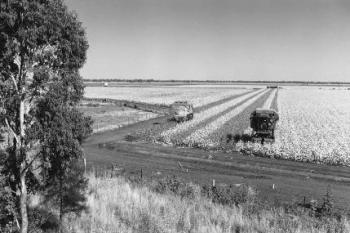
Cotton harvest in progress at Narrabri, New South Wales (July 1995). (Photograph courtesy P.E. Kriedemann)
Worldwide, the genus Gossypium consists of over 40 species of perennial xerophytic shrubs (including domesticated cotton, G. hirsutum). They are frost-sensitive short-day plants found along banks and beds of dry streams. Though the genus is pan-tropical, individual species have limited distribution and are of relic status with little genetic diversity, suggesting a declining genus. All species except two are diploid. The diploid species are divided into five genomes, each of which is largely confined to one continent. Australia has a rich flora of wild species, some very rare, but none has contributed to commercial varieties so far.
Cotton lint consists of seed hairs that collapse in cross-section and form convoluted ribbons when mature allowing them to be spun into yarn. Apart from G. herbaceum the other wild species have stiff seed hairs that cannot be spun. Traits appropriate to spinning were selected after domestication and cotton was then grown in temperate regions. Further varieties were selected for longer and finer fibre and heavier yield. Domestication did not involve loss of sensitivity to daylength as a trigger for reproductive development. Moreover, adoption of an inherent annual habit was not required because termination of a cropping cycle can be imposed by withholding irrigation in combination with defoliation.
Cotton is grown in the Yemen in a way that offers invaluable insight into the ecology of cotton’s wild ancestors, and helps explain the behaviour of modern crops. Erratic floods in the Yemen are impounded in order to store the water in their deep alluvial soil. Cotton is then grown entirely on this stored water. Such conditions are remarkably similar to the natural environment of wild ancestors of cotton, and strikingly illustrated by the occurrence of an indigenous wild species as a weed in cultivated crops. Common adaptive traits are seen in both wild and cultivated cotton. The root system explores the soil to the depth wetted, and an indeterminate shoot develops at a rate unaffected by the amount of stored water, until approximately three-quarters of the water is exhausted, whereupon morphological development and vegetative growth stop abruptly, and the crop matures. Plant size and fruit number thus depend on duration of development, which in turn depends on how long it takes for soil water to run out.
This pattern of development is well adapted for survival in arid and semi-arid environments where the water supply from rainfall or floods is erratic and can vary greatly from one season to the next. An indeterminate habit allows plants to make full use of variable water supplies by growing large or small according to water supply. Cotton plants appear to recognise a signal indicating that soil water supply is running out. They then stop development, shed young fruit and mature the fruit that are already set. Passioura et al. (1993) have accumulated evidence from several sources that plants react to drying soil in response to signals from their roots. In irrigated crops, a succession of drying cycles replaces a single prolonged cycle in rainfed crops, presumably generating a different pattern of signals.
There appears to be another signal at the wet end of the range that triggers the rank growth syndrome. Most bolls are shed, unable to assert their priority for assimilates, while vegetative growth is excessive indicating no shortage of resources. This is presumably a latent response from wild progenitors to maximise vegetative growth and delay setting fruit when conditions allow. Both signals are keys to managing cotton crops.
Cotton had been grown in Australia experimentally from time to time in the first half of the nineteenth century, but it took reverberating events in the USA to induce large-scale production in Australia. A world shortage of cotton during the American Civil War and later depredations of the boll weevil, exacerbated by shortage of foreign exchange after World War I, stimulated production of rainfed cotton in Queensland. Additionally, in the early 1960s restrictive US Farms Bills persuaded Californian growers to bring their methods of intensive (irrigated) production to Australia. So began the modern Australian industry. Over the next 30 years the industry expanded dramatically and in the course of 15 years Australia swung from being an importer of cotton to being the world’s fourth largest exporter. Cotton ranks third in Australia in value as an export crop.
Visitors to the Ord Valley in 1970 witnessed an ecological disaster when Heliothis armigera (genus subsequently renamed Helicoverpa) became resistant to DDT. Cotton research resumed on the Ord with new technology and a lot of hard-won wisdom. Intensive cotton production in the tropics is a great challenge, being afflicted by an interaction between pests and rank growth and is rarely successful. Synthetic growth substances and transgenic varieties now offer hope of success.
Narrabri sustains temperate climate production in irrigated valleys between the 22nd and 32nd parallels in eastern Australia. The crop has brought much prosperity and wealth to those valleys, to their towns and to individuals who live there, and even to the nation as a whole. Such are the economic realities. But when we consider the ecological realities, cotton is a disruptive crop. Production on the vertisol plains is intensive, highly mechanised, with heavy inputs of nitrogen (up to 200 kg ha–1), irrigation water (up to 9 ML ha–1), and pesticide (one or two herbicide and 8 to 10 insecticide sprays). Given such requirements, is cotton production sustainable?
Cotton was threatening to become an ecological pariah in the 1970s. Heavy use of pesticides and irrigation water for cotton growing was of great concern. We needed a simulation model to explore options for pest and irrigation management at tactical and strategic levels. At a tactical level we wanted to use fruit counts to evaluate the potential for pest damage during the season. At a strategic level we wanted to identify the ‘best bet’ strategy for using limited irrigation water supplies in the face of uncertain rainfall. We needed to extrapolate the results of our experiments in a few years and locations to any year and any location in the cotton growing regions. OZCOT evolved as a simulation model for management of cotton crops.
Trying to build my own model I agreed with Conway (1977) that simulation models at that time were of little value in tactical pest and crop management (Hearn and Room 1979). We used a non-dynamic trajectory of yield development consisting of the number of fruit needed at any time in the season to achieve a specified yield by a specified date. Actual numbers were compared with the trajectory to determine how much pest damage could be tolerated.
The fruit model SIRATAC pest-management system was then built in a succession of steps (Hearn and da Rosa 1985):
A simulation model results that is simple and elegant, and which captures the dynamics of cotton fruiting when water and nitrogen are not limiting. This model saw more than 10 years’ service in the SIRATAC pest-management system.
We had asked 20 years earlier, ‘Why does the crop close its doors, and why do some bolls drop out?’ In these models we recognise that older bolls compete against other sinks for limited assimilate supply, and are successful. Twenty years previously we could not predict when the crop would stop producing flower buds and how many fruit would shed, or whether the crop would compensate for pest damage. Now we could. We had no more data than when these questions were asked; instead we had more relevant understanding. We did not need data on assimilate supply and demand. What we needed were concepts of competition among sinks for limited supply of assimilates, and the priority of the older fruit over other sinks including young fruit and buds generating more fruit.
The OZCOT and hydroLOGIC models were developed from the SIRATAC fruit model by linking it to the Ritchie (1972) water balance model for use in situations where water and nitrogen are limiting. Ritchie’s model had already been used with a stress-day yield function to analyse strategies with limited water supplies (Hearn and Constable 1984). A leaf area generator, a boll growth model and a rudimentary soil nitrogen model were added, and photosynthesis included explicitly. OZCOT and hydroLOGIC have been widely used as manage-ment tools (Hearn 1994).
A new model, CERCOT, has been built by linking OZCOT with the soil water and nitrogen models from the CERES family of models, in order to simulate soil and plant nitrogen dynamics more realistically. Light interception and conversion to dry matter are done in the way pioneered by Monteith and followed in CERES, and partitioning is linked to the fruiting dynamics. CERCOT is currently in the final stages of validation.
Our modelling has thus gone a full circle. We started by turning our backs on simulation models and using a static model. A simple dynamic model was then built which has been made progressively more complex over the years. At no stage was it more complex than it needed to be to solve the problems being addressed.
Cotton is always fascinating and sometimes maligned, a crop that has shaped the history of many countries. Cotton is grown in a remarkable range of environments and economic circumstanccs from tropical to temperate, and from small-scale subsistence holdings to large and intensive corporate farms. There has been a dark side to cotton — slavery, colonial exploitation and alleged environmental vandalism. It is a crop that our media and environmentalists love to hate, a crop alleged to exhaust soil and require excessive amounts of insecticides and water; and yet this crop clothes humanity in natural fibre!
Equally for plant science, empiricism in cotton growing has given way to process-based models of growth and reproductive development as an aid to management on a huge scale. Such application of basic principles from crop physiology takes on added significance for a species that natural selection honed as a perennial, but which farming practice now manages as an annual. Moreover, genotype × environment interactions are still at work on Gossypium hirsutum, but this time human selection for inherent earliness with wide adaptability to photoperiod will help shape future genotypes.
Brown, K.J. (1968). ‘Translocation of carbohydrate in cotton: movement to fruiting bodies’, Annals of Botany, 32, 703–713.
Constable, G.A. and Hearn, A.B. (1981). ‘Irrigation of crops in a subhumid climate, 6: effects of irrigation and nitrogen fertiliser on growth, yield and quality of cotton’, Irrigation Science, 2, 17–28.
Hearn, A.B. and Fitt, G.P. (1992). ‘Cotton cropping systems’, in Field Crop Ecosystems, ed. C.J. Pearson, 85–142, in Ecosystems of the World, series ed. C. Goodall, Elsevier: Amsterdam.
Passioura, J.B. (1996). ‘Simulation models: science, snake oil, education, or engineering?’, Agronomy Journal, 88, 690–694.
Turner, N.C., Hearn, A.B., Begg, J.E. and Constable, G.A. (1986). ‘Cotton (Gossypium hirsutum L.): physiological and morphological responses to water deficits and their relationship to yield’, Field Crops Research, 14, 153–170.
Trolinder, N.L., McMichael, B.L. and Upchurch, D.R. (1993). ‘Water relations of cotton flower petals and fruit’, Plant, Cell and Environment, 16, 755–760.
Van Iersel, M.W., Oosterhuis, D.M. and Harris, W.M. (1994). ‘Apoplastic water flow to cotton leaves and fruits during development’, Journal of Experimental Botany, 45, 163–169.
Visiting Fellow, Research School of Biological Sciences, Australian National University, Canberra
 [7]
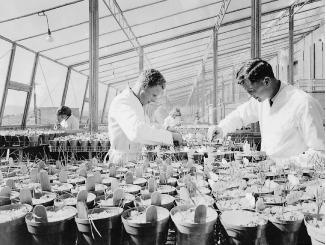
Adaptive features of cereals under study by 'plant physiologists' during early days in the Canberra Phytotron 'CERES' (c. 1962). (Photograph courtesy A. Agostino, CSIRO Plant Industry, Canberra)
When we plant physiologists are asked...to justify public support for our research, most of us would, I imagine, invoke its potential value to agriculture and horticulture...scratch a plant physiologist as many a sceptical review committee has done, and you find an agronomist, plant breeder or horticulturist. (Evans 1977)
‘Adaptation in nature and performance in cultivation’ now emerge as connected themes for Plants in Action. As demonstrated here in Part I, successful adaptation in nature does not necessarily imply satisfactory performance in cultivation. This arises because selection in nature results in traits that do not coincide with the performance requirements of agriculture or other forms of intense cropping. Overall rates of carbon acquisition and the scale of photoassimilate partitioning into reproductive organs (harvest index) are often sacrificed in nature in favour of devices for survival. This is especially evident over much of Australia where natural selection pressures commonly relate to environmental stresses, and native plants have evolved accordingly. Adaptation in our post-Gondwanan flora to drought, fire, nutrient stress and soil salinisation has attracted special attention from ecophysiologists.
Aboriginal Australians made extensive use of native species throughout millennia of occupation, and had long since come to terms with the vagaries and seasonal limitations of our endemic flora. Europeans were not so adjusted and their arrival provided an impetus for increased productivity of domesticated species. Initial efforts were based on poorly adapted exotic crop plants in drought-prone and nutrient-poor soils. In effect, both genotype and environmental issues had to be addressed, but problems faced by early settlers were not articulated in those terms at that time.
Early selection of genetic variants better adapted to local conditions was mercifully successful, but largely empirical. Explanation and extrapolation into new environments had to wait for an emerging plant science to define underlying processes and adaptive responses — processes in the sense of genetically determined workings of plants that enabled them to be fitted to a given niche in nature, adaptive responses in the sense that requirements for successful growth and reproductive development had to fit the environmental cues of a given location. Daylength, temperature and moisture stress proved to be important driving variables in this respect.
Development of plant science in Australia and New Zealand was shaped by issues of crop production, and a distinction in research philosophy gradually emerged between what might be termed process physiology and integrative plant science. Process physiology depends upon a reductionist approach to analysing the inner workings of plants at progressively finer levels of organisation and contributes to our detailed ‘understanding’. Such understanding finds application in both natural and managed ecosystems via integrative research.
Reductionists commonly use well-defined test systems with inherent properties that suit their analysis of particular processes such as ion uptake, photosynthetic electron flow or induction of flowering. They usually work within an established conceptual framework or paradigm, and define questions in a way that makes them amenable to test via experimentation with their test system. A well-defined system helps minimise ambiguity. Working paradigms do not remain fixed. Rather, they undergo often radical revision as new knowledge renders old paradigms untenable and a ‘crisis’ ensues (Kuhn 1970). A major revision of concepts pertaining to leaf gas exchange during the 1970s is a case in point. Discovery of C4 photosynthesis, definition of Rubisco function and an appreciation of photorespiration proved to be so highly congruent that a new paradigm emerged for gas exchange.
Whereas reductionist research implies an analysis of component parts at increasing levels of detail, integrative research implies a synthesis of interacting components to produce a model of plant function. Crop management models are built in this way, and cotton farming already depends closely on models used for decision-support systems. In that case, early attempts to account for variation in growth and reproductive development between seasons or across different locations were based on observation and inference. The resulting models ‘worked’, but were largely empirical and lacked a useful conceptual framework of component processes; they were of little use outside the reference frame within which they had been constructed. Current cotton models are more than empiric, being process based, and drawing upon an extensive knowledge of growth and develop-mental response to environmental inputs, especially water. As a result they are more generic and of wider predictive value.
A similar rationale applies to application of basic concepts in explaining adaptive features of any plant and, from that knowledge, predicting performance under defined conditions. Plantation forests are a case in point where likely scenarios of tree growth as a function of site quality need to be explored well ahead of investment decisions. Such analyses necessitate validated models which in turn draw upon comprehensive data sets of genotype x environment interactions on the physiology of particular tree species (e.g. see Battaglia and Sands (1997) for Eucalyptus globulus).
As an aside, when simulation models in agriculture, horticulture or forestry are used to apply outcomes from process physiology to real-world situations, significant gaps in basic understanding become apparent and can influence direction of future forest research. In this way, related streams of reductionist and integrative research also become interactive.
By analogy, Plants in Action seeks to engender such a two-way flow of information on all levels of organisation in vascular plants. Those levels stretch from gene expression during growth and reproductive development of individual plants to human and environmental selection pressures. Those unrelenting pressures shape genotypes and thus adaptation of wild species in nature, as well as the performance of domesticated plants in cultivation.
Cremer, K.W. (ed.) (1990). Trees for Rural Australia, Inkata Press: Melbourne.
Evans, L.T. (1977). ‘The plant physiologist as midwife’, Search, 8, 262–268.
Evans, L.T. (1983). ‘Science and the suburban spirit’, Search, 13, 307–311.
Eldridge, K., Davidson, J., Harwood, C. and van Wyk, G. (1993). Eucalypt Domestication and Breeding, Clarendon Press: Oxford.
Lloomis, R.S. and Connor, D.J. (1992). Crop Ecology: Productivity and Management in Agricultural Systems, Cambridge University Press: Cambridge.
Lowe, I. (ed.) (1996). Australia: State of the Environment 1996, CSIRO: Melbourne.
Michalewicz, M.T. (ed.) (1997). Plants to Ecosystems: Advances in Computational Life Sciences Series, Vol. 1, CSIRO: Melbourne.
Swanage, M. (ed.) (1990). Biology: The Common Threads (Parts 1 and 2), Australian Academy of Science: Canberra.
Swanage, M. (ed.) (1996). Environmental Science, Australian Academy of Science: Canberra.
Links:
[1] http://plantsinaction.science.uq.edu.au/edition1//?q=figure_view/961
[2] http://sci-wikibook.bacs.uq.edu.au/drupal/?q=figure_view/14
[3] http://plantsinaction.science.uq.edu.au/edition1//?q=figure_view/13
[4] http://plantsinaction.science.uq.edu.au/edition1//?q=figure_view/15
[5] http://plantsinaction.science.uq.edu.au/edition1//?q=figure_view/962
[6] http://plantsinaction.science.uq.edu.au/edition1//?q=figure_view/964
[7] http://plantsinaction.science.uq.edu.au/edition1//?q=figure_view/963