
It is sometimes possible to extrapolate from in vitro biochemical or single-cell reaction to whole-plant responses to temperature, but a recurring theme in considering the response of plants to changes in temperature is the complexity imposed by integration and acclimation.
Integration is a major issue when considering the influence of temperature on assimilate partitioning to different plant organs, particularly, for example, when examining the balance between root and shoot growth. Tissues have varying ability to adapt to a change in the environment: they will either maximise their function under the new conditions or restructure and go into a period of dormancy (survival mode) until the stress has abated.
Given a considerable body of knowledge on plant response to temperature it is now possible to define temperature optima as well as limits for growth, and to relate growth and development to field temperature. This has a practical application in modelling the response to temperature and predicting likely consequences of genetically modified plant reaction.
Under normal field conditions mean day temperatures can commonly be 5°C to 10°C higher than mean night temperatures, with a much greater amplitude between maximum and minimum temperatures. The importance of this day/night differential (sometimes designated as thermoperiodicity) has received considerable attention in relation to the growth and yield of glasshouse crops where there is the possibility of some degree of temperature control. However, it is also of interest in field crops in relation to the development of models for use in predicting the effect of weather conditions on crop development.
Total plant growth would be favoured by low night temperatures as this would reduce respiratory losses at a time when the supply of carbohydrate might become limiting. However, dry matter production for a wide range of crops grown under constant but optimal temperature is equal to and often greater than dry matter production by the same crops grown under differential day/night temperatures with the same mean value. Where a day/night temperature differential is imposed, low night temperatures rather than low day temperatures favour growth. The amplitude of the day/night temperature differential is also important and increasing this from 10°C to 20°C can reduce growth.
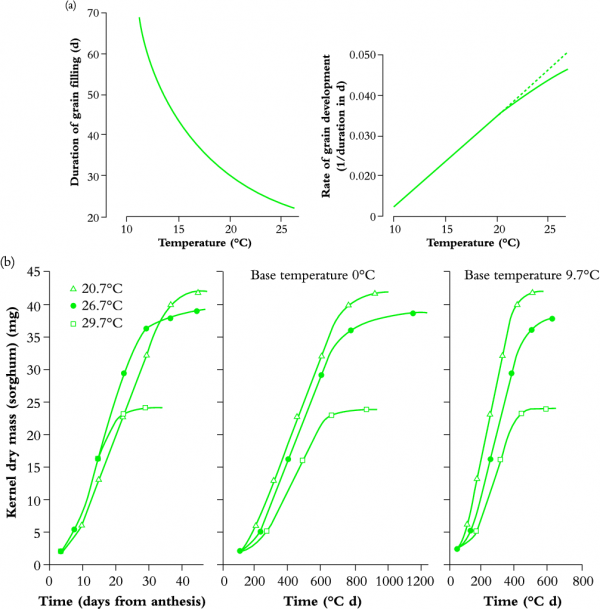
In practical terms the time taken for organ initiation and development or between one developmental stage and another is dependent on temperature and can be related to cumulative heat (thermal time). ‘Heat sums’ used in this way often have a considerable advantage over the use of normal calendar time, particularly in analysing field data where the temperature varies from season to season or from one planting to another. However, it is important to take into account the possibility that heat sums can be influenced by other environmental factors, such as light. The use of thermal time depends on the linearity of the response to temperature and a knowledge of the base temperature below which growth or development does not occur (Figure 14.13). Thermal time is simply a summation of cumulative differences between daily mean temperature and a specified base temperature, and has units of degree-days (°C d). Linearity of crop response to temperature is lost as the optimum temperature is approached, but the use of thermal time may be extended into the higher temperature range through the use of a curvilinear model. Base temperature may show genetic variation and differ between one developmental stage and another. The base temperature for bud break in grapevines is approximately 4°C, but is closer to 7°C for leaf appearance (Moncur et al. 1989). In wheat, base temperature increases with successive stages of development (Angus et al. 1981).
 [1]
Figure 14.13 Phenology (timing of cardinal points in growth and development) can be predicted with greater certainty via thermal units than via calendar time. The units used, degree-days (°C d), are a summation of mean daily temperature X time. Useful application of thermal time is limited to the range where temperature responses are linear. For this reason a base temperature has to be defined, below which growth or development approaches zero, and an optimum temperature, above which the rate of growth no longer increases or may decrease with temperature. Cereal grains illustrate some of the advantages and difficulties of using thermal units for analysing growth data. (a) The duration of grain filling in response to temperature in wheat when plotted as the reciprocal of time (1/ duration in days) against temperature should be a straight line. This relationship obviously breaks down at the high end of the temperature scale. (b) The effect of temperature on the pattern of kernel filling in sorghum can be presented either using calendar time or thermal time (°C d). The shift to thermal time suggests that temperatures of` 26°C and higher are above the optimum for kernel filling and this is most evident when a more realistic base temperature for sorghum of 9.7°C is used instead of 0°C (Based on Chowdhury and Wardlaw 1978)
Heat sums have been used to predict the stages of crop development, knowledge that can be important for timing the application of herbicides, insecticides and fertiliser.
This takes account of the interaction between daylength and temperature in controlling development. Integration of temperature with time is now restricted to the duration of the light period. Thus ‘photothermal time’ = Σ L (TL – TB), where L is day length as a fraction of 24 hours, TL is the average temperature during daylight hours, and TB is base temperature.
Considerable effort has gone into modelling relations between thermal environment and plant responses with a number of specific aims, namely to predict the likelihood of success of extending a particular crop into new regions, to predict phenology in a particular season and ensure the most effective application of fertiliser and agricultural chemicals, or to gain a better understanding of the basic processes that limit yield.
These models will often include data on maximum and minimum temperatures, solar radiation, photoperiod, rainfall, evaporative demand, soil water-holding capacity and nutrition. Temperature is thus one of several environmental factors that may influence plant growth and development and it is important to recognise the potential interaction between temperature and these other factors.
As discussed above (Section 14.2) light has an important role in regulating the effect of low temperature on the chlorophyll status of leaves of chilling-sensitive species and therefore on photosynthesis and growth. Interactions between temperature and light are complex and influence early stages of seedling establishment through to shoot number (branching), leaf shape and canopy development. In any crop, not all plant organs are at the same temperature, while direction, level and duration of incident radiation are also varying constantly. The combination of light and temperature vary from one location to another and although in a Mediterranean climate rising temperatures are often associated with increasing light, in the monsoonal regions of the tropics the high summer temperatures can be associated with high cloud cover and low light.
Temperature is also an important factor in plant water use. Low temperature can restrict the uptake of water by roots in some species, while high temperature, by lowering the relative humidity of the air (which increases the vapour pressure deficit), will increase the evaporative demand of the air and increase the rate of transpiration through the leaves. The latter will result in more rapid use of soil water and increase the possibility of drought. One of the main difficulties in assessing the interaction between temperature and water stress is because temperature influences both water use and the rate of plant development in parallel.
Uptake of mineral nutrients and their redistribution from one organ to another within plants are influenced by both nutrient availability and temperature. The optimum temperature for nutrient uptake varies between species and also from one mineral element to another. The importance of nutrition in relation to temperature then depends on whether the uptake and redistribution of nutrients can keep pace with the increased growth rates that are observed, for example, with increasing temperature. This would appear to be the case for phosphorus in wheat (even when the supply of phosphorus is low) where increasing temperature results in an increased concentration of leaf phosphorus, an increase that is also expressed in the grains at maturity. Thus in this example any deleterious effect of high temperature on yield would not appear to be mediated through plant phosphorus.
Links:
[1] http://plantsinaction.science.uq.edu.au/edition1//?q=figure_view/708