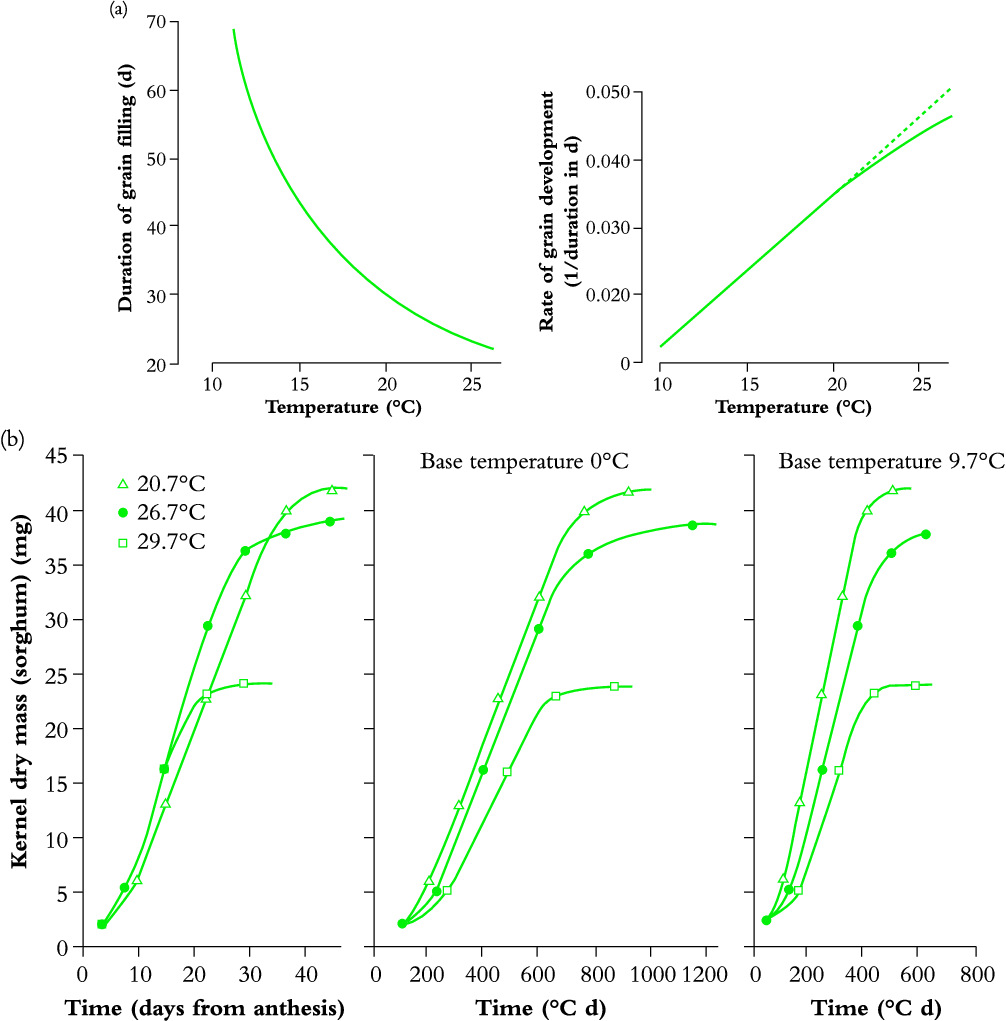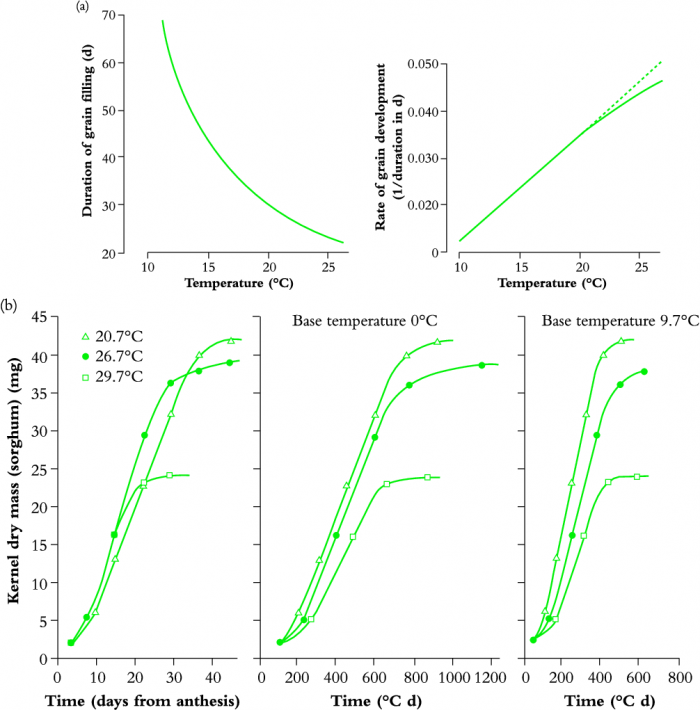
Figure 14.13 Phenology (timing of cardinal points in growth and development) can be predicted with greater certainty via thermal units than via calendar time. The units used, degree-days (°C d), are a summation of mean daily temperature X time. Useful application of thermal time is limited to the range where temperature responses are linear. For this reason a base temperature has to be defined, below which growth or development approaches zero, and an optimum temperature, above which the rate of growth no longer increases or may decrease with temperature. Cereal grains illustrate some of the advantages and difficulties of using thermal units for analysing growth data. (a) The duration of grain filling in response to temperature in wheat when plotted as the reciprocal of time (1/ duration in days) against temperature should be a straight line. This relationship obviously breaks down at the high end of the temperature scale. (b) The effect of temperature on the pattern of kernel filling in sorghum can be presented either using calendar time or thermal time (°C d). The shift to thermal time suggests that temperatures of` 26°C and higher are above the optimum for kernel filling and this is most evident when a more realistic base temperature for sorghum of 9.7°C is used instead of 0°C (Based on Chowdhury and Wardlaw 1978)