
Several processes take place as fruit ripen to become edible and then senesce. They may take place while fruit are still attached or after harvest. Fruit are regarded as ready to harvest once they ‘mature’ because they are then capable of normal ripening off the plant. Tomato, banana and avocado are examples of fruit that can be mature at picking yet totally inedible until subsequent ripening processes have occurred. In contrast, strawberries, oranges, boysenberries and grapes are examples of fruit that need to stay on the tree or vine until ready to eat in order to have their desired eating characteristics. Underlying differences in their physiology are outlined below.
 [1]
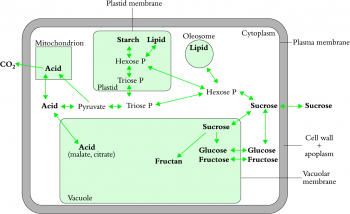
Figure 11.9 Carbohydrate economy in developing fruits is drived by import and recycling of photoassimilates between different metabolic compartments. Sucrose or less commondly other forms of translocated carbon (Table 11.1) arrive via phloem conduits and are loaded into cytoplasmic compartments. As shown schematically, carbohydrate can then be partitioned to vacuolar storage or converted to other sugars and, in the form of hexose phosphate, transferred to plastids where it is used to synthesise starch. Each step is reversible, and as happens during ripening, starch in plastids is transformed back ito sugars that subsequently accumulate in cacuoles as indicated. Other specialised organelles (oleosomes) store lipids while mitochondria draw upon imported and locally fixed carbon for ATP generation.
(Original diagram courtesy R.L. Bieleski)
During development, photosynthate is stored in fruit (and other sink organs such as root vegetables, seeds and flowers) in either a soluble or insoluble form (Figure 11.9). Fruit that store carbon in a soluble form (e.g. berry fruit, peaches, persimmon, melon, grape, citrus) need to remain on the plant until nearly ripe if they are to survive postharvest storage and meet customer expectations. In most cases the major and rapid increase in soluble sugar content does not occur until late in development, signalling the beginning of ripening. Because the sugar source is the parent plant, harvesting such fruits too early reduces their final sugar content to unacceptable levels. In contrast, there are other fruits that store their carbon in insoluble forms, particularly starch. This allows greater efficiency in accumulating carbon, as the storage product is more compact, osmotically inactive and better segregated from metabolic processes. Examples are avocado, which stores carbon as both starch and lipid, and kiwifruit, apple, pear, mango, papaya and banana, all of which store carbon as starch.
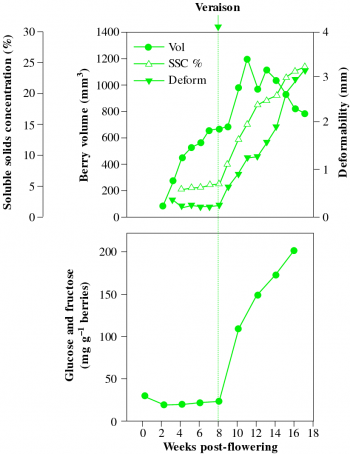
In fruits that store carbon as sugar and organic acid during development, colour changes followed by softening signal that fruit are becoming mature and ready to harvest. The challenge facing postharvest physiologists is to assess when such fruit are still sufficiently firm to allow easy handling and storage, but have enough sugar for a true ripe flavour to develop. A developing crop is typically monitored with a simple refractometer test (soluble solids concentration based on refractive index of expressed juice). In grapes, a rapid rise in sugar content (beginning at ‘veraison’) may need to reach SSC values of around 20% (with, say, 17% sugar and 2% acid as the main soluble components) before a successful harvest can be assured (Kanellis and Roubelakis-Angelakis 1993).
There is more to good flavour than high sugar content, with sugar to acid ratio being particularly important, so that a combination of SSC to acid ratio with a minimum SSC level may be required. For example, New Zealand mandarins may not be exported to Japan if the SSC to acid ratio is below 10 (when the proportion of acid is too high). In other crops such as melon, the acid component is unimportant, and sugar content primarily dictates fruit quality.
In fruits that store carbon as starch, time of picking is less dependent on sugar content, since a doubling or more of sugar concentration by starch hydrolysis can still take place after the fruit are picked. Once starch utilisation has started, fruit can be picked without much detriment to final eating quality. SSC measurements alone are then insufficient, and measurements of total solids, dry matter, oil content and starch concentration are used as well. For example, in kiwifruit sequential measure-ments of SSC are combined with dry matter measurements; in apple and pear, the pattern of starch distribution within the fruit is recorded along with SSC and ethylene measurements; in mango, total solids (and fruit shape, flesh colour and firmness) are recorded; in papaya, colour changes and sequential SSC measurements are recorded; in avocado, dry matter, some-times in combination with oil content, is used. In banana, shape or ‘fullness’ of fruit is an important criterion rather than starch level because bananas can be harvested over a remarkably wide range of maturities and still ripen satisfactorily.
Thus, when fruit store carbon in insoluble forms, they can often be harvested while still hard, lending greater flexibility to postharvest handling and ensuring a longer storage life.
 [2]
Figure 11.10 Grapes undergo an abrupt change in their physiology midway through development. For about 8 weeks after flowering, berry volume increases steadily but fruit are hard (low deformability) and sugar content low. At 'veraison' invertase activity rises abruptly and reducing sugar content increases rapidly, reaching about 20% of fresh weight when ripe. Berries attain full size by 10-12 weeks, and approach an asymptote in sugar content 2-3 weeks later.
(Based on Davies and Robinson 1996)
In sugar-storing fruits a major shift in metabolism generally takes place when fruit expansion is almost complete, heralding a rapid increase in sugar content (Frommer and Sonnewald 1995). Control points for sugar entry and accumulation by fruits include:
1. rate of sugar production by leaves and delivery to transport pathways;
2. reallocation of sugar from supporting vegetative growth towards fruit growth;
3. enhanced unloading of sugar from transport streams into fruits;
4. enhanced transfer of sugar across plasma membranes into cells or through plasmodesmal connections between cells;
5. onward metabolism of sugar in the cytoplasm, or transfer to storage in vacuoles;
6. increased respiratory utilisation of sugar to provide energy for metabolic processes.
As with any biological system, multiple controls operate concurrently to drive a given pattern of maturation. Such events lead us to more robust indicators of ripeness, and improved ways of manipulating maturation to yield higher sugar content and better handling properties. These options are outlined below.
In melon, where sucrose is the main sugar to increase, there is a corresponding decrease in acid invertase and an increase in sucrose phosphate synthase (SPS) activity (this synthesises sucrose from hexose phosphate and adenylated precursors). In grape (Figure 11.10), hexoses accumulate; SPS, sucrose synthase and hexokinase activities all increase (Manning 1993), but acid invertase does not. In addition, expression of mRNA coding for acid invertase and activity both peak just prior to or at veraison (Davies and Robinson 1996).
In tomato there are different genotypes that accumulate either hexoses or sucrose. Most cultivars are hexose accumu-lators and acid invertase is active during growth and ripening (Klann et al. 1993). SSC % hardly changes in commercial tomatoes subsequent to 20 d postanthesis. Sucrose accumu-lators lack acid invertase.
One transgenic tomato has been reported (Ohyama et al. 1995) where the type of sugar stored by fruit has been manipulated. Acid invertase activity was suppressed by antisense RNA resulting in sucrose accumulation in a normally hexose-accumulating cultivar. Conventional breeding studies using crosses between the two types of tomato also showed that an acid invertase gene is not transcribed during ripening of the sucrose accumulators (Harada et al. 1995).
 [3]
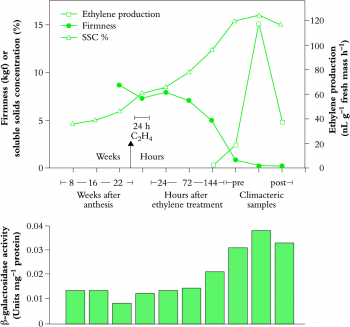
Figure 11.11 Kiwifruit show some dramatic changes in physiological status during development. For 24 weeks after flowering, fruit are hard and sugar content low. Meanwhile starch content (not shown) rises to about 12% of fresh mass. Ripening in fruit harvested around 24 weeks can be triggered by exposure to an external source of ethylene even though the fruit are not yet producing ethylene by themselves, and are incapable of an autocatalytic response. Within a week of such treatment starch becomes hydrolysed and sugar concentration rises from 7% to 15%. Fruit then soften rapidly and the enzymens responsible, such as β-galactosidase, increase in activity. Fruit do eventually show a peak in ethylene production, but not until ripening is well under way.
(Based on Win 1996)
Fruit which store starch switch from starch synthesis during development to starch hydrolysis during ripening. Starch–sugar interconversion involves a larger number of enzymes and a greater complexity of control than is required for sugar storage alone (Frommer and Sonnewald 1995). No transgenic plants have yet been reported where a starch-storing fruit or lipid-storing fruit has been altered to store only sugars, or vice versa, but results with potato suggest it should be possible. In potato, control of both insoluble carbon storage and sugar to starch conversion has been attained with ‘sense’ and ‘antisense’ constructs (see Section 10.4) for specific carbohydrate enzymes (Smith and Martin 1993; Stitt and Sonnewald 1995).
Kiwifruit provide an example of biochemical changes in a starch-storing fruit (Figure 11.11). They are normally harvested with starch contents ranging from 4 to 10% (dry matter con-centrations between 14 and 20%; SSC between 6.2 and 12%). At picking, the main sugars are sucrose, glucose and fructose. As fruit ripen after harvest, sucrose content increases only slightly, while fructose and glucose increase in parallel to become the predominant sugars in ripe fruit (MacRae et al. 1992). Labelling with radioactive precursors indicates that all three sugars are actively synthesised during ripening, and there are increases in the activities of a number of sucrose-metabolising enzymes, particularly SPS and invertase. The starch-degrading enzyme a-amylase increases two-fold.
Organic acid content of kiwifruit also changes after harvest. At room temperature malate decreases and citrate increases while quinate remains unchanged. However, during cool storage (0–4°C), malate increases. Such changes are enough to alter the flavour balance in the ripe fruit. Where fruit store carbon in an insoluble form, there are several potential control points for sugar metabolism (Figure 11.9) including:
1. hydrolysis of starch to glucose;
2. transfer of sugar precursors from starch-containing plastids (amyloplasts);
3. synthesis or degradation of sucrose;
4. synthesis of hexoses;
5. transfer of sugar to vacuoles or export from cells;
6. carbon flow between sucrose and malate or citrate;
7. production of CO2 from sugar or acid precursors;
8. transfer of malate or citrate across the vacuolar or mitochondrial membranes.
Interference in any of these processes should affect ripening and/or flavour development after harvest. Such interference may be physical (as in storage temperature), chemical (as in atmosphere composition) or genetic (by modifying activities of specific proteins which control flow between particular metabolites).
Links:
[1] http://plantsinaction.science.uq.edu.au/edition1//?q=figure_view/536
[2] http://plantsinaction.science.uq.edu.au/edition1//?q=figure_view/537
[3] http://plantsinaction.science.uq.edu.au/edition1//?q=figure_view/538