
 [1]
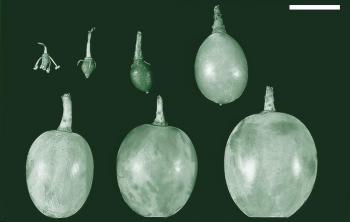
A grape is a 'berry', so that fruits on sultana grape vines are stenospermocarpic berries! Pollination and fertilisation were successful, but embryos so formed soon aborted. Pericarp tissues none the less continued their development to produce the familiar item of commerce about 100 d later. A range of stages in that development is shown here. Upper-row fruit illustrate stages in preveraison development where fruit are small, hard, green and accumulating organic acid. Postveraison fruit (lower row) are transluscent, soft textured, enlarging rapidly and accumulating sugar. Scale bar = 5 mm.
(Photograph courtesy E.A. Lawnton)
Whence it is probable, that the use of these leaves, (which are placed, just where the fruit joins the tree) is to bring nourishment to the fruit. And accordingly, I observe ... that all peach leaves are pretty large before the blossom goes off; And that in apples and pears the leaves are one third or half grown, before the blossom blows: So provident is nature in making timely provision for nourishing the yet embrio fruit ...
(Stephen Hales, Vegetable Staticks, 1727)
Most of the exaggerated developments of certain parts of the basic fruit structure arose naturally but have been accentuated by modern breeding programs to maximize the desirable features of each fruit and minimize the superfluous features. The production of seedless cultivars of certain fruits represents an extreme development in this latter respect.
(Wills et al., Postharvest, 1989)
Fruits evolved as vehicles for production and dispersal of seed. Humans then imposed further selection pressures to develop products for our use. Such development has occurred during the past century and our concept of a fruit as a sweet and fleshy object for eating is really quite recent in evolutionary terms.
Despite modifications and exaggerations of fruit structures due to human selection, and with a few seedless exceptions such as banana and sultana grapes, fruit growth is largely dictated by seed development. Processes underlying those influences are considered here, followed by an account of postharvest changes.
Postharvest technology is also a human device to serve human needs, and includes everything that happens to crops between harvest and human utilisation. However, preharvest events do impact on subsequent postharvest behaviour. Genetic background is particularly important, in part determining crop response to growth and storage environments. Postharvest techniques can be slight, as in grain stores, or highly developed, as in controlled atmosphere storage of fresh produce.
In every instance, some key concepts apply. In particular, potential quality of fresh commodities is irretrievably fixed by harvest time, with no further opportunities to manipulate their basic properties. After harvest, storage time may be as short as the few minutes taken for immediate consumption, or extremely prolonged as with years of seed bank storage. Most research discussed here is concerned with storage periods of 2–25 weeks. Handling over this period has a profound effect on final usefulness because a crop is still alive throughout this process and vulnerable to adverse conditions. Postharvest physiology is therefore of particular importance to countries such as Australia and New Zealand which ship a large portion of their crops to distant markets. Accordingly, kiwifruit (Actinidia deliciosa) is used here as an example where principles of postharvest research have been applied successfully in establishing a new international crop on a stable and permanent basis.
Wild fruits often contain components which make them unattractive to potential consumers until they are ready to be dispersed. These commonly include calcium oxalate crystals (raphides), bitter flavours and astringent tastes. However, humankind adapted fruit for personal use by applying intense selection pressure to remove unpleasant components and enhance desired features. These include appealing flavour with well-developed aroma volatiles and sweetness, bright colour, pleasant texture and high food value. As early as the seventeenth century, Gerard recorded that ‘some peares are sweet, divers fat and unctuous, others soure, and most are harsh, especially the wilde peares’. Nowadays, all European and Asian cultivars are sweet with greatly reduced acidity and tannin content compared to their various wild parents. Persimmons provide another example where an originally astringent fruit has given rise to a non-astringent form.
During the twentieth century, additional selection pressures have been applied to temperate fruits in a drive for cultivars that are well suited to postharvest handling and storage. This has not been true for most tropical fruits, which have had little selection for such characteristics and which still present challenging problems for postharvest researchers and breeders.
The history of kiwifruit shows some of the steps that will be needed. It was a wild species until 1900, when domestication began. A major commercially valuable cultivar, Hayward, was selected around 1930. This event was followed by progressive development of techniques for cultivation, handling and marketing — all required to make a new fruit commercially successful. Several features of kiwifruit physiology make it amenable to commercialisation, namely (1) an unusual flavour combined with good nutritional value, (2) retention of chlorophyll so that inside tissues remain bright green when ripe, (3) a long and manageable ripening period resulting in a long harvest season where fruit can be picked in a mature but firm condition, and (4), especially important, kiwifruit tolerate lengthy low-temperature storage without subsequent shelf life being compromised.
 [2]
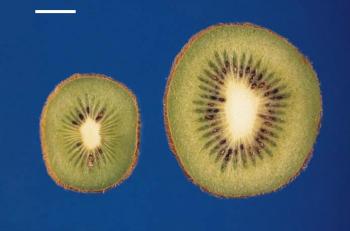
Figure 11.1 Poor pollination (left) compared with normal pollination (right) influences seed number and hence kiwifruit development. A fully pollinated fruit carries at least a 1000 seeds spread more or less evenly lengthwise, and in about 35 locules around its circumference. Faulty pollination causes big disparities in seed number per locule (from around 30 to near zero). There is a corresponding change in relative development of adjacent tissues. Scale bar = 1 cm.
(Photograph courtesy of M. Heffer and R.L. Bielski)
Pollination, followed by pollen tube growth and fertilisation, instigates fruit growth (Figure 11.1). If pollination does not occur, flowers are shed (only rare exceptions). Nevertheless, a developmental program of gene expression for fruit growth has already been established well ahead of floral biology. Primordia may have been initiated up to six months before a particular flower opens, and ovary development continues during flower growth with ovary tissues forming late in this process. As part of that outcome, homology between leaves and sepals is noteworthy and evident in many fruits (Gillaspy et al. 1993). Sepals show leaf-like cell layers, stomata and chloroplasts.
The generic term ‘fruit’ covers a wide range of structures, all supporting and protecting seeds, but where the various parts have developed from the original fertilised flower in various distinctive ways. In the simplest form, ovary walls grow along with seeds, and as they develop, the ovary walls dry out to become a pod (legume) or capsule (poppy). In others (particularly fleshy fruits), the main structure can arise by exaggerated development of a particular part of the original floral unit. These include ovary wall or central axis, the receptacle that supports anthers and ovary, or even petals and sepals. In morphological terms, fruits are structures that develop from fertilised or stimulated ovules, plus associated floral parts that originate from the parent plant.
Mechanistically, a fruit is a single dispersal unit which includes seeds and associated tissues, developed as a single body. This broad description includes structures derived from a single ovary (as in simple fruits such as apple, avocado and mango) as well as compound fruits where separate ovaries are joined (an aggregate fruit such as blackberry and cherimoya) or where separate flowers are collected into a single structure (pineapple and breadfruit). A detailed discussion on fruit structure and classification is given in Spjut (1994).
During fruit development, an ovary wall becomes a pericarp: either dry as in a dehiscent pea pod and the indehiscent caryopsis of barley, or fleshy as in berries (grapes). Three morphologically distinct strata are present and developed to varied degrees: exocarp (fruit skin), mesocarp (fruit flesh) and endocarp (inner cell layers).
An exocarp will develop a cuticle and may exhibit a variety of morphological features such as coarse hairs (kiwifruit) or fine hairs (peach). Exocarp plus cuticle restrict gas exchange, and determine general appearance of ripening fruit. Most cuticles are highly impermeable to gases, so that water vapour, O2 and CO2 diffuse mainly via either stomata or lenticels or by mass flow through cavities at the calyx and stem ends of fruit.
Mesocarp tissues usually represent the fleshy part of a fruit, and commonly hold chloroplasts and starch grains. In fleshy fruits such as berries (e.g. tomato, kiwifruit and grapes) this tissue typically comprises large parenchyma cells and contains the main vascular network.
Endocarps are less common, but typically develop as a dense hard case around a seed, as in peach, apricot or macadamia.
An ovary must be stimulated in some way for fruit growth to occur; this is normally by pollination and fertilisation. This important principle was established as early as the 1960s when Nitsch and others (Sections 9.2.2, 9.3.1) showed that gibberellins and auxins are involved in the pollination stimulus. Subsequent hormone production by the fertilised ovary is critical to stimulating fruit development (Nitsch 1970).
By implication, a suitable balance of growth regulators applied to unpollinated fruitlets can result in fruit set, and in practice gibberellins GA4 and GA7 are very effective in setting parthenocarpic (seedless) apple fruit (Dennis 1986). By contrast, parthenocarpy is rare in kiwifruit, although repeated appli-cations of napthaleneacetic acid (NAA) with benzyladenine (BA) and gibberellin have been successful (Hopping 1986). Such results confirm that growth regulators — alone or in combination — can trigger cell division in ovaries or related tissues that ultimately become fruits.
Seedless fruits have arisen via human selection of genotypes in which ovaries produce an adequate supply of growth regulators without any stimulation from the germinating pollen and developing seed (triploid banana), or where fertilisation is closely followed by seed abortion (stenospermocarpic, as in sultana grapevines; see Chapter 11 frontispiece). In the absence of pollination, levels of endogenous hormones such as auxins and gibberellins normally fall markedly (Nitsch 1970) and flowers abscise or fruitlets stop growing. The molecular signals responsible for this reduction are still not known.
 [3]
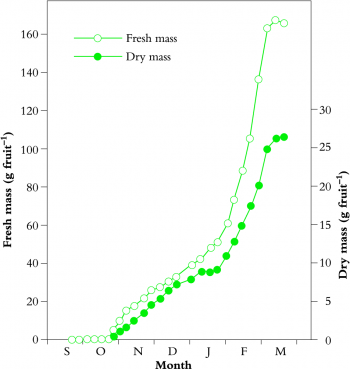
Figure 11.2 Peach growth is biphasic, showing a double sigmoidal pattern in terms of both fresh mass and dry mass. Pericarp cell division is especially active during early stages of phase 1, while enlargement of an existing population of cells is largely responsible for growth during phase 2.
(Based on Chalmers and van den Ende 1975)
Fruit can increase in mass or volume by 100-fold or more from fertilisation to maturity, and such changes commonly follow a sigmoid curve (Figure 11.2 for peach; see Harris et al. 1968 for grape). Interpretation of such growth curves is complex because a single variable (mass, length, volume) is commonly applied to an object which contains several organs and different tissue types, each developing at their own rate and in accordance with their own program. Moreover, at a cellular level, comparative levels of division and expansion change with ontogeny, while shifts in airspace percentage also play a part in volume increases. Added to this, changes in storage products (oil, starch and sugar) and structural carbohydrate (endocarp thickening) influence dry matter content. Representative cases are covered later.
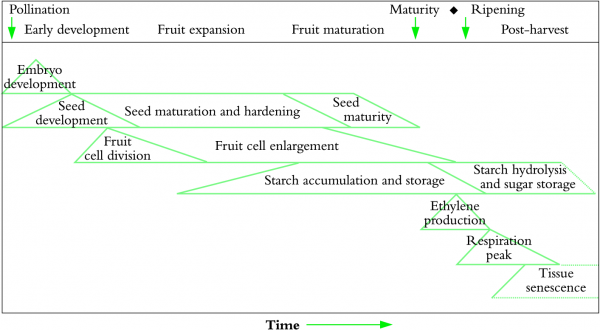
Despite complexities of fruit growth and development, there are some overall consistencies in patterns of cell division and enlargement, as well as tissue differentiation and fruit enlargement (Figure 11.3). During the first one to four weeks, flesh volume increases rapidly and embryo volume remains small. Growth at this time is mainly the result of cell division. In many commercial fruits (e.g. apple, kiwifruit, tomato and peach), cell division may cease a few weeks after anthesis, and fruit growth slows down, reflected as an inflection in the growth curve, and signalling an end to the first sigmoid phase.
 [4]
Figure 11.3 A great number of complex process are intergrated in space and time during seed developmnet and fruit growth and shown here schematically. In broad terms, embryo differentiation and seed development are already well advanced as pericarp enlargement gets underway, and seed maturation usually precedes onset of ripening; consequently fruits ingested prematurely still represent vehicles for seed dispersal. A phase of carbohydrate accumulation during fruit maturation gives way to starch hydrolosis and sugar storage during maturation, accompanied by a peak in ethylene output and respiratory activity as fruits ripen.
(Original diagram courtesy I.B. Ferguson)
During early growth, the fertilised embryo and endosperm develop and seeds start to form (Figure 11.3). A second phase begins where the pericarp resumes growth and continues to enlarge until slowing for a second time as fruit mature. This second phase in fruit growth is mainly accomplished by cell expansion in longitudinal, radial and tangential planes. Longitudinal growth, where cells enlarge parallel to the long axis of the fruit, will often be a big factor for development of elongate fruits such as cucumber and marrow. Radial growth increases diameter as in some pumpkins. Increases in cell volume during fruit growth can be considerable. Mature watermelons end up with some of the largest parenchyma cells in the Plant Kingdom, about 0.7 mm in diameter (Bollard 1970).
In contrast to this general pattern where cell division ceases after a few weeks, pericarp cells of avocado fruit continue to divide over the whole growth period so that cells in mature fruit are still relatively small (Schroeder 1953).
Cell enlargement is not a uniform process. Cells in various regions of a fruit often enlarge at different rates and in different planes, so that many mature fruit show strong gradients in cell size from their surface to the centre. In apple fruit, cells closest to the core are smallest, with cell size increasing towards the fruit surface. Conversely in many berries, such as cucumber, kiwifruit and grape (Harris et al. 1968), the smallest cells are found in outer regions of the pericarp, with size increasing progressively towards inner regions.
 [5]
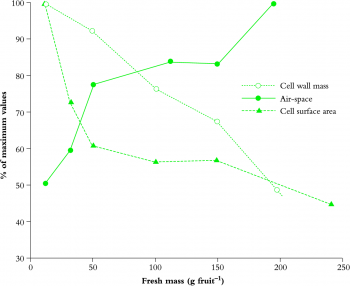
Figure 11.4 Physical characteristics of apples change during growth and development with a notable increase in gas space to a maximum of around 0.1 mL gas mL-1 tissue at maturity, and corresponding decrease in cell wall mass to around 15 mg g-1 fresh mass. Cell surface area shows an early rapid decrease from around 340 cm2 mL-1 tissue.
(Based on Harker and Ferguson 1988)
Patterns of cell growth and differentiation in cell layers can influence the quality of mature fruit. For example, pepino fruit with a compact exocarp composed of tightly packed cells are less likely to bruise during postharvest handling than cultivars having large intercellular airspaces. As cell size increases during development, other accompanying characteristics also change, such as cell wall thickness, differentiation of specific cell types (e.g. sclereids) and formation of cell inclusions (oil, raphides). In feijoa and pear, development of sclereids in the mesocarp provides the characteristic gritty texture. As another example, juiciness of orange depends on prior differentiation of juice sacs in the endocarp (see Bain 1958 for anatomical development of citrus fruits).
Extent and distribution of airspaces are particularly important, affecting both fruit texture and physiological properties. For instance, in apples, airspace relative to fruit volume can double during development, while cell wall thickness and relative cell surface area both decline (Figure 11.4). Such changes affect gas exchange and diffusion of solutes through pericarp tissues due to increased tortuosity.
 [6]
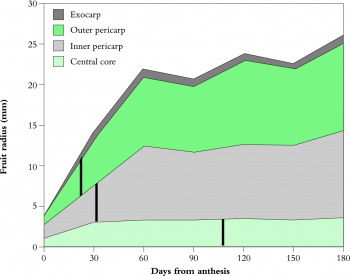
Figure 11.5 Radial growth in kiwifruit is due mainly to enlargement of outer and inner pericarp. Vertical lines indicate cessation of cell division in each tissue.
(Unpublished data courtesy K. Gould and I.B. Ferguson)
Development of kiwifruit fruit is particularly complex. All tissues of the mature fruit (exocarp, outer and inner pericarp and central core) are already discernible in the ovary before anthesis and pollination. Each layer grows to a different extent and at different rates, so that the relative contribution of each to the total fruit volume varies with time (Figure 11.5). Cell division ceases first in the exocarp and last in the innermost regions of the central core. The outer pericarp is first seen as a homogeneous population of cells but by 14 d after pollination two cell types become visible, namely small isodiametric parenchyma cells full of starch grains, and much larger heavily vacuolate ovoid cells in which the frequency of starch grains per unit volume is low. The larger cells grow more rapidly than the smaller cells, and both cell types grow more rapidly in the inner regions towards the central core.
Anatomy affects our perceptions of kiwifruit quality. Hairs are developed as multicellular projections of the skin, giving a characteristic bristly appearance and rough feel. Tough skin relative to soft flesh is another important character imparted by development of primary cell wall thickenings in the hypodermal collenchyma. Ripe fruit colour is due to tannin deposits in those same cells. In addition, some small parenchyma cells in the outer pericarp deposit calcium oxalate crystals (raphides), surrounded by polysaccharide mucilage, and this tissue can cause throat irritation in many people.
Fertilisation is generally crucial for fruit set and pericarp development (Figure 11.1). As fertilised ovules develop into seeds, this influence on pericarp growth continues where production of hormones by the endosperm and developing embryo promotes pericarp growth. The importance of seeds as sources of hormones for initiation and stimulation of fruit growth is implied by fruit response to exogenous hormones in parthenocarpic systems (development of fruit without seeds).
 [7]
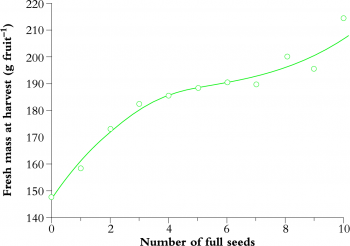
Figure 11.6 Fruit size in Braeburn apples depends closely on number of viable seeds per fruit (up to a normal maximum of 10 per fruit) emphasising the strong influence that seed development has on fruit growth.
(Based on Broome 1995)
Applying auxin and gibberellins to unfertilised embryos is one way of achieving parthenocarpy; another is to use auxin transport inhibitors such as chloroflurenol to prevent loss of auxin from embryos so that a threshold level for pericarp response is exceeded. Studies of parthenocarpy in tomatoes and cucumbers indicate that high auxin levels enhance embryo cell division, and this cell division phase seems to be more critical than subsequent cell expansion in determining final fruit size.
Such results imply a cooperative mode of action where gibberellins combine with auxins to initiate cell division. Seed cytokinins and cell division are similarly related (Gillaspy et al. 1993) because tomato seeds accumulate cytokinins which subsequently influence cell division in surrounding pericarp tissue (Bohner and Bangerth 1988).
Such interdependence between seed development and fruit growth shows up in final size, and apple seed numbers frequently correlate with fruit growth (Figure 11.6) or with shape and size of fruit. As a case in point, inadequate pollination of kiwifruit (Figure 11.1) results in distortion, and a curvilinear relationship emerges between seed number and fruit weight (Hopping 1986). A similar response is obtained when young seeds are surgically removed from immature strawberry fruits, causing a corresponding distortion in flesh development.
Despite ample evidence that natural control of fruit shape is primarily exerted by plant hormones originating from seeds and stimulating growth to varying degrees, this is not true for all fruit. In banana, fertile seeds actually suppress development of the fleshy pulp. In this anomalous case, fertilisation failure allows an ovary to grow.
In marrow, tomato and kiwifruit, ovary shape dictates spatial distribution of seeds. They in turn influence pericarp growth, so that fruit size and shape then become a function of initial ovary shape plus subsequent fertilisation and seed development.
As fruits grow, proportions of cell wall, carbohydrate, organic acid, lipid, phospholipid and volatile (aroma) compounds change dramatically; and within each of those groups there are changes in the proportion of individual group members. Of these, by far the most important in practical terms is carbohydrate economy. Two sets of issues are at stake: (1) rate of growth, attainment of maturity and final fruit size, and (2) aroma, flavour and texture in ripe fruit. Both carry commercial implications.
Enlarging fruit require carbohydrate to sustain cell division, enlargement and tissue specialisation. Only in later stages are carbohydrates typically retained as either starch or soluble sugars (Ho 1988). Soluble carbohydrate is mainly imported as photoassimilate, with only a minor contribution from local CO2 fixation, and reassimilation of respiratory CO2.
At peak growth rate, usually early summer, there is an intense flow of photoassimilate from mature leaves (sources) into rapidly enlarging fruit (sinks). Sugars generated by photosynthesis, along with amino acids and phosphate within the plant’s vascular network, move via phloem into enlarging fruits.
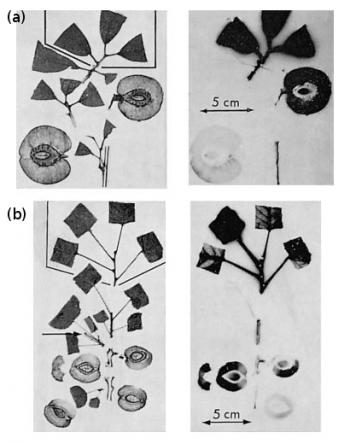
Sources of photoassimilate can be identified by providing individual leaves with 14CO2 and following the pattern of labelled material into neighbouring organs (Figure 11.7). Leaves typically begin to show a net export of photosynthate at about 50–60% of full size (Section 6.1; Figure 6.3). In kiwifruit, leaves 49% expanded failed to export the radiolabelled products of 14CO2 photosynthesis, whereas those 64% expanded transported labelled photosynthate into younger leaves (Lai et al. 1988).
 [8]
Figure 11.7 Photoassimilate moves from mature leaves of peach (a) and apricot (b) into the pericarp of maturing fruits nearby. 14CO2 was administered for about an hour to source leaves (boxed area top left side in (a) and (b)) and movement of 14C-labelled photoassimlates over the subsequent 24 h was traced by autoradiography of harvested material (right side a and b). Intense labelling of source leaves indicates a high level of residual activity, but strong incorporation of 14C photoassimilates into the pericarp of adjacent fruits is also evident. Endocarp tissues had hardened and failed to import current photosynthate, although seeds developing inside the endocarp did become labelled.
(Based on Kriedmann 1968)
Distribution patterns of 14C-labelled products relate to developmental morphology of fruiting shoots. Typically source leaves are nearby on the same lateral branch, both above and below the fruit. In apple, fruiting spurs may develop primary leaves (emerging soon after budburst), then spur leaves (in a rosette at the base of the flower), then bourse leaves (growing on spur bourse shoots). Each in turn provides assimilate for the next phase of leaf growth (primary → spur → bourse); then as leaf expansion ceases, all provide assimilate to the developing fruit (Tustin et al. 1992). Leaves on adjacent extension shoots can provide some photosynthate to fruit, but if indeterminate growth continues furthermost leaves become progressively less important as suppliers, and more significant as competitors. If the normal suppliers are removed, carbohydrate can come from longer distances, sometimes from leaves more than a metre away (Bollard 1970).
Relative strength of source and sink is a major factor for distribution patterns, but transport options are dictated by vascular connections. During plant growth, development occurs in an orderly and patterned manner, creating separate files of leaves. This pattern (phyllotaxis) is accompanied by a matching pattern of vascular connections. Photosynthate tends to move along a pathway of least resistance, following these direct vascular connections where they exist, hence distribution patterns generally follow phyllotaxis.
This importance of phyllotaxis in carbohydrate allocation to the fruit is well shown in kiwifruit, where quite specific leaf–fruit connections exist. Patterns of assimilate distribution from leaf to fruit have been studied by taking a number of matched lateral fruiting branches of kiwifruit vines, then supplying 14CO2 to one leaf on each, at various nodal positions along the stem, from node 1 (base) to node 10 (tip). Each lateral also had one fruit each on nodes 1 and 2, while the remaining nodes had leaves only. Distribution of 14C-labelled photosynthate was allowed to proceed for 6 d, and the total radioactivity in each leaf and fruit on the lateral was then measured. Specifically, node 1 fruit received assimilate from their own subtending leaf (node 1 leaf) and from leaves on nodes 6 and 9. Node 2 fruit was supplied by its subtending leaf and leaves on nodes 7 and 10. Assimilate from remaining leaves was distributed generally within the main body of the plant. However, if the apex of the lateral was removed to stop extension growth, fruit then drew assimilate from all leaves. By implication, a drastic change in source–sink relationships can override restriction on carbon transport imposed by vascular patterns in intact plants (Lai et al. 1988).
 [9]
Table 11.1
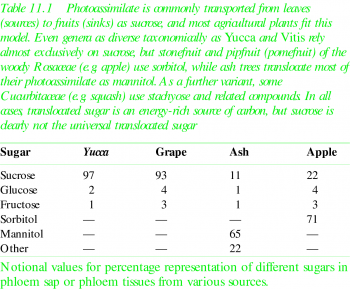
Radiolabelling of photoassimilates has also been used to identify which compounds are transported into storage organs. Analyses of phloem tissues and phloem sap shows that in most plants carbohydrate enters fruits primarily as sucrose. However, other soluble carbohydrates can predominate in some plants of commercial importance (Table 11.1).
In the woody Rosaceae (apples, pears, stonefruit), the sugar alcohol sorbitol is the major photosynthetic product at 60–85% of transported carbon, the remainder being mainly sucrose. Regard-less of transport form, photoassimilate arriving in fruits is rapidly converted to the storage products characteristic of the fruit in question (principally starch, glucose, fructose and sucrose). Thus the identity of labelled sugars in fruits often differs markedly from the form transported. For example, sorbitol concentration is high during early development of apple fruits and more or less reflects the composition of photo-assimilate in transit. By maturity, sorbitol content will typically decline to below 5% of the total soluble carbohydrate (Beruter 1985).
If sorbitol reaching fruits is not fully metabolised, apoplasm accumulation results and pericarp tissues become glassy in a disorder called ‘watercore’ (see below; Figure 11.21). This is a common problem with some apple cultivars such as Fuji. Sugar transport and accumulation can thus have economic importance — both in terms of desired taste characteristics and postharvest fruit quality.
In kiwifruit, the polyol myo-inositol may comprise up to 35% of soluble carbohydrate in developing fruit, and up to 20% in leaves. As yet, we do not know whether inositol, like sorbitol, is transported in the phloem, or whether there may be physiological disorders caused by inadequate metabolism of sorbitol within fruits. Such findings challenge our common perception of sucrose as the universal transport carbohydrate in economic crops, and suggest that we still have a lot to learn about the control of carbohydrate metabolism.
Carbon transport and subsequent metabolism in developing fruit cannot be viewed in isolation, particularly when aspects of fruit quality, such as taste and flavour, are directly dependent on such processes. In particular, sugar–acid balance and contents are primary determinants of the taste attributes of fruit, and so are of major significance for consumers. Too much acid and the fruit is tart and unpalatable; too little and the fruit is insipid and bland. In horticultural terms, acid levels are often expressed as titratable acidity (TA), and this is used as one indicator of taste. Another indicator used is the refractive index of the expressed sap (recorded as °Brix). This is a measure of the soluble solids concentration (SSC %) of expressed juice and represents the sum of organic acid, salts and sugar contents. Several organic acids may be present, but certain ones are characteristic of particular species or cultivars. For example, malic acid predominates in pipfruit (pomefruit), citric acid is dominant in citrus, while tartaric acid is dominant in grapes. In kiwifruit, malic, citric and quinic acids are the major ones, and in total may exceed 1.5% of the fresh weight (Beever and Hopkirk 1990).
Acids are not transported into fruit via phloem connections, but are synthesised in situ. Part of the acid component comes from metabolism of the sugar imported through the phloem, but part can be synthesised by local fixation. In citrus, dark fixation of CO2 by mature fruit makes a meagre contribution to acid balance (Young and Biale 1968) but interconversion of imported carbon is of more consequence. In that case, citrate synthase and subsequent enzymes in the citric acid cycle appear to determine whether imported carbon (as sucrose) is transformed into other sugars or is metabolised further to organic acids.
Starch–sugar balance is a major factor in consumer perceptions of fruit quality. In many fruits, including apples, bananas and kiwifruit, starch accumulates throughout devel-opment, being laid down as granules in plastids. In kiwifruit, starch may reach 50% of the total dry matter towards the end of fruit growth (at about 15 weeks after pollination; Beever and Hopkirk 1990). As fruit approach maturity (17–20 weeks after pollination), there is a rapid onset of starch hydrolysis. Starch content at the onset of this conversion is not enough to account for all the sugar present in ripe fruit, and this implies that maturing fruit continue importing sugar up to harvest. Continuing import of 14C-labelled photoassimilate into maturing peach and apricot fruits confirms that pattern (Figure 11.7).
The dynamic between starch breakdown and soluble sugar increase can be a critical index of fruit maturity. Kiwifruit are judged to be mature enough to be harvested and to ripen properly if their soluble solids levels reach a specific target value. Starch pattern tests are used as maturity indices for some apple cultivars.
As an additional factor in their dietary appeal, fruits are rich sources of vitamins, particularly the anti-scorbutic vitamin C (L-ascorbic acid) — an observation with naval connotations and drummed into generations of children! Moreover, vitamin C can be a major metabolite (greater than 2 g kg–1 fresh weight) in fruit such as acerola, rosehip, quandong, kiwifruit, citrus, blackcurrants and guavas, and has strong anti-oxidant properties. This may account for a notable absence of browning in kiwifruit and citrus when sliced (in conjunction with relatively low levels of polyphenols and polyphenol oxidase in those tissues). Vitamin C levels increase in the fruit during early growth, and tend to be stable through to maturity.
A number of other important vitamins have fruits or seeds as their major sources in the human diet. The B group vitamins such as B1, B2, pantothenic acid and biotin are present in both fruit and seeds, while B3 and B6 are particularly supplied in seeds. The vitamin A precursor β-carotene is found in useful quantities in some fruits, for example peaches, apricots, melons and cherries.
Phenolics such as anthocyanins and tannins are also important in fruit and are responsible for much of the visual appeal of intact fruit (e.g. tamarillo), exposed flesh (e.g. cherry) or extracted juice (e.g. guava). They also contribute to flavour characteristics, adding a slight and pleasing astringency (as with the dessert apple) or a more aggressive one (as with cider apples and green bananas). Phenolics may also reduce deposition of lipids on our artery walls and so reduce incidence of heart disease, apparently through an ability to mop up free radicals which otherwise aid the deposition process.
Tannins in persimmon fruit are a special feature of that fruit and provide an interesting example of the potential dominance of a single quality characteristic in determining how a given fruit is used. The first cultivars of persimmon originating in China were markedly astringent, having high soluble tannin levels which made the fruit inedible until the tannins became condensed during the softening stages of ripening and early senescence. These original cultivars were therefore not eaten until the fruit flesh had become a glutinous paste. Later selection in Japan produced non-astringent cultivars such as Fuyu which lose their astringency during the later stages of maturation, so that they can be eaten in a firm crisp state more typical of a fruit like apple. In persimmon, water-soluble tannins are compartmented in specific tannin cells of the mesocarp tissue. Tannin accumulation ceases with cell growth, and in non-astringent cultivars astringency declines both through soluble tannin dilution and through poly-merisation, where soluble tannins are condensed into an insoluble form.
 [10]
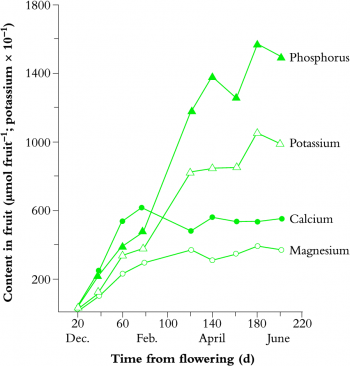
Figure 11.8 In kiwifruit, as in most fruit, accumulation of calcium is confined to early stages of development that coincide with cell division. By contrast, phosphorous and pottasium move into fruit over the whole growing season and are able to enter via either the xylem or phloem. Magnesium import is meagre but progressive. Note the expanded scale for pottasium. Fruit content of nutrient ions at maturity would be as follows: phosphorous 1600, calcium 600, magnesium 400 and potassium 10 000 μmol per fruit.
(Based on Ferguson 1980)
Just as fruit require an inward flow of carbohydrate and water to provide for seed growth and pericarp expansion, so mineral nutrients are also supplied. As a rule, concentrations of the major mineral nutrients in fruit are lower than in other organs such as the leaves, and the patterns of phosphorus, potassium, calcium, magnesium and nitrogen accumulation usually differ.
Mineral nutrients move into the fruit most rapidly during the early stages of development (Figure 11.8) at a time when xylem water flow dominates. As fruit approach maturity, surface to volume ratio declines, the skin becomes less permeable to water loss (sometimes through blockage of previously active stomata), and large amounts of photoassimilate are imported via phloem connections. As a results, a significant part of the water reaching fruit now enters through the phloem and is accompanied by photoassimilate. Mobile ions such as K+ and HPO42– are loaded into the leaf veins along with the photo-assimilate, travel in the phloem and so reach fruit over the whole growing season. In contrast, less mobile nutrients such as Ca2+ fail to reach fruit during later stages, so that Ca2+ concentration remains steady or even declines slightly (Figure 11.8).
Nutrient deficiencies in fruit are relatively uncommon, except for those associated with calcium. Calcium deficiencies are expressed in the form of blossom-end rot in tomatoes, and bitter pit plus lenticel blotch in apple fruit. These apple disorders tend to be expressed during postharvest storage, but symptom expression is somehow related to the previous ripening environment. These disorders show up as a pitting of flesh and skin, reducing fruit value or even rendering those commodities unmarketable. Such commercial penalties have resulted in development of preharvest sprays and postharvest dips of calcium salts that diminish bitter-pit incidence in harvested fruit. Where there is little or no calcium recycling via phloem, calcium needs to be applied directly to fruit to have a beneficial effect.
Several processes take place as fruit ripen to become edible and then senesce. They may take place while fruit are still attached or after harvest. Fruit are regarded as ready to harvest once they ‘mature’ because they are then capable of normal ripening off the plant. Tomato, banana and avocado are examples of fruit that can be mature at picking yet totally inedible until subsequent ripening processes have occurred. In contrast, strawberries, oranges, boysenberries and grapes are examples of fruit that need to stay on the tree or vine until ready to eat in order to have their desired eating characteristics. Underlying differences in their physiology are outlined below.
 [11]
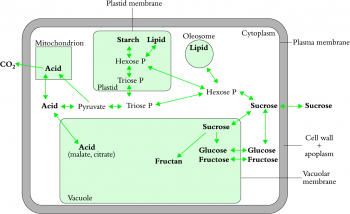
Figure 11.9 Carbohydrate economy in developing fruits is drived by import and recycling of photoassimilates between different metabolic compartments. Sucrose or less commondly other forms of translocated carbon (Table 11.1) arrive via phloem conduits and are loaded into cytoplasmic compartments. As shown schematically, carbohydrate can then be partitioned to vacuolar storage or converted to other sugars and, in the form of hexose phosphate, transferred to plastids where it is used to synthesise starch. Each step is reversible, and as happens during ripening, starch in plastids is transformed back ito sugars that subsequently accumulate in cacuoles as indicated. Other specialised organelles (oleosomes) store lipids while mitochondria draw upon imported and locally fixed carbon for ATP generation.
(Original diagram courtesy R.L. Bieleski)
During development, photosynthate is stored in fruit (and other sink organs such as root vegetables, seeds and flowers) in either a soluble or insoluble form (Figure 11.9). Fruit that store carbon in a soluble form (e.g. berry fruit, peaches, persimmon, melon, grape, citrus) need to remain on the plant until nearly ripe if they are to survive postharvest storage and meet customer expectations. In most cases the major and rapid increase in soluble sugar content does not occur until late in development, signalling the beginning of ripening. Because the sugar source is the parent plant, harvesting such fruits too early reduces their final sugar content to unacceptable levels. In contrast, there are other fruits that store their carbon in insoluble forms, particularly starch. This allows greater efficiency in accumulating carbon, as the storage product is more compact, osmotically inactive and better segregated from metabolic processes. Examples are avocado, which stores carbon as both starch and lipid, and kiwifruit, apple, pear, mango, papaya and banana, all of which store carbon as starch.
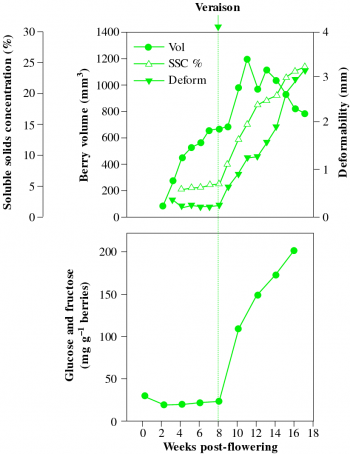
In fruits that store carbon as sugar and organic acid during development, colour changes followed by softening signal that fruit are becoming mature and ready to harvest. The challenge facing postharvest physiologists is to assess when such fruit are still sufficiently firm to allow easy handling and storage, but have enough sugar for a true ripe flavour to develop. A developing crop is typically monitored with a simple refractometer test (soluble solids concentration based on refractive index of expressed juice). In grapes, a rapid rise in sugar content (beginning at ‘veraison’) may need to reach SSC values of around 20% (with, say, 17% sugar and 2% acid as the main soluble components) before a successful harvest can be assured (Kanellis and Roubelakis-Angelakis 1993).
There is more to good flavour than high sugar content, with sugar to acid ratio being particularly important, so that a combination of SSC to acid ratio with a minimum SSC level may be required. For example, New Zealand mandarins may not be exported to Japan if the SSC to acid ratio is below 10 (when the proportion of acid is too high). In other crops such as melon, the acid component is unimportant, and sugar content primarily dictates fruit quality.
In fruits that store carbon as starch, time of picking is less dependent on sugar content, since a doubling or more of sugar concentration by starch hydrolysis can still take place after the fruit are picked. Once starch utilisation has started, fruit can be picked without much detriment to final eating quality. SSC measurements alone are then insufficient, and measurements of total solids, dry matter, oil content and starch concentration are used as well. For example, in kiwifruit sequential measure-ments of SSC are combined with dry matter measurements; in apple and pear, the pattern of starch distribution within the fruit is recorded along with SSC and ethylene measurements; in mango, total solids (and fruit shape, flesh colour and firmness) are recorded; in papaya, colour changes and sequential SSC measurements are recorded; in avocado, dry matter, some-times in combination with oil content, is used. In banana, shape or ‘fullness’ of fruit is an important criterion rather than starch level because bananas can be harvested over a remarkably wide range of maturities and still ripen satisfactorily.
Thus, when fruit store carbon in insoluble forms, they can often be harvested while still hard, lending greater flexibility to postharvest handling and ensuring a longer storage life.
 [12]
Figure 11.10 Grapes undergo an abrupt change in their physiology midway through development. For about 8 weeks after flowering, berry volume increases steadily but fruit are hard (low deformability) and sugar content low. At 'veraison' invertase activity rises abruptly and reducing sugar content increases rapidly, reaching about 20% of fresh weight when ripe. Berries attain full size by 10-12 weeks, and approach an asymptote in sugar content 2-3 weeks later.
(Based on Davies and Robinson 1996)
In sugar-storing fruits a major shift in metabolism generally takes place when fruit expansion is almost complete, heralding a rapid increase in sugar content (Frommer and Sonnewald 1995). Control points for sugar entry and accumulation by fruits include:
1. rate of sugar production by leaves and delivery to transport pathways;
2. reallocation of sugar from supporting vegetative growth towards fruit growth;
3. enhanced unloading of sugar from transport streams into fruits;
4. enhanced transfer of sugar across plasma membranes into cells or through plasmodesmal connections between cells;
5. onward metabolism of sugar in the cytoplasm, or transfer to storage in vacuoles;
6. increased respiratory utilisation of sugar to provide energy for metabolic processes.
As with any biological system, multiple controls operate concurrently to drive a given pattern of maturation. Such events lead us to more robust indicators of ripeness, and improved ways of manipulating maturation to yield higher sugar content and better handling properties. These options are outlined below.
In melon, where sucrose is the main sugar to increase, there is a corresponding decrease in acid invertase and an increase in sucrose phosphate synthase (SPS) activity (this synthesises sucrose from hexose phosphate and adenylated precursors). In grape (Figure 11.10), hexoses accumulate; SPS, sucrose synthase and hexokinase activities all increase (Manning 1993), but acid invertase does not. In addition, expression of mRNA coding for acid invertase and activity both peak just prior to or at veraison (Davies and Robinson 1996).
In tomato there are different genotypes that accumulate either hexoses or sucrose. Most cultivars are hexose accumu-lators and acid invertase is active during growth and ripening (Klann et al. 1993). SSC % hardly changes in commercial tomatoes subsequent to 20 d postanthesis. Sucrose accumu-lators lack acid invertase.
One transgenic tomato has been reported (Ohyama et al. 1995) where the type of sugar stored by fruit has been manipulated. Acid invertase activity was suppressed by antisense RNA resulting in sucrose accumulation in a normally hexose-accumulating cultivar. Conventional breeding studies using crosses between the two types of tomato also showed that an acid invertase gene is not transcribed during ripening of the sucrose accumulators (Harada et al. 1995).
 [13]
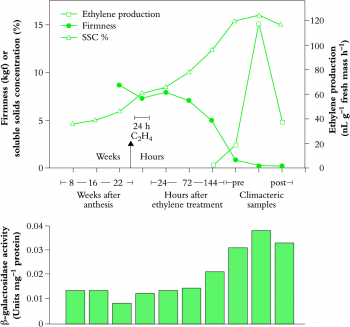
Figure 11.11 Kiwifruit show some dramatic changes in physiological status during development. For 24 weeks after flowering, fruit are hard and sugar content low. Meanwhile starch content (not shown) rises to about 12% of fresh mass. Ripening in fruit harvested around 24 weeks can be triggered by exposure to an external source of ethylene even though the fruit are not yet producing ethylene by themselves, and are incapable of an autocatalytic response. Within a week of such treatment starch becomes hydrolysed and sugar concentration rises from 7% to 15%. Fruit then soften rapidly and the enzymens responsible, such as β-galactosidase, increase in activity. Fruit do eventually show a peak in ethylene production, but not until ripening is well under way.
(Based on Win 1996)
Fruit which store starch switch from starch synthesis during development to starch hydrolysis during ripening. Starch–sugar interconversion involves a larger number of enzymes and a greater complexity of control than is required for sugar storage alone (Frommer and Sonnewald 1995). No transgenic plants have yet been reported where a starch-storing fruit or lipid-storing fruit has been altered to store only sugars, or vice versa, but results with potato suggest it should be possible. In potato, control of both insoluble carbon storage and sugar to starch conversion has been attained with ‘sense’ and ‘antisense’ constructs (see Section 10.4) for specific carbohydrate enzymes (Smith and Martin 1993; Stitt and Sonnewald 1995).
Kiwifruit provide an example of biochemical changes in a starch-storing fruit (Figure 11.11). They are normally harvested with starch contents ranging from 4 to 10% (dry matter con-centrations between 14 and 20%; SSC between 6.2 and 12%). At picking, the main sugars are sucrose, glucose and fructose. As fruit ripen after harvest, sucrose content increases only slightly, while fructose and glucose increase in parallel to become the predominant sugars in ripe fruit (MacRae et al. 1992). Labelling with radioactive precursors indicates that all three sugars are actively synthesised during ripening, and there are increases in the activities of a number of sucrose-metabolising enzymes, particularly SPS and invertase. The starch-degrading enzyme a-amylase increases two-fold.
Organic acid content of kiwifruit also changes after harvest. At room temperature malate decreases and citrate increases while quinate remains unchanged. However, during cool storage (0–4°C), malate increases. Such changes are enough to alter the flavour balance in the ripe fruit. Where fruit store carbon in an insoluble form, there are several potential control points for sugar metabolism (Figure 11.9) including:
1. hydrolysis of starch to glucose;
2. transfer of sugar precursors from starch-containing plastids (amyloplasts);
3. synthesis or degradation of sucrose;
4. synthesis of hexoses;
5. transfer of sugar to vacuoles or export from cells;
6. carbon flow between sucrose and malate or citrate;
7. production of CO2 from sugar or acid precursors;
8. transfer of malate or citrate across the vacuolar or mitochondrial membranes.
Interference in any of these processes should affect ripening and/or flavour development after harvest. Such interference may be physical (as in storage temperature), chemical (as in atmosphere composition) or genetic (by modifying activities of specific proteins which control flow between particular metabolites).
 [14]
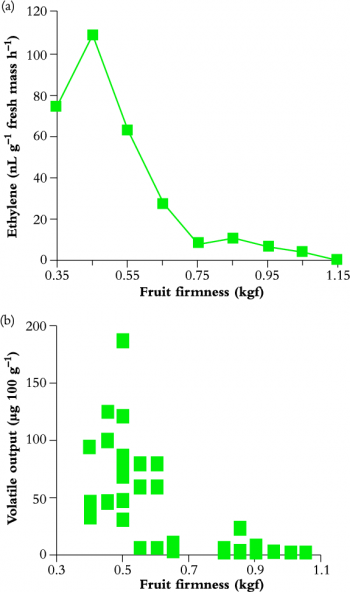
Figure 11.12 Ethylene production, total volatiles (including flavour compounds) and tissue firmness are interrelated in ripening kiwifruit. Production of ethylene (a) is highest from soft fruit, with firmness of around 0.45 kgf. Fruit is considered soft and ripe enough to eat once firmness falls below 0.7 kgf. As fruit soften, production of specific aroma compunds (volatiles in (b)) rises dramatically as fruit pass through their climacteric. Ethylene production and aroma production are biochemically linked.
(Based on Paterson et al. 1991)
Several major changes can take place as fruits ripen. Not all occur in every type of fruit, but taken collectively they charac-terise ripening processes. They include:
1. a rise in respiration rate;
2. production of ethylene;
3. flesh softening;
4. appearance of colour;
5. formation of volatiles with associated development of flavour (Figure 11.12).
One prime objective of a postharvest physiologist is to ensure these changes occur immediately prior to fruit purchase or in the hands of a consumer. Sometimes all events take place at about the same time, denoting the time of optimal eating quality. However, the linkage is not a rigid one. Throughout ripening, respiration remains tightly coupled (Section 2.4) so that one consequence of increased respiration is an increase in available energy as ATP. Biological energy is used for many biosynthetic events, and more ATP is consumed during ripening to produce the many attractive characteristics of a ripe fruit.
 [15]
Table 11.2
 [16]
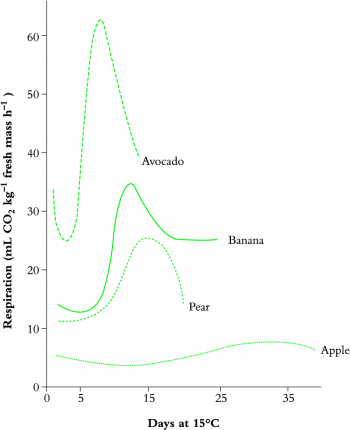
Figure 11.13 Respiratory output of CO2 can undergo dramatic change as fruits ripen. Early research on apple and pear led to a classic model of a postharvest climacteric rise associated with ripening and linked in time with ethylene production. Studies with tropical fruits such as avocado and banana then revealed characteristic 'waveforms' of even wider amplitude.
(Based on Biale 1950; Tucker 1993)
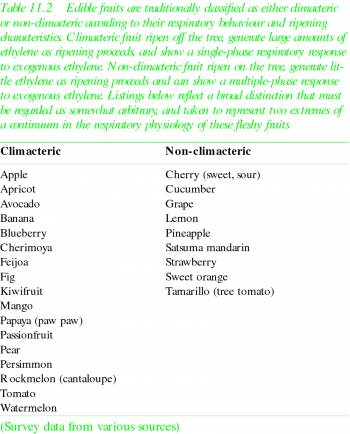
Ethylene production is closely associated with ripening of many fruits. Typically, fruit will generate barely detectable amounts until ripening when there is a burst of production. Fruit fall more or less into two classes of behaviour (Table 11.2) with respect to ethylene physiology. In type 1, as fruit progress towards edibility, respiratory rate increases followed by a decline as fruit senesce. Pear, banana and avocado (Figure 11.13) show an especially strong response. Ethylene pro-duction also increases sharply to a maximum at this time, and then declines before fruit rots intervene and lead to a renewed output. The major rise in ethylene production may take place before, just after or close to the respiratory peak. Such fruit are classed as climacteric, with apple, avocado, banana, fig, mango, papaya, passionfruit, pear and tomato being classic examples. Climacteric fruit ripen after harvest, and need not remain on the tree or vine. Type 2 fruit, exemplified by blueberry, cherry, citrus, cucumber, grape, pineapple and strawberry (Table 11.2) do not show such sharp changes. Respiration rate either remains unchanged or shows a steady decline until senescence intervenes, with no increase in ethylene production; these are called non-climacteric fruits. Paradoxically, both unripe climacteric and non-climacteric fruit do increase their respiration rate when exposed to exogenous ethylene.
All fruits were once classified under this either/or nomenclature but many variations between the two types became apparent, so the original classification is better seen as two extremes of a continuum. For example, kiwifruit progress through most of the ripening changes in the absence of any rise in ethylene and CO2 production; this occurs only towards the end of ripening and softening as fruit are undergoing middle lamella dissolution. Ripening is no longer perceived as always being driven by ethylene production or by a rise in respiration.
Ethylene is both a promoter and a product of fruit ripening, and an accelerant of senescence in vegetables and cut flowers. Ethylene hastens ripening in a number of fruit (Tucker 1993), and despite contrasts in endogenous ethylene production most fruits nevertheless respond to exogenous ethylene as an external ripening trigger.
In climacteric fruits, ethylene exposure brings about an autocatalytic production of ethylene, and ripening proceeds rapidly, continuing even when exogenous ethylene has been removed. In non-climacteric fruits, when ethylene is present loss of chlorophyll proceeds more rapidly and respiration increases.
Taking kiwifruit as a test case, ethylene promotes ripening, but if exposure to ethylene is insufficient, or fruit are too immature, then removal of ethylene results in non-climacteric behaviour. Ethylene as a ripening trigger is used commercially with banana, avocado and early-season kiwifruit to ensure that fruit are at optimum ripeness when eaten. Conversely if kiwifruit are to be stored a long time, then ambient ethylene must be removed (usually by scrubbing this gas from coolstore environments).
 [17]
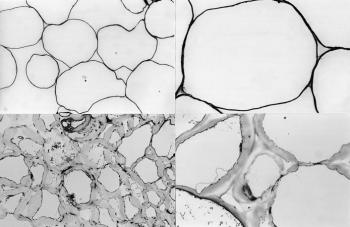
Figure 11.14 Anatomical features greatly influence our perception of fruit texture and eating pleasure. Contrasting apple with kiwifruit, cell size, wall thickness and distribution of intercellular gas spaces are all relevant to species differences and changes that accompany ripening. Cross-sections of ripe apple flesh (top pair) and ripe kiwifruit flesh (bottom pair) at low (x120) and high (x310) magnification. The apple tissue (top left) shows cells having densely staining thin walls. Tissue from kiwifruit (bottom left) shows cells with thick, swollen and weakly staining walls. The two right-hand figures give views of individual cells, corresponding to the tissue views.
(Photomicrographs courtesy I.C. Hallett, E.A. MacRae and T.F. Wegrzyn)
Characteristic textures of different fruits and their manner of softening can be linked with anatomical features (Figure 11.14). Some fruit which are picked while hard subsequently soften markedly as a result of extensive modifications to cell wall structure. Other fruit such as apple or watermelon remain crisp and soften only slightly. Their thin cell walls remain relatively unaltered. Both types of softening occur in the pear family: Asian pear (Nashi) shows a crisp apple-like texture, whereas many European pears soften to give ripe fruit a melting texture. Interspecific crosses between the two types show that texture is heritable (Harker et al. 1996).
Many textural characteristics relate to the fate of fruit flesh when fractured and crushed in the mouth. Contributing factors include cell size, cell adhesion, turgor and packing, wall thickness, wall composition and the reaction of cells to shearing stress as they are chewed (Harker et al. 1996). For example, an apple has large (0.1–0.3 mm diameter), turgid, thin-walled cells that are loosely packed (airspace c. 20% of fruit volume). When that flesh is chewed, cells fracture and release their sugary contents as free juice. In contrast, kiwifruit has minimal airspace (c. 2% of fruit volume) and cell walls are thick and hydrophilic (Figure 11.14). Such cells tend to pull apart when the flesh is chewed, resulting in a paste moistened by liquid held in cell walls or released by damaged cells. Avocado also has cells with walls that are thick and soft and which tend to pull apart as in kiwifruit, but avocado also has a high proportion of oil that gives the pulp an oily quality in the mouth.
 [18]
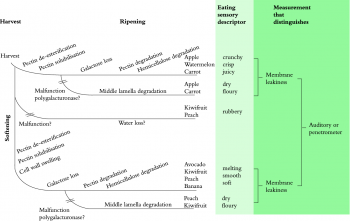
Figure 11.15 A schematic diagram of ripening processes in different types of fruit that result in distinctive eating qualities. Limited degradation and swelling of cell walls results in turgid cells that burst as the fruit is chewed, giving a crisp and juicy texture. If degradation proceeds further, cell walls become swollen and some cells tend to pull apart as the fruit is chewed, giving a smooth paste in the mouth with a melting texture. If the middle lamella is completely broken down, there is even less release of cell contents and a floury texture is experienced.
(Original diagram courtesy R.L. Bieleski)
Cell wall softening thus plays an important part in determining fruit texture and ripening characteristics (Figure 11.15). This involves modification and/or removal of various polysaccharides making up pectin and hemicellulose wall components. Wall softening has been the subject of much research worldwide, mostly using tomato as a model, but also other fruits in the search for common themes. Consistent changes include an increasing hydrophilic character of the cell wall as it thickens and swells, pectin solubilisation, reduction of size of individual polymers after solubilisation, and loss of galactose from individual polymers (e.g. Hobson and Grierson 1993; Redgwell et al. 1997) (Figure 11.15). Polygalacturonase (an enzyme that solubilises and degrades pectins) increased de novo 10–50-fold in tomato fruit during ripening (see Brady 1987). Understandably this enzyme was originally accorded a major role in controlling ripening. Studies with transgenic tomatoes have since shown otherwise (Section 11.7).
Kiwifruit softening has also been intensively studied (Harker et al. 1996) and chemical analyses of cell wall components show some consistent changes during early stages of ripening. These include:
Once kiwifruit have begun softening to ripeness, but prior to the climacteric rise and associated dissolution of middle lamellae, these changes continue. There is a further increase in pectin solubilisation, galactose loss, and cell wall swelling as well as degradation of pectins and a reduction in the size of xyloglucan polymers. All these chemical changes reach their maximum prior to the climacteric rise. Such results (along with associated studies on the enzymes polygalacturonase, b-galactosidase, pectin methyl esterase and xyloglucan endoglycosyltransferase) indicate that pectin solubilisation and cell wall swelling are important events in the control of kiwifruit softening. However, detailed mechanisms are still unclear.
 [19]
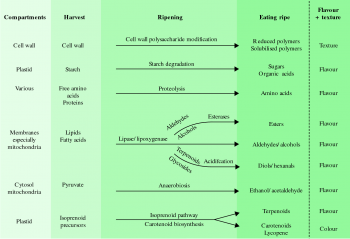
Figure 11.16 A schematic diagram of biochemical changes in different cell compartments as fruit mature, ripen and become edible. Numerous compounds contributed by various processes combine to create the sensory properties associated with texture, flavour and colour that are found attractive.
(Original diagram courtesy R.L. Bieleski)
During ripening (Figure 11.16) most fruit change colour. Their bright colour which evolved to attract dispersal agents such as birds, browsing animals and primates now becomes a particularly important visible indicator of maturity and ripeness. Pomefruit, stonefruit and strawberries provide good examples where colour is a prime indicator of ripeness.
By analogy with senescence in most green tissues such as leaves, colour change by fruits involves chlorophyll loss and an increase in production of yellow, orange, red or purple pigments. Yellow, orange or red pigmentation, as seen in oranges and tomatoes, arises from conversion of chloroplasts to chromo-plasts (Figure 11.16). New proteins are formed as end-products of the phytoene pathway and lead to accumulation of yellow-orange carotenoids or red lycopene. Red and purple pigments of the type seen in grapes and boysenberries result from products of the anthocyanin pathway, and are located in vacuoles. Both types of pigment can occur in the same fruit.
Not all fruit show definite colour changes as they ripen, so other indices of their physiological state are needed. Next to colour, humans rely on aroma to detect when fruit is ready to eat. Later stages of ripening in almost all fruits are accompanied by a production of volatile compounds (volatiles), creating much of the attractiveness to birds, fruit bats, browsing animals and insects. Maturity at harvest strongly influences the capac-ity of a fruit to produce a characteristic suite of volatiles, and some fruits can only be harvested at about the time when the first volatiles are already being produced.
 [20]
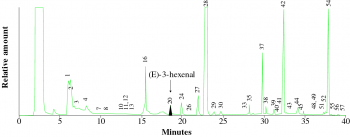
Figure 11.17 Aroma volatiles collected from a sample of kiwifruit juice can be separated by capillary gas chromatography. Amidst these multiple peaks, some 'fingerprint' compounds have been identified. '1' is ethyl acetate; '4' is ethanol; '12' is ethyl butanoate; '16' is hexanal; '28' is E-2-hexanal; '37' is hexanol. In this sample, peak 20 (E-3-hexenal) was responsible for an unpleasant 'off' flavour despite a meagre prescence.
(Original data courtesy H.Young, HortResearch, Auckland)
These volatiles join with sugars and acids in creating the flavour profile that is unique to each fruit (Figure 11.17). In general, one or two key compounds are regarded as characteristic for fruit of given species or cultivars, and are often used in synthetic mixtures to represent that commodity. Flavour agents for most fruits contain a mixture of volatile acids, aldehydes, alcohols, esters, terpenoids and aromatics. Because human taste sensations and experiences play such an important part in characterising these compounds, a vocabulary has developed to describe their sensory nature. The terms mostly used are ones which relate a particular flavour sensation to that of a widely available standard, and have led to terms like ‘buttery’, ‘grassy’, ‘floral’, ‘vanilla’ and ‘citrus’.
Surprisingly little is known about biosynthetic pathways or control processes for production of flavour compounds. Aside from ethanol and acetaldehyde, which are generally produced from sugars by anaerobic respiration, many are derived from fatty acids which form part of the membrane lipids. Lipases or hydrolases initially cleave off the fatty acids, then lipoxygenases and/or isomerases and/or lyases produce aldehydes such as E-2-hexenal. These compounds have ‘grassy’ aromas reminiscent of green peppers, and are also produced in leaves as a response to wounding. Alcohol dehydrogenases can then transform aldehydes to the corresponding alcohols, which also contribute to ‘green’ aromas. Esterases then probably act on alcohols to form esters, which generally contribute ‘fruity’ and ‘sweet’ characteristics. Such esters often become prominent during over-ripeness and senescence.
Even less is known about the terpenoids which also contribute to a total flavour profile. Some come from glycosidic precursors through action of a glucosidase, or may result from acid catalysis when compartmentation between vacuolar and cytoplasmic contents is lost on completion of ripening.
Examples of fruit where important volatiles have been identified include: mango — ocimene, myrcene and dimethylstyrene; muskmelon (cantaloupe) — ethyl-2-methyl butyrate, 3-methyl butyl acetate, ethyl butyrate, ethyl hexanoate, hexyl and benzyl acetate and some nine-carbon alcohols and aldehydes; apple and pear — two- to six-carbon esters such as butyl ethanoate, 2-methyl butyl ethanoate and hexyl ethanoate; strawberry — furaneol.
Specific volatiles are especially important in wine grapes where an individual volatile can become the dominant charac-teristic used in marketing a specific wine type. Examples include the ‘grassy’ character of methoxypyrazine in Sauvignon Blanc, the ‘richness’ of b-damacenone in red wine, or the ‘foxy’ character of methyl anthranilate produced by Vitis labruscana.
Kiwifruit appear to lack fingerprint volatiles. Instead, they are characterised by a balance of esters, aldehydes and alcohols in which branched volatiles or terpenoids are poorly re-presented (Figure 11.17; Paterson et al. 1991). Ethyl butanoate and E-2-hexenal contribute most to an overall impression, with butanoate having a positive effect and aldehydes a negative effect on consumer response to flavour intensity. A characteristic kiwifruit aroma and flavour requires both compounds plus hexanal but other compounds not yet defined are also needed.
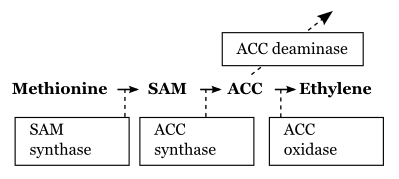
Ethylene metabolism has been a main focus for biochemical research into fruit behaviour (see Feature essay 11.1). Following 30 years of biochemical studies, transgenic plants with modifications to the ethylene synthetic pathway have now been used to explore ways of controlling fruit ripening. The pathway of biosynthesis is as follows: methionine (a sulphur-containing amino acid also important in protein synthesis) is converted to SAM (S-adenosylmethionine) through the action of SAM synthase; SAM is converted to ACC (amino-cyclopropane carboxylate) through action of ACC synthase; ACC is converted to ethylene through action of ACC oxidase. In summary:
 [21]
Transgenic tomatoes have yielded much information about steps in the control of ripening (Gray et al. 1994). On the one hand, fruit with reduced levels of ACC oxidase arising from antisense ACC oxidase constructs (Section 11.7) developed and grew normally. The only changes were delays in ripening and over-ripening and a reduction in shrivelling associated with senescence. All ripening processes still occurred. One interesting difference related to fruit harvest. Fruit remaining on vines ripened much faster than those which were detached when mature and ripened off the plant. On the other hand, fruit with much reduced ACC synthase activity from an antisense ACC synthase construct were unable to produce ethylene during fruit ripening (the level was 0.5% of normal). These fruit were severely delayed in colouring and in onset of the respiratory climacteric, and were slow to soften. Similarly, removal of ACC by formation of an inert side-product due to bacterial ACC deaminase resulted in fruit with similar characteristics to the two previous examples. Fruit with a high level of ACC deaminase were more like fruit with reduced ACC synthase, whereas those with moderate levels of ACC deaminase resembled fruit with reduced ACC oxidase.
Such experiments imply that there are many parallel processes which accompany ethylene responses, but are not specifically dependent on ethylene. That is, ethylene does not control all the processes of ripening as once believed. Rather, ethylene interacts with gene expression at both transcriptional and translational levels, acts as a modulator of ripening and can coordinate some of the processes (see Hobson and Grierson 1993). Future research will concentrate on the nature of ethylene receptors and how they in turn modulate gene expression.
In contrast to other fruit such as banana or apple, kiwifruit produce very low quantities of ethylene, yet are very sensitive to this hormone (Beever and Hopkirk 1990; Given 1993). An absolute minimum threshold has not yet been determined, but is known to be below 0.5 µL L–1 air. This sensitivity is such that kiwifruit can be triggered to ripen by nearby ripening apples or bananas. As a consequence, the kiwifruit industry is very strict in its control of ethylene sources (such as car exhaust) in handling and packing environments, and during storage.
Barry McGlasson
 [22]
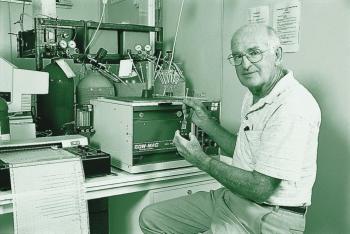
Figure 1 Barry McGlasson, University of Western Sydney Hawkesbury, Richmond Campus, at his gas chromatograph (fitted with flame ionisation detector) analysing ethylene concentration in gas samples taken from air exiting enclosed containers of harvested plums.
Plants, fungi and bacteria produce a host of volatile com-pounds. Some attract or repel animals, some create powerful emotions in humans and some induce morphological and metabolic changes in adjacent plant tissues. Of all these emanations only ethylene is recognised as a natural gaseous plant hormone.
Ethylene has been used unintentionally to manipulate crops such as fig as far back as the third century bc. The sycamore fig originated in eastern central Africa, where it was naturally pollinated by a small wasp that makes its home inside the fruit. When the sycamore fig was taken into the eastern Mediterranean countries, including Egypt, pollinating wasps were left behind. Nevertheless, young fruit which were mechanically injured set parthenocarpically and ripened without seed! A 1633 herbal noted that ‘It bringeth forth fruit oftener if it be scraped with an iron knife, or other like instrument’. The fruit is ‘like in juice and taste to the wilde fig, but sweeter, and without any grains or seeds within’. We now know that wounding young fruit would have stimulated ethylene production and this gas induced those figs to grow and develop parthenocarpically. David Blanpied summed up this piece of history by recasting Amos 7:14 (OT), ‘I was no prophet, neither was I a prophet’s son; but I was an herdsman, a gatherer of sycamore fruit’, as ‘I was an herdsman and an activator of ACC synthase in sycamore figs’ (Blanpied 1985).
Blanpied’s quotation nicely sums up the history of ethylene as a plant hormone because it takes us from simple fruit behaviour to underlying biochemistry. Once the presence of ethylene in plant emanations was proved chemically, a lively debate followed as to whether a gas could really be defined as a hormone. There were two major developments that resolved this issue. First was the invention of gas chromatography which soon enabled measurement of ethylene at concentrations that were physiologically meaningful and in small gas volumes (Burg and Stolwijk 1959). Second, a non-volatile plant product, 1-aminocyclopropane-1-carboxylate, was found to be the immediate precursor of ethylene (Adams and Yang 1979). Any lingering doubts that ethylene was a plant hormone have now been completely erased by application of molecular methods.
This story of ethylene mixes applications of plant physiology with human intuition, and is conveniently related to three eras that represent technical evolution in this area of plant science, namely, pre-1935 (an age of mystery), 1935–1979 (an age of enlightenment) and post-1979 (an age of opportunity).
In 1858, Fahnestock in the USA observed that illuminating gas caused plant senescence and leaf abscission, and Girardin (1864) in France subsequently showed that ethylene was a component of illuminating gas. Many suspected that such plant responses were due to ethylene, but it took a Russian student, Neljubov (1879–1926), to establish that ethylene is a biologically active compound. As a young man he observed that pea seedlings germinated in the dark grew in a horizontal direction when exposed to laboratory air containing burnt gas. He showed that the plants resumed normal growth when the air was first passed over heated CuO to oxidise hydrocarbon gases. This growth response was used as a bioassay for the next 50 years. We now know that these pea seedling responses are induced by as little as 0.06 µL L–1 ethylene.
Many publications from around 1910 indicated that ethylene was produced by ripening fruit such as pears and apples. By 1923, Denny (US Department of Agriculture) had patented ethylene for ripening bananas, tomatoes and pears, removing astringency from persimmons and loosening walnut husks. Finally (1934) Gane in Britain produced conclusive proof that ethylene is a natural product of plants, and to obtain enough ethylene for his tests he collected gases from about 28 kg of apples. He extended this proof to other fruits a year later.
Following Gane’s confirmation that ethylene generation was common in fruits, research interests broadened beyond this simple ethylene–fruit connection. By 1940 the postharvest pioneer Jacob Biale (University of California, Los Angeles) showed that green citrus mould (Penicillium digitatum) also produced ethylene, thereby extending ethylene physiology to plant–fungus interactions. Hormonal interrelations entered this picture when the synthetic auxin 2,4-D was later shown to stimulate ethylene production by plants (Morgan and Hall 1962), confirming earlier indirect observations on auxin responses (Zimmerman and Wilcoxon 1935). Ethylene was by now acknowledged as instrumental in fruit ripening, but a nagging question remained as to whether ethylene was a true ripening hormone or merely a by-product of ripening events (Biale et al. 1954). I entered the field at this stage, and to resolve this issue of hormone status we needed to establish whether ethylene production by fruits increased ahead of ripening. Progress in unravelling cause and effect would hinge on development of a sensitive assay for ethylene.
Strong indications of ethylene involvement in ripening came from Workman and Pratt (1957). These authors used cold mercuric perchlorate solutions to bind specifically ethylene rather than other gases, and thus trap a sufficient amount from ripening tomatoes to measure it manometrically. However, the much greater sensitivity of gas chromatography subsequently allowed Burg and Stolwijk (1959) to demonstrate via frequent monitoring that ethylene production actually precedes the onset of ripening in some fruit.
Scientifically, these were exciting times. As a PhD student at the University of California, Davis, I was a member of one of the first teams to use a gas chromatograph fitted with a flame ionisation detector to measure internal ethylene con-cen-trations in a ripening fruit (Lyons et al. 1962). We showed conclusively that cantaloupe (rockmelon) was climacteric. Harvested fruit showed an increase in ethylene production with onset of a respiratory climacteric and ripening.
 [23]
Figure 2 Ethylene generation influences postharvest behaviour of Cymbidium flowers. When the pollen cap is removed from the floral column either by insect pollination or by human mishandling, endogenous ethylene production is triggered in that flower (left side), bringing about anthocyanin synthesis, cupping of petals and swelling of column tissues within 3 d. Intact flowers (right side) remain fresh for three weeks. Scale bar = 1 cm.
(Photograph courtesy R.L. Bieleski)
Over the next 20 years an explosion of publications docu-mented ethylene involvement in many plant responses. Burg and Burg (1960s) demonstrated that ethylene was essential for ripening as well as other developmental events in plants. Senescence is a case in point, and a clear ethylene response is shown in Figure 2 for Cymbidium flowers.
A further practical development from ethylene research dates from 1963 with synthesis of ‘Ethephon’ (2-chloroethyl-phosphonic acid) (also called ‘Ethrel’). This water-soluble compound is readily absorbed by plants, and breaks down to release ethylene above pH 4.6. Ethephon thus provides a convenient way of applying ethylene to plants under field con-ditions and is still widely used to promote uniform maturation of processing tomatoes as an aid to mechanical harvesting.
Three broad research themes in ethylene physiology were now underway: mode of action, inhibition of action and biosynthesis. However, a major problem confounding our best efforts in all three areas was the autocatalytic behaviour of ethylene. This gas stimulates its own production, so how do you distinguish between the external ethylene you have applied experimentally as a stimulus, and the endogenous ethylene which is produced as a response by the plant tissues? Con-fronted by this dilemma, we devised a neat trick based upon a closely related gas (McMurchie et al. 1972). Propylene is a three-carbon analogue of two-carbon ethylene, and can stimulate typical ethylene responses! Moreover, propylene is also easily distinguished from ethylene by gas chromato-graphy. We now had an elegant tool for analysis of ethylene physiology.
Spurred by this development, we applied propylene to citrus fruit (non-climacteric) and to bananas (climacteric) to mimic an exogenous ethylene stimulus, and measured endo-genous ethylene production directly. Citrus respiration was stimulated without any increase in ethylene production, whereas in banana both respiration and endogenous ethylene production were stimulated. These outcomes were consistent with our paradigm of ripening in climacteric versus non-climacteric fruit.
Once ethylene was widely acknowledged as a ripening hormone, there was a strong demand by industry for practical control methods in order to extend fruit storage life. Our original approach was to remove ethylene from fruit storage atmospheres by scrubbing with oxidising agents such as per-manganate. Commercial absorbents containing permanganate are available but inconvenient to use because the absorbent has to be packaged to prevent contact with stored fruit. The search for other ways of avoiding or inhibiting ethylene action continued. By 1976, Beyer showed that silver ions are a potent inhibitor of ethylene action, and a new set of management options opened up immediately. Ag+ is readily bound by plant tissue but not easily translocated and thus of limited ap-plication. However, the silver thiosulphate complex (STS) is negatively charged and can move readily through plant tissues. This observation had little practical value for fruits which are eaten, but has had wide use in slowing the ethylene-driven senescence of cut flowers. In 1979 Sisler introduced volatile unsaturated ring compounds as inhibitors of ethylene action, the most potent being norbornadiene. Sisler has subsequently developed 1-methylcyclopropene (1-MCP), a gaseous com-pound which is essentially an irreversible inhibitor and safe to use (Sisler and Serek 1997).
While ethylene was gaining wider application in post-harvest physiology, research continued with unravelling the biosynthetic pathway. The first clue came when Lieberman and Mapson (1964) supplied the general precursor 14C-methionine to ripening tissue and found 14C activity in the ethylene produced. Methionine had been noted as a possible precursor from the discovery that rhizobitoxin inhibits ethylene production (Owens et al. 1971). Rhizobitoxin inhibits pyridoxal phosphate-containing enzymes of the kind involved in methionine-utilising pathways. Adams and Yang (1977) working at UC Davis then showed convincingly that S-adenosylmethionine (SAM) rather than methionine was a key precursor in ethylene biosynthesis. Two years later they topped this triumph by discovering the immediate precursor of ethylene, namely 1-aminocyclopropane-1-carboxylate (commonly abbreviated to ACC). Within another few years, Yang and co-workers had managed to define the biochemical pathways that generate ACC from methionine via SAM.
Major advances in our knowledge of ethylene biosynthesis and physiological roles have come from gene technology. The chain of biochemical steps from SAM to ethylene is now known, and the genetic codes for enzymes involved have been defined. Detailed characterisation of ACC oxidase in particular was a significant outcome of gene technology. Despite years of effort, all attempts to extract the enzyme had failed. It was widely believed to be associated with the cell membranes, because activity was lost once the cells were disrupted. Recognising that each protein (enzyme) is linked to its unique gene (DNA) through a unique mRNA, Grierson and co-workers searched for mRNAs that increase during tomato ripening. This was a predicted behaviour for the mRNA modulating ACC oxidase, an enzyme that increases markedly in tissue activity during ripening. Expression of one particular cDNA clone enabled the enzyme to be ‘fished’ from tissue extracts. As a result this enzyme proved to be soluble (cytoplasmic) and not membrane bound.
Increased awareness of genes involved in ethylene biology creates opportunities for answering many remaining questions about ethylene-driven behaviour. One that continues to hold my curiosity concerns regulation of ethylene production in relation to ontogeny of plant organs, an issue unresolved since my early work with developing tomato fruit. In those experiments, I observed that tomato fruit harvested less than 15 d after anthesis failed to undergo normal ripening whereas fruit harvested somewhat later began ripening in a few days (McGlasson and Adato 1977). How then are ethylene-driven events coordinated with organ ontogeny?
Answers will come when we understand the mode of ethylene action, and as an initial step analogous to other areas of hormone physiology ethylene receptors have now been identified (Section 9.2.1).
Molecular tools offer new clues, given the exciting dis-covery of mutant genes from Arabidopsis thaliana plants that are insensitive to ethylene. Insensitive mutants have enabled isolation of the ETR1 gene which encodes a protein that binds ethylene and is antagonised by competitors of ethylene action. Similarly, a ripening-impaired mutant tomato (Never Ripe) has been found to contain a homologue of ETR1 that encodes proteins lacking the ability to receive ethylene (Section 9.3.3). The question remains of how many kinds of ethylene receptors there are.
In 1972 we established a distinction between climacteric and non-climacteric fruit in their response to exogenous ethylene that led us to propose two systems for regulation of ethylene production. System 1 would be responsible for back-ground ethylene production found in non-climacteric fruit and in pre-climacteric fruit. System 2 would account for the increased ethylene production associated with ripening in climacteric fruit. It will be especially gratifying if future devel-opments confirm our original model.
As a step in this direction, we know that propylene induces a rapid increase in respiration without any increase in endo-genous ethylene production with pre-climacteric fruit. 1-MCP has turned out to be a very useful tool for distinguishing between events regulated by ethylene and those that are independent. We have found that 1-MCP prevents the initial increase in respiration in Japanese plums induced by propylene as well as delaying normal ripening and the accompanying ethylene and respiratory climacterics. Because 1-MCP binds so strongly it could greatly assist our efforts to recover and characterise native ethylene receptors.
Gene technology in conjunction with better recognition and utilisation of natural fruit variants will almost certainly enable us to develop cultivars of highly perishable commodities such as stonefruit that will cool store longer and have better shelf life. Transgenic tomatoes and melons already exist which require ethylene treatment to ripen. Natural mutants of nectarines have been reported that require ethylene treatment to ripen and we have described two cultivars of slow-ripening Japanese plums with a suppressed ethylene climacteric pheno-type (Abdi et al. 1997). In contrast to normal cultivars, when treated with 1-MCP the slow-ripening plums seem unable to regenerate ethylene receptors unless they are treated with propylene. (This application calls for propylene so that pro-duction of endogenous ethylene can be detected.)
Once applied, these new technologies could provide horti-culture with ‘designer fruit’ which are initially insensitive to ethylene and consequently easy to store. As required, this stored fruit could then be dosed with gas to produce ethylene receptors and thus trigger ripening. As shown experimentally, propylene would work, but ethylene will be preferred for commercial applications on grounds of lower cost and higher activity.
Abdi, N., Holford, P., McGlasson, W.B. and Mizrahi, Y. (1997). ‘Ripening behaviour and responses to propylene in four Japanese type plums’, Postharvest Biology & Technology,
12, 21–34.
Adams, D.O. and Yang, S.F. (1977). ‘Methionine metabolism in apple tissue’, Plant Physiology, 60, 892–896.
Adams, D.O. and Yang, S.F. (1979). ‘Ethylene synthesis: identification of 1-aminocyclopropane-1-carboxylic acid as an intermediate in the conversion of methionine to ethylene’, Proceedings of the National Academy of Science, USA, 76, 170–174.
Biale, J.B., Young, R.E. and Olmstead, A.J. (1954). ‘Fruit respiration and ethylene production’, Plant Physiology, 29, 168–174.
Blanpied, G.D. (1985). ‘Introduction to the symposium, Ethylene in postharvest biology and technology of horticultural crops’, HortScience, 20, 40–41.
Burg, S.P. and Stolwijk, J.A.A. (1959). ‘A highly sensitive katharometer and its application to the measurement of ethylene and other gases of biological importance’, Journal of Microbiological and Technological Engineering, 1, 245–259.
Lieberman, M. and Mapson, L.W. (1964). ‘Genesis and biogenesis of ethylene’, Nature, 204, 343–345.
Lyons, J.M., McGlasson, W.B. and Pratt, H.K. (1962). ‘Ethylene production, respiration, and internal gas concentrations in cantaloupe fruits at various stages of maturity’, Plant Physiology, 37, 31–36.
McGlasson, W.B. and Adato, I. (1977). ‘Relationship between the capacity to ripen and ontogeny in tomato fruits’, Australian Journal of Plant Physiology, 4, 451–458.
McMurchie, E.J., McGlasson, W.B. and Eaks, I.L. (1972). ‘Treatment of fruits with propylene gives information about the biogenesis of ethylene’, Nature, 237, 235–236.
Morgan, P.W. and Hall, W.C. (1962). ‘Effect of 2,4-diclorophenoxyacetic acid on the production of ethylene by cotton and grain sorghum’, Physiologia Plantarum, 15, 420–427.
Owens, L.D., Lieberman, M. and Kunishi, A. (1971). ‘Inhibition of ethylene production by rhizobitoxine’, Plant Physiology,
48, 1–4.
Sisler, E.C. and Serek, M. (1997). ‘Inhibitors of ethylene responses in plants at the receptor level: recent developments’, Physiologia Plantarum, 100, 577–582.
Workman, M. and Pratt, H.K. (1957). ‘Studies on the physiology of tomato fruits. II. Ethylene production at 20°C as related to respiration, ripening and date of harvest’, Plant Physiology,
32, 330–334.
Zimmerman, R.H. and Wilcoxon, F. (1935). ‘Several chemical growth substances which cause initiation of roots and other responses in plants’, Contributions Boyce Thompson Institute of Plant Research, 7, 209–229.
Abeles, F.B., Morgan, P.W. and Saltveit, M.E. (1992). Ethylene in Plant Biology, 2nd edn, Academic Press: San Diego.
Wills, R., McGlasson, B., Graham, D. and Joyce, D. (1998). Postharvest: An Introduction to the Physiology and Handling of Fruit, Vegetables and Ornamentals, 4th edn, UNSW Press: Sydney.
One broad approach to conferring longer storage life on any plant product is to slow metabolism by holding material at low temperature. Additional methods introduced since the 1960s have been superimposed on cool storage and fall into two general classes: specific gas atmospheres to slow fruit metabolism even further and pretreatments that bring tissues into a state that improves their subsequent storage life (Figure 11.18). Specific temperature management techniques are discussed below. Other examples of extended storage include drying in crops such as onions and wheat, ‘curing’ kumara (sweet potato) prior to storage and ‘pulsing’ cut flowers with sucrose to build up carbohydrates and thus prolong shelf life.
Fruit were originally held in cold caves at prevailing temperatures, but experience showed that a ‘best’ temperature can be sharply defined, and may differ between species or even cultivars (Wang 1991). At one extreme, freezing irreversibly damages a living product so that –0.5°C is generally the lowest temperature used. Apple cultivars are often best stored at or close to this minimum. In contrast, some fruits of tropical origin (avocado, banana) suffer chilling injury (Section 14.4) and store best between 7–10°C or 12–13°C respectively. Even persimmon, a temperate plant in many respects, has an optimum storage temperature of around 10°C, tolerating 0°C for only short periods.
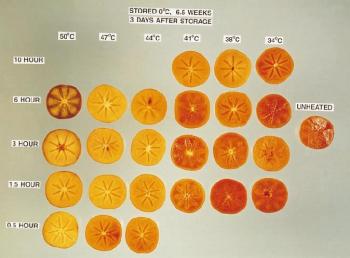 [24]
Figure 11.18 Paradoxically, heat treatment extends subsequent storage life of persimmons at low temperature (6.5 weeks at 0°C). Untreated fruit (far right) suffer from cold injury and disintegrate following removal from cold store. Fruit pretreated at 50°C for more than 2 h suffer heat damage and the polyphenols become oxidised (top left). However, there is a window of treatment intensity that allows fruit storage at 0°C without damage for a full term. This window is shown as a band of light-coloured fruit rising from the bottom left to the right (0.5-1.5 h at 50°C, 1.5-6 h at 47°C, and 3-6 h at 44°C).
(Original data courtesy A.B. Woolf)
At 0°C, respiration is reduced to a level that is just enough to maintain cell function. Sugar is slowly consumed during this process so that fruit with a low sugar content at harvest are less durable. Commodities such as kiwifruit, which are picked with large supplies of carbohydrate in the form of starch, have an additional source of sugar to utilise, giving longer storage lives than those entirely reliant on soluble reserves, such as grapes.
Low-temperature storage has played an important part in the development of successful fruit export industries in Australasia, because of the great shipping distances between orchard and consumer. The success of kiwifruit as a new fruit has been largely due to its ability to be stored at 0°C for six months or more with no detriment to flavour or texture (see Beever and Hopkirk 1990).
Associated with low-temperature storage is a wide range of techniques to manage temperature changes en route to storage (Kader et al. 1985; McDonald 1990). Again there are strong species differences. Speed of cooling and methods employed for heat extraction are both important. There can be passive or forced air cooling, evaporative cooling of leafy vegetables, use of dry air or moisture-laden air and harsh or gentle techniques. For example, kiwifruit packed into trays and held on standard pallets can take a week to cool from ambient temperatures around 15–20°C to their storage temperature of –0.5–0°C. Forced air cooling can do this in only 8–10 h, yielding fruit that are much firmer, easier to handle and longer lasting.
Temperature change can be usefully imposed as a sequence of steps. In ‘ramping down’, temperature is reduced to an intermediate point, held there for a brief time, then again reduced to the final storage temperature. In ‘preconditioning’, fruit is held for a longer time at a pretreatment temperature, then taken rapidly to its final storage temperature. This is becoming an important commercial method for increasing tolerance to low temperatures. Preconditioning temperatures may be elevated, as in heat preconditioning, or close to the temperature which normally causes chilling damage. In each case, the pretreatment is intended to increase uniformity of fruit behaviour and allow fruit to adjust metabolically to reduced temperatures.
One further variant that sometimes gives better storage behaviour is to pretreat fruit to a temperature as high as 47°C (Figure 11.18), or else impose ‘intermittent warming’ where fruit is occasionally brought back to room temperature (Paull 1990). High-temperature effects were uncovered during a search for alternatives to pest fumigation and are now used quite empirically to good effect.
Humidity levels are often combined with temperature manage-ment. Lowering temperature in coolstores generally lowers relative humidity because water condenses on heat exchangers during cooling. Storage problems may arise due to water loss rather than fruit temperature alone, and so it is generally desirable to maintain a high relative humidity (>95%). With kiwifruit, there is generally only a 1–2% water loss during six months’ storage if high-humidity conditions are maintained, compared to 4% or more when there is no effort to raise coolstore humidity.
Some fruits, flowers and vegetables are extremely susceptible to water loss (e.g. wilting of lettuce and deterioration of lychee), and in such cases the relative humidity needs to be held close to 100%. With valuable products like Cymbidium orchids, each flower stem may be fitted with a vial holding water to supply it throughout the storage period. The problem is compounded because flowers and leaves have a much greater surface area with many stomata whereas bulky fruit generally have a waxy coat and lack stomata. Their moisture loss occurs via calyces and fruit pedicels.
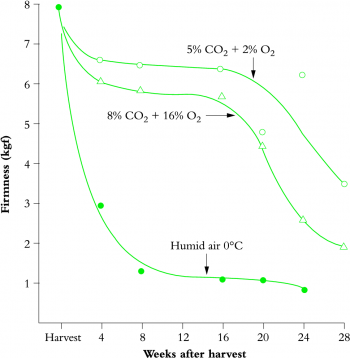 [25]
Figure 11.19 Storage life of kiwifruit can be greatly extended by controlled atmospheres. Under standard conditions (humidified air, 0°C) firmness declines exponentially over time, reaching limited acceptability by 8 weeks. Storage life ends once fruit firmness drops below about 0.9 kgf. Fruit are then soft enough to eat. Softening in cold store was slowed and storage life greatly extended by holding fruit in atmospheres containing either 5% CO2 + 2% O2 (top curve) or 8% CO2 + 16% O2 (middle curve).
(Based on McDonald and Harman 1982)
Rates of metabolism can be reduced and storage life further extended by modifying atmospheric composition during storage. Elevated CO2 and reduced O2, used either separately or together, can delay ripening and slow onset of senescence (Figure 11.19). These methods were originally developed on a commercial scale for apples, but have been progressively applied to many other fruits and vegetables. Container shipping helped their introduction because a sealed container makes it easier to maintain the required atmospheres along with reduced temperatures. Active control is achieved through sensors and scrubbers that help control flow and composition of recirculating atmospheres. Ethylene is also removed this way. Such storage using active control systems became known as controlled atmosphere or CA storage (Kader et al. 1985).
Another form of gaseous modification is achieved by passive methods. Fruit respiration is used to reduce the concentration of O2 and increase that of CO2 inside an enclosed space. The fruit is prevented from becoming anaerobic by making such enclosures out of plastic films that are partially permeable to O2 and CO2. In this way a balance is set up between removal of O2 by the fruit, and its replacement through inward diffusion from outside air. Such storage, known as modified atmosphere or MA storage, is very dependent on interaction between the rate of respiration (itself highly dependent on fruit temperature), film permeance, presence of any punctures in the film, and the surface to volume ratio of the container. Despite such problems, MA storage is potentially more flexible than CA storage, because fruit are in smaller independent packages that can usually be moved intact throughout handling and retailing.
How do these altered atmospheres delay ripening and retard senescence? Several routes are possible. One common obser-vation is that fruit respiration drops in response to the changed atmosphere (Knee 1991). This could occur via acidification of the cytosol, resulting from an elevated CO2 concentration redirecting metabolism towards alcohol or lactate/succinate or malate production rather than CO2 production. Another alternative is a direct effect of ultra-low O2 concentrations (<2%) on cytochrome c oxidase in the mitochondrial electron transfer pathway, preventing that enzyme from functioning properly. When both high CO2 and low O2 concentrations are combined then the beneficial effects may be additive.
Fruit differ with respect to critical values for tolerance to O2 or CO2 concentrations, and ideally we might make a model for predicting the tolerance limits for a new cultivar or fruit from our specific background information on its physiological behaviour. However, there is a key problem in manipulating atmospheres by static modelling approaches. The critical gas composition exists within the flesh of a fruit, not in the environment around it, while differences in genetic background cause each cultivar to behave differently with respect to metabolism and thus internal gas composition.
Conditions during storage are especially critical because optimum levels of CO2 and O2 teeter on a threshold between aerobic respiration (desirable) and anaerobic respiration (undesirable). Fruit differ in their sensitivities to anaerobic respiration, but are normally intolerant of prolonged periods (>3 d). Disorders and off-flavours then appear. Species vary in their response to the altered atmospheres of CA, and can even differ according to cultivar and harvest. This variation is seen in both the final concentration of CO2 and O2 within stored fruit, and in the time taken to equilibrate. Understandably, commercial enterprises operate under safe conditions, that is, close to an ideal atmosphere but with a margin of safety to avoid anaerobiosis. This in turn means that fruit storage is almost never completely optimal for that fruit. Normally, an internal 0.5% (0.5 kPa) partial pressure is the minimum O2 level tolerable, and 10% or 10 kPa is the maximum for CO2.
Kiwifruit tolerate a storage atmosphere of 8% CO2 and 1% O2 without detriment (see McDonald 1990). Atmospheres of 5% CO2 and 2% O2 are considered optimal for long storage in CA. These conditions delay fruit softening markedly, especially when combined with low temperature. When fruit are held in too high a concentration of CO2 (10–14%) there is a differential effect on core tissue and when that fruit is removed to air, cores fail to soften even though the green pericarp tissues ripen normally. If fruit remain for extended periods at 10–14% CO2, pericarp tissues also break down and off-flavours develop upon transfer to air.
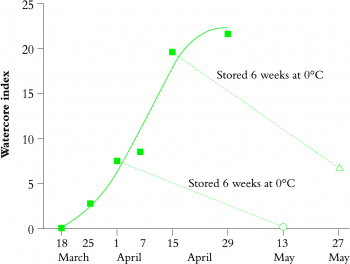 [26]
Figure 11.20 Postharvest incidence of the storage disorder watercore in Fuji apple is related to picking date (and thus fruit maturity). Watercore index represents the percentage fruit volume occupied by waterlogged tissue. Fuji is prone to this disorder, especially when fruit are picked mature. Early harvesting thus becomes an important control method.
(Original data courtesy F.R. Harker)
When fruit, vegetable or flower products are put into post-harvest storage, they are on a slow path to senescence and death, and a number of disorders can arise during that time. Several storage disorders have physiological origins, and are often highly specific to species, cultivar, season and even growing region. Fruit maturity at picking is one important factor (Figure 11.20) and four examples of postharvest physiological disorders in apple are listed below to illustrate our partial understanding of the problems that do occur, and to provide a glimpse of a large and complex area of postharvest physiology.
Bitter pit is a brown, bitter pitting of the skin in some cultivars, particularly Cox’s Orange Pippin. It is primarily a response to inadequate calcium content in the skin, and can be greatly reduced by spraying fruit on the tree with calcium-containing solutions during the later stages of fruit development.
Scald is a brown, sunburn-like discolouration of the skin surface, particularly in cultivars like Granny Smith. It appears to be connected with the nature of the cuticular wax and lipids and with the production of free radicals, and can be greatly reduced by application of a ‘free radical mop’ like diphenylamine.
Core flush is a browning of internal fleshy tissues sur-rounding the core of a fruit, and may have more than one cause. One factor seems to be the O2 supply to the core, since conditions potentially causing anaerobiosis (large size, a closed and airtight calyx and a low-O2 atmosphere) increase incidence.
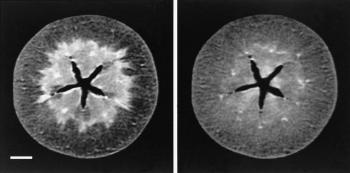 [27]
Figure 11.21 NMR images from the equatorial plane of an apple show watercore (waterlogging) as an intense white region. The first scan (left) was taken from a Fuji apple with severe watercore at the time of harvest. The second scan (right) was taken of the same fruit after cool storage for 15 weeks at 0°C, when symptoms had disappeared due to resorption of intercullar water. Scale bar = 1 cm.
(Original images courtesy C.A. Clark)
Watercore is a condition where there are glassy, water-logged sections of tissue towards the centre of the fruit, typically centred around the vascular bundles. Severe watercore leads to anaerobiosis, development of fermentation flavours, and core browning similar to core flush. Fuji is an especially susceptible cultivar. Watercore is more severe in sweet fully mature fruit (Figure 11.20) and involves a breakdown in transport of sorbitol across cell membranes. As outlined earlier (Section 11.3.3) sorbitol is the main soluble carbohydrate supply for early growth in apple fruits. Unlike other storage disorders watercore becomes less severe or even disappears during storage (Figure 11.21) presumably because pericarp cells eventually resorb intercellular water and sugar and allow airspaces to reform.
Great successes in seed and fruit production have already come from selection of existing genotypes with desirable composition, storage or eating qualities. Can fruit growth, maturation and postharvest physiology be modified even further for human convenience? Examples of genotype x¥ environment interaction are immediately apparent in post-harvest physiology where genetic intervention by conventional breeding has already yielded remarkable dividends with pome- and stonefruits, as well as with citrus and a range of other subtropical species. Persimmon provides an extreme example of existing technology where intense selection of genetic variants has resulted in the non-astringent variant Fuyu. Notwithstanding such positive outcomes, a new generation of ‘designer’ fruit is emerging, and some issues are discussed here.
As our knowledge of underlying physiology has improved, more sophisticated techniques have been applied to regulation of crop yield and postharvest behaviour. We are now entering an era where specific events in fruit growth and maturation can be targeted via molecular biology once enzymes in key pathways have been identified. Moreover, given the range of postharvest options outlined above, there has been a major research drive towards genetic manipulation of fresh crops to permit greater flexibility in their postharvest management, and towards producing crops with enhanced flavours.
Almost every aspect of improved product quality and extended postharvest storage life of crops is potentially amenable to genetic engineering. For example, improved tolerance to low temperature would be very desirable in many tropical crops where development of chilling injury below 10°C is a major limit to storage life. Improved tolerance to anaerobic conditions would be valuable in holding fruit at very low O2 levels, and prevention of fruit softening until an external trigger is provided would simplify postharvest handling. One such instance is outlined below.
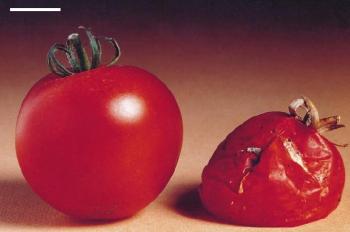 [28]
Figure 11.22 Genetic manipulaton can have a profound effect on ripening. Normal tomatoes (right) and Flavr SavrTM tomatoes (left) were picked when both were nearly ripe (light red) and held at room temperature for four weeks. By this time normal fruit had softened and rotted but Flavr SavrTM fruit was still firm and edible. This genetically modified fruit lacked polygalacturonase and had a much better shelf life, as well as improved flavour and handling qualities. Scale bar = 2 cm.
(Photograph courtesy A.J. Conner)
Tomato has characteristics of production, handling and human use that are common to both fruits and vegetables. Tomato also provides an example of a well-documented and well-publicised genetically engineered foodstuff. Tomato is one of the most widely used fruit and vegetable crops internationally. A key to this global adoption is our ability to harvest the fruit in a firm state, control postharvest changes long enough for fruit to reach markets without softening unduly and avoid damage from chilling injury or disease.
During past studies on tomato postharvest behaviour, several avenues of research suggested that endopolygalacturonase was responsible for degrading cell wall pectin during softening (Section 11.5.4). A mutant tomato with decreased amounts of this enzyme also displayed delayed ripening. A priori, genetic manipulation to prevent this enzyme from forming should prevent fruit from softening and facilitate handling. How could this be achieved?
Three broad approaches are used in manipulating genetic makeup:
1. New genes conferring new biochemical pathways can be brought in from another organism (as in adding a pathway to remove ACC, Section 11.5.6).
2. Expression of an existing gene in the organism can be greatly enhanced (‘sense’ manipulation) (Figure 11.22).
3. A ‘negative copy’ of the plant gene can be introduced to prevent products of the normal gene being expressed (‘antisense’ manipulation).
Two companies (Calgene in the USA and ICI in Britain) were associated with researchers in a race to clone the endopolygalacturonase gene from tomato, to produce its antisense form, and to use that to make transgenic plants that had reduced production of endopolygalacturonase. Initial experiments produced either antisense copies and incorporated these into normal tomato, or sense copies which were inserted into the mutant tomato (Hobson and Grierson 1993). In both cases, fruit ripening was affected due to changed levels of endopolygalacturonase. In the modified mutant, fruit softened and became more like normal fruit. In the antisense plants, fruit softening was delayed (not prevented) and soft fruit did not become overripe and thus susceptible to rots.
These research results were not exactly as expected, but nevertheless had significant commercial value. Inhibiting synthesis of endopolygalacturonase only affected softening and not other ripening indicators. This argued against an earlier hypothesis that all ripening steps would be delayed because all physiological variables were intimately linked. Because transgenic fruits retained their firmness, they were left on vines longer, resulting in more carbohydrate accumulation prior to harvest. Moreover, fruit could be harvested partially coloured rather than mature green, thereby allowing ripening processes to progress more naturally and yielding fruit with markedly better flavour and appearance. To move from experimental results to public availability, the fruit had to go through a series of tests (Redenbaugh et al. 1992). Following USDA approval, a transgenic cultivar producing fruit with >99% reduction in polygalacturonase activity was named Flavr SavrTM by Calgene, and was released for marketing to the public under the brand identity of McGregor.
Flavr SavrTM tomato provides a dramatic example of how molecular techniques can change properties of a fruit in ways that help both postharvest handling and eating qualities. Political and ethical issues aside, wider use of genetically engineered plants could have a major impact on postharvest handling of many other horticultural products. Consumers will need to be well informed about changes resulting from conventional breeding and those resulting from genetic engineering. There will also need to be improved physiological and biochemical knowledge about the postharvest responses of each species to be engineered.
Over the past century, fruit production and postharvest technology have been a powerful influence on progress in human societies and personal lifestyles. Very few people in ‘developed societies’ now grow their own fruit or vegetables; mass production has become much more efficient and wastage much lower; food quality has increased and people are better nourished; seasonal fruits are available year round; large amounts of product are distributed worldwide. Even cut flowers have become commodities of global trade instead of specimens from our own gardens, and in all cases postharvest technology has grown from process physiology. This area of plant science still offers exciting prospects for global horticulture, especially in tropical environments where new issues confront physiologists.
Gray, J.E., Picton, S., Giovannoni, J.J. and Grierson, D. (1994). ‘The use of transgenic and naturally occurring mutants to understand and manipulate tomato fruit ripening’, Plant, Cell and Environment, 17, 557–571.
Seymour, G., Taylor, J. and Tucker, G. (eds) (1993).Biochemistry of Fruit Ripening, Chapman and Hall: London.
Stitt, M. and Sonnewald, U. (1995). ‘Regulation of metabolism in transgenic plants’, Annual Review of Plant Physiology and Plant Molecular Biology, 46, 341–368.
Warrington, I.J. and Weston, G.C. (1990). Kiwifruit: Science and Management, New Zealand Society for Horticultural Science: Wellington.
Links:
[1] http://plantsinaction.science.uq.edu.au/edition1//?q=figure_view/837
[2] http://plantsinaction.science.uq.edu.au/edition1//?q=figure_view/526
[3] http://plantsinaction.science.uq.edu.au/edition1//?q=figure_view/527
[4] http://plantsinaction.science.uq.edu.au/edition1//?q=figure_view/528
[5] http://plantsinaction.science.uq.edu.au/edition1//?q=figure_view/529
[6] http://plantsinaction.science.uq.edu.au/edition1//?q=figure_view/530
[7] http://plantsinaction.science.uq.edu.au/edition1//?q=figure_view/531
[8] http://plantsinaction.science.uq.edu.au/edition1//?q=figure_view/532
[9] http://plantsinaction.science.uq.edu.au/edition1//?q=figure_view/533
[10] http://plantsinaction.science.uq.edu.au/edition1//?q=figure_view/535
[11] http://plantsinaction.science.uq.edu.au/edition1//?q=figure_view/536
[12] http://plantsinaction.science.uq.edu.au/edition1//?q=figure_view/537
[13] http://plantsinaction.science.uq.edu.au/edition1//?q=figure_view/538
[14] http://plantsinaction.science.uq.edu.au/edition1//?q=figure_view/539
[15] http://plantsinaction.science.uq.edu.au/edition1//?q=figure_view/541
[16] http://plantsinaction.science.uq.edu.au/edition1//?q=figure_view/542
[17] http://plantsinaction.science.uq.edu.au/edition1//?q=figure_view/543
[18] http://plantsinaction.science.uq.edu.au/edition1//?q=figure_view/544
[19] http://plantsinaction.science.uq.edu.au/edition1//?q=figure_view/545
[20] http://plantsinaction.science.uq.edu.au/edition1//?q=figure_view/546
[21] http://plantsinaction.science.uq.edu.au/edition1//?q=figure_view/989
[22] http://plantsinaction.science.uq.edu.au/edition1//?q=figure_view/550
[23] http://plantsinaction.science.uq.edu.au/edition1//?q=figure_view/551
[24] http://plantsinaction.science.uq.edu.au/edition1//?q=figure_view/553
[25] http://plantsinaction.science.uq.edu.au/edition1//?q=figure_view/554
[26] http://plantsinaction.science.uq.edu.au/edition1//?q=figure_view/555
[27] http://plantsinaction.science.uq.edu.au/edition1//?q=figure_view/556
[28] http://plantsinaction.science.uq.edu.au/edition1//?q=figure_view/557