
Xylem conduits are responsible for delivery of water, inorganic nutrients and organic forms of nitrogen and phosphate to transpiring leaves (Section 5.2). Phloem conduits are subsequently responsible for redistribution of such resources to organs such as apices and reproductive structures (including developing fruit). These organs have inherently low rates of transpiration and thus sap import via xylem vessels.
Assimilation of carbon and nutrient resources and subsequent distribution are closely linked events. Resource distribution is analysed by considering a plant as a coordinated network of assimilatory regions (sources) linked to regions of resource utilisation (sinks). The vascular system provides a path for assimilate transport from source to sink.
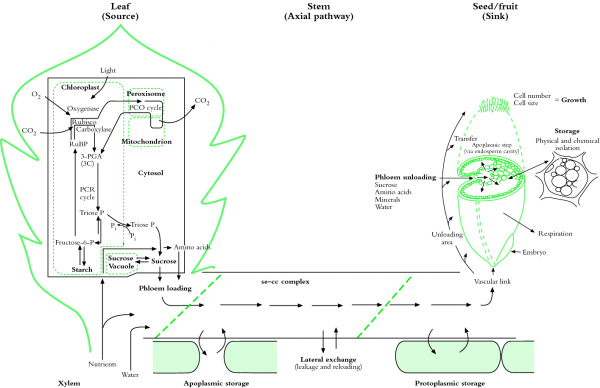
Activities of the following key transport processes contribute to overall flow of photoassimilates through a source–path–sink system (Figure 5.13).
 [1]
Figure 5.13 Schematic diagram of transfer and transport processes contributing to the flow of assimilates acquired from aerial or soil environments, through the source-path-sink system. CO2 fixed by photosynthesis in chloroplasts has several possible fates (Figure 2.18). It either enters photorespiration or starch biosynthesis or crosses to the cytosol as triose phosphate (triose P), giving rise to sucrose. Some sucrose can be stored in vacuoles of mesophyll cells. Both starch and vacuolar sucrose serve as temporary storage pools from which the cytoplasmic sucrose pool is replenished. Amino acids can be synthesised from reduced carbon and nitrogen delivered in the transpiration stream. Sucrose, amino acids and mineral nutrients are loaded into sieve element—companion cell (se—cc) complexes of leaf phloem for long-distance transport to non-photosynthetic sinks.These solutes are exchanged reversibly between se-cc complexes and short- and long-term storage pools along the axial pathway. Short-term storage pools include phloem apoplasm, whereas the protoplasm of non-transport cells provides a long-term storage pool. Transport of solutes from se-cc complexes to either storage pools or principal sinks is called phloem unloading. On reaching the cytoplasm of principal sink cells, photoassimilates and mineral nutrients support respiration and growth or are stored as solutes in vacuoles or polymers in amyloplasts (starch) or protein bodies (protein)
 [2]
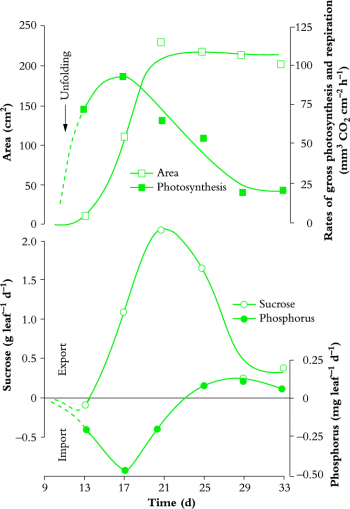
Figure 5.12 Time course of sucrose and phosphorus (P) net import and export from a leaf during its development. As a cucumber leaf expands, net sucrose export coincides with the rise in net leaf photosynthetic rate (O) to meet photoassimilate demands of young leaves. Once a leaf has reached some 30% of its final area, net photosynthesis by the whole leaf exceeds photoassimilate demand by growth processes and so excess sucrose can be exported. Thereafter, the rate of sucrose export closely follows photosynthetic rate, reaching a maximum when the leaf reaches its final size and gradually declining thereafter. Import of P (and other mineral nutrients) continues throughout leaf expansion and P export only starts once the leaf is fully expanded. Sucrose import and export were calculated from the difference between rates of whole-leaf photosynthesis and dry matter gain (Based on Hopkinson 1964; reproduced with permission of Journal of Experimental Botany)
Net export of photoassimilates occurs from fully expanded leaves (Figure 5.12) and long-term storage pools located along the axial transport pathway. Chloroplasts of C3 plants (Section 2.1.8) partition photoassimilates between the photosynthetic oxidative cycle and starch biosynthesis or release them immediately to the cytosol as triose phosphate for sucrose synthesis. In non-starch-forming leaves, high concentrations of sugars can be accumulated in the vacuoles of mesophyll cells or made available for immediate loading into the phloem and export. Leaves also serve as secondary sources for nutrients and amino acids previously delivered in the transpiration stream. Nutrients and amino acids can be exported in the phloem immediately, or after accumulation in short-term storage pools.
An additional source of photoassimilates is located along the axial phloem path (petioles, stems, peduncles, pedicels and roots) as a result of leakage from the vascular tissues. Leaked photoassimilates accumulate in short- or long-term storage pools which serve as secondary sources to buffer photo-assimilate supplies to the sinks against shifts in export rates from the primary photoassimilate sources.
Assimilates including sucrose, amino acids and nutrients are transferred into sieve elements of fully expanded leaves against significant concentration and electrochemical gradients. This process is referred to as phloem loading. The cellular pathways of phloem loading, and hence transport mechanisms and controls, vary between plant species (Section 5.5). Longitudinal transport of assimilates through sieve elements is achieved by mass flow and is termed phloem translocation. Mass flow is driven by a pressure gradient generated osmotically at either end of the phloem pathway, with a high concentration of solutes at the source end and a lower con-entration at the sink end (Section 5.4). At the sink, assimilates exit the sieve elements and move into recipient sink cells where they are used in growth or storage processes. Movement from sieve elements to recipient sink cells is called phloem unloading. The cellular pathway of phloem unloading, and hence transport mechanisms and controls, vary depending upon sink function (Section 5.6).
Many sink organs are characterised by low rates of transpiration (an exception is a developing leaf) so that most assimilates are delivered by the phloem. Having reached the sink cell cytoplasm through the post-sieve-element transport pathway (see Section 5.6), assimilates are either metabolised to satisfy the energy, maintenance and growth requirements of sink cells or are compartmented into polymer or vacuolar storage. Collectively, metabolism and compartmentation create a demand for assimilates which is ultimately responsible for driving phloem import.
Sink and source strength must be in balance at a whole-plant level. Thus, an increase in whole-plant sink strength must be matched by an equal increase in source strength, either through increases in source activity or source size. Prior to canopy closure in a crop, much of the increase in source strength comes from increased source size, source activity remaining relatively constant. Significantly, until a leaf has reached some 30% of its final size, photoassimilates for leaf production are exclusively imported through the phloem from fully expanded leaves (Figure 5.12).
On canopy closure, self-shading and senescence of the lower leaves result in whole-plant photosynthesis being restricted to the uppermost leaves exposed to direct sunlight. Under these conditions, either genetic or environmentally imposed differences in source activity can influence biomass production.
During domestication of crop plants, plant breeders selected for crop yield via maximum investment into harvested organs (mostly seeds). Total plant biomass production of advanced wheat is the same as its wild progenitors yet grain yield has increased some 30-fold through breeding (Table 5.2). That is, whole-plant source and sink strength have not changed. Increases in wheat yield (Table 5.2) are associated with a diversion of photoassimilates from vegetative organs to the developing grain, as illustrated by the relative accumulation of 14C photoassimilates exported from the flag leaf (Table 5.2).
Final grain yield is not only determined by partitioning of current photoassimilates, but also depends upon remobilisation of non-structural carbohydrates stored in stems, particularly under conditions where environmental stress impairs leaf photosynthesis (Wardlaw 1990). In fact, remobilisation of reserves affects yield in many food plants. For example, deciduous fruit trees depend entirely on remobilised photo-assimilates to support flowering and fruit set as do early stages of pasture regrowth following grazing.
 [3]
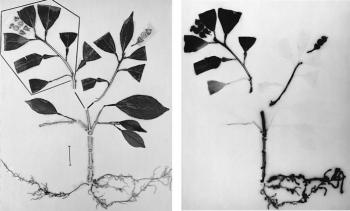
Figure 5.14 Photoassimilate distribution in a rooted cutting of Washington Navel orange (mounted specimen shown on left; matching autoradiograph on right). 14CO2 was supplied to source leaves (boxed area top left) for a day, and movement of 14C-labelled assimilate followed by autoradiography of harvested plant material. 14C photosynthates were distributed widely via vascular conduits to sinks including some roots and a fruit on an adjacent shoot (note stem labelling between sources and sinks). Nearby mature leaves failed to import; they were additional sources of photosynthate. Scale bar = 2 cm (Unpublished material courtesy P.E. Kriedemann)
Photoassimilate transport to harvestable organs plays a central role in crop yield brought about by greater harvest indices. This raises questions about transport and transfer processes that collectively influence photoassimilate partitioning between competing sinks.
Historically, these questions were elucidated by observing partitioning patterns of photoassimilates exported from specified source leaves labelled with 14C supplied as a pulse of 14CO2. Following a chase period, in which 14C photoassimilates are transported to and accumulated by recipient sink organs, the plant is harvested. The pattern of photoassimilate partitioning operating during the pulse is deduced from 14C activity accumulated by sinks (Figure 5.14).
Photoassimilates are partitioned from source leaves to sinks in characteristic and reproducible patterns. For instance, in a vegetative plant, lower leaves are the principal suppliers of photoassimilate to roots, whereas upper leaves are the principal suppliers to the shoot apex. Leaves in an intermediate position export equal quantities of photoassimilates in either direction. However, the pattern of photoassimilate partitioning is not static, it changes with plant development. In vegetative plants, the direction of flow from a leaf changes as more leaves above it become net exporters. Furthermore, at the onset of reproductive development, growing fruits or seeds become dominant shoot sinks for photoassimilates at the expense of vegetative apices.
Photoassimilate partitioning patterns can be altered experimentally by removal of selected sources (e.g. leaves) or sinks (e.g. fruits). These manipulative experiments demonstrate that photoassimilate partitioning reflects the relative strengths of individual sources and sinks. Properties of the phloem pathway connecting sources with sinks are examined in Section 5.4.
J.S. Pate
 [4]
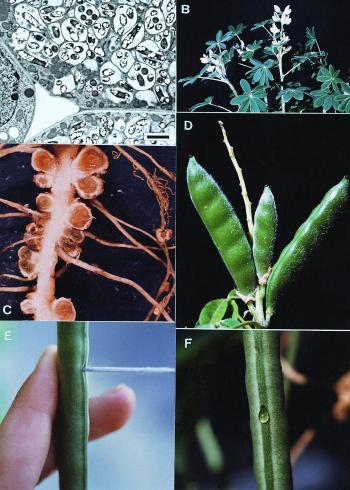
Figure 1 (A) Transmission electron micrograph of a root nodule; (B) flowering specimen of white lupin (Lupinus albus); (C) nodules on the root system of a white lupin plant. Some of the nodules are cut open to reveal the pink haemoglobin pigmentation typical of actively N2-fixing nodules; (D) fruits of lupin with their ends cut off to induce bleeding from the phloem; (E) 'cryopuncturing' of the fruit of cowpea (Vigna unguiculata) with a needle cooled in liquid nitrogen; (F) phloem bleeding from a cryopunctured fruit
Dry matter of a typical green plant contains a large and relatively constant proportion of carbon (35–50%), virtually all of which is derived from photosynthetic fixation of CO2 by leaves or other green parts. Comparable values for nitrogen in dry matter tend to be more variable, with lowest levels in roots and stems (0.5–1.5%) and considerably higher levels in leaves (3–5%) where much nitrogen is associated with enzymes involved in photosynthesis. Higher levels are en-countered in seeds (6–7%) and other storage organs in which large quantities of protein are being stored.
Most plants rely on nitrate (NO3–) or ammonium (NH4+) in the soil as their prime sources of nitrogen but certain leguminous plants gain nitrogen directly from the atmosphere by engaging in symbiosis with N2-fixing bacteria in nodules on their roots (Figure 1A and B). White lupin is one such leguminous plant. Accompanying photographs show a flowering shoot (Figure 1B), nodules (Figure 1C) and pods (Figure 1D) of white lupin (Lupinus albus L.). Subcellular details of a nodule, with bacterial symbionts clearly visible, are seen in a transmission micrograph (Figure 1A).
Consider lupin plants which are effectively nodulated and growing in a rooting medium to which all nutrients except nitrogen have been supplied. Allocation of carbon and nitrogen within the plant can then be examined in terms of the interrelationships of two mutually dependent, self-supporting (autotrophic) processes — photosynthesis and N2 fixation. Within such a system, nodules supply further fixed nitrogen only so long as shoots export photosynthetically produced sugars. Shoots provide energy for nitrogen fixation, as well as carbon skeletons for synthesis of amino acids and other nitrogenous solutes which carry fixed nitrogen from nodules to other plant parts. Conversely, increasing demands for photosynthetic products as plants progress through their life cycles can be met only if nitrogen from nodules continues to be available for expansion and functioning of new photosynthetic surfaces.
One complication which pervades experimental study on a plant such as lupin is that the carbon and nitrogen status of differently aged parts of the plant change continuously over a growth cycle. This is principally because new, actively growing tissues continuously come on stream as users of carbon and nitrogen whereas older plant parts progressively lose dry matter and especially nitrogen as they approach senescence. Because of their high protein content and relatively unthickened walls, young tissues require nitrogen rather than carbon. At the same time, nitrogen can be mobilised most effectively back into the plant from older organs prior to their senescence, since this nitrogen is attached mostly to degradable molecules such as protein. Conversely, carbon in dry matter is associated mostly with the non-degradable fabric of cell walls and is accordingly retrieved to a very limited extent prior to organ and tissue death. Thus, large proportions of the already accumulated resources of nitrogen within a plant are continuously recycled from old stem and leaf tissue to new leaves and eventually to fruits. Such recycling occurs to a much smaller extent with respect to carbon.
Before one can understand how carbon and nitrogen are allocated to different organs over a prescribed interval of growth of a plant such as lupin, quantitatively accurate information is required on the following:
1. changes in carbon and nitrogen contents of dry matter in each plant part;
2. assessment of net gaseous exchanges of carbon as CO2 occurring in photosynthesis or respiration of each plant part;
3. estimates of total nitrogen gain of plants by N2 fixation, as determined by summation of net increments or losses of nitrogen in plant parts over the study period;
4. estimates of net daytime photosynthetic gain of carbon by whole plants, as determined from measurements of increments or losses of carbon in organ dry matter, respiratory losses of carbon by root and nodules and night-time respiratory losses of carbon by the shoot system.
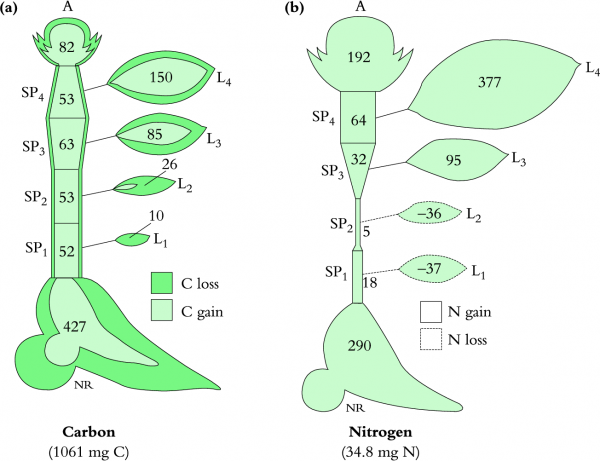
It then becomes possible to construct simple models illustrating patterns of consumption of carbon and nitrogen by various plant parts. These are shown in Figure 2 for a specific week in the life of our lupin plant. Each model visualises the proportional amounts of carbon or nitrogen being processed, using appropriately shaped ‘cartoons’ for each class of organ drawn to an area proportional to the respective amounts they gain (positive values, shapes in solid lines) or lose (negative values, shapes in broken lines) during the interval under examination. The model for carbon (Figure 2a), depicting proportional allocation of the 1061 mg carbon produced as net photosynthate, includes a stippled halo around each plant part to represent the respiratory losses accompanying a specified gain or loss of carbon by that part. Overall, we find that the nodulated root (NR) consumes a very large proportion (43%) of carbon generated by the plant in net photosynthesis, and most of the carbon so used is lost as respired CO2 rather than incorporated into dry matter. The two upper strata of leaflets (L3 and L4, Figure 2) consume the next greatest proportion (24%) followed by the various levels of stem axis plus petioles (SP1–SP4) (22%), shoot apex (A) (8%) and older leaves (L1 and L2) (4%).
 [5]
Figure 2 Representation of the consumption of (a) carbon and (b) nitrogen by plant parts of white lupin (Lupinus albus) during mid-vegetative growth (51-58 d after sowing). L1-L4, four strata of leaflets; SP1-SP4 corresponding strata of stem segments and associated petioles; NR, nodulated root; A, shoot apex. Each profile for utilisation depicts net gain or loss of carbon or nitrogen. The profile for carbon includes losses of carbon as respired CO2. Absolute amounts entering the plant as carbon of net photosynthate or fixed N2 are indicated (Based on Pate and Layzell 1981)
The equivalent allocation ‘cartoon’ for the 34.8mg nitrogen fixed in the study period (Figure 2b) is shaped very differently. L4 is the dominant sink for nitrogen (38%) followed by the nodulated root (NR) (29%), shoot apex (A) (19%) and L1 (9%); extremely modest gains by stem and petiole tissue (SP) and net losses of nitrogen from the lower strata of leaves (L1 and L2) are observed.
So far we have not considered the role of long-distance transport conduits of xylem and phloem when carbon and nitrogen are partitioned to fulfil the requirements of plant parts (Figure 2). White lupin bleeds xylem fluid from the top of its root after the shoot has been cut off, thus enabling an inventory to be made of organic solutes passing up from roots and nodules to shoots through the xylem. Importantly, white lupin also bleeds from the sieve tubes of its phloem, if shallow cuts are made into stem, petiole or fruit (Figure 1D shows phloem sap bleeding from pods of lupin). Data from these sap samples are used to assess what carbon and nitrogen solutes are moving in the various streams of translocate being transported from any of the age groups of leaves to each of a number of possible consuming (sink) organs within the system. Another legume, cowpea (Vigna unguiculata), also bleeds from phloem and has been used for studies similar to those described here for lupin. Cowpea, however, bleeds only from its fruits and only if these are cryopunctured (Figure 1E and F). To determine which source leaves serve which sink regions within plants, 14C-feeding studies need to be conducted in single source leaves which are fed 14CO2 and the fate of 14C-labelled sucrose and other assimilates which they export are subsequently traced within the plant.
 [6]
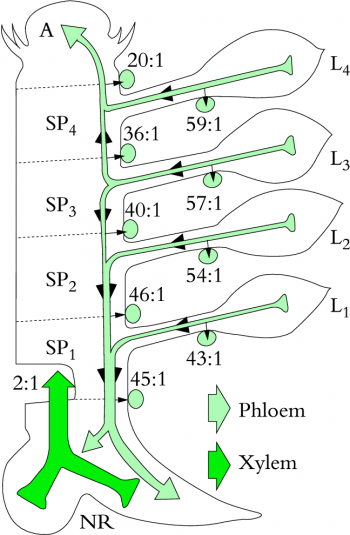
Figure 3 Carbon to nitrogen weight ratios in the xylem and various phloem streams of plants of white lupin during mid-vegetative growth (51-58 d after sowing). Plants were entirely dependent on N2-fixing nodules for nitrogen. Coding of plant parts as in Figure 2 (From Pate and Layzell 1981; reproduced with permission of Kluwer Academic Publishers)
Armed with the above information, a transport profile can be gained, a picture of where resources move in a lupin plant (Figure 3). Directions of flow between source leaves and consuming parts of the plant, as determined by 14C feeding, are indicated by arrowed pathways in the figure. Local ratios (by weight) of carbon to nitrogen within different plant parts are shown; they reflect outcomes of carbon and nitrogen transport. For example, the xylem (drawn in black) delivers fluid to transpiring parts with solutes of very low C : N ratio, because sugars are virtually absent and the major solute is the amino acid asparagine (C:N of 2:1). Conversely, the youngest leaves (L4), which are most active in exporting sugars, are not yet losing much nitrogen, so they produce phloem translocate (dotted pathways) of relatively high C:N ratio (59:1). Downward-moving translocate from the shoot shows a C:N ratio which could be predicted from a mixture of the streams of translocate originating in the three strata of leaves which supply the root. One surprising finding is that the apical part of a shoot receives phloem translocate with a relatively low C:N ratio of 20:1, despite being fed from the upper leaves (L3 and L4) which are generating much less nitrogen rich solute streams (C:N ratios of 57:1 and 59:1 respectively). Clearly phloem sap must be modified en route from source leaves to shoot apex. How is this differential partitioning of nitrogen towards the apex achieved?
Combining the information described so far the model for partitioning of 1000 units of carbon of net photosynthate is dominated by phloem-mediated transfer of photosynthate from leaves to root and shoot apex. Corresponding xylem flow of carbon is proportionately much less and reflects the extent to which carbon supplied to nodules is returned to the shoot in the form of xylem-exported amino compounds formed in N2 fixation. Approximately 8% of the total carbon exported from photosynthesising leaves cycles through roots and nodules. This substantial demand by nodules for photosynthate is most striking. During mid-vegetative growth, 24% of the carbon of net photosynthate is translocated to nodules, over half of which is respired, and the remainder incorporated into nodule dry matter or returned to the plant attached to fixation products.
The complementary model for partitioning 1000 units of fixed nitrogen revolves around bulk export of newly fixed nitrogen from nodules. As expected, transpiring leaves act as principal initial destinations for such nitrogen. However, a proportion of nitrogen is transferred from xylem to phloem within veins of lower leaves, becoming available to roots. Similar xylem to phloem transfer in upper leaves provides nitrogen for shoot apices.
Note that the three lower strata of leaves (L1–L3), are, in effect, short changed for nitrogen through withdrawal of nitrogen from xylem traces supplying these lower leaves. After withdrawal, this nitrogen passes back into xylem traces, moving further up the stem.
As a result, xylem sap in the body of the stem becomes progressively enriched with nitrogen, and upper leaves thus receive considerably more nitrogen per unit of transpirational activity than nitrogen-deprived older leaves further down the canopy. This subtle shuttle system within a stem results in over 40% of currently fixed nitrogen being targeted towards upper, still expanding leaves — the very site of greatest demand for nitrogen at this stage in plant growth.
Two other features of this model for nitrogen deserve mention:
1. In a legume totally dependent on its nodules for nitrogen, parts of the root system extending below or laterally outwards beyond the nodules cannot receive nitrogen directly from xylem since the sap in this tissue moves upwards. Instead they gain nitrogen indirectly as phloem translocate supplied from the shoot (Section 3.6). Consequently, roots growing in soils deficient in nitrogen will be tightly controlled by nitrogen from shoots.
2. Substantial amounts of nitrogen moving through stem xylem into uppermost parts of the shoot are shuttled laterally across to the phloem stream moving photosynthate from upper leaves to the shoot apex. The apex accordingly acquires much more nitrogen than one would ever expect from its weak transpirational activity or from the phloem streams generated in the upper nurse leaves. Such stem-located processes of xylem to phloem transfer, together with xylem to xylem transfers in lower stems, comprise extremely important elements in differential partitioning of nitrogen and, indeed, of a number of other nutrient elements in herbaceous plants such as barley, castor bean, pea and lupin (Pate and Jeschke 1995). Demonstrations of such transfer activity between xylem and phloem clearly call into dispute previous suppositions that vascular tissues in stems play merely passive roles in straight throughput of solutes. Transport can be regulated at all points along the pathway.
Although our model is ‘empirically’ based on actual observations and measurements constructed for a particular set of growth circumstances, it can still be used to predict what might happen if the system were to be perturbed in any of a number of ways. For instance, were N2 fixation suddenly to cease, the model would suggest that xylem export of nitrogen from the nodulated root would cease almost immediately and that those organs first to suffer would be the shoot apex and any young leaves still dependent on xylem to meet the demands of their growing photosynthetic tissues for nitrogen. Then, if nitrogen starvation continued, senescence of lower leaves would commence and, according to the model, nitrogen released would become available mostly to root growth as opposed to rescuing upper shoots from nitrogen deficiency. Indeed, from observation, nitrogen starvation reduces new shoot growth, followed in turn by yellowing of leaves, and increased rather than decreased root growth.
Empirical models of the kind described in this essay may describe adequately events involved in partitioning of carbon and nitrogen, but they still tell us virtually nothing of the nature of the underlying cellular and molecular processes which modulate and regulate resource distribution in whole plants. To achieve such a picture, much more has to be learned about regulation of solute loading and unloading into both xylem and phloem elements. Particularly interesting in this connection would be a detailed study of how xylem to xylem or xylem to phloem transfers are coordinated along the stem throughout the life of a plant and how these activities change in relation to supply and demand of various donor and receptor regions of a plant during a cycle of growth and development.
References and further reading
Pate, J.S. (1996). ‘Photoassimilate partitioning and consumption in nitrogen-fixing crop legumes’, in Photoassimilate Partitioning in Plants and Crops: Source : Sink Relationships, eds E. Zamski and A.A. Schaffer, 467–477, Marcel Dekker: New York.
Pate, J.S.and Jeschke, W.D. (1995). ‘Role of stems in transport, storage and circulation of ions and metabolites by the whole plant’, in Stems and Trunks: Their Roles in Plant Form and Function, ed. Barbara L. Gartner, 177–204, Academic Press: New York.
Pate, J.S. and Layzell, D.B. (1981). ‘Carbon and nitrogen partitioning in the whole plant — a thesis based on empirical modelling’, in Nitrogen and Carbon Metabolism, ed. J.D. Bewley, 94–134, Martinus Nijhoff/Dr. W. Junk Publishers: The Hague
Links:
[1] http://plantsinaction.science.uq.edu.au/edition1//?q=figure_view/300
[2] http://plantsinaction.science.uq.edu.au/edition1//?q=figure_view/299
[3] http://plantsinaction.science.uq.edu.au/edition1//?q=figure_view/301
[4] http://plantsinaction.science.uq.edu.au/edition1//?q=figure_view/303
[5] http://plantsinaction.science.uq.edu.au/edition1//?q=figure_view/304
[6] http://plantsinaction.science.uq.edu.au/edition1//?q=figure_view/305