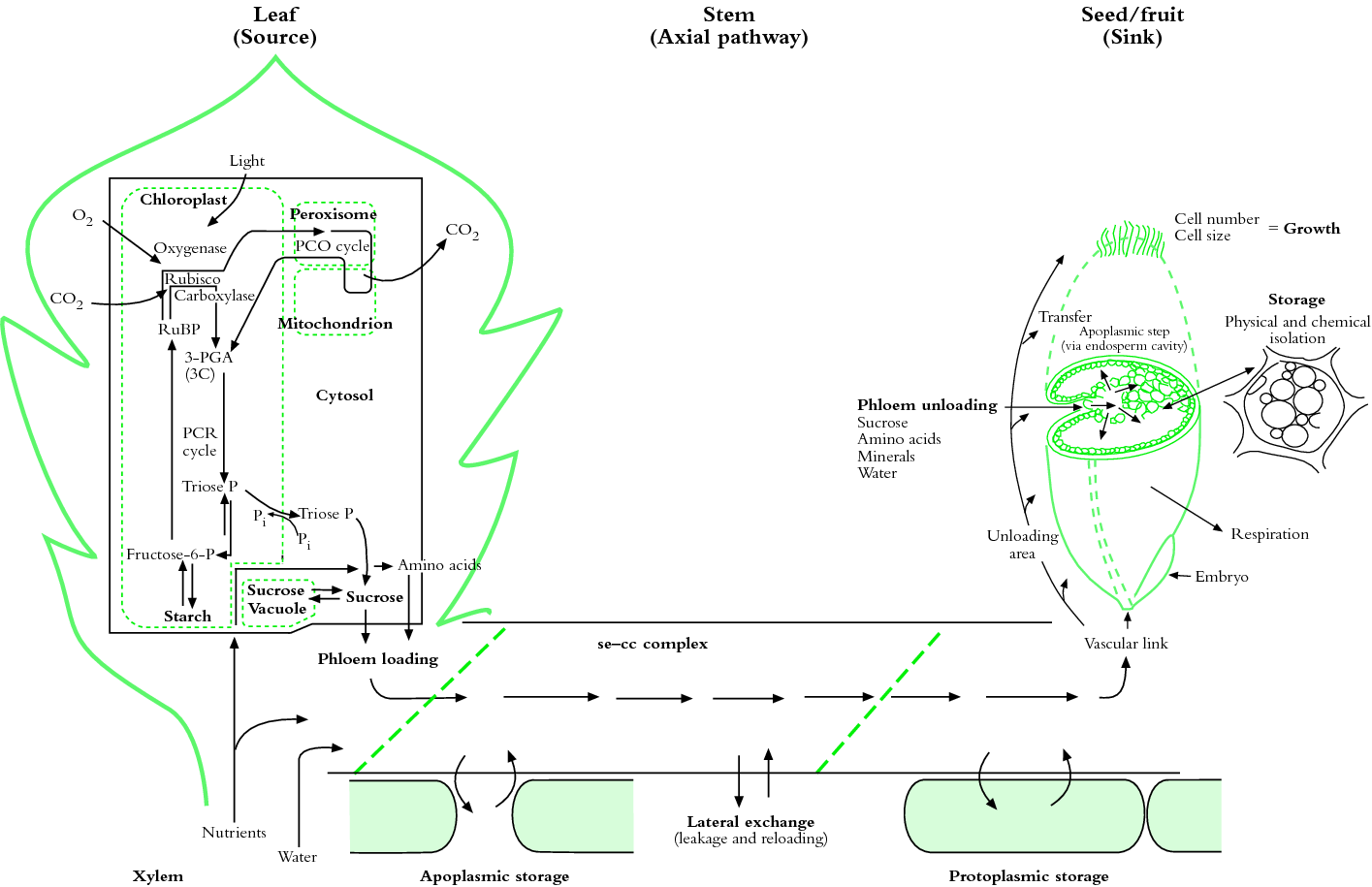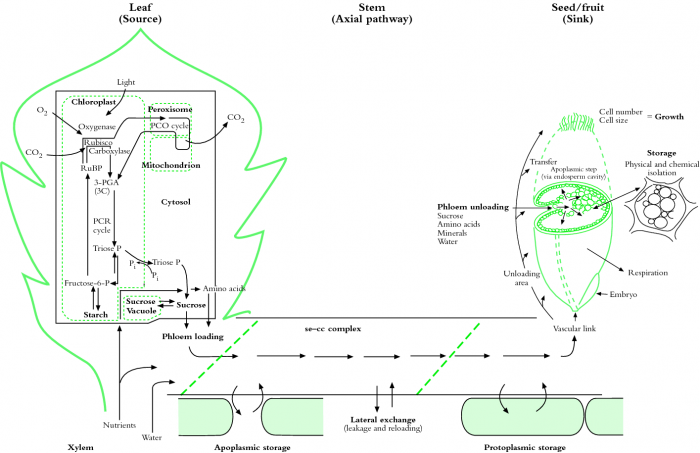
Figure 5.13 Schematic diagram of transfer and transport processes contributing to the flow of assimilates acquired from aerial or soil environments, through the source-path-sink system. CO2 fixed by photosynthesis in chloroplasts has several possible fates (Figure 2.18). It either enters photorespiration or starch biosynthesis or crosses to the cytosol as triose phosphate (triose P), giving rise to sucrose. Some sucrose can be stored in vacuoles of mesophyll cells. Both starch and vacuolar sucrose serve as temporary storage pools from which the cytoplasmic sucrose pool is replenished. Amino acids can be synthesised from reduced carbon and nitrogen delivered in the transpiration stream. Sucrose, amino acids and mineral nutrients are loaded into sieve element—companion cell (se—cc) complexes of leaf phloem for long-distance transport to non-photosynthetic sinks.These solutes are exchanged reversibly between se-cc complexes and short- and long-term storage pools along the axial pathway. Short-term storage pools include phloem apoplasm, whereas the protoplasm of non-transport cells provides a long-term storage pool. Transport of solutes from se-cc complexes to either storage pools or principal sinks is called phloem unloading. On reaching the cytoplasm of principal sink cells, photoassimilates and mineral nutrients support respiration and growth or are stored as solutes in vacuoles or polymers in amyloplasts (starch) or protein bodies (protein)