
Around 90% of higher plants are infected by fungi and form mycorrhizal associations. Fungal symbiosis with a plant host is based on the provision of carbon from plant to fungus and inorganic nutrients from fungus to plant. Benefits to the host are considerable. Without mycorrhizal associations many higher plants would be unable to complete their life cycles. Both modern agriculture and natural ecosystems such as forests and grasslands rely strongly on mycorrhizal associations. Competitive advantages which come from efficient nutrient extraction from low-fertility soils have ensured that mycorrhizal symbioses have spread widely. Curiously, though, some genera have no mycorrhizas but have adapted to nutrient-poor sites in other ways (e.g. Lupinus and Banksia).
Mycorrhizal associations are classified according to the way in which fungi interact with a host plant root, in particular the nature of the interface that forms between host plant and fungus. This classification leads to a number of distinct types of mycorrhizal association; however, only three of these are widely distributed in the plant kingdom: arbuscular mycorrhizas, ectomycorrhizas and ericoid mycorrhizas. Mycorrhizal types generally form with a characteristic group of plant species but there are occasional examples of overlap such as eucalypts which have both arbuscular mycorrhizal and ectomycorrhizal types. Arbuscular mycorrhizas occur in a vast array of herbaceous genera (in fact, some 80% of all plant species), while ectomycorrhizas are most common in tree species (including the families Betulaceae, Pinaceae, Fagaceae, Dipterocarpaceae, Leguminaceae and Myrtaceae). Ericoid mycorrhizas are confined to genera within the Ericales, including Ericaceae and Vacciniodeae in the northern hemisphere and Epacridaceae in the southern hemisphere.
Not only do the three types differ in host preference and in the structures they form during association with the host root, they also differ in the ways by which they enhance host plant growth. Indeed, each type appears to have evolved to suit a particular soil habitat, with arbuscular mycorrhizal infection most common in vegetation that is native to regions of relatively high mean annual temperatures and rates of evapotranspiration, where mineralisation of soil organic matter to inorganic nitrogen is rapid. By contrast, ectomycorrhizal associations are largely confined to trees in habitats where temperatures and evapotranspiration are lower, leading to slower rates of decomposition and accumulation of plant litter in soil. In heathlands of polar and alpine regions, where temperatures and rates of evapotranspiration are further reduced (and in some Mediterranean-type heaths such as those found in Australia), ericoid mycorrhizas predominate.
In gross terms, key nutritional differences between these three environments are as follows. In upland soils dominated by ericoid mycorrhizas, the processes of ammonification and nitrification (conversion of organic nitrogen to NH4+ and NO3–, respectively) are severely inhibited, leading to an accumulation of organic nitrogen and rendering nitrogen the major growth-limiting nutrient. In the context of Australian heaths, nitrogen may be equally limiting in the sandy heathland soils, where its availability will rely on the (often moisture-limited) decomposition of plant debris. In forests where ectomycorrhizas dominate, ammonification occurs more readily, but nitrification remains slow and nitrogen availability is the major nutritional limitation to plant growth. By contrast, nitrification generally occurs freely in soils that favour arbuscular mycorrhizal associations. The mobility of NO3– in soil means that nitrogen is available relatively freely to plant roots so that phosphorus availability often becomes limiting to growth.
Each type of mycorrhizal association has thus evolved distinctive symbiotic forms to enhance host plant growth and survival (Read 1991). While such strategies endow largely nutritional benefits upon the host, mycorrhizal infection is also known to enhance plant water status, confer protection against root pathogens, contribute to soil structure via hyphal binding of soil particles and render plants less susceptible to toxic elements in some circumstances. This section will, however, focus solely upon nutritional benefits to the host plant.
 [1]
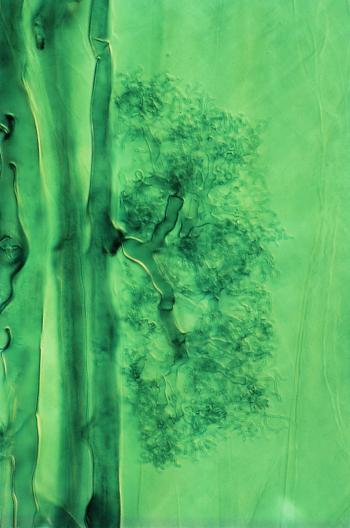
Figure 3.13 Mature arbuscule of Glomus mosseae which has formed in a root cortical cell of leek (Allium parvum). A large surface area between fungus and host cell enables exchange of organic solutes and mineral nutrients across the interface formed by the two membrane systems. Roots were cleared, stained with Chlorazol black and viewed with interference contrast microscopy (Photograph courtesy M. Brundett; reproduced with permission of ACIAR and CSIRO Forestry and Forest Products)
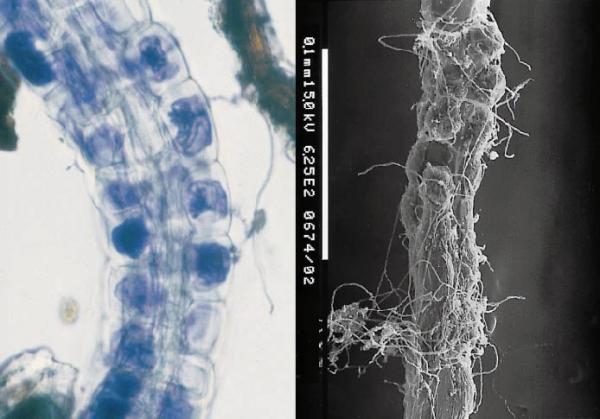
Arbuscular mycorrhizal associations are formed by fungi from the family Glomales (Zygomycetes). During the infection process, fungal hyphae penetrate the epidermal cell layer before forming highly branched structures called arbuscules within individual cells of the cortex (Figure 3.13). Hyphae do not penetrate the endodermis or enter the stele. Arbuscules represent the major interface across which nutrient and carbon exchange takes place in arbuscular mycorrhizal symbioses. Although the plant cell wall is penetrated during infection, the host plasma membrane remains intact and apparently functional, proliferating to surround the arbuscular branches as they develop. The interface between fungus and plant thus comprises membranes of both partners separated by a region of apoplasm, a feature common to all types of mycorrhizal association (Smith et al. 1994). The highly branched nature of arbuscules is thought to increase the surface area to volume ratio of the host plant by up to 20-fold, providing an extensive interface across which nutrient exchange can take place. Ericoid mycorrhizal fungi (largely ascomycetes) form a similar interface between cell walls and membranes in the fine hair roots of the Ericales. Fungi penetrate the epidermal cells, forming dense hyphal coils which are surrounded by host plasma membrane, although the extent to which this increases the surface area of host plasma membrane has not yet been determined (Figure 3.14).
 [2]
Figure 3.14 (a) Hair root of Lysinema ciliatum, from the Australian Epacridaceae, stained with Trypan blue showing enlarged epidermal cells containing intracellular hyphal coils. Hyphae only penetrate single epidermal cells (× 450). (b) Scanning electron micrograph of L. ciliatum showing enlarged ‘balloon-like’ epidermal cells and loose hyphal weft (Photographs courtesy K. Dixon)
 [3]
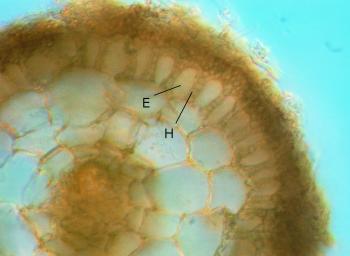
Figure 3.15 Transverse section of an ectonqycorrhiza showing a Hartig net (H) in roots of Eucalyptus globulus. Fungal hyphae are structurally modified, making intimate contact with root epidermal cells (E) and enabling exchange of resources through the interface between fungus and host (× 300) (Photograph courtesy I. Tommerup and M. Brundett; reproduced with permission of CSIRO Forestry and Forest Products)
Ectomycorrhizal symbioses are formed largely by higher fungi in the Basidiomycotina and Ascomycotina, which form mycorrhizas with the short lateral roots of trees. Unlike arbuscular mycorrhizas and ericoid mycorrhizas, ectomycorrhizal fungi do not normally penetrate host cell walls. Rather, they form an entirely intercellular interface, with extensively branched hyphae penetrating between epidermal and cortical cells, forming a network known as the Hartig net (Figure 3.15). Depending upon the tree species involved, the Hartig net may extend as far as the endodermis, the highly branched hyphae providing a potentially vast surface area for nutrient exchange between the partners. Ectomycorrhizas are further differentiated from the other two main mycorrhizal types by the fact that the fungus forms a dense hyphal mantle around each short lateral root, sealing the normal absorptive surface of lateral roots from the soil environment to a greater or lesser extent. In such cases, the short lateral root will become entirely dependent upon the fungal symbiont for its nutrient supply.
The association between fungus and host plant delivers nutrients via: (1) mobilisation and absorption by fungal mycelia; (2) translocation to the fungus–root interface and (3) transfer across the fungus–root interface (Cairney and Burke 1996).
In addition to hyphae in direct contact with the root surface, all mycorrhizal fungi produce mycelium (extramatrical mycelium) which grows from the infected root surface into surrounding soil. Both arbuscular mycorrhizal and ectomycorrhizal fungi produce copious extramatrical mycelium, with arbuscular mycorrhizal mycelia extending several centimetres from the infected root surface and ectomycorrhizal mycelium potentially spreading for up to several metres. In either case, the mycelium extends well beyond the nutrient depletion zone for immobile nutrients around individual roots and displays a complex architecture that renders it an efficient nutrient-collecting network. Extramatrical mycelium is the component of mycorrhiza which efficiently mines bulk soil for scarce nutrients and translocates absorbed nutrients to the fungus–root interface where transfer to the host plant is effected.
 [4]
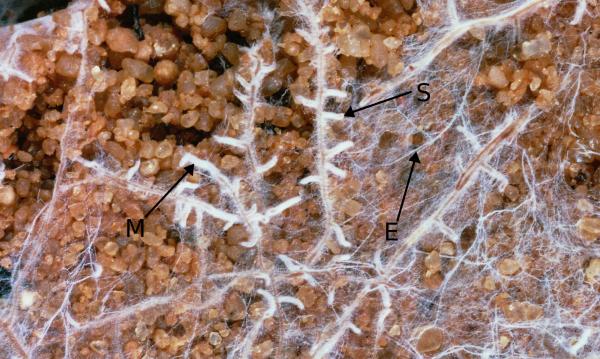
Figure 3.16 Abundant mycelium (M) of Scleroderma ramifies through soil forming a sheath (S) around roots of a eucalypt (E). Resultant ectomycorrhizas benefit the host through enhanced nutrient uptake (especially phosphorus) from surrounding soil (Photograph courtesy I. Tommerup; reproduced with permission of CSIRO Forestry and Forestry Products)
Extramatrical mycelium of many ectomycorrhizal fungi spread as a diffuse mat of individual hyphae where the leading edge progressively differentiates by hyphal aggregation behind the growing front to form complex linear multi-hyphal structures known as rhizomorphs (Figure 3.16). Hyphae up to 35 µm in diameter at the core of rhizomorphs are devoid of cell walls and play a role in transport of inorganic nutrients or photoassimilates. In arbuscular mycorrhizas, diffuse hyphae (diameter 1–5 µm) at the growing front provide a vast surface area for nutrient absorption, while larger diameter hyphae (up to 10 µm) constitute an excellent translocatory infrastructure for efficiently moving solutes from bulk soil through the rhizosphere to root surfaces (Read 1992).
Many experiments have demonstrated a relationship between arbuscular mycorrhizal infection and improved plant phosphorus status. Arbuscular mycorrhizal fungi do not appear to have access to sources of soil phosphorus that are otherwise unavailable to non-mycorrhizal roots. However, extramatrical mycelium provides a large surface area for orthophosphate absorption from bulk soil through production of up to 250 m of mycelium cm–1 of colonised root. Increased plant absorption of nitrogen and other macronutrients such as calcium and sulphur and micronutrients including zinc and copper also appear simply to reflect the increased absorptive surface of the extramatrical mycelium. Some arbuscular mycorrhizal fungi might still be shown to extract phosphate from organic forms in soil through the action of extracellular phosphatases. Absorption of orthophosphate is maximised by the action of a high-affinity transporter which is expressed only in extramatrical mycelium of arbuscular mycorrhizal fungi during symbiosis with the plant (Harrison and van Buuren 1995).
The extramatrical mycelium of ectomycorrhizal fungi increases the absorptive area of a root system several-fold. This increase is undoubtedly important in extending the volume of soil explored by the host plant and consequently the quantity of minerals available. Ectomycorrhizal fungi, however, use additional strategies to enhance nutrient acquisition. Many secrete extracellular proteinases and peptidases that effectively hydrolyse organic nitrogen sources to liberate amino acids which can be absorbed by the fungi. Like northern hemisphere forest soils, where nitrogen mineralisation through the action of these enzymes is well established, Australian forest soils have considerable organic nitrogen which can be mineralised. Even though the rate of mineralisation by ectomycorrhizal fungi is unquantified in southern hemisphere forests, ectomycorrhizal-derived enzymes are likely to be of importance in tree nutrition. Ectomycorrhizal fungi also produce extracellular phosphomonoesterases and phosphodiesterases, the latter mediating access to phosphorus sequestered within nucleic acids. Some ectomycorrhizal fungi produce hydrolytic enzymes within the cellulase, hemicellulase and lignase families that may facilitate hyphal entry to moribund plant material in soil and access to mineral nutrients sequestered therein. In these ways ectomycorrhizal fungi shortcircuit conventional nutrient cycles, releasing nutrients from soil organic matter with little or no involvement of saprotrophic organisms. Ectomycorrhizal fungi also release siderophores capable of complexing iron and oxalate to improve potassium uptake. Reducing agents released by ectomycorrhizal fungi enhance ion uptake from stable oxides (e.g. MnO2), further contributing to host plant nutrition.
In contrast, ericoid mycorrhizal fungi produce little extramatrical mycelium and infection does not significantly increase the absorptive surface of the host root system (Figure 3.14). Hair root systems of plants in the Ericales form extremely dense mats with a potentially large absorptive area in heathland soils, reducing the need for extensive extramatrical mycelium. A major contributor to nutrient acquisition in the Ericales is production of a complex array of extracellular enzymes that can release nitrogen and, to a lesser extent, phosphorus from simple organic compounds and plant litter. Ericoid mycorrhizal fungi are important sources of these enzymes. This is of particular importance in high-rainfall, low-temperature environments where the activities of decomposer organisms are extremely limited and organic matter accumulation is large.
 [5]
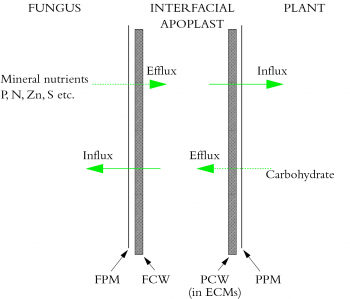
Figure 3.17 A simplified view of the symbiotic interface showing fungal (FPM) and plant (PPM) plasma membranes through which fluxes of solutes occur. Carbohydrates efflux into the interfacial apoplasm where they become available for influx to the fungus. Mineral nutrients extracted from soil by the fungus are effluxed to the same space, making them available for the host plant. Fungal cell wall (FCW) occupies the apoplasm in all mycorrhizal associations but plant cell wall (PCW) is only present in the interface of ectomycorrhizas, where fungal hyphae are intercellular. In arbuscular and ericoid mycorrhizal associations, hyphae penetrate PCW and therefore only FCW occupies the interface (Based on Smith and Read 1997).
Regardless of the mycorrhizal type, nutrients arrive at the fungus–root interface within the symplasm of the fungus (Figure 3.17). Transfer to the host plant involves efflux across the fungal plasma membrane and subsequent absorption from the apoplasm of the interface across the plasma membrane of the host root cells. Escape of substrates from the interface is minimised by elaborate fungal structures. Impermeable extracellular material deposited between hyphae of the mantle in some ectomycorrhizas and at the points of hyphal entry into cells in arbuscular mycorrhizas and ectomycorrhizas create a defined apoplasmic compartment. Not only does this prevent leakage from the interface apoplasm but it also means that local chemical and physical conditions can be controlled by the activities of both partners.
Ectomycorrhizal fungi derive carbon for growth and metabolism from host roots, largely as photoassimilate. Sucrose is thought to be hydrolysed in root cell walls and glucose is then absorbed by hyphae from the interface apoplasm.
Identifying control steps in phosphate transport across a fungus–root interface has proved difficult because fungi store phosphate as polyphosphates, making it difficult to estimate the concentration gradient of free orthophosphate across the fungal plasma membrane. Indeed, rates of phosphate release from these polyphosphate reserves might determine phosphate efflux rate to the apoplasm. Transport proteins in fungal and host plasma membranes must also play a central role in phosphate uptake by mycorrhizal roots and considerable effort is being made to discover the combination of phosphate transporters and channel proteins coordinating this flux. Cloning of a high-affinity transporter from arbuscular mycorrhizal fungi is a start in this search. Absorption of phosphate across the host plasma membrane is believed to be mediated by a 2H+/orthophosphate symporter energised by an H+-ATPase. A quantitative picture of how mycorrhizal associations transport phosphate will require more knowledge of transport kinetics, fungal phosphate metabolism, channel gating factors (Section 4.1) and interaction between fungal and host genomes.
Links:
[1] http://plantsinaction.science.uq.edu.au/edition1//?q=figure_view/120
[2] http://plantsinaction.science.uq.edu.au/edition1//?q=figure_view/123
[3] http://plantsinaction.science.uq.edu.au/edition1//?q=figure_view/124
[4] http://plantsinaction.science.uq.edu.au/edition1//?q=figure_view/125
[5] http://plantsinaction.science.uq.edu.au/edition1//?q=figure_view/126