
 [1]
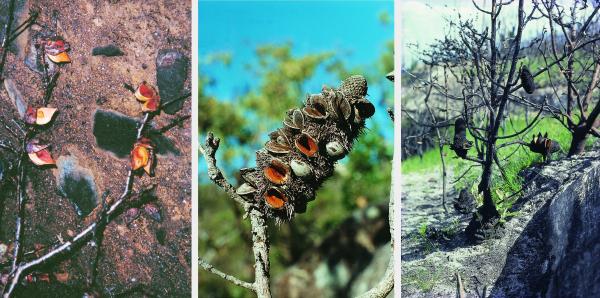
Figure 19.2 (a) Seed capsules of Hakea that have opened after an intense fire that killed the parent plant four weeks earlier in John Forrest National Park, Western Australia. Seeds have been shed onto the surrounding ‘ash bed’. (b) Follicles of Banksia serrata open after a long dry period, revealing the brown surface of empty seed capsules. Note that some follicles are still closed; these could open later in response to fire, releasing more seed (Sydney). (c) Fire has severely burnt bushland in the Blue Mountains near Sydney, causing a Banksia serrata tree to respond rapidly. Seed capsules have opened to release seed and the lignotuber has sprouted to generate new leaves. Note also monocotyledons in the background have resprouted from leaf bases immediately after this fire ((a) Photograph courtesy Inez Tommerup; (b) photograph courtesy D.A. Adamson; (c) photograph courtesy P.M. Selkirk)
 [2]
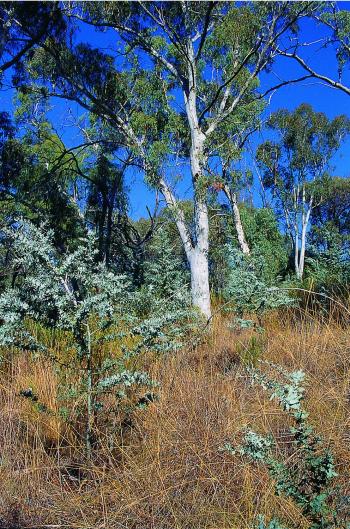
Figure 19.3 Re-establishment of Cootamundra wattle (Acacia baileyana) after fire near Canberra years earlier had ruptured the impermeable, hard seed coats. (Photograph courtesy R.H. Groves)
 [3]
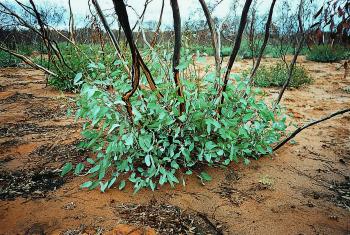
Figure 19.4 Epicormic growth of mallee eucalypts one year after a fire in western Victoria. (Photograph courtesy P.E. Kriedemann)
 [4]
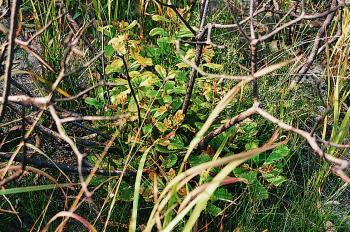
Figure 19.5 Resprouting of Banksia spp. In the season following a fire in the Royal National Park, New South Wales; dead wood is all that remains of the previous shoot while new shoots are established from tissues that survived the fire. (Photograph courtesy B.J. Atwell)
 [5]
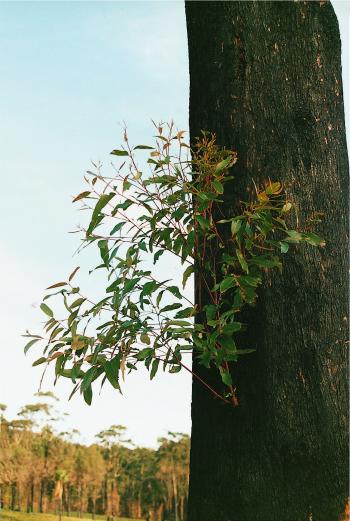
Figure 19.6 Aerial shoots appear from epicormic buds of a eucalypt tree near Wollongong, New South Wales, after severe fire had destroyed the entire leaf canopy in the previous summer. (Photograph courtesy B.J. Atwell)
 [6]
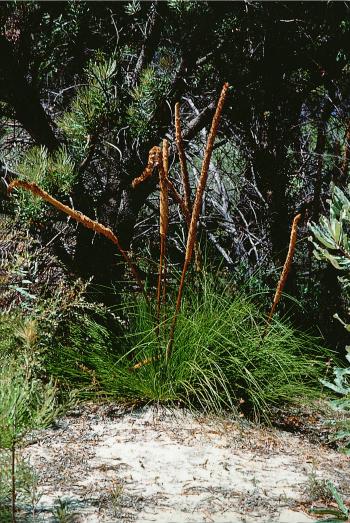
Figure 19.7 Stimulation of flowering in Xanthorrhoea spp. Growing in John Forrest National Park, Western Australia, after a fire nine months earlier. Note also resprouting of burnt trunks of banksia trees in the left of this picture. (Photograph courtesy Inez Tommerup)
Fire regimes that occur naturally across most of the Australian landscape have given rise to distinct adaptive features in the native flora. Climatic zones across Australia ranging from temperate to tropical have generated commensurate contrasts in fire frequency and intensity, in turn selecting for diverse combinations of genetic traits that confer tolerance to fires. Fire-tolerant plant communities such as sclerophyll woodlands generally have admixtures of species in which some or all of these adaptive characters are represented (Specht et al. 1958; Purdie 1976a, b).
The principal fire-tolerant responses in plants can be summarised in the following four broad categories:
Seeds of many species of Casuarina, Hakea, Banksia, Leptospermum and Eucalyptus are encased in woody capsules capable of remaining dormant for years and resisting predation. An entire fruiting body (‘cone’) can contain dozens of seeds (e.g. Stenocarpus) or only a pair as in the case of Hakea (Figure 19.2a). The fruiting bodies of Casuarina and Banksia include numerous hard follicles (Figure 19.2b). As each follicle opens after fire, a few seeds are dispersed onto the surrounding soil. Woody capsules can survive intense summer fires, releasing seed subsequently which then germinates in an ash bed enriched in nutrients (Figure 19.2c). Long periods of desiccation also cause capsules of some species to rupture, thereby ensuring that seeds are released into soil before the onset of a rainy season (Figure 19.2b).
Short periods of intense heat break seed dormancy in some Acacia species, thereby triggering extensive germination and rejuvenation of communities. Highly water impermeable phenolic compounds in the seed coat of these species are disrupted by heat from fires (and long periods of high temperatures), allowing imbibition and
germination to proceed. The short-lived Cootamundra wattle (Acacia baileyana) has large seed banks in soil ready to germinate once a fire has passed; Figure 19.3 shows new recruits that have established after a fire.
Many genera, in particular Eucalyptus, have woody storage organs called lignotubers with cambial tissues capable of resprouting after fire. Young epicormic shoots grow vigorously from charred stumps or stems of a parent plant, fed by nutrient and carbon stores laid down earlier. Resprouting from burnt stem bases of a mallee eucalypt (Figure 19.4) and the burnt stump of a banksia tree (Figure 19.5) are illustrated. New shoots also arise from aerial buds that can withstand fire (Figure 19.6) and from subterranean rhizomes of monotcotyledons.
Some geophytes (plants with organs such as tubers that can lie dormant) and the grass trees Xanthorrhoea and Kingia undergo profuse flowering in the season following fires. Trunks of grass trees, comprising densely packed leaf bases, survive intense summer fires and give rise to spectacular inflorescences in the following rainy season (Figure 19.7). Some orchid species produce flowers after fire from bulbs lying below the zone of heating. Nutrients concentrated in an ash bed after fires might directly promote initiation of these inflorescences in underground organs.
Section 19.3 deals with the occurrence of reseeding and resprouting under different fire regimes; these strategies can individually confer tolerance to fire but often coexist within the same fire-affected community and are sometimes even found within a single species (e.g. Figure 19.10).
Smoke stimulates germination of many Australian species as well as seeds native to the South African fynbos (de Lange and Boucher 1990) and Californian chaparral (Keeley and Fotheringham 1997). Smoke treatments have been applied to seeds of almost 100 Western Australian plants chosen from 20 angiosperm families and a gymnosperm family on the grounds that their seeds were notoriously difficult to germinate (Dixon et al. 1995). Exposing seeds to smoke or ‘smoked water’ in a glasshouse either hastened or prolonged germination in half the taxa and in a quarter of the taxa broke previously intractable dormancy. Genera such as Verticordia (Myrtaceae), Hibbertia (Dilleniaceae) and Stirlingia (Proteaceae) responded positively to smoke. Equally, smoke treatments in the field stimulated germination in all 15 taxa studied, in many cases smoke and fire appearing to act independently by stimulating germination additively.
Smoke is a mixture of thousands of combustion products. The hydrocarbon ethylene has been implicated in smoke-induced flowering of Xanthorrhoea but phytohormonal effects of many other gaseous components of smoke are yet to be considered. Nitrogen oxides elicit responses similar to smoke in the American chaparral plant Emmenanthe penduliflora. Ammonia, too, is implicated in breaking of dormancy in some South African species, thereby supporting the view that nitrogenous compounds in smoke are biologically active.
Fire can be a major determinant of the composition of plant communities and it sometimes defines the boundaries between dissimilar plant communities (Section 19.4). Species with little tolerance to fire can be pushed rapidly to extinction within a single generation while others profit from resources liberated through the impact of fire. For example, light levels beneath a canopy improve after fire-intolerant species are eliminated, raising light and heat capture by emergent seedlings and epicormic shoots of fire-tolerant species.
Reduced water and nutrient withdrawal by plants killed by fire leaves these resources available for establishment of fire-tolerant plants. Furthermore, ash released from burnt plant material (‘ash-bed effect’) supplies a flush of particular inorganic nutrients for new plant growth (Renbuss et al. 1972). However, nutrient enrichment might be short lived and depends on the nutrient in question. Calcium, magnesium and potassium can be leached through sandy soils after fires and made unavailable for new seedlings. Analysis of burnt and unburnt sites at Wilsons Promontory, Victoria, revealed major nutrient perturbations in the surface 2 cm of soil; burning improved phosphate concentrations by at least 30% while nitrogen was depleted by about 30% (Adams et al. 1994). Post-fire colonisation by Leptospermum and Kunzea spp. was rapid in these conditions. Shrublands and forests are often enriched in nitrogen-fixing species after fire because of temporary nitrogen deficits and sometimes specifically through fire-induced germination (Figure 19.2). Moreover, natural inhibitors of germination (allelochemicals) can be destroyed by intense heat. Hence the opportunity created by fire can be quickly seized by species with seeds or vegetative structures able to survive burning.
Land management can be achieved through use of fire because of these differential responses of species to fire regimes. For example, weed infestation can be reduced through judicious use of fire, as demonstrated in some coastal Victorian national parks where boneseed (Chrysanthemoides monilifera) is known to be restricted by two fires lit in short succession.
Effects of smoke on germination are not widely exploited by land managers as yet but they have potential for propagation of species previously considered unamenable for cultivation (e.g. Verticordia spp.). Evidence that smoke is biologically active when perfused through water and progress in isolating the active constituents from smoke open the way for dormancy breaking in these fire-dependent species. Some commercially useful species can be induced to flower by exposure to heat and the gases which fires release; Christmas bells (Blandfordia grandiflora) and kangaroo paws (Anigozanthos spp. from Western Australia) both flower more profusely in response to fire.
Animal habitat is also affected by fire, not only immediately after burning but also through long-term shifts in plant community composition. Exploitation of fire to maintain open sclerophyllous woodlands is thought to have been practised locally by Aboriginal Australians for tens of thousands of years (Section 19.4). Maori in New Zealand burnt the largely coniferous lowland forests, thereby eliminating podocarp stands and opening the landscape to grasses. Conifers of the southern hemisphere such as araucarias, podocarps and even the drought-tolerant Callitris spp. are generally intolerant of fire because they lack seed resistance to heat and a capacity to resprout.
Links:
[1] http://plantsinaction.science.uq.edu.au/edition1//?q=figure_view/905
[2] http://plantsinaction.science.uq.edu.au/edition1//?q=figure_view/904
[3] http://plantsinaction.science.uq.edu.au/edition1//?q=figure_view/906
[4] http://plantsinaction.science.uq.edu.au/edition1//?q=figure_view/907
[5] http://plantsinaction.science.uq.edu.au/edition1//?q=figure_view/908
[6] http://plantsinaction.science.uq.edu.au/edition1//?q=figure_view/909