
Fire creates heat and gases (‘smoke’) as living and dead plant material burns. However, the immediate impact of fires varies, depending on the amount of combustible material, how fast it burns and how fast heat is transferred to the surrounding biota. Fire is analysed here as a physical phenomenon by quantifying the release of heat energy as plant materials burn. However, fires do more than release energy; they have chemical impacts on plants through smoke and ‘ash-bed’ effects that are dealt with in Section 19.2. In turn the biological responses of plants to fire intensities are highly variable, depending on species and time scales (Sections 19.2 and 19.3). The effect of fire on an ecosystem is a function of: (1) intervals between fires; (2) fire intensities, that depend on fuels, atmospheric conditions and terrain; (3) seasonalities of fires; and (4) whether or not fires burn any peat that may be present. These variables are the components of ‘fire regimes’ (Gill 1975, 1981a).
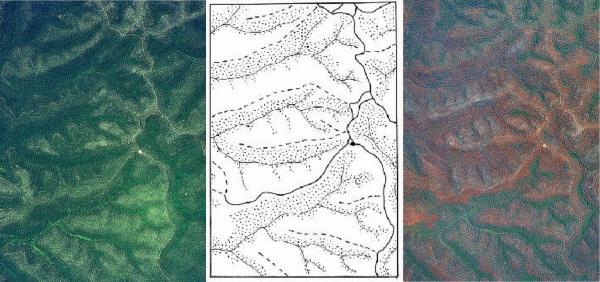
Complex impacts of fires can be seen in Figure 19.1, showing differential effects of fire on woodland and open forest growing on a dissected sandstone landscape north of Sydney. The extent of burnt and unburnt plant material left after this fire varies dramatically, giving rise to differential fuel loads that will affect subsequent fire regimes. Erosion patterns also vary locally after such large fires, affecting rates of revegetation and production of new fuel.
 [1]
Figure 19.1 A dissected sandstone landscape north of Sydney (latitude 33°S) before (a) and after (c) a severe fire in January 1994. Complex effects of burning are well illustrated in this area of east-west ridges and valleys. Larger inputs of solar energy on north-facing slopes than south-facing slopes affect vegetation type, fire regimes and subsequent erosion patterns that form east—west valleys. (a) Vegetation on ridges and north-facing slopes is eucalypt woodland and shrubland with sparse foliage cover and much bare ground; on south-facing slopes and along creeks vegetation is denser open eucalypt forest with little or no bare ground. (b) Diagram to show: ridge crests (dashed lines), sometimes in the form of roads (thick solid lines); creeks (thinner solid lines); open forest (stippled) and woodland and shrubland (no symbol). (c) Immediately after fire and before scorched leaves are shed from the tree canopy. Woodland and shrubland is extremely exposed while in open forest a dense but scorched leaf canopy remains. Some creeklines still have green vegetation that could burn in a future fire. (Aerial photographs courtesy New South Wales government: (a) Homes Valley New South Wales, Run 13, Frame 86, 27 November 1992 and (c) Hunter Region Bushfires January 1994, New South Wales 4185 (M1979), Run 19, Frame 159, 4 February 1994; (b) illustration courtesy D.A. Adamson and P.M. Selkirk)
Heat production from burning material (Q) is described thus:

where h is the mean heat of combustion in kJ kg–1 and w is fuel loading (biomass burnt) in kg m–2, giving Q the units kJ m–2.
Rates of heat production determine the impact of surface fires on topsoil, seeds and microbes buried in the topsoil and living plants. Fires burning below ground (ground fires) are not considered here (see Gill 1995). The rate of heat production by surface fires, or ‘fire intensity’ (Byram 1959), is given by:

where I is fire intensity in kW m–1 and r is the rate of spread of the ‘fire edge’ in m s–1. Note that the unit of fire intensity is expressed as a rate per unit of fire edge rather than a rate per unit area, thereby avoiding the need to make difficult measurements of the depth of flame at the edge.
Fires pass a plant very quickly — usually within a few minutes: how long flames persist at the base of a plant seems to change little within a fuel type (e.g. grass or litter) but greatly between fuel types such as grassland and sclerophyll forest (McArthur and Cheney 1966). Rates of spread of fires vary widely and, together with the more limited variation in fuel loadings, fire intensities vary from a few kW m–1 up to about 100 000 kW m–1 (Gill and Moore 1990). Large variations in the rates of spread of fires at their edges can occur within the one fire. Heat of combustion varies much less and is usually regarded as a constant.
So where does the heat from a fire go? It is transferred by conduction (down into soil, for example), radiation (especially from flames) and convection (typified by hot gases in the ‘convection column’ or ‘smoke plume’). In practical terms, the physical effects of these heat transfers on plants and soil are assessed by duration of exposure to high temperatures.
A temperature of about 60°C will cause the instantaneous death of most hydrated cells while the resinous bonds holding the valves of some woody seed follicles closed melt at about 75°C (Gill 1976; Wardrop 1983). Water boils at about 100°C; at this point water vaporises causing total thermal arrest. Charring of tissues begins at about 300°C and ash forms above about 500°C.
Combustion of leaves is possibly the simplest response to consider in a fire because leaves are usually thin (fractions of millimetres) and hydrated. They are therefore poorly insulated. Leaves subject to hot dry conditions prior to the onset of fire quickly reach 60°C and begin to die (Gill 1995).
Unlike leaves, many tissues are insulated. Typically, the cambium of a tree is insulated from external heating by bark, sometimes fully alive and hydrated, sometimes partly dead and superficially flammable. Other examples are seeds in the woody fruits of plants of genera such as Hakea, Casuarina, Eucalyptus and Callitris and seeds present in the soil. To predict how heat affects temperature of tissues, it is necessary to quantity the relationships between temperature and heat.
The rate of temperature change in plant tissue is determined by thermal diffusivity, κ (m2 s–1). Surface tissues of plants heat up relatively slowly because of low κ. Thermal diffusivity is described by the following equation:

where k is thermal conductivity (kJ s–1 m–1 °C–1), c is specific heat of the tissue ( kJ kg–1 °C–1), and ρ its density (kg m–3).
While k of plant tissues varies widely, κ is often regarded as a constant for large variations in moisture content and density (Gill and Ashton 1968; Vines 1968). Thickness of bark is therefore the main factor determining how well the base of a tree (bole) is protected from fire. Severe thinning of the flammable bark of stringybark trees (Eucalyptus spp.) and some paperbark trees (Melaleuca spp.) by fire can expose underlying tissues to damaging temperatures.
Bark thickness varies widely according to plant species, position on the plant, vigour and history of exposure to previous fires. Bark thickens through differentiation of phloem initiated in the vascular cambium (Section 7.1). Meanwhile, bark becomes thinner due to regular decortication, which is under physiological control (as in most ‘gumbarked’ species of Eucalyptus), or sloughing of dead tissues, which is under mechanical and environmental controls (as in most ‘stringybarked’ Eucalyptus). In general, bark thickness increases with girth in woody plants and decreases with height: stems well above ground have thinner bark than trunks of the same girth at ground level (Gill and Ashton 1968). In some eucalypts, allometric relationships have been established between cross-
sectional areas of bark and stems (Brack et al. 1985).
Non-dicotyledonous plants such as tree ferns and woody monocotyledons have vascular bundles dispersed throughout their fibrous stems. By contrast, cycads have a ring of vascular tissue embedded deep within a stem cortex. Consequently, modes of tissue regeneration and long-distance transport in these plants are dissimilar to dicotyledonous plants, where an annulus of phloem overlies a cylinder of xylem with each cell type distinctly separated by a vascular cambium. The principles of high temperature damage as heat is conducted to successively deeper layers of tissue are the same for all these plant groups but the physiological consequences differ. Death of the vascular cambium after severe fires have removed bark can kill an entire tree through preventing restoration of phloem activity.
Physical difficulties of measuring temperatures of fires have been partly overcome by the use of thermocouples: temperatures up to about 900°C have been measured in Australian fires (Moore et al. 1995).
How long temperatures at the plant surface remain at 100°C is critical in predicting the extent of tissue death from fires (Gill 1981b). While tissues are dehydrating, the temperature stays at boiling point but once most of the water has been lost, temperatures will rise. Depths of bark affected by the elevated temperatures of fires can be quite shallow. For gumbarked species, this depth can be estimated some time after the fire has passed because bark killed by the fire is shed from the tree while live bark persists (Gill 1981b).
Soils, like bark, are good insulators. A low-intensity fire — say, about 90 kW m–1 — produces substantial temperatures in the flaming zone while temperatures in the surface soil only rise to about 100°C ( Shea et al. 1979). However, more intense fires — up to 2500 kW m–1 — heat soil to a depth of 6 cm and increase surface soil temperatures more than 250°C above ambient (Shea et al. 1979). Heating of surface soil can kill microorganisms, seeds and other plant tissue. Changes in soil chemistry may also occur which, together with sterilisation, can temporarily increa
The physical attributes of fires kill some plant tissues and change soil chemistry. Subsequently, availability of light, water, nutrients and biomass for grazing animals can change, generating ‘fire effects’ that are secondary outcomes of fire. The immediate effects of a fire set the scene for the next fire which can again modify a plant community according to its intensity, type and season of occurrence — hence the importance of fire regimes. Outcomes for a plant community depend on many genetic properties of plant species, not just tolerance to a fire.
Links:
[1] http://plantsinaction.science.uq.edu.au/edition1//?q=figure_view/899