
About 30 million hectares of mainland Australia are underlain by salt, including both arid and semi-arid rangelands plus arable lands with naturally occurring saline subsoil. As something of an indictment of management practices over the past century, at least four million hectares are suffering from human-induced (secondary) salinisation. This includes large scalded areas where overgrazing has led to erosion of topsoil and exposure of saline subsoil, plus about 1.2 million hectares subject to secondary salinisation where saline groundwater emerges as surface seeps on previously arable land. Irrigation salinity due to saline irrigation water and/or inadequate drainage adds another 500 000 ha to our national total.
 [1]
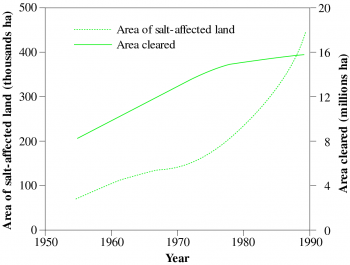
Figure 17.1 Secondary salinisation is a consequence of comprehensive land clearing, and in southwest Western Australia cleared areas have increased linearly between 1955 and 1975 with a subsequent decline in rate of expansion. By contrast, salt-affected areas have increased curvilinearly and with a faster rate of expansion subsequent to 1975. (Note the different scales: area cleared is in millions of hectares whereas area salt affected is in thousands of hectares) (A smoothed representation or data from George 1990)
Most dryland salinity is evident in wheat-growing and sheep-grazing zones of Western Australia and South Australia which occupy the 400–600 mm rainfall region. Here extensive land clearing with subsequent cropping and grazing has increased net accessions of rain to groundwater. Local hydrologic cycles have been disturbed to such an extent that rising water tables (commonly highly saline) have broken out on lower slopes to form saline seeps (hence ‘secondary salinisation’). Salt-sensitive plants soon die in these discharge zones, and if recharge areas are left uncorrected saline seeps expand upslope, leading to further land degradation. Secondary salin-isation is an insidious process and continues long after native vegetation is cleared. For example, land cleared for agriculture in southwest Western Australia has increased in area more or less linearly between 1950 and 1990 but at a decreasing rate of expansion (Figure 17.1). By contrast, the corresponding area of salt-affected land has increased curvilinearly, and with an increasing rate of expansion. Australia wide, secondary salinisation is spreading at a compounding rate of about 5% per year (SCAV 1982). By 2020, somewhere between 10% and 25% of previously arable land could be out of production.
Turning to a more geographically confined issue in eastern Australia, salinisation of irrigated land in the Murray–Darling basin derives from salt left behind by intrusions of seawater that commenced at least 65 million years ago. The Murray River now flows across sediments that are underlain by highly saline groundwater, and even prior to European settlement Murray River water was naturally saline at times of low flow. Extensive development of irrigation schemes in the Murray–Darling basin over the past 100 years or so has led to a dangerous rise in groundwater over large areas where capillary rise of salt in fine-textured soils can put irrigation cropping at risk. Regional projects for subsurface drainage and groundwater pumping schemes are restoring a new hydrologic balance within some parts of the Murray–Darling basin, so that long-term viability of irrigation cropping and grazing enterprises is now assured in such areas. Stable forms of agriculture will continue to call for salt-tolerant cultivars, while long-term horticulture necessitates salt-excluding rootstocks. Reclamation of degraded land is possible where saline groundwater can be safely disposed of, and salt-affected soils restored to an arable state by leaching out profile salt. Soil ameliorants such as gypsum are commonly applied as part of this leaching process to displace Na+ ions adsorbed by clays during salinisation.
Aside from salinisation, about 30% of agricultural land in Australia is already sodic. Such land is difficult to manage and susceptible to degradation (including erosion) due to poor soil structure. Soil physical properties are adversely affected by an accumulation of Na+ salts. Clay particles, by their very nature, carry a negative charge. When more than 6% of these charges are balanced by sodium ions, those soils are regarded as sodic. The extent of sodium adsorption in soils depends on the proportion of sodium to multivalent ions in the soil solution (especially Ca2+ and Mg2+) and is expressed as a sodium adsorption ratio (SAR) defined as:

where [Na], [Ca] and [Mg] are the concentrations of sodium, calcium and magnesium, respectively, in soil solutions or 1:5 soil:water extracts, and expressed as millimoles L–1.
In dry sodic soils, clay particles are linked by Na+ ions and remain as aggregates. On wetting by rain or fresh water of low salinity, Na+ ions become highly hydrated leading to separation of clay particles. Further wetting leads to extensive hydration. Clay particles then disperse as single individuals. Such soil is technically ‘dispersed’ (i.e. an absence of water-stable aggregates) and lacks structure. Notably, however, if a dry sodic soil is wetted with saline irrigation water, dispersion of clay particles does not occur to the same extent and some structure is retained. This property can be used to good effect during reclamation of sodic soils, but has to be managed carefully. Relying on NaCl to maintain clays in a stable state is a hazardous tactic and risks osmotic and ion toxicity effects on plant growth.
In contrast to a Na+-affected (sodic) soil where clay particles disperse on wetting, Ca2+ linked or Mg2+ linked clays swell to a more limited extent. As a consequence, those clay particles do not disperse as soils wet and structure is retained (Rengasamy and Olsson 1991).
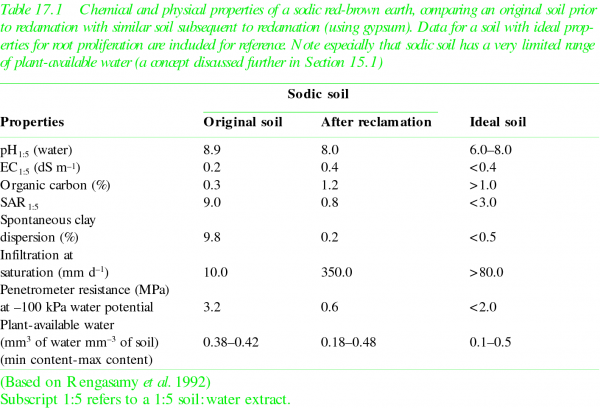
Swelling and dispersion of sodic clays destroy soil structure, and by so doing reduce porosity and permeability which predisposes to waterlogging. Poorly structured sodic soils offer a high resistance to root growh that can be inferred from
penetrometer data (Table 17.1). Root growth is restricted, because sodic soils are either too wet (immediately after rain or irrigation) or after a few days of fine weather, too dry. In effect, there is only a narrow range of available water over which plant roots can grow and sustain plant function in a sodic soil (see net range of available water in Table 17.1).
 [2]
Table 17.1
Sodic soils can be reclaimed via gypsum application, or in the case of acid sodic soils, gypsum + lime. Ca2+ ions in both gypsum and lime act by displacing Na+ ions which are sub-sequently leached out of the profile. As clay particles become charged with these divalent cations in place of monovalent ions, such clays cease swelling and dispersing so that soil structure is immediately improved by this change in their physico-chemical properties. Root growth ensues, and soil structure is further improved by accumulation of organic matter.
Substances in aqueous solution lower the free-energy status of solvent molecules (water), and the resulting osmotic pressure of that solution (where pure water is zero) can be derived from physical chemistry. Osmotic pressure (P) generated by a salt that dissociates into ions in aqueous solution, or by undissociated organic molecules in solution, can be calculated from the historic van’t Hoff expression (Equation 17.2). This relates osmotic pressure of an ideal solution (i.e. a dilute solution of an ideal solute) to the concentration of that solute expressed in terms of its osmolality and RT (where R is the universal gas constant and T is absolute temperature in degrees Kelvin). Thus,

where Π is osmotic pressure (expressed in megapascals, MPa), c is concentration (osmoles per litre of water) and RT is 2.48 at 25°C (litre-MPa per mole).
 [3]
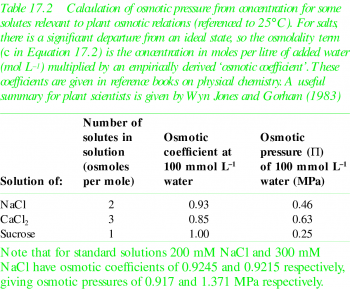
Table 17.2
The osmotic pressure of a solution can be calculated from solute concentration per litre (or per kilogram) of water (see Table 17.2 for an example based on sucrose). With organic compounds such as sucrose that do not dissociate into ions in water, osmolality (osmoles per litre of water) is the same as molality (moles per litre of water), which is almost the same as the more familiar term molarity (moles per litre of solution). At 100 mM, the discrepancy between osmolality and osmolarity is only about 1%.
When calculating the osmotic pressure of a salt solution (e.g. a solution of NaCl) each molecule of NaCl dissociates into two ions. In a solution of CaCl2, each molecule dissociates into three ions. Osmotic impact varies according to that dissociation, and must be taken into account when calculating osmotic pressure (see osmoles per mole in Table 17.2). A molecule of NaCl dissociates into two ions in solution, so that osmolality is almost two times the molality. However, osmotic effects from that dissociation are not complete, and deviations from ideal behaviour are accommodated by empirically deter-mined osmotic coefficients. Calculated values of osmotic pressure for solutions of NaCl and CaCl2 are given in Table 17.2.
Links:
[1] http://plantsinaction.science.uq.edu.au/edition1//?q=figure_view/791
[2] http://plantsinaction.science.uq.edu.au/edition1//?q=figure_view/817
[3] http://plantsinaction.science.uq.edu.au/edition1//?q=figure_view/818