
Elements essential for plant growth generally occur at soil concentrations that range between deficient or adequate for plant growth. Instances do occur, however, where there are excess concentrations of either essential or non-essential elements. These toxicities may occur naturally, as saline soils (Section 17.1), in soils developed from parent materials high in heavy metals (Section 16.5.3), or through soil acidification (Section 16.5.1).
Human action can exacerbate natural processes. This has occurred with salinisation of the landscape as a result of clearing native vegetation or through irrigation. Heavy metals have accumulated in the landscape through industrial pollution, through the use of fungicides that contain Cu or the use of superphosphate which may contain Cd.
Accelerated acidification has occurred through certain farming practices and is a particularly serious problem on sandy soils with low buffer capacity. Application of N fertilisers and inclusion of pasture legumes in rotations increase acidification. Also, drainage of some estuarine soils for farming or urban uses, in which S is present in the reduced state (e.g. as iron pyrite) under waterlogged conditions (i.e. acid sulphate soils), results in oxidation of S and reduction in soil pH. Certain mine spoils are also acid, particularly those high in iron pyrite, which on oxidation result in acidification of spoil in situ or of runoff waters. Acid rain is a further problem, and in industrialised nations, especially in Europe and northeastern USA, there is considerable atmospheric pollution which produces acid rain containing dissolved oxides of N and S. This acid rain may fall long distances away from the source of pollution, and has led to international disputes.
As soils acidify, plant growth generally declines and there is a decrease in the range of plant species that may be grown. The activity of soil fauna and flora decreases also. The extent of acid soils and the degree to which plant growth is reduced by acid soil factors make these soils of considerable ecological and economic importance.
Soil pH (negative logarithm of the molar activity of hydrogen ions) has been used to define acid soils. Since pH is measured on a logarithmic scale, it is important to realise that a soil with pH 4 is 10 times more acid than a soil with pH 5! Acid soils may be classified as those soils with a pH of less than 7 (i.e. neutral pH). However, this has little value in practice, since most plant species will only show reduced growth at substantially lower pH. Thus, soils with a pH of less than 5.5 may be regarded as acid (i.e. those in which growth of many plant species is adversely affected).
Acid soils occupy about 30% of global land surfaces, and predominate in two major regions of the world: humid temperate forests and humid tropics and subtropics (von Uexküll and Mutert 1995). However, many soils in other areas are acid also. Tropical acid soils alone comprise approximately two billion hectares, or 14%, of the total ice-free area of the world. Approximately 40% of the world’s arable soils (i.e. those on which crops may be grown) are acid.
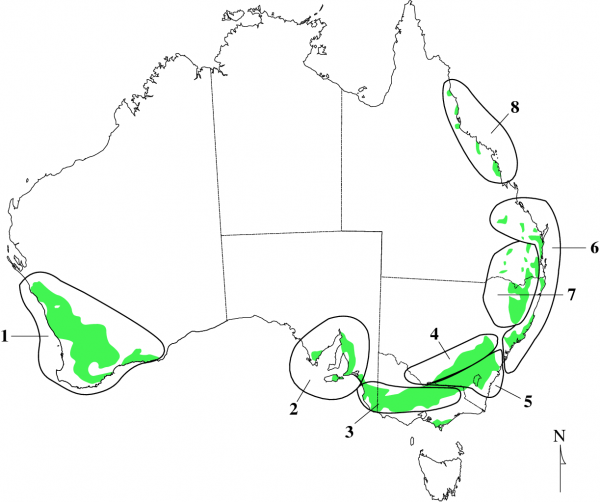
Eight regions of Australia have been identified in which agricultural production is reduced by acid soils (Figure 16.15). In southern Australia, these include the wheat and sheep belt of Western Australia, the southern portion of South Australia, cropping and grazing lands of southeastern South Australia along with the western, central and northeastern districts of Victoria. There are also about one million hectares of highly acidic soils in Tasmania. Further north in New South Wales, the cropping and grazing regions of the Riverina and southwestern slopes contain many acid soils, as do the tablelands and wet sub-tropical coastal farming regions of New South Wales and Queensland. Soils of the tropical wet coast of Queensland and adjacent intensively cropped and grazed areas are also acid to a considerable extent.
 [1]
Figure 16.15 Eight areas around mainland Australia numbered to match major biogeographic regions, where soil acidification has serious implications for reduced growth of crops and pastures. All areas commonly receive sufficient rainfall for nitrate leaching, and include poorly buffered soils with a long agricultural history. (Based on Land and Water Resources Research and Development Corporation 1995)
Overall, acid soils are most common where rainfall exceeds 450 mm year–1 and more than 80 million hectares of the most productive agricultural land in Australia are acidic, with more than 40% of this land being highly acidic (Land and Water Resources Research and Development Corporation 1995). Acid sulphate soils of coastal areas may also acidify when drained for crop production or urban use, with consequent effects on estuarine aquatic life. This most noticeably results in fish kills, often following rains after a dry period during which oxidation of soil S has occurred.
 [2]
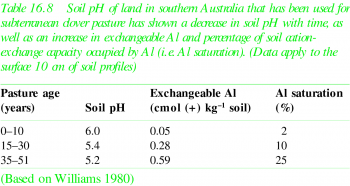
Table 16.8
Acid soil infertility in Australia is now recognised as an insidious and invisible form of land degradation. Worldwide, soil nutrient decline and acidification are often the most easily visible forms of land degradation. A landmark Australian study showed that soils under subterranean clover pasture acidify, with a decrease from a soil pH of around 6.0 in virgin soils to pH 5.2 where pasture had been grown for more than 30 years (Table 16.8). Subsequent studies have shown that the acid addition rate over extensive areas of New South Wales ranges from near zero to 3–5 kmol H+ ha–1 year–1, with up to 20 kmol H+ ha–1 year–1 in some exploitative systems (Helyar et al. 1990). With an acid addition rate of 4 kmol H+ ha–1 year–1, there would be a decrease of about 1 pH unit in the surface 30 cm of a sandy loam within 30 years. This would take about 120 years in more strongly buffered clay soils.
Soil pH has a marked effect on nutrient availability (Figure 16.2) by affecting both solubility of soil minerals present and the ability of plant roots to absorb nutrients. Generally, a decrease in soil pH increases availability of cations, especially essential micronutrients, Fe, Mn, Cu and Zn. In contrast, availability of Mo decreases, often to such an extent that acid soils are deficient in plant-available Mo. Availability of P also decreases at low pH via fixation with hydrous oxides of Fe and Al, although reactions with Ca can also reduce P availablility around pH 8.5 (Figure 16.2).
Al toxicity has been recognised for over 60 years. Shortly after the turn of the twentieth century, soil scientists found Al present in solution leached from soils. However, later attention was given to hydrogen clays, and following development of glass electrodes research emphasis was placed on soil pH for many years — an example of technology driving science! Despite publication of research results between the late 1920s and late 1960s, deleterious effects of Al on plant growth did not attract interest again until the early 1970s. Some of those findings are outlined here.
 [3]
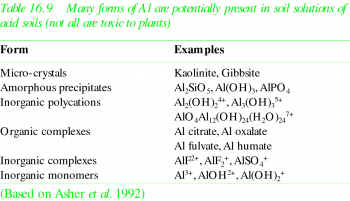
Table 16.9
Al is the most common metal in the earth’s crust (8% of dry mass) and comprises some 7% of soils, where it has a complex chemistry. Al is an important component of aluminosilicate compounds, including clay particles. As soils acidify, Al dissolves from these solid forms, and enters solution with the potential to then become toxic (Table 16.9). Not all Al in the soil solution is toxic, however, providing challenges to biologists to identify those forms that are. Those shown to be toxic to plants include the inorganic Al monomers (Al3+, AlOH2+, Al(OH)2+) and the inorganic polycation AlO4Al12 (OH)24 (H2O)247+ (known as Al13).
The concentration of Al in the soil solution is often low (<50 µM), and activities of monomeric Al in the soil solution that reduce root growth have been found to range from 4 to 15 µM. A further challenge to analytical chemists is to develop techniques able to discriminate between toxic and non-toxic forms of Al, made all the more difficult because of the low concentration of toxic Al. This concentration has been calculated to be about 0.1 g Al in 1 m3 of soil (c. 12 µM Al or one-third of one part per million in the soil solution). The same 1 m3 of acid soil would contain a total of 70 kg Al.
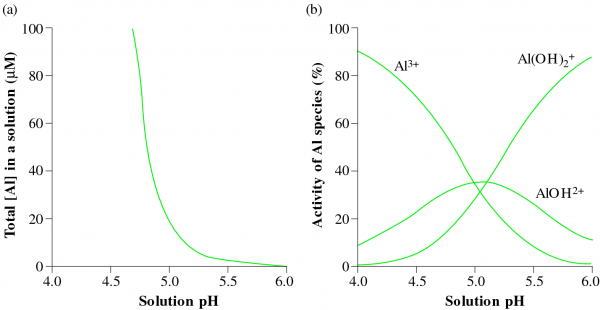
Solubility of Al decreases dramatically with an increase in soil pH (Figure 16.16a), and the concentration of inorganic monomeric Al in solution is also affected by organic and inorganic anions. Complexes of Al with organic ligands of low relative molecular mass, especially citric and malic acids, are also considerably less toxic. Tolerant plants benefit from such chelating mechanisms. In addition, organic matter increases the concentration of fulvic and humic acids, resulting in the formation of Al fulvate and Al humate. These complexes are considerably less toxic than the inorganic monomeric species.
 [4]
Figure 16.16 (a) Total concentration of all ionic species of Al in solution as a function of pH. In (b) a solution that initially contains 1000 μM CaCl2 and 100 μM AlCl3 (used to approximate a soil solution) shows a marked decrease in concentration of Al3+ from pH 4.0 to pH 6.0, and a change in relative activities of different inorganic monomeric Al species. Underlying equilibria responsible for such pH effects are summarised below. Values for pK coincide with the pH of a solution where the reaction mixture would be 50% dissociated. Increasing H+ ion concentration due to decreasing pH forces such equilibria towards Al3+, thus inducing Al toxicity.
Al3+ + H2O ⇔ AlOH2+ +H+ pK = 5.00
Al3+ + 2H2O ⇔ AlOH2+ +2H+ pK = 10.10
(Based on Kinraide 1990)
Biological effects of ions are often better related to activ-ity in solution rather than to concentration. In addition to soil pH effects on Al solubility, speciation of Al in solution changes with pH (Figure 16.16b). At pH 4.0, most of the inorganic monomeric Al is present as Al3+; this decreases with an increase in pH while the activities of the hydroxy Al species (AlOH2+, Al(OH)2+) increase. At alkaline pH, aluminate ions (e.g. Al(OH)4–, Al(OH)52–) enter into solution but are not toxic to plant roots (Kinraide 1990).
Soluble Al in solution has a rapid effect on root growth, with the effects often visible within 2 d. Microscopically, decreased root growth may be evident within a few hours of exposure to Al, and changes in Golgi apparatus activity have been documented to occur within 5 h of placing roots in a solution containing Al. To be toxic, the root tip must be exposed to Al (Ryan et al. 1993).
 [5]
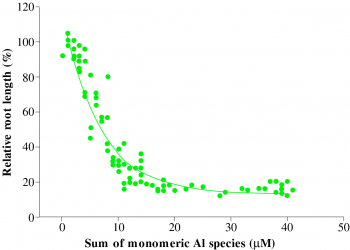
Figure 16.17 Soybean root growth decreases markedly as the sum of activities of monomeric Al species in solution increases. (Based on Alva et al. 1986)
While the toxic effect of Al has been known for more than 60 years, the biochemical basis of Al toxicity has not been clarified. However, Al is known to exert its primary toxic effect on roots, initial effects including a reduction in root length (Figure 16.17) (through reduced cell elongation) and damage to cortical cells of the root epidermis near the root tip. Proliferation of root hairs, important for uptake of water, essential nutrients and for infection by N-fixing rhizobia in legumes, is severely reduced by Al at concentrations lower than those that reduce root growth. Proposals for the primary toxic effect have included reactions of Al with components of the cell wall, plasma membranes, cytoplasm and nucleus (Kochian 1995).
Visible effects of soluble Al on plant tops are considered to be a secondary effect through reduced nutrient uptake. Symptoms include those similar to deficiencies of Ca, Mg, Fe, and P, probably as a result of decreased root proliferation and of reduced root activity. Further secondary effects include a reduction in uptake of water, increased sensitivity to drought and decreased N2 fixation by nodulated legumes.
Plant species differ markedly in tolerance to soluble Al in the soil solution. As with toxicity, the biochemical basis of genetic tolerance of Al toxicity is not clearly understood. However, malic acid excretion by root apices of Al-tolerant wheat is known to be five- to ten-fold greater than that excreted by Al-sensitive wheat. Malic acid presumably complexes soluble Al, making it less toxic (Delhaize et al. 1993), and that capacity for excretion co-segregates with Al tolerance in progeny from crosses between near-isogenic lines. By implication, a single major gene is probably responsible for an Al tolerance that is functionally linked to Al stimulation of malic acid excretion (Delhaize et al. 1993).
Mn, an essential element for plants (Section 16.3), is about the tenth most abundant element in the earth’s crust. Like Al, Mn chemistry in acid soils is complex, affected by both soil pH and soil redox potential. Mn occurs in rocks mostly in co-ordination with O2+ and as the divalent Mn2+ in soil solution and in natural waters. Biotic and abiotic oxidation occurs readily so that Mn does not generally occur to excess except in acid soils or in waterlogged soils (assuming there are sufficient Mn-containing minerals). Mn toxicity may occur following soil sterilisation due to loss of microorganisms that normally oxidise Mn2+.
Al is a root toxin, whereas high Mn is mainly toxic to shoots (at very high Mn concentration, root growth may be affected directly). Thus, unlike Al, which often has an immediate effect on root proliferation, Mn must accumulate in shoots to become toxic. Three types of symptoms result from Mn accumulation: dark-brown, necrotic spots on lower leaves, distortion of expanding leaves (possibly an induced Ca deficiency) and chlorosis of young leaves. Such chlorosis is often interpreted as an Fe deficiency due to reduced Fe uptake by roots due to excess Mn (Figure 16.8).
Considerable genetic differences in tolerance to high concentrations of plant-available Mn exist among plant species, and even among lines within a species. Such variation may occur via differences in root exclusion of excess Mn, complexation of Mn within roots, or shoot tolerance of high Mn. Sunflower, watermelon and cucumber all show shoot tolerance and even excrete Mn in a biologically inactive form around trichomes (hairs) on leaves and stems (Blamey et al. 1986).
 [6]
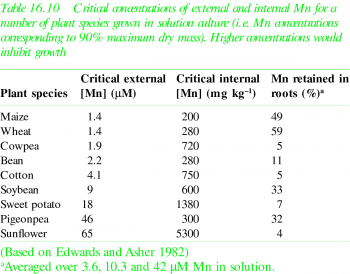
Table 16.10
External Mn concentrations at which plant growth is reduced also vary greatly among plant species. In carefully controlled solution culture (Edwards and Asher 1982), the critical external concentration (i.e. the concentration required for 10% reduction in plant dry mass) in the two most sensitive species, maize and wheat, was 1.4 µM Mn (Table 16.10). In contrast, sunflower growth was only reduced with 65 µM Mn in solution. Likewise, the critical internal Mn concentrations varied also, from 200 mg kg–1 in maize to 5300 mg kg–1 in sunflower. Although cowpea and bean had a similar external critical concentration, cowpea was able to tolerate a much higher tissue Mn. A higher retention of Mn in roots of soybean enabled this species to tolerate a higher external Mn concentration than cotton.
Acid soil problems have been traditionally corrected via application of agricultural lime (CaCO3) or dolomite (CaCO3 + MgCO3). Such amelioration raises soil pH, reducing Al and Mn concentrations in the soil solution, as well as adding the essential nutrients Ca and Mg. Lime or dolomite is generally required to raise soil pH to a level at which Al or Mn toxic-ities no longer affect plant growth (often above pH 5.5). Rates required vary considerably depending on soil type, with clay soils requiring higher rates to increase soil pH (greater buffering capacity referred to earlier in connection with acidification). Moreover, lime requirements for sustainable agriculture vary with farming systems. For example, lime required (kg CaCO3 ha–1 year–1) to balance net acid accumulation is about: 0.8 for wool, 6.0 for lamb and 7–20 for
cereal enterprises (Slattery et al. 1991). Even though cereal production is not greatly acidifying, Australia’s average wheat crop of 15 million t would have removed alkalinity equivalent to 135000 t CaCO3 as well as 6000 t Ca, 18 000 t Mg and 66 000 t K (along with 330 000 t N, 42 000 t P and 26 000 t S) from the land. Most of the crop was used for human consumption either in Australian cities or overseas. There would be little return of these nutrients to their original fields.
Application of lime in Australia falls far below that required to balance losses of alkalinity. Annually, c. 0.5 million t of lime is used in Australia, but more like 2.25 million t are needed annually as prophylactic dressings (Land and Water Resources Research and Development Corporation 1995). Overliming is a potential problem, especially on sandy soils, due to reduced availability of essential micronutrients, especially Zn, while root diseases such as ‘Take all’ of cereals are exacerbated.
Amelioration of some acid soils is possible via application of gypsum (CaSO4.2H2O) which provides a readily soluble form of Ca. Leaching soluble Ca applied as gypsum may improve root growth in acid subsoil horizons. Application of Mo is also beneficial where this essential micronutrient is in short supply due to low pH.
Finally, breeding and selection for crop tolerance to acid soil limitations has immediate application in agriculture, but an understanding of factors involved is crucial because tolerance to one factor limiting growth on acid soils (Al toxicity) does not imply tolerance to another such as Mn excess or Mo deficiency.
Acid soil infertility is a major limitation to plant growth worldwide, especially in the humid tropics, subtropics and temperate zones. Infertility results primarily from toxicities of Al or Mn and from deficiencies of Ca, Mg, K, P and Mo. While there are many soils that are naturally acid, farming practices and industrial processes contribute to increased soil acidification. These include use of N fertilisers, especially where they exacerbate the loss of basic cations through leaching and crop removal, and growth of legumes, which increase soil N status. Acid rain is important in industrialised regions.
Two complementary approaches may be used to overcome the adverse effects of soil acidity. The first is amelioration of acid soils through application of lime or gypsum to arrest degradation occasioned by a loss of basic cations. Unless these basic cations are replaced, land degradation through acidification and nutrient decline is inevitable. The second is a quest for genotypes better adapted to acid soil conditions. Genetic ap-proaches alone simply buy time and will result in further soil acidification, but do offer a beneficial trade-off: tolerant plants would draw water and nutrients from acid subsoils which are difficult, if not impossible, to ameliorate any other way.
Certain rocks, low in silica but rich in ferromagnesium minerals, give rise to soils of typically high pH known generically as ultramafic or, less accurately, serpentine soils (the mineral is mottled green and resembles a snake’s skin). Such soils are rich in Cr, Co, Ni, Fe and Mg, but severely deficient in N, P, K, Ca and possess a high Mg:Ca ratio.
These chemical features select for a highly characteristic flora which often shows stunted growth with chlorotic foliage, and morphologies typical of desert perennials. Such species usually result in clearly defined boundaries between serpentine and adjacent vegetation.
Even more remarkable, serpentine species frequently accumulate prodigious quantities of Cr, Co and Ni, and can even serve as indicator plants for underlying lithology. Serpentine deposits plus associated plant species occur in Tasmania and Queensland, but notable in eastern Australia are the Coolac–Kiandra deposits near Tumut in New South Wales that are dominated by Casuarina stricta, Ricinocarpos bowmanii and Xanthorrhoea australis in place of the Eucalyptus melliodora woodland on adjacent granitic soils. Lyons et al. (1974) provide further details on that deposit, and explain that ‘... X. australis strongly favours soils high in magnesium and low in copper, whereas the distribution of C. stricta appeared to be controlled mainly by the high potassium and nickel values in the soils...’
 [7]
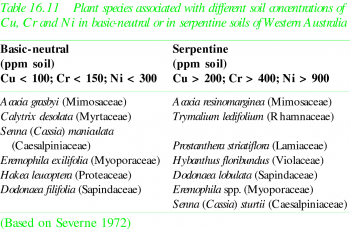
Table 16.11
 [8]
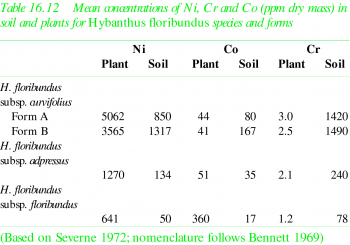
Table 16.12
Within Australia the most extensive deposits are adjacent to the eastern goldfields of Western Australia. Vegetation surveys in Western Australia also show plant associations that reflect lithology. For example, a belt of Eucalyptus aff. cylindrocarpus woodland coincided with an Ni anomaly, while soils high in both Ni and Cr supported Melaleuca laterifolia. Certain plant species thus serve as indicators of soil metal content, and Ni deposits lead to sharp discontinuities in species distribution (see Table 16.11 for more details on soil–plant correlations).
Ernst (1974), cited in Brooks (1987), defined the Hybanthion florbundii Alliance to cover the serpentine vegetation of Western Australia. In such communities, the Alliance commonly replaces eucalypt woodland more common from Kalgoorlie–Kambalda to Leonora, and is characterised by the Ni-hyperaccumulator Hybanthus floribundus and its associated species Grevillea acuaria. H. floribundus was only the third such plant to be documented worldwide, and this species is a reliable indicator of nickeliferous soils for two reasons. First, H. floribundus is restricted to ultramafic outcrops and their drainage areas. Moreover, within these shrub communities, a significant positive correlation exists between stand density and soil Ni content, especially on soils where Ni content exceeds 880 ppm. Second, all subspecies and forms of H. floribundus hyperaccumulate Ni, and in one case Co, even when soil levels are low (Table 16.12).
Despite such unusual nutritional physiology where Ni can accumulate to over 5000 ppm dry mass, no selective advantage for plant growth and reproduction from Ni accumulation is obvious, although herbivores might be discouraged by high levels of tissue Ni (see Batianoff et al. 1990 for more details). Mechanisms that permit plant tolerance to such hyperaccumulation have yet to be defined.
Serpentine soils occur naturally, but other metal-containing soils have been formed as a consequence of mining and smelting of ores (e.g. Cu, Pb and Ni), or following coal mining where a highly acidic overburden (pH <4.5) predisposes to Al and Mn toxicity (Section 16.5.2). Plant growth will then be limited by both heavy-metal toxicity and effects of Al or Mn, as well as by deficiency of essential nutrients such as N, P, K, Cu and Mg. Such deficiencies can of course be alleviated by fertiliser applications, which also carry a potential side benefit of heavy-metal attenuation via formation of complexes (e.g. Al–PO4).
Prospects for successful mine site rehabilitation are thus improved on both counts, but increasingly successful colonisers have been shown to have mycorrhizal associations (Khan 1978; Gardner and Malajczuk 1988). Mycorrhizal fungi are widely recognised as enhancing host plant uptake of sparse nutrients (Section 16.4.1), but they can also detoxify heavy metals, and strong selection for tolerance to Ni, Al, Zn and Cu has been reported from Europe and North America (see Jones and Hutchinson 1988). Similarly, selection of metal-tolerant isolates (ecotypes) in the ectomycorrhizal fungus Pisolithus tinctorius has been noted for Al-containing soils in Western Australia, where Al tolerance of isolates was positively correlated with Al concentration in source soil (Egerton-Warburton et al. 1993).
Root anatomy of Eucalyptus rudis seedlings following inoculation with P. tinctorius reveals a well-developed mycorrhizal sheath, a larger root diameter and intact cells compared to smaller root dimensions and necrotic tissue in non-mycorrhizal roots.
 [9]
Table 16.13
 [10]
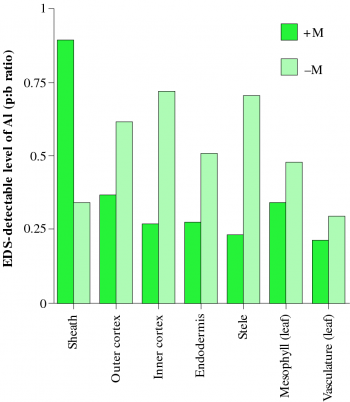
Figure 16.18 Mycorrhizal (M) associations with roots of Eucalyptus rudis enable seedlings to exclude Al more effectively. Tissue Al was significantly lower in all components measured with energy dispersive X-ray analysis (EDS). Levels of elements in those tissues are shown here as peak:background (p:b) ratios. 'Sheath' refers to fungal material external to roots. (Based on Egerton-Warburton et al. 1993; reproduced with permission of Kluwer Academic Publishers)
 [11]
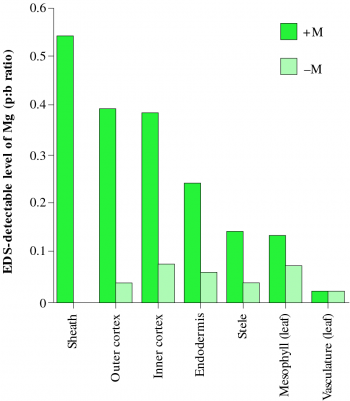
Figure 16.19 Magnesium (Mg) levels in tissues of Eucalyptus rudis seedlings were significantly increased due to mycorrhizal associations on roots. Leaf veins were not affected, but leaf mesophyll, stele, endodermis, inner root cortex and outer root cortex were all higher for inoculated compared with non-inoculated plants. 'Sheath' refers to fungal material external to roots. Mg levels were determined with energy dispersive X-ray analysis (EDS) and are shown here as peak:background (p:b) ratios. (Based on Egerton-Warburton et al. 1993; reproduced with permission of Kluwer Academic Publishers)
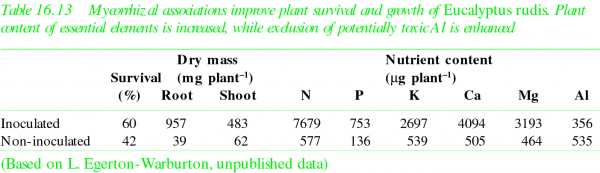
Benefits of mycorrhizal associations in metal-containing soils include improved survival of seedlings, greater growth and higher nutrient content (Table 16.13). One notable difference between inoculated and non-inoculated eucalypt seedlings concerns internal distribution of Al rather than total content per plant. The mycorrhizal sheath of inoculated plants accumulates Al, resulting in lower concentrations in roots and leaves. By contrast, non-mycorrhizal plants show strong accumulation in all tissues (Figure 16.18).
In addition, the higher P content of mycorrhizal seedlings (Table 16.13) also comes from accumulation and storage as polyphosphate granules by the mycorrhizal sheath (see Ashford et al. (1986) and Orlovich et al. (1989) for more information on these structures).
Polyphosphate granules form an effective sink for Al in E. rudis–P. tinctorius associations, and conceivably formation of Al–PO4 complexes in these granules represents a beneficial detoxification site for excess Al in these low pH soils.
K content in mycorrhizal plants was also much higher (Table 16.13), and was associated with a minor reservoir of K in root sheaths, and a major localisation in leaf mesophyll. Xylem-mobile elements such as K would be expected to accumulate at vein endings in this way (Section 5.2).
Mycorrhizal associations have greatest impact on plant Ca and Mg content and distribution (Table 16.13, Mg in Figure 16.19), and such significant increases might affect nutritional physiology in several ways. They could (1) facilitate uptake of Ca and Mg from acidic soils frequently impoverished with respect to Ca and Mg; (2) offset adverse effects of Al on uptake of Ca and Mg by roots; (3) ameliorate Al toxicity through enhanced Ca uptake.
In effect, efficient acquisition and distribution of Ca might be a prerequisite for Al tolerance. Consequently, any selection pressure experienced by mycorrhizal fungi in high-Al soils which has resulted in improved tolerance to heavy metals probably operates via the capacity of mycorrhizal fungi to enhance Ca and Mg uptake into their host plants.
Links:
[1] http://plantsinaction.science.uq.edu.au/edition1//?q=figure_view/745
[2] http://plantsinaction.science.uq.edu.au/edition1//?q=figure_view/746
[3] http://plantsinaction.science.uq.edu.au/edition1//?q=figure_view/748
[4] http://plantsinaction.science.uq.edu.au/edition1//?q=figure_view/750
[5] http://plantsinaction.science.uq.edu.au/edition1//?q=figure_view/751
[6] http://plantsinaction.science.uq.edu.au/edition1//?q=figure_view/752
[7] http://plantsinaction.science.uq.edu.au/edition1//?q=figure_view/753
[8] http://plantsinaction.science.uq.edu.au/edition1//?q=figure_view/754
[9] http://plantsinaction.science.uq.edu.au/edition1//?q=figure_view/755
[10] http://plantsinaction.science.uq.edu.au/edition1//?q=figure_view/756
[11] http://plantsinaction.science.uq.edu.au/edition1//?q=figure_view/757