
 [1]
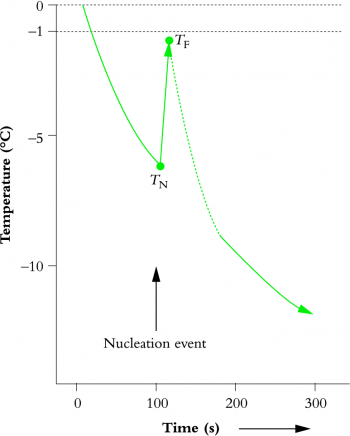
Figure 14.20 A notional cooling curve for an aqueous solution. As heat is extracted steadily, solution temperature falls below 0 °C, and water molecules, now in an unstable state, supercool to around -5 °C. A nucleating event occurs at temperature TN, and heat is released as ice forms (latent heat of fusion), resulting in a sudden increase in temperature to TF. The extent of freezing-point depression (0 – TN °C) also serves as a measure of osmotic pressure. (Original sketch courtesy M.C. Ball)
Ice melts at 0°C, and an equilibrium mixture of ice and water has traditionally provided a temperature reference for thermocouples. Ice thawing in pure water will maintain a temperature of 0°C, but if instead of allowing ice to thaw, heat is extracted steadily from a body of water, then ice does not reform at 0°C (Figure 14.20). Instead, the water will remain liquid, and will supercool until some nucleation event occurs. A tiny particle of ice, or even vibration in the presence of dust particles, is usually sufficient to trigger ice formation together with an abrupt release of heat (latent heat of fusion). In Figure 14.20, TF – TN represents supercooling, and the degree to which TF is less than zero (freezing-point depression) relates to the amount of solute present in solution. Osmotic pressure, vapour-pressure depression and elevation of boiling point are similarly related to the amount of solute present (referred to collectively as colligative properties of solutions).
Highly purified water can be supercooled to about –40°C, and ice will form spontaneously, but such conditions do not apply in plants because water is not absolutely pure. Instead tissue water is in contact with cell surfaces and invariably holds solutes in solution and colloids in suspension which aids ice nucleation.
During a frost episode in nature, plants experience a sequence of events similar to that summarised in Figure 14.20. Tissue water supercools, and cell sap freezing point is depressed by osmotically active material. Moreover, plants are also equipped with ice nucleating agents that can be of either plant or bacterial origin (e.g. Pseudomonas syringae). As with solutions, formation of ice in plants is accompanied by a release of heat. This exothermic response can be detected by sensitive infrared thermography, and has been used to trace ice propagation during a freezing event in leaves and shoots (Wisniewski et al. 1997).
When plants experience a frost, ice initially forms within intercellular spaces (apoplasm) where solute concentration is least. Water potential in that region is immediately lowered and water molecules migrate from symplasm to apoplasm across plasmalemma membranes and towards regions of ice crystallisation. Water potential in the apoplasm will decrease by about 1.2 MPa per degree below 0°C, so that an apoplasm at –4°C will have a water potential of around –4.8 MPa (i.e. equivalent to an osmotic pressure twice that of seawater), which will dehydrate the symplasm. As one positive trade-off, the symplasm is at least less likely to freeze thanks to solute concentration. In addition, plasmalemma membranes discourage entry of ice crystals that might otherwise seed ice crystal for-mation within the symplasm. Nevertheless, partial dehydration does perturb cell biochemistry due to concentration of metabolites, and the accompanying shrinkage of cells and organelles generates structural tensions.
In frost-sensitive material, cell disruption follows the course outlined above, which unfolds over about 3°C on a cooling curve. Membrane integrity might be lost at around –4°C as apoplasm ice formation ruptures membranes. Intracellular freezing ensues at around –7°C and is inevitably lethal due to the combined effects of membrane injury, symplasm dehydration and protein denaturation.
Tissue damage following freezing can be demonstrated by a loss of differential permeability, metabolite leakage and failure to achieve either plasmolysis or deplasmolysis. Solutions bathing frozen/thawed tissue thus show a sudden increase in electrical conductivity according to freezing damage, and that value then serves as a reliable assay for comparative frost tolerance. For example, population screening based on metabolite leakage has enabled breeding for improved frost tolerance in Eucalyptus nitens for plantation forestry (Raymond et al. 1992).
Leaves on temperate plants often need to accommodate ice formation, and Rhododendron provides such an example. Frozen leaves appear wilted, but regain their normal turgid appearance following thawing. Camellia leaves behave similarly. They take on a semi-transparent appearance when frozen, but recover without damage when thawed. In both cases, their altered physical appearance at low temperature is due to formation of a frostblaze, that is, a lens of ice crystals that forms between layers of tissue that are readily cleaved. Ice localised in this way is rendered harmless, and is lost easily on thawing.
Frost hardiness is a dynamic and composite property of plant cells involving cell size, wall thickness, osmotic pressure of cell sap and membrane properties, all of which can feature in either delaying onset or diminishing adverse consequences of ice formation (Steponkus et al. 1993; Wolfe and Bryant 1992). In any plant, organs that are growing rapidly are frost sensitive, and this is especially the case with early spring growth. Frost hardiness is thus least during the growing season, but increases during autumn and reaches a peak in winter. Clearly, this is an adaptive feature of perennial plants that is attuned to seasonal necessity. Moreover, the extent of this hardening process is heritable, and requires low temperature for onset and maintenance. Return to milder conditions can lead to dehardening with disastrous consequences for horticulture when an early spring is followed by a deep freeze. Frost prevention then becomes crucial.
 [2]
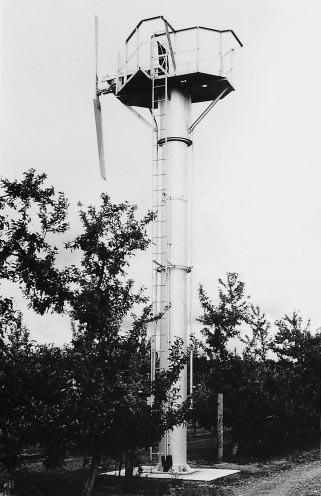
Figure 14.21 Alleviation of frost damage with wind machines. During a temperature inversion, upper air layers are warmer than the air at tree level, and these huge fans can be used to drive the warmer air down into the trees and across the ground to counter radiative heat loss. A special variant has involved use of helicopters as mobile adjustable fans. Operating costs are much higher and maintaining a low-flying circuit in pre-dawn darkness can be hazardous! (Photograph courtesy E.W. Hewett)
Radiation frosts are common in some horticultural regions of Australasia due to high radiative losses from earth to sky on still calm nights. The air at ground level becomes chilled by contact with radiating surfaces and drains downslope to form ‘frost pockets’ that are commonly 5°C colder than the surrounding countryside. One related outcome, especially on calm mornings, is formation of a temperature inversion. Upper layers of air (30–50 m above ground) remain warmer (5–15°C) than the air at tree level. Under these conditions, wind machines (Figure 14.21) can be used to drive the warmer air down into the crop and over the soil surface, displacing the cold air and countering radiative heat losses. Given a consistent layer of warm air within reach of these fans, one wind machine every 5–7 ha will protect an orchard against temperatures down to about –3°C. A combination of clean burning oil heaters plus wind machines is even more effective.
An alternative but remarkably effective method of alleviating frost damage depends upon the latent heat of freezing (Figure 14.20 and Frontispiece to Chapter 14). Stored irrigation water is typically around 10°C, and as it cools on irrigated surfaces each gram of water will release about 10 calories of heat. On top of that, the latent heat of fusion adds a further 80 calories. In effect, a thousand litres of water supplies as much heat by this means as complete combustion of 12 L of oil. While both water and ice phases are present on trees (see the Frontispiece to this chapter) and ice is continuing to form, plant tissues so encased will remain at 0°C, just above freezing point for plant tissues. Overhead sprinklers are thus used with good effect to prevent frost damage, but application rate has to be closely controlled. Too little water and plants freeze, too much water and orchards become waterlogged, thereby exchanging one damaging condition for another. Application rates between 2 and 6 mm h–1 will generally suffice to prevent freezing damage to crops at air temperatures down to –6°C.
 [3]
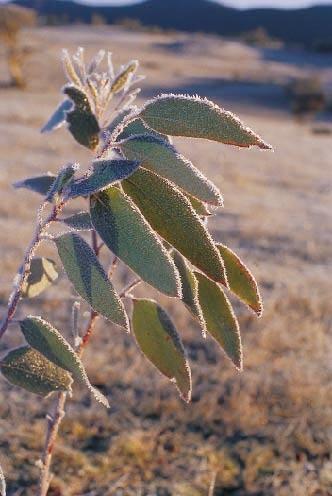
Figure 1 Snow gums (Eucalyptus pauciflora) in the Gudgenby Valley (sub-alpine region of southeastern Australia) are subject to frost for about 200 d each year. Exposed juvenile trees have to endure low temperature and the strong sunlight of early morning to survive. (Photograph courtesy C. Holly)
Re-establishment of eucalypts in open pastures of the New South Wales tablelands is problematic, with up to 80% of young trees failing to survive beyond three years. An urgent need for landscape restoration following deforestatation and overgrazing of these areas has become widely recognised, and a successful strategy for tree establishment is crucial to that process.
Photoinhibition of young trees at low temperature was soon recognised as a factor in those early losses (Ball et al. 1991). The first clue that sunlight × temperature was an issue came from two chance observations of unusual patterns in seedling establishment.
 [4]
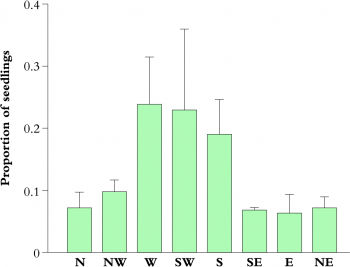
Figure 2 Relative distribution of seedlings in relation to geographical bearing around adult trees of mountain beech on the Waimakariri floodplain, New Zealand (Original observations courtesy Marilyn Ball (BSBS ANU), Jack Egerton and Matt McGlone (Landcare Research New Zealand))
The first observation concerns mountain beech (Nothofagus solandri). This is a dominant canopy tree in subalpine forests of New Zealand, and patterns of seedling regeneration around isolated trees on the Waimakariri floodplain are highly characteristic. While 95% of young seedlings occur beneath the canopy of a parent tree, they are not distributed randomly. Rather, they tend to cluster on the western side, and 65% occur in a narrow sector between 165°S and 285°S (Figure 2). Wind effects on seed dispersal are not responsible because prevailing winds blow in the opposite direction; however, seedlings on the south to western sides of parent trees are protected from direct sunlight all day throughout winter, and from morning sun in spring and early summer.
The second observation concerns a similar asymmetric pattern of regenerating seedlings the occurs under isolated trees of snow gum (Eucalyptus pauciflora) growing along the Orroral Valley in southeastern Australia. In this case, tiny seedlings probably establish randomly around a parent tree during favourable seasons, but are subsequently culled by adverse conditions to produce this now familiar pattern of seedling regeneration.
In both cases, the combination of intense cold and strong sunlight seemed to be proving adverse to seedling survival because the asymmetry in seedling establishment roughly coincided with morning shadows cast by parent trees. Chris Holly tested this idea with artifical shelters on Eucalyptus polyanthemos seedlings in an open pasture (Holly et al. 1994). Seedlings were planted either on open ground or in individual shelters consisting of open-topped cylinders made from one of three types of shadecloth transmitting 30%, 50% or 70% sunlight. Air temperatures inside and outside of these shelters differed by less than 2°C so that irradiance was the major factor that differed between treatments. During winter, leaves became photoinhibited as indicated by a loss in variable fluorescence (Fv/Fm from in vivo chlorophyll a fluorescence measured in situ; Section 1.2.5). The extent of this loss in variable fluorescence (measured pre-dawn) was in direct proportion to treatment irradiance. Seedlings grew only slowly during winter, and most severely photoinhibited plants grew the slowest. Correlations between growth and photoinhibition as measured during winter persisted into spring even though pre-dawn Fv/Fm made a substantial recovery in all plants.
Spring growth of Eucalyptus polyanthemos appears to be adversely affected by cold-induced photoinhibition over winter. A loss in photosynthetic effectiveness reduces carbon gain during spring, and recovery presumably extends over many weeks, hence a persistence of slower growth despite recovery in Fv/Fm.
In practical terms, establishment of eucalypt seedlings in frost-prone areas benefits from a reduction in irradiance over winter. By analogy, cold-induced photoinhibition could also be responsible for patterns of seedling establishment under parent trees as noted originally.
Ball, M.C., Hodges, V.C. and G.P. Lughlin (1991). ‘Cold-induced photoinhibition limits regeneration of snow gums at tree line’, Functional Ecology, 5, 663–668.
Holly, C., Laughlin, G.P. and Ball, M.C. (1994). ‘Cold-induced photoinhibition and design of shelters for establishment of eucalypts in pasture’, Australian Journal of Botany, 42, 139–147.
Links:
[1] http://plantsinaction.science.uq.edu.au/edition1//?q=figure_view/723
[2] http://plantsinaction.science.uq.edu.au/edition1//?q=figure_view/724
[3] http://plantsinaction.science.uq.edu.au/edition1//?q=figure_view/725
[4] http://plantsinaction.science.uq.edu.au/edition1//?q=figure_view/726