
 [1]
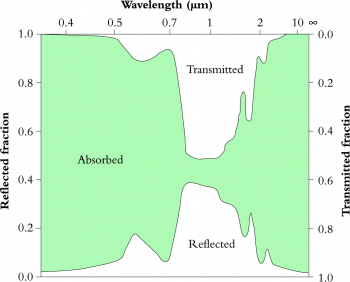
Figure 14.18 Solar radiation striking a leaf is either reflected, transmitted or absorbed. Photosynthetically active radiation (0.4 to 0.7 µm) is strongly absorbed, whereas near-infrared radiation which would heat leaves but is useless for photosynthesis (between about 0.8 and 2 µm) is only weakly absorbed. Far-infrared radiation is strongly absorbed, but energy per quantum is greatly diminished at these long wavelengths, so that consequences for leaf heating are greatly diminished (Based on Gates 1965)
 [2]
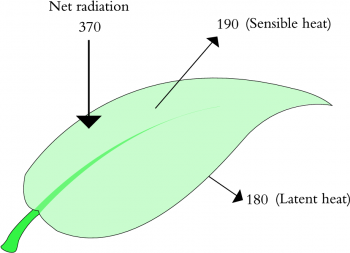
Figure 14.19 A notional energy budget for a mesophytic leaf on a well-watered plant. Taking an incident irradiance of 400 J m-2 s-1 as representative of midday conditions, 30 units are reflected, leaving 370 J m-2 s-1 absorbed. If air temperature is taken to be 20°C, relative humidity 50%, wind speed 0.8 m s-1 and leaf area 0.01 m2 (i.e. 100 cm2), then transpiration will be about 4 mmol H20 cm-2 s-1, and latent heat exchange will account for about 180 J m-2 s-1. Sensible heat exchange will account for the remainder (about 190 J m-2 s-1) (Based on Nobel 1983)
Physical principles responsible for heat and mass exchange between plants and their aerial environment are well established (Gates 1965). Process-based models of energy fluxes have been extensively validated under both laboratory (wind tunnel) and field conditions, with much attention focused on canopy and leaf heat budgets.
When solar radiation strikes a leaf (Figure 14.18), some is reflected, some is absorbed and some is transmitted. Absorbed energy is subsequently dissipated via three main avenues: reradiation of long wavelengths to nearby surfaces and sky; conduction and convection of sensible heat (directly measurable or able to be ‘sensed’); and latent heat exchange (energy consumed to evaporate water and commonly referred to as transpirational cooling).
In Figure 14.19, conduction plus convection of sensible heat compared with latent heat exchange are about equally responsible for dissipation of absorbed energy. Photosynthetic utilisation of radiant energy is of course crucial in biological terms, but insignificant for leaf energy budgets and is ignored here.
Irrespective of species or location, any organism, over an extended period, will lose exactly as much energy as it gains otherwise that organism would grow either hotter and hotter, or cooler and cooler. In either circumstance it would die, and noting that vascular plants exist across a remarkable range of thermal environments, they must have evolved with adaptive features that make them expert at balancing their energy budgets. Note, however, that plants probably never achieve short-term (moment by moment) equilibrium with their environment. Energy inputs, energy utilisation and options for energy dissipation vary incessantly, and often abruptly. For that reason, plants in nature would only ever achieve a quasi-steady energy state and useful inferences about their heat budgets can only be drawn from detailed process models plus comprehensive sets of test data.
A considerable fraction of solar radiation incident on leaves is reflected (Figure 14.18), and that fraction varies enormously with wavelength. Reflectance shows a modest peak around green wavelengths, causing plants illuminated with white light to appear green to our eyes. Significantly, the spectral sensitivity of our eyes also peaks at those wavelengths corresponding to green. Reflectance is especially low for blue and red wave-lengths (preferentially absorbed for photosynthesis; Figures 1.8, 1.9).
Leaf reflectivity increases abruptly in the near infrared, to a maximum between about 0.75 and 1.0 µm. This feature enables leaves to forestall energy gain and thus heat build up due to absorption of wavelengths that contribute nothing to photosynthetic carbon gain (but recall photomorphogenic effects of red and far-red radiation either side of 0.7 µm; Section 8.4).
Confining reflectance measurements to visible wavelengths provides an estimate of ‘albedo’ or ‘whiteishness’ of a surface, and plant communities are known to vary in albedo according to habitat and adaptive response. Expressed as a percentage of incident visible radiation, some desert plants show values up to 35% due to thick cuticle or dense pubescence, but most crop communities are around 25%. Pine forests are even lower due to canopy structure and needle geometry, while large water bodies are lowest of all at around 5%. Albedo thus varies according to vegetation type as well as growing conditions, and serves as a basis for remote sensing, enabling satellite detection of changes in crop condition or patterns of land use.
All bodies possessing energy emit radiant energy in proportion to the fourth power of their absolute temperature:
Radiation emitted (energy flux density) = σT4 (14.3)
where σ is a coefficient of proportionality (Stefan–Boltzmann constant) and equals 5.670 ×10⁻⁸ J m–2 s–1 K–4
True black bodies have an emissivity (e) of 1, and Equation 14.3 holds (providing a basis for remote sensing of surface temperature). However, plants are only imperfect blackbodies (e ≥0.9), and an additional term has to be introducted to Equation 14.3 to cover this minor departure from ideal conditions. As an aside, the laws of conservation of energy show that absorptivity = emissivity, so that good absorbers are also good emitters.
Radiation emitted by the sun and earth may be approximated by black body radiators at temperatures around 6000 K and 250 K respectively. This large contrast in surface temperature means that spectral curves for sunlight do not overlap those for reemission of radiation from the earth back to space. Incoming radiation is commonly referred to as shortwave solar radiation (0–3.0 µm) and outgoing radiation as long-wave radiation (3.0–100 µm). The earth’s atmosphere is a good absorber in the 3–100 µm waveband (Figure 12.1) due to the combined actions of CO2, ozone and organic molecules, but most of all to H2O vapour. Most long-wave radiation lost from earth to space occurs via a gap in the solar spectrum between about 8 and 12 µm (the atmospheric ‘window’).
Net radiation absorbed by a leaf is thus a balance between incoming shortwave radiation and outgoing shortwave plus long-wave radiation. Incoming shortwave radiation includes direct-beam solar radiation, diffuse sky radiation and reflections from surroundings. Outgoing radiation includes reflected shortwave plus re-emitted long-wave radiation from both leaf surfaces.
Combining all of these terms, a leaf will have a positive energy balance in daytime due to incoming radiation, and a negative balance at night-time due especially to long-wave radiation from leaf to sky (and other cold objects nearby). On clear cold winter nights with a sky temperature of around –50°C and a leaf temperature initially of around 10°C, radiant heat loss from leaf to sky will be prodigious. If calm con-ditions prevail on such nights, exchange of sensible heat is restricted by a thick boundary layer and leaves will fail to draw much warmth from that source. As a consequence, leaf temperature will continue to fall below air temperature, and chilling injury or frost damage will result (Sections 14.4, 14.6 and Case study 14.1). Large leaves, which have thicker boundary layers than small leaves, are especially vulnerable, and because boundary layers are thicker away from the leaf edges, dew or frost generally forms first on leaf centres.
An exchange of sensible heat occurs when leaves are either warmer or cooler than the surrounding air. The rate of exchange is proportional to the difference in temperature between a leaf and its surrounding air. Heat transfer occurs by molecular conduction across a thin boundary layer of air which is ‘attached’ to both sides of any leaf. Boundary-layer resistance to heat transfer varies according to the thickness of that layer which in turn is a function of leaf geometry (plane, cylinder, sphere) and imposed wind speed. For a flat leaf, mean boundary-layer thickness (δ) can be calculated as:
δ= 6.5 (d/υ)1/2 (14.4)
where δ is leaf width in metres (m), υ is wind speed in metres per second (m s–1) and δ is in millimetres (mm). Taking a case where d = 0.05 m and υ = 1 m s–1, δ will be 1.5 mm. Other relationships will apply to different shapes.
Boundary layers around leaves remain laminar until the product of wind speed and leaf width exceeds about 0.3 m2 s–1. Above this value, boundary layers become turbulent, and will occur at a wind speed of around 6 m s–1 when d = 0.05 m (cf. the example above).
Sensible heat transfer between leaf and air can also occur by free convection. This process is much more efficient in terms of heat flux density, and arises from the circulation of fluid over an object which is in turn maintained by gradients in temperature, and hence fluid density.
Evaporation (transpiration in plants, perspiration by animals) is obviously a cooling process. Evaporation amounts to a phase change from liquid to vapour, and consumes a large amount of energy, namely 2.45 kJ g–1 at 20°C. Transpiration thus constitutes an important mode of heat loss, and the reverse applies when water vapour condenses onto a leaf as dew or frost (see Section 14.6.1 for liberation of heat when water freezes).
Water evaporating from wet cell walls inside leaves collects as vapour within substomatal cavities, and passes via stomatal pores and the leaf boundary layer to ambient air (Figures 1.1, 1.2).
Water vapour partial pressure inside leaves of known temperature is commonly taken as being equivalent to the saturation vapour pressure of air at that temperature. The water vapour partial pressure outside transpiring leaves is derived from the atmospheric humidity measurement. That difference in partial pressure drives transpiration, while stomatal and boundary-layer resistances constrain transpiration. Latent heat transfer due to transpirational cooling, or more formally ‘heat flux density’ (JTH), is thus a net outcome of transpirational flux (E) times latent heat of vaporisation (λ):
JTH = E × λ (14.5)
For a typical broad leaf (Figure 14.19) with an area of 0.01 m2, on a mild day (air temperature 20°C, leaf temperature 25°C) with a relative humidity of 50% and a moderate wind (0.8 m s–1), resulting in a transpiration rate of 7.2 µg H2O cm–2 s–1, transpirational cooling would account for dissipation of about one-half of the total energy absorbed, and sensible heat exchange for the other half.
Sensible heat exchange and latent heat exchange are both influenced by boundary-layer resistance, and are therefore subject to variation according to leaf shape, size and aero-dynamic conditions. In addition, latent heat exchange will be subject to control by atmospheric humidity, and will be a more significant component of leaf heat budgets on days of low humidity. Accordingly, leaves on well-watered mesophytes benefit from transpirational cooling in balancing their heat budgets, but desert plants have to rely on sensible heat ex-change to a greater extent. Their generally smaller size would diminish boundary-layer resistance and would thus facilitate heat loss via that means. Small size plus surface coatings to enhance reflectivity could offer a selective advantage under dry conditions.
Links:
[1] http://plantsinaction.science.uq.edu.au/edition1//?q=figure_view/721
[2] http://plantsinaction.science.uq.edu.au/edition1//?q=figure_view/722