
Soil–plant interrelations are dynamic and subject to both inputs (fertilisers, pollutants, soil chemistry) and losses (erosion, leaching, harvesting). Metal ions are released into soil solution via weathering and solubilisation of soil minerals (Section 16.1) as well as via decomposition of organic matter.
Available ions are those that a particular root system can acquire. Strictly speaking, only ions in soil solution would be considered available, but due to a dynamic equilibrium that exists between the soil solution and other ion pools from which ready transfer into the soil solution can occur, ions adsorbed onto exchange sites can also be considered as available, or at least as influencing the available fraction.
Factors affecting ion supply to plant roots include ion activities in the soil solution, usually referred to as intensity, and the degree and rate of replenishment of the soil solution ion pool from other pools (ions adsorbed on solid soil particles or labile organic compounds and ions present in other readily soluble compounds), usually referred to as capacity. The capacity factor therefore determines a buffer power for a particular metal. The relationship between capacity and intensity factors for each particular metal is heavily dependent on pH.
Clay particles are negatively charged and therefore surrounded by a swarm of (positively charged) cations. Clay minerals owe a part of their negative charge to isomorphous substitution (cations of higher charge, like Al3+, are replaced by those of lower charge, like Mg2+) thus leaving a surplus of (non-
neutralised) negative charges which are satisfied with adsorbed, exchangeable cations. In addition, soil colloids (e.g. humus, hydrous oxides) that exhibit protonated complexing functional groups (–OH, –COOH) also contribute to the cation exchange capacity of soils:
| M1+ | + | M2X | ↔ | M2+ | + | MX |
| (solution) | (solid) | ↔ | (solid) | (solution) |
Since dissociation of –OH and –COOH groups (especially those on organic matter) is pH dependent, cation exchange capacity increases with an increase in pH. With an increased cation exchange capacity, metal cations are attracted to these negative sites on solid particles, soil solution is depleted and therefore metal availability reduced.
Cations are held more strongly (less reversibly) when pH increases from 5 to 7. Cu, Zn, Ni, Cd and other metals become significantly less soluble and less exchangeable when pH increases from 5 to 7. Retention of metals in soil can occur through several processes: (1) cation exchange (non-specific adsorption), (2) specific adsorption, (3) organic complexation and (4) co-precipitation. In a given situation most, if not all, of these processes contribute to metal retention in soils.
In order to maintain electroneutrality, negative charges on solid particles (soil colloids) are balanced by an equal amount of cations; an exchange refers to the exchange between counter-ions balancing the surface negative charge on the soil colloids and ions in soil solution. Such an exchange is reversible, stoichiometric and diffusion controlled. Moreover, there is a certain degree of selectivity of the adsorbent. The higher the valency of an ion, the greater its replacing power (H+ behaves like a polyvalent cation). By contrast, with greater degrees of hydration, a given ion will exhibit a lower replacing power.
Adsorption by cation exchange represents electrostatic binding through the formation of outer-sphere complexes with the surface functional groups. An outer-sphere complex means that at least one molecule of a solvent comes between the functional group and the ion.
Specific adsorption is pH dependent and related to the hydrolysis of the heavy-metal ion. In specific adsorption partly covalent bonds are formed with the lattice ions. Partly covalent bonds are inherently stronger than electrostatic binding involved in the non-specific cation exchange (e.g. Zn can be adsorbed on Fe and Al oxides 7 and 26 times more strongly than their corresponding cation exchange capacity at pH 7.6 would imply). Metals most able to form hydroxy complexes are specifically adsorbed to the greatest extent:
Hg > Pb > Cu >> Zn > Co > Ni > Cd
Specific adsorption may also include diffusion of metals into mineral interlayer spaces and their fixation there. Such diffusion increases with an increase in pH.
Organic matter may either increase or decrease availabil-ity of micronutrients, Al and heavy metals. Reduced availability is due to complexation with humic acids, lignin and other organic compounds of high molecular weight (insoluble precipitates are thus formed). Conversely, increased availability may result from solubilisation and thus mobilisation of metals by low molecular weight organic ligands (e.g. short-chain organic acids, amino acids and other organic compounds). Stability constants of chelates with several metals occur with increasing order as:
Cu > Fe = Al > Mn = Co > Zn
Co-precipitation represents formation of mixed solids by simultaneous precipitation as occurs with Fe and Mn oxides.
 [1]
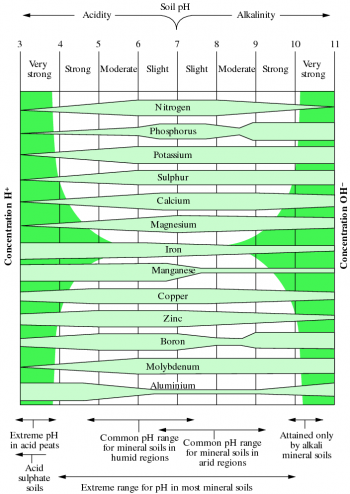
Figure 16.2 A highly diagrammatic picture of soil nutrient availability (and element toxicity) as a function of pH. Increasing acidity or alkalinity correspond to logarithmic increase in concentration of H+ and OH- respectively (vertical bars). Horizontal bars represent relative availability (or toxicity) at any particular pH. Most agricultural soils will be slightly acid (pH around 5.5 to 6.5) and essential nutrients are all readily available within that range. Of particular note, highly acid soils are conducive to both Al and Mn toxicity and to Mo deficiency. Highly alkaline soils are conducive to B toxicity but to Fe, Zn and Mn deficiencies. (Based on various sources including Handreck 1978 and Marshner 1995)
The pH value most relevant to soil and plant chemical processes is pH of the soil solution. A soil is acidic if the pH of its aqueous solution phase is <7 and alkaline if that pH exceeds 7. Nutrient element availability varies accordingly (Figure 16.2), and beyond the range of pH 4–8 plant growth becomes a function of pH per se, plus pH effects on nutrient ion availability.
In chemical terms, pH represents a measure of H+ activity in a soil solution which is in a dynamic equilibrium with a negatively charged solid phase. H+ ions are strongly attracted to these negative sites and have sufficient power to replace other cations from them. A diffuse layer in the vicinity of a negatively charged surface has higher H+ activity than the bulk soil solution.
Soil pH varies in time and space. Diurnal fluctuations of as much as one pH unit may occur, as well as spatial variations (horizontal and vertical down the soil profile). Soil pH also varies over seasons. During seasons with low to moderate rainfall when evapotranspiration greatly exceeds precipitation, salts are not being removed by deep percolation and increased salts tend to reduce pH by forcing more of the exchangeable H+ ions into the soil solution. Conversely, during wet seasons, salts are removed from the topsoil and pH goes up. This season to season fluctuation in total salt content should not be confused with long-term soil acidification (Section 16.5).
Soil pH is a dominant influence on solubility and therefore availability and potential phytotoxicity of metals (Figure 16.2). Low pH favours free metal cations and protonated anions, higher pH favours carbonate or hydroxyl complexes. There-fore, availability of micronutrient and toxic ions (which are present in soil solution as cations) increases with increasing soil acidity. By contrast, availability of those present as anions (MoO42–, CrO42–, SeO4–, SeO3– and B(OH)4–) increases with increasing alkalinity (see Case study 16.1).
Plant growth is dependent on availability of water and nutrients in the rhizosphere, the soil–root interface consisting of a soil layer varying in thickness between 0.1 mm and up to a few millimetres depending on the length of root hairs (Section 3.3). Availability of nutrients in the rhizosphere is controlled by the combined effects of soil properties and interactions between plant roots and adjacent microorganisms in the surrounding soil.
Chemical conditions in the rhizosphere are usually very much different from those in the bulk soil further away from roots. Root-induced changes in the rhizosphere pH are a result of the balance between H+ and HCO3– excretion, evolution of CO2 by respiration and loss of various organic compounds known collectively as root exudates.
The balance between H+ and HCO3– excretion depends upon the cation/anion uptake ratio. Greater excretion of H+ accompanies a greater absorption of cations than anions and results in rhizosphere acidification. Conversely, when uptake of anions exceeds uptake of cations, excretion of HCO3– exceeds that of H+. The chemical form of soil N (ammonium v. nitrate) is an influential factor for the cation/anion ratio. Ammonium-fed plants take up more cations than anions, and they usually have a more acidic rhizosphere than bulk soil, while nitrate-fed plants take up more anions than cations and show the opposite relationship between rhizo-sphere and bulk soil pH. Plant effects on rhizosphere pH also vary with genotype, which can in turn influence nutrient ion availability (Section 3.3.1).
Overall, plants and soils must be regarded as interacting components in any ecosystem, and because plants take up more basic than acidic components, any net increase in ecosystem biomass will result in some degree of soil acidification.
Boron (B) is an essential micronutrient, but is potentially toxic to plants over much of southern Australia where high concen-trations of soil B reduce crop yields, especially in sensitive varieties.
Toxic levels of soil B can derive from over-application of B when correcting a deficiency, contamination in industrial and sewerage sludges, high concentrations in groundwater used for irrigation and high levels in parent material, including marine sediments. Seawater normally contains appreciable levels of B and as a consequence deposits that remain after ancient seas recede contain high levels of B and other soluble salts. As these deposits weather, B is released and slowly redistributed by leaching.
Boric acid, B(OH)3, is the main form of free B in soil, and of much lower solubility than the accompanying sodium chloride in soils derived from these marine sediments. As a consequence, B has not been leached from root zones in low- rainfall environments of southern Australia. In addition, hydroxyl groups of boric acid react with clay particles and remain bound under alkaline conditions, so that leaching is further decreased. Geographic regions with high soil B usually correspond to areas of marine sediments, rich in clay and subject to low rainfall.
Soil B in southern Australia has been determined from analysis of soil cores, plant shoots, harvested grain and from observation of B toxicity. Visible symptoms on leaf tips of barley include distinctive black spots within dead leaf tissue. High-B soils occur on Eyre Peninsula, mallee regions of South Australia and Victoria and low-rainfall regions of inland southeastern Western Australia. B toxicity is very widespread, and levels are generally highest in subsoils rather than root zones. Soil amelioration is thus an impractical solution, so that most research efforts have been directed towards selection of B-tolerant crop varieties.
 [2]
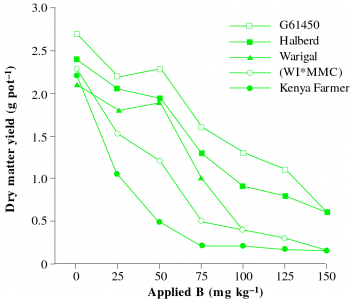
Figure 1 Dry matter yield of shoots of five varieties of wheat grown in a pot experiment with soil at seven levels of B (Based on Paull et al. 1991)
Genetic variation in crop response to B has been identified (Figure 1). Similar variation has also been observed for several other major crops of southern Australia, including barley, oats and peas. While there is some variation in B tolerance among Australian varieties of these crops, more tolerant lines have been identified in collections from the Middle East, India, Japan and parts of South America. In all cases, these B-tolerant crops have adapted to soils subject to either marine or volcanic influence.
Tolerance to high concentrations of B is under the control of a number of major genes, and segregation ratios observed in F2 and F3 generations conform to the Mendelian ratio of 1/4 homozygous sensitive to 1/2 heterozygous to 1/4 homozygous tolerant. Two examples of segregation ratios in wheat shown here compare observed ratios (Obs) with expected ratios (Exp); Chi-square analysis (χ2) confirms that observed frequencies agree with Mendelian prediction:
Sensitive |
Heterozygous |
Tolerant |
χ2 |
||
| Warigal × (Wl*MMC) | Obs | 27 | 63 | 32 | |
| Exp | 30.5 | 61 | 30.5 | 0.34 | |
| Halberd × Warigal | Obs | 27 | 63 | 20 | |
| Exp | 27.5 | 55 | 27.5 | 2.80 |
These genes act in an additive manner and tolerant varieties have dominant alleles at more loci than do sensitive varieties.
Plant response to B is thus subject to control by major genes, so that genes for tolerance can be transferred to sensitive varieties by backcrossing. This involves hybridisation between a sensitive, but otherwise well-adapted, variety and a tolerant variety. Progeny are tested for response to B and tolerant selections are then crossed to the sensitive variety. Progeny of this cross are again tested for response to B and tolerant plants selected. It is possible to reconstitute the agronomic traits of the sensitive variety, but now with tolerance to B, by repeating this cycle a number of times. In one such outcome (Figure 1) three cycles of backcrossing transferred B tolerance from Halberd to the sensitive variety Schomburgk. Halberd was the most widely grown variety in Australia during the 1970s and 1980s, but more recent varieties, such as Schomburgk, have higher yield potential and better flour quality. Both tolerant and sensitive plants occurred among the progeny and a tolerant selection resulted in the new variety BT-Schomburgk.
Mechanisms responsible for root acquisition of B are not known, but B uptake is known to be closely correlated with water use and is higher under conditions conducive to rapid transpiration. Once absorbed, B moves with the transpiration stream and concentrates at xylem endings. Concentration gradients thus develop within leaves, and overall leaf concen-tration will vary with transpirational history. B concentrations are generally highest at leaf tips or along margins, depending upon venation, and are higher in old leaves compared with young leaves. For example, B concentration in the terminal
4 cm of a barley leaf, when grown under high B conditions, was 2493 mg kg–1 (dry mass), while the corresponding concen-tration for a segment 14–20 cm from the tip was only 82 mg kg–1. Average concentration for the whole leaf was 208 mg kg–1 (J.G. Paull, unpublished data).
 [3]
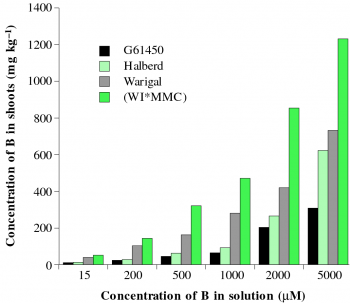
Figure 2 Concentration of B in shoots of four varieties of wheat when grown in a solution culture experiment with six B treatments. (Based on Nable 1988)
Visible symptoms of B toxicity coincide with regions of highest B concentration and consist initially of chlorosis followed by tissue death. Varieties that tolerate high concen-trations of B (Figure 1) are able to exclude B from their roots. They therefore have lower shoot concentrations (Figure 2) and exhibit less severe symptoms of B toxicity compared with more sensitive varieties.
In retrospect, B tolerance was probably a major factor influencing progeny selection from breeding programs for wheat varieties in Australia. Several varieties have dominated Australian wheat production in southern Australia during the twentieth century and the majority of these are tolerant to B. On the other hand, varieties grown in New South Wales and Queensland, where high concentrations of B do not occur, are invariably sensitive to soil B. For example, the variety Halberd, which is one of the most tolerant Australian varieties, was the most widely grown variety in southern Australia during the 1970s and 1980s. Cultivation of Halberd was most concentrated in areas of high soil B. At some silos on Eyre Peninsula, Victorian and South Australian mallee regions as well as inland Western Australia, more than 70% of the total grain receivals were Halberd. By contrast, in low-B regions, Halberd accounted for less than 20% of production. By implication, any successful field crops in southern Australia will have some measure of B tolerance.
Nable, R.O. (1988). ‘Resistance to boron toxicity amongst several barley and wheat cultivars: a preliminary examination of the resistance mechanism’, Plant and Soil, 112, 45–52.
Paull, J.G., Rathjen, A.J. and Cartwright, B. (1991). ‘Major gene control of tolerance of bread wheat (Triticum aestivum L.) to high concentrations of soil boron’, Euphytica, 55, 217–228.
Links:
[1] http://plantsinaction.science.uq.edu.au/edition1//?q=figure_view/681
[2] http://plantsinaction.science.uq.edu.au/edition1//?q=figure_view/683
[3] http://plantsinaction.science.uq.edu.au/edition1//?q=figure_view/682