
Forests and woodlands store about 80% of all biotic above-ground organic carbon and 40% of all biotic below-ground organic carbon. They therefore represent a major pool of global carbon. In addition they are major determinants of regional climate through their role in energy and mass transfer between atmosphere and biosphere. About 20% of water flux to the atmosphere occurs through vegetation, mostly forests.
Tropical forests and woodlands also represent one of the few remaining terrestrial ecosystems that are relatively pristine. In addition they are sites of high biodiversity, covering only 6% of the world’s surface but containing up to 50% of the world’s plant and animal species.
Combined areas of tropical forests and woodlands represent 42% of the world’s forested area, 59% of the global forest biomass and 57% of total soil carbon. They are found between 23°N and 23°S. Tropical and subtropical forests and woodlands occupy about 35% of Australia.
Clearly, a knowledge of tropical tree ecophysiology is vital to informed management of these ecosystems, and Section 13.5 will cover some aspects of tropical tree growth and physiology under elevated CO2.
Generalising from extensive data on container-grown tropical species, light-saturated photosynthesis is increased (on average by 50%) and gs is decreased (on average by 50%) in response to a doubling of ambient CO2 concentration provided pot size is sufficiently large. An increase in assimilation coupled to a decrease in gs may appear counter-intuitive. However, in a CO2-enriched environment, CO2 concentration within a leaf is still larger (often double) than that in a leaf in ambient air, and thus assimilation rate is still enhanced.
These results are consistent with a range of results observed for temperate and boreal tree responses (Eamus and Jarvis 1989). Increased assimilation responses may be attributed to increased substrate concentration (CO2) and decreased photorespiration. Few measurements of the activation state of Rubisco have been made for tropical species, but declines in carboxylation efficiency as inferred from A:pi curves have been observed for Eucalyptus tetrodonta and other tropical species (Eamus et al. 1995; Ziska et al. 1991). A decline in the amount and activity of Rubisco in response to CO2 enrichment has been observed in a range of annual and tree species, and probably represents an optimisation response, whereby nitrogen is relocated from non-limiting steps in photosynthesis (carbon fixation) to those steps limiting the rate of photosynthesis. In a CO2-enriched environment carbon supply to Rubisco is non-limiting but electron transport or Calvin cycle turnover may have become limiting.
Some of the increase in assimilation rate, expressed as per unit leaf area, is attributable to an increase in the thickness of photosynthetic tissue (mesophyll), resulting in a decreased specific leaf area (area of leaf per unit dry mass of leaf). Typically specific leaf area decreases by approximately 10–40%. Although some of this decrease may result from increased leaf density, reflecting increased starch storage in leaves growing with CO2 enrichment, much of the decrease in specific leaf area is the result of thicker leaves, with either more layers of photosynthetic cells or thicker cells. Consequently the mass of photosynthetic tissue per unit leaf area increases, and assimilation rate per unit leaf area increases. Nevertheless, when assimilation rates are expressed as per unit dry mass, they are still significantly increased by CO2 enrichment because of an increase in substrate supply and decreased photorespiration.
A loss of photosynthetic potential has been observed in some tropical tree species, including Eucalyptus tetrodonta, but not in others (e.g. Mangifera indica, mango). This loss of potential can be shown by comparing the assimilation rate at a common pi of trees grown in ambient conditions with trees grown in enriched conditions. By using a common pi, any variation in assimilation rate due to differences in substrate concentration is removed. The loss of photosynthetic potential is often due to the loss of activity or a decline in the amount of Rubisco. Foliar nitrogen content frequently declines in CO2-enriched trees, reflecting a change in allocation of plant nitrogen.
Instantaneous rates of assimilation for trees grown in ambient but measured in enriched conditions are often larger than those of trees grown in enriched but measured in ambient conditions (Figure 13.3). This results not only from down-regulation but also a decline in stomatal density (Table 13.1), which restricts entry of CO2. Stomatal aperture is important in plants grown with CO2 enrichment but measured in ambient conditions because of the decrease in CO2 concentration upon transfer to ambient conditions. When measured in a CO2-enriched environment, the larger gradient in CO2 concentration between ambient air and leaf airspaces compensates for reduced gs, but when measured in ambient conditions a lower stomatal density results in a lower pi and hence a lower assimilation rate than is measured for ambient-grown trees measured in ambient conditions.
Decreased gs is due to reduced stomatal density (Table 13.1) as well as reduced aperture. Given an increase in assimilation but a decline in gs, instantaneous water use efficiency (ratio of assimilation to transpiration) also increases. Such increases may delay onset of drought or reduce the severity of a drought, but a more likely scenario in nature is that the increase in leaf area per plant, plus the increase in leaf temperature often associated with a decreased leaf transpiration rate, will offset increased water use efficiency.
The tropics are warmer than temperate zones and as shown earlier (Figure 13.7) the impact of CO2 enrichment on CO2 assimilation is greater under warm conditions than under cool conditions. As temperature increases, gas solubilities decrease, but the ratio of solubilities of O2 to CO2 increases. Furthermore the specificity of Rubisco for CO2 decreases with increased temperature. Consequently photorespiration (relying on the oxygenase function of Rubisco) is favoured over CO2 assimilation as conditions become warmer, shown also as an increase in G* (Case study 1.1). As a result, the stimulation of CO2 assimilation due to increased atmospheric CO2 concentration also increases (Figure 13.7). Moreover, the temperature optimum for assimilation increases as atmospheric CO2 concentration increases. Finally, as Rubisco activation declines (a common outcome of CO2 enrichment) the temperature threshold for a positive impact of CO2 enrichment is increased. Overall, increased atmospheric CO2 concentration has a larger impact at high temperatures that at low temperatures. A priori, tropical locations should favour a large growth response due to CO2 enrichment.
CO2 enrichment generally reduces stomatal density, stomatal conductance and transpiration rate per unit leaf area. In addition, total leaf area per plant and root:shoot ratios might increase, while solute content of leaves (carbohydrates and inorganic ions) could also be affected. All of these factors can influence plant water status via effects on water uptake and/or water loss.
In a study of Maranthes corymbosa, a tropical monsoon vine forest tree, leaf water potential was consistently higher under CO2-enriched conditions than in control conditions through--out the day (Figure 13.9). Similarly in Eucalyptus tetrodonta, a savanna species of tropical Australia, pre-dawn water potential was also higher under CO2-enriched conditions. These results were attributed to decreased transpiration rate per plant. However, during daytime, leaf water potential of E. tetrodonta growing with CO2 enrichment was equal to or lower than that of plants growing in ambient CO2 conditions. These apparent discrepancies probably resulted from different responses of root:shoot ratios between these two species (Eamus et al. 1995). In M. corymbosa, the root:shoot ratio was the same in ambient as in CO2-enriched plants. Roots were able to supply enough water for transpiration from leaves with reduced gs. In contrast to M. corymbosa, the root:shoot ratio of E. tetrodonta declined in response to CO2 enrichment and by implication there may not have been enough roots to maintain water potential higher than that of control values.
The response of whole-plant water use to CO2 enrichment is variable. In some studies the rate of transpiration per plant can be almost identical for plants growing in ambient or CO2-enriched conditions. Thus the reduction in transpiration rate per leaf area is balanced by increased leaf area per plant and the rate of depletion of soil water is the same for ambient and CO2-enriched plants (Gifford et al. 1984). In contrast Reekie and Bazzaz (1989) found that in all five tree species studied, soil water content was higher and the water requirement for growth (grams H2O transpired per gram biomass formed) was lower in CO2-enriched trees.
In tropical trees both total plant mass and leaf area per plant vary in their sensitivity to elevated CO2. Percentage changes range from –10% to + 300%. Despite some exceptions, plant growth is generally enhanced by CO2 enrichment. Such increases result from increased availability of fixed carbon due to increased assimilation rate and decreased respiration rates. In some cases, CO2 enrichment stimulates leaf initiation and branching (Section 6.2) and faster assimilation per unit leaf area becomes compounded by a larger assimilatory surface,
Species thus differ in both the nature and extent of biomass increase under elevated CO2, with correlated changes inmorphology and phenology. Accordingly, their competitive abilities in communities will also be affected by climate change. In one empirical study on tropical species where elevated CO2 was taken as a driving variable (Rekkie and Bazzaz 1989) five tropical tree species were grown separately and in competition with each other, under ambient or CO2-enriched conditions. CO2 enrichment significantly influenced the relative biomass of each species. In ambient conditions species ranking in terms of whole-plant biomass was Senna multijuga > Cecropia obtusifolia > Trichospermum mexicanum > Piper auritum > Myriocarpa longipes. In contrast, under CO2 enrichment, the ranking changed to Trichospermum mexicanum > Cecropia obtusifolia > Senna multijuga > Piper auritum > Myriocarpa longipes. There were clear differences in comparative response to CO2 enrichment between species. The importance of S. multijuga declined significantly whereas the importance of T. mexicanum and C. obtusifolia increased substantially.
In view of their photosynthetic attributes, C4 plants are not expected to respond to CO2-enrichment because their natural CO2-concentrating mechanisms ensure that Rubisco is working closer to a saturating partial pressure of CO2 than in C3 plants. Paradoxically, a number of studies have shown increased leaf area and plant height. For example, Gifford et al. (1984) found 14%, 29% and 40% increase in leaf area per plant for amaranth, sorghum and maize respectively. Such increases may result from a decrease in respiration and/or a stimulation of leaf/branching initiation and emphasise that factors beyond leaf photosynthesis need to be recognised as components of plant response to elevated CO2.
That aside, large-scale ecosystem dynamics are nevertheless underpinned by biomass accumulation, and events that either add or substract from that biomass capital will impact on species composition. In Australian savannas at least 90% of grasses are C4 plants and all trees are C3 plants. On average, C3 species show a larger response to CO2 enrichment than C4 species. If climate change results in a longer wet season and warmer conditions, canopy cover by trees may increase and grass cover may therefore decline. Since grasses represent the major fuel load for bush fires and their persistence is related to burning frequency, global CO2 enrichment combined with less frequent fires will impact on vegetation structure with a possible shift in species composition towards C3 plants including trees.
 [1]
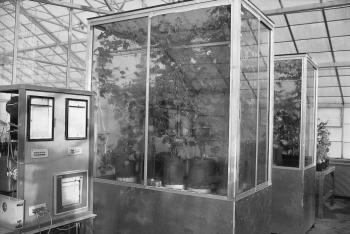
Figure 1 Potted grapevines in two naturally illuminated heat therapy cabinets (37-40 °C day and night), one at ambient CO2, the other held around three × ambient (CSIRO Horticulture Laboratory, Merbein) (Photograph courtesy E.A. Lawton)
Grapevine viruses are endemic to original habitats of certain Vitis species. They have spread worldwide via vegetative propagation with rootstocks a common source of scion infection (grapevine viruses are graft transmissable). Vine debilitation and reduced yields generally follow infection, though they are not always attributed to a causal agent because other visible symptoms can be diffuse.
Prior to the advent of molecular techniques during the 1980s virus detection was based on host plant symptomology plus visible reactions by indicator plants, and therapy of infected vines was based on prolonged exposure of entire potted vines to high temperature (37–40°C day and night) (Figure 1). Shoot tips generated during therapy were attenuated in virus ‘titre’, and if candidate plants lived long enough (100 d or more) virus-free tip cuttings could be produced.
According to practitioners of this method (Nyland and Goheen 1969), terminal meristems differentiate growing points ahead of vascular development, and during heat therapy those intensely meristematic growing points remain isolated from phloem-translocated virus. Put another way, sustained high temperature constrained the spread of virus to a greater extent than host plant cell division, and virus-free cells resulted. Harvesting those cells is technically demanding, and in former times well-nigh impossible, hence an early reliance on tip cuttings.
In principle, production of new meristems during heat therapy afforded good prospects of virus elimination, but host plants frequently died from heat stress, and especially if carbon resources had become depleted prior to treatment. Recognising that photorespiratory loss of carbon would be greatly enhanced at 40°C, and noting that ambient CO2 might be depleted in growth cabinets sealed for heat retention (cf. Figure 13.13), CO2 enrichment was implemented in the hope of restoring a positive carbon balance. Potted vines were held under high humidity in naturally illuminated cabinets at either ambient (c. 315 µmol CO2 mol–1) or enriched conditions (c. 1250 µmol CO2 mol–1) and responses measured over 14 d (further details in Kriedemann et al. 1976).
As anticipated, grapevine survival improved under CO2 enrichment. Net assimilation rate (NAR; Section 6.1) increased from 2.36 to 5.60 g m–2 d–1) and there was some evidence of leaf starch accumulation. Again, as theory predicted, transpiration decreased from around 1050 g m–2 d–1 at ambient CO2 to about 450 g m–2 d–1 under elevated CO2 and may have contributed to alleviation of high-temperature stress. There was also recorded an early example of photosynthetic acclimation where rates of CO2 assimilation in ambient air were down-regulated in grapevines heat treated under high CO2.
 [2]
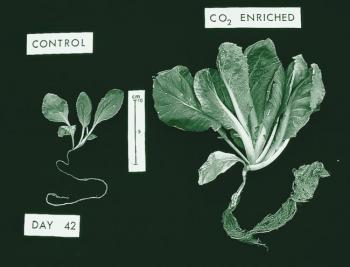
Figure 2 Seedlings of wong bok (Brassica pekinensis) show a spectacular growth response to elevated CO2 (three × ambient) when grown for 42 d under continuously warm conditions (32 °C day and night) intended to mimic a tropical environment (left side ambient, right side CO2 enriched). The same growth cabinets as shown in Figure 1 were used. Scale bar = 10 cm. (Photograph courtesy P.E. Kriedemann)
At a time when heat therapy remained de rigueur for virus elimination, CO2 enrichment of heat therapy cabinets found wide application for vine improvement. That technology has since been replaced by molecular methods for detection and elimination, but plant growth response to CO2 at high temperature still holds relevance for protected cultivation in tropical environments where net carbon gain is compromised by photorespiratory loss. Leafy green vegetables such as wong bok (Brassica pekinensis) proved responsive in our heat therapy cabinets, and especially during early vegetative phases where faster assimilation plus gains in leaf area were quickly compounded during near-exponential growth (Figure 2; Section 6.2). Marketable mass is therefore reached more quickly than at ambient CO2, and this faster cropping cycle is significant commercially. A quest for genetic variation in this capacity for response to elevated CO2 at high temperature would be likely to pay practical dividends.
Kriedemann, P.E., Sward, R.J. and Downton, W.J.S. (1976). ‘Vine response to carbon dioxide enrichment during heat therapy’, Australian Journal of Plant Physiology, 3, 605-618.
Nyland, G. and Goheen, A.C. (1969). ‘Heat therapy of virus diseases of perennial plants’, Annual Review of Phytopathology,
7, 331–354.
Links:
[1] http://plantsinaction.science.uq.edu.au/edition1//?q=figure_view/669
[2] http://plantsinaction.science.uq.edu.au/edition1//?q=figure_view/670