
Controlled environment and field studies clearly demonstrate that biomass production and yield are increased in both C3 and C4 species in response to CO2 enrichment. A survey of experiments carried out on a large number of species (Figure 13.2) established that doubling atmospheric CO2 concentration from 350 to 700 µmol CO2 mol–1 stimulates vegetative growth by an average of 37%. Although this is a substantial response, it remains lower than is expected, based on short-term CO2 response curves of leaf photosynthesis. While photosynthetic downregulation (Section 13.2.5) can account for much of this, additional field factors such as water, nutrient or light availability may also account for some of this difference between expected and observed growth responses. Furthermore, these factors interact with CO2 concentration and modify the impact of CO2 enrichment. Section 13.3 addresses these issues.
Potential growth rate is set by genetic factors. However, field growth is generally limited by one or more environmental variables such as sunlight, temperature, availability of mineral nutrients (especially nitrogen and phosphorus) and water.
In a linear sequence of events, limitation of an outcome by one component is common. In complex biological systems such as vascular plants, single-factor limitation is unusual. This is partly because plants balance resource acquisition and allocation to optimise several factors which then become colimiting for growth. For example, photosynthesis can be colimited by several factors despite large variations in the rate of assimilation that occur throughout a day as photon irradiance and temperature vary. Consequently, a growth response to relief of one limiting factor, such as atmospheric CO2, will depend not only on genetically determined potential but also on the relative availability of other colimiting environmental factors. Moreover, increased atmospheric CO2 can also alter plant responses to other environmental variables. Clearly, a study of plant growth responses to high CO2 calls for some discussion of genotype × environment interactions.
 [1]
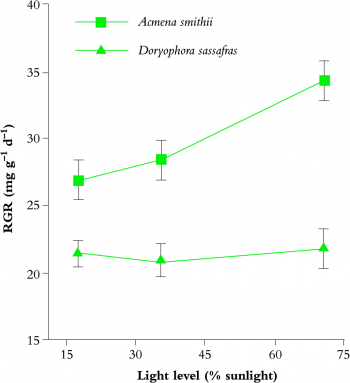
Figure 13.5 Relative growth rate (RGR) for Acmena smithii and Doryophora sassfras. A. smithii achieves higher RGR than D. sassfras, especially at higher light levels. Data points are the average of two CO2 treatments, 350 and 700 umol CO2 mol -1. (2 × standard errors of means are shown) (D.J. Wiggins, M.C. Ball, R.M. Gifford and G.D. Farquhar, pers. comm. 1996)
The nature of CO2 enrichment differs from increasing the availability of light or any other environmental variable in one important respect. Besides increasing the availability of a limiting resource, CO2 enrichment reduces inefficiency through a reduction in the photorespiratory loss of carbon. So even under extreme light-limiting conditions, CO2 enrichment can be expected to enhance net photoassimilation. This is most frequently expressed as an increased quantum efficiency. In addition, a frequently observed consequence of increasing the supply of photoassimilate in response to CO2 enrichment is increased leaf area. This has the feed-forward effect of causing increased radiation interception, which further amplifies the initial response to CO2 enrichment. Increased light and elevated CO2 can therefore interact positively to affect relative growth rate via an initial effect on rate of leaf expansion (Figure 13.5).
Relative growth rate can be limited by utilisation rather than generation of photoassimilates. Such sink limitation can lead to feedback inhibition of photosynthesis (Section 13.2.5). Those species with a high intrinsic relative growth rate (RGR) in any given light environment are likely to be able to respond to CO2 enrichment better than species with a lower RGR for the same light environment. Under shade conditions, plants with a high RGR are more likely to benefit from the direct and compounding benefits of an increased photoassimilate supply. Plants with a low RGR, when subject to abundant illumination, may be so well supplied with photoassimilate that sinks are growing almost as fast as the prevailing temperature allows. In that scenario, further photosynthetic stimulation by CO2 enrichment would not lead to increased sink activity and feedback inhibition of photosynthesis may follow.
 [2]
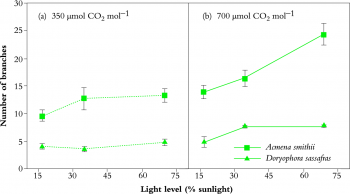
Figure 13.6 Number of branches produced under different combinations of irradiance and atmospheric CO2 concentration in Acmena smithii and the more apically dominant Doryophora sassafras. A. smithii has a greater phenotypic plasticity and is better able to increase sink number in response to CO2 enrichment. (2 × standard errors of means are shown) (D.J. Wiggins, M.C. Ball, R.M. Gifford and G.D. Farquhar, pers. comm. 1996)
In addition to strong RGR (strong sinks) some species possess a greater phenotypic plasticity and are able to generate additional sinks according to growing conditions (i.e. indeterminate growth). Such plants show a larger and more sustained response to CO2 enrichment than determinate species (Figure 13.6). Doryophora sassafras Endl. and Acmena smithii (Poir.) Merr. and Perry are two species endemic to warm temperate rainforests of New South Wales. D. sassafras typically establishes under low light regimes and A. smithii establishes under a wide range of light environments. Both species are capable of germination under mature rainforest canopies and persist in low light environments.
A. smithii differs from D. sassafras in its response to both low and high light environments. Not only can A. smithii achieve a faster RGR than D. sassafras at all light levels, but A. smithii also has the phenotypic plasticity to increase sink number, largely through an increase in branching (Figure 13.6). Enhanced branching thus increases the capacity of A. smithii to use photoassimilates in response to higher light. In contrast, D. sassafras is more apically dominant and is unable to increase sink strength commensurate with the enhanced capacity to produce photoassimilates.
The response of A. smithii to CO2 enrichment is similar to its response to increased light. Increased availability of both resources may increase photosynthetic capacity and both have the ability to induce physiological and morphological changes in many species. Both factors influence leaf elongation and branching and thereby lead to a positive interaction on whole-plant RGR by sustaining faster expansion over a larger number of leaves.
Temperature effects on plant growth and development raise two sets of issues within a context of interactions between CO2 enrichment and environmental factors. First, will the rate of net photosynthesis at any given temperature be altered by CO2 enhancement and, second, will a growth response to CO2 enrichment be temperature dependent?
 [3]
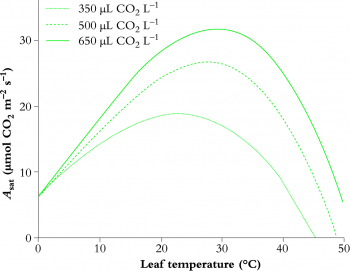
Figure 13.7 Predicted light-saturated rates of assimilation with leaf temperature for three different CO2 concentrations. (Based on Long 1991)
The dual carboxylase/oxygenase function of Rubisco results in a reduction in net photosynthesis as O2 competes with CO2 for access to the key CO2-acceptor molecule of C3 photosynthesis, ribulose-1,5-bisphosphate (RuBP). As temperature rises, both CO2 solubility and specificity of Rubisco for CO2 decreases. Moreover, CO2 solubility decreases to a greater extent than does O2 solubility. Taken together, these changes favour oxygenation of RuBP, so for any given CO2 concentration increased temperature will increase RuBP oxygenation relative to carboxylation. Consequently the proportional enhancement of assimilation in response to CO2 enrichment increases because of a progressively larger benefit of inhibiting photorespiration as temperature increases (Figure 13.7). (See Long (1991) and Eamus (1996) for further discussion.)
Mean global surface temperatures are expected to increase by approximately 1.5–4°C with a doubling of the atmospheric CO2 concentration from 350 to 700 µmol CO2 mol–1. This may appear inconsequential in comparison with the common occurrence of temperature fluctuations of up to 30°C in a single day. However, small temperature rises over an entire season will have a significant effect on crop yield and pasture growth largely because of the acceleration of developmental rates. Temperature increases and CO2 enrichment independently accelerate development of annual crop species. In wheat and rice, successive leaves appear faster and time to flowering is shortened by increases in both temperature and CO2. In determinant species such as wheat (Triticum aestivum L.) and rice (Oryza sativa L.), yield is often dependent on whole-plant biomass production. Consequently, hastened development (faster phenology) decreases the time available for radiation interception prior to maturity. This decreases biomass accumulation and yield.
The scale of temperature × CO2 interactions on yield is thus set by phenology, and isolines that differ primarily in the duration of their life cycle provide useful test material. The near-isogenic wheat varieties Hartog and Late Hartog provide a good example of a genetically dependent phenology. Using these two varieties, experiments were carried out (H. Rawson, pers. comm. 1997) to determine whether duration could increase the advantage gained by higher temperatures at elevated CO2 concentrations. Temperatures were increased by 2°C above ambient in both winter and summer growing conditions (Figure 13.8).
 [4]
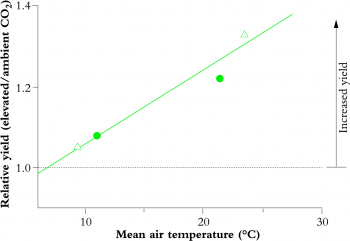
Figure 13.8 Grain yield response of wheat (Hartog and Late Hartog) to increasing CO2 concentration from 350 µmol mol-1 to 700 µmol mol-1, expressed as a ratio of yield from enriched to yield under ambient CO2 concentrations. Symbols represent two different sites (H. Rawson, unpublished data)
In summer, the mean daily maximum was approximately 23°C. The maximum daily temperature was over 30°C, with temperatures exceeding 40°C on 17 occasions. Crop yield responded dramatically under these conditions. Doubling the ambient atmospheric CO2 concentration led to a biomass and grain yield increase of over 30% in the shorter duration genotype (Hartog). As a result of its slower developmental rate and subsequent increased radiation interception, biomass production was greater in Late Hartog than Hartog in two consecutive summer studies. In winter, when mean temperature was around 10°C, the increase in yield in response to CO2 enrichment ranged from 8% to 12%.
Based on responses to a doubling of the current CO2 concentration over a range of temperatures, a 1.8% increase in biomass production and yield with each °C rise in temperature can be anticipated (Figure 13.8). These data imply a considerable benefit in terms of grain yield in a future CO2-enriched environment, but extrapolation to areas where summer temperatures are already marginal for production would be misleading. In those cases, cereal yield will be constrained by environmental stresses despite potential benefits from higher CO2.
 [5]
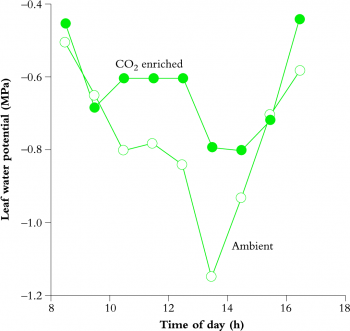
Figure 13.9 CO2 enrichment can enhance leaf water potential in some species. Maranthes corymosa, a tropical monsoon rainforest species of north Australia, maintains a significantly higher leaf water potential throughout the day. (Based on Eamus et al. 1995)
 [6]
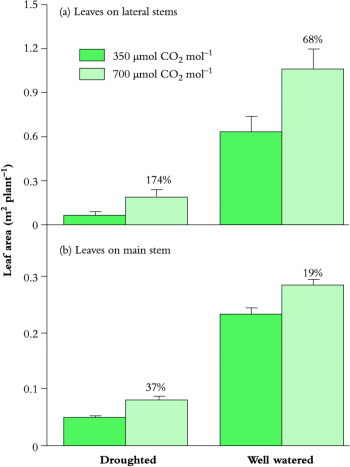
Figure 13.10 (a) Total area of leaves on lateral stems of 23-week-old Eucalyptus tereticornis grown at ambient and elevated CO2 concentrations and two levels of water supply (50% field capacity – droughted; field capacity – well watered). (b) Total area of leaves on main stem. Treatments as for (a). Values above columns represent percentage increase in leaf area at high CO2. The percentage stimulation in leaf area per plant is largest in droughted plants. (2 × standard errors of means are shown) (Based on B.J Atwell and J.P. Conroy, pers. comm. 1996)
 [7]
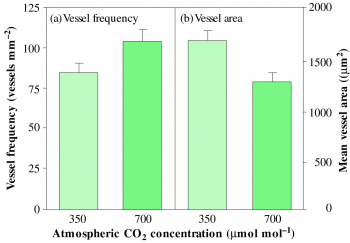
Figure 13.11 Influence of CO2 enrichment on vessel frequency and mean vessel area of stems of 23-week-old Eucalyptus tereticornis grown under well-watered conditions. (Based on B.J. Atwell and J.P. Conroy, pers. comm. 1996)
One of the primary responses to soil water deficit is a reduction in stomatal conductance. A primary response of many species to CO2 enrichment has also been a reduction in stomatal conductance. A doubling of atmospheric CO2 from 350 to 700 µmol CO2 mol–1 reduces stomatal conductance by about 40%, regardless of the conductance in normal air. This reduction is due partly to reduced stomatal aperture and partly to reduced stomatal density. Furthermore changes in stomatal conductance due to CO2 enrichment are often more pronounced for water-stressed plants than for well-watered ones. As the amount of water lost through transpiration is largely dependent on stomatal aperture, CO2 enrichment can result in maintenance of higher leaf water potentials at any given soil water content (Figure 13.9) as has been observed in Maranthes corymbosa, a tropical tree of northern Australia. However, any improvement in water relations at high CO2 due to reductions in soil water depletion is often counter-balanced in C3 plants by increased leaf area production under high CO2. In C4 plants, lower transpiration at high CO2 is not counterbalanced by a greater leaf area, so that growth can benefit from an improved supply of soil moisture.
In addition to potential advantages from reduced stomatal conductance there are at least two reasons why increased growth may occur in water-stressed plants in response to CO2 enrichment. First, the internal concentration of CO2 (ci) is increased at high atmospheric CO2 concentrations (ca) compared to ambient conditions despite reductions in stomatal conductance as water stress develops. Additional photoassimilates may allow plants to osmoregulate more effectively and to respond more quickly to any alleviation of water stress (compensatory increase in leaf size following rewatering was covered in Section 6.2.7). Second, by slowing down leaf appearance and expansion rates, water deficits induce a reduction in the number of active sinks at any one time. As we have seen, a common response to CO2 enrichment is increased sink strength. In Eucalyptus tereticornis, doubling atmospheric CO2 concentration from 350 to 700 µmol CO2 mol–1 substantially increased total leaf area per plant. The increase in total leaf area is largely a result of decreased apical dominance leading to enhanced lateral branching and a subsequent increase in leaf number per plant. Water-stressed plants show a more dramatic response (Figure 13.10).
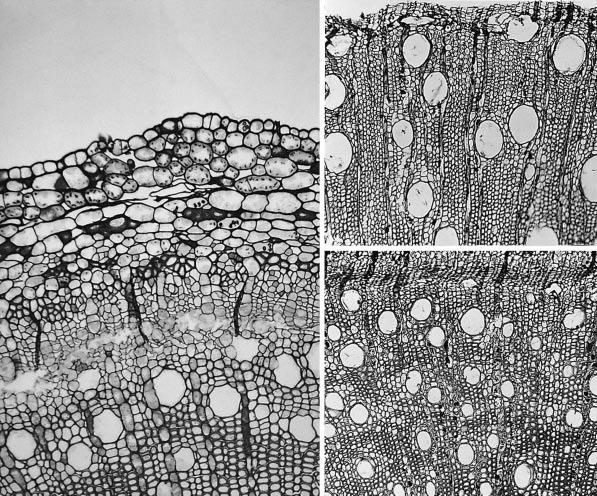
CO2 enrichment also enhances sink generation in woody stems, leading to a 30% increase in dry mass (under well-watered conditions). In this instance (Figure 13.11) expression of enhanced sink capacity occurs via an increase in the number of vessels per unit cross-sectional area and a decrease in their average diameter (Figure 13.12). Fast-growing species of Eucalyptus such as E. grandis typically respond in this way to improved growing conditions so that basic wood density does not diminish with site improvement (Bamber et al. 1982). Change in wood properties (Figure 13.12 B, C) is not only important in determining the capacity of eucalypts to respond to CO2 but has implications for carbon cycling in forests: carbon stored in wood remains sequestered until after tree death, and subsequent release will be slowed by higher wood density.
 [8]
Figure 13.12 Photomicrographs of transverse sections from Eucalyptus grandis (a) show location of vessels (ve) in secondary xylem in relation to cortex (co) and cambium (ca). Photomicrographs of stem sections from E. tereticornis (b and c) show a greater abundance of narrower vessels in stems grown under CO2-enriched conditions (c) compared with ambient CO2 (b). Remnants of a cambial layer are evident along the top edges of sections in (b) and (c). Scale bar = 100 µm. (Photomicrographs courtesy P.E. Kriedemann (a); B.J. Atwell and J.P Conroy (b and c))
Interactions between high CO2 and other environmental variables on growth and photosynthetic attributes are obviously complex. Given that results presented here come from experiments where only one factor in addition to atmospheric CO2 was altered, extrapolation to field situations is problematic. Nevertheless, genetic variation in growth and yield response to high CO2 is considerable. Contrasts between species and even between cultivars in their sensitivity to high CO2 suggests that breeding varieties more responsive to high CO2 may be possible.
 [9]
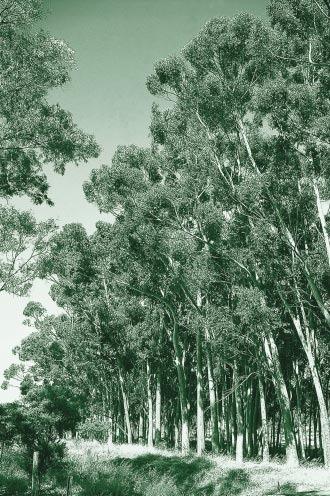
Figure 1 A healthy stand of Eucalyptus cladocalyx (sugar gums) near Ouyen (north-western Victoria). Sugar gums are indigenous to South Australia but they have been planted widely throughout the world. They are common on farms in western Victoria because this area was settled by farmers from South Australia who brought the seed with them. The tree was popular because it coppices easily, forming long straight branches that could be used for fence posts, but stock avoid eating the young shoots.
(Photograph courtesy P.E. Kriedemann)
Young tips of eucalypts are particularly attractive to mammalian herbivores such as koalas as well as to insects because they are higher in protein and nitrogen but lower in fibre (softer) than old leaves. Such herbivory impacts on plants because these shoots are future sources of photoassimilate. Lost foliage needs to be replaced, consuming valuable energy and nutrient stores. Vascular plants have evolved with a range of physical and chemical mechanisms that increase their resistance to herbivores and minimise such losses.
Nevertheless, these mechanisms are ‘expensive’ in terms of energy and of resources that could otherwise be used for photosynthesis. Cyanogenic glycosides are one such group of chemical defence compounds that are both nitrogen rich and take much energy to synthesise.
Cyanogenic glycosides consist of a cyanide group (N C-) bound to a sugar. When the sugar is cleaved by a ß-glycosidase enzyme, free hydrocyanic acid (HCN) is released. HCN interferes with cytochrome oxidase (Section 2.4) and is extremely toxic to herbivores. Such plants are termed cyanogenic. They avoid poisoning themselves by storing cyanogenic glycosides and the β-glucosidase in separate places: glycoside in vacuoles and enzyme in apoplasm. Enzyme and substrate are brought together when a leaf is crushed, as in chewing. About 4% of all plants are cyanogenic, including a number of species of Eucalyptus. Cyanogenesis discourages grazing by both mammalian and invertebrate herbivores.
Cyanide production represents a resource cost to a plant in terms of nitrogen. Given that nitrogen is in limited supply in most ecosystems, any diversion of nitrogen away from primary metabolism is likely to have a negative impact on plant growth. Any benefit takes the form of reduced herbivory. There is thus a trade-off between the benefit of reduced herbivory and the cost in terms of lower growth rates. Will this balance change in a high-CO2 world?
Plants at elevated CO2 grow faster and more efficiently (using less water and fewer nutrients per unit CO2 fixed) than those at ambient levels. If atmospheric concentration of CO2 is doubled from 350 to around 750 µmol mol–1, biomass and photosynthetic rates increase. Leaves from plants grown at elevated CO2 also contain lower concentrations of nitrogen and protein. Since most of a plant’s nitrogen is invested in photosynthetic enzymes, nitrogen use efficiency increases under elevated CO2 (Table 6.7).
If plants grown at elevated CO2 are able to achieve higher rates of photosynthesis with less nitrogen, then nitrogen in excess of those requirements could be used for other purposes such as the synthesis of herbivore defence compounds.
 [10]
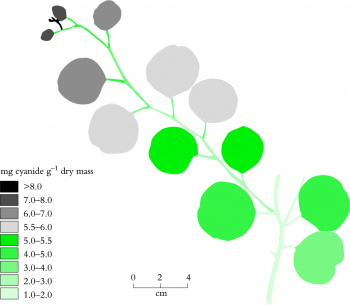
Figure 2 This tone-coded diagram of a typical branch of a 6-month-old Eucalyptus cladocalyx seedling shows a gradient in concentration of cyanogenic glycosides (measured as cyanide) from younger to older parts. Tips are softer and are highly sought after by herbivores, but higher levels of cyanogenic glycosides may offer protection (Original diagram courtesy R.M. Gleadow)
 [11]
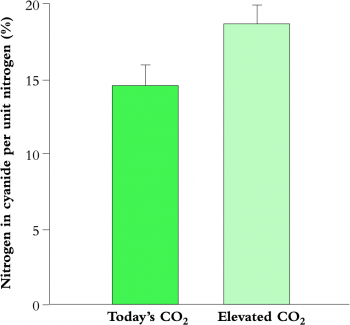
Figure 3 Leaf nitrogen invested in cyanogenic glycosides as a proportion of total leaf nitrogen was significantly greater in leaves of Eucalyptus cladocalyx seedlings grown at elevated CO2 concentration (about 350 µmol mol-1). As a result, leaves from plants grown at elevated CO2 are both less nutritious and more toxic to herivores. (Based on Gleadow et al. 1998)
Accordingly the hypothesis that increased efficiency of nitrogen use under elevated CO2 would lead to an increase in nitrogen allocation to cyanogenic glycosides was tested. Seedlings of Eucalyptus cladocalyx (sugar gum) were chosen for the study (Gleadow et al. 1998) because they invest up to 20% of leaf nitrogen in cyanogenic glycosides (Figure 2), and consequently any changes would be readily detected.
Seedlings of E. cladocalyx were grown in a pair of glasshouses that differed only in the amount of CO2 in the atmosphere — extra CO2 was added to one chamber to raise the atmos-pheric concentration of CO2 from 350 to 750 µmol mol–1.
The growth response of seedlings was typical of woody plants grown at elevated CO2 — biomass increased, leaves were thicker and the leaf area ratio (LAR, Section 6.1) was reduced. In addition, the concentration of nitrogen and protein in leaves decreased, implying gains in the efficiency of nitrogen use. More importantly, allocation of nitrogen to cyanogenic glycosides increased significantly in plants grown at elevated CO2 (Figure 3). As a result, plant protein content decreased and the amount of protein relative to the amount of cyanogenic glycosides decreased even more. Plants would not only be less nutritious to herbivores, but also more toxic.
If these controlled-environment experiments are good predictors of what will happen in more complex, natural ecosystems then the balance between plants and herbivores in the next century could be different. While this is good news for plants, it is bad news for herbivores. In a future high-CO2 world plants are likely to be less nutritious and also contain increased concentrations of toxins and defence compounds. Plants will be able to grow faster and be more resistant to herbivores. That outcome will have serious implications for herbivores such as leaf-eating mammals, who are already under threat from habitat destruction.
Gleadow, R.M., Foley, W.J. and Woodrow I.E. (1998). ‘Enhanced CO2 alters the photosynthesis–defence relationship in cyanogenic Eucalyptus cladocalyx F. Muell.’, Plant, Cell and Environment, 21, 12–22.
Links:
[1] http://plantsinaction.science.uq.edu.au/edition1//?q=figure_view/654
[2] http://plantsinaction.science.uq.edu.au/edition1//?q=figure_view/655
[3] http://plantsinaction.science.uq.edu.au/edition1//?q=figure_view/656
[4] http://plantsinaction.science.uq.edu.au/edition1//?q=figure_view/657
[5] http://plantsinaction.science.uq.edu.au/edition1//?q=figure_view/658
[6] http://plantsinaction.science.uq.edu.au/edition1//?q=figure_view/659
[7] http://plantsinaction.science.uq.edu.au/edition1//?q=figure_view/660
[8] http://plantsinaction.science.uq.edu.au/edition1//?q=figure_view/661
[9] http://plantsinaction.science.uq.edu.au/edition1//?q=figure_view/662
[10] http://plantsinaction.science.uq.edu.au/edition1//?q=figure_view/663
[11] http://plantsinaction.science.uq.edu.au/edition1//?q=figure_view/664