
Solar radiation is linked to agricultural productivity via biomass production and allocation to harvested parts (e.g. grain). Radiation is considered here only in relation to canopy photosynthesis. Biomass is obviously derived from photosynthesis, but is less than total carbon assimilation due to a large respiratory loss (see Case study 12.2). Carbon lost via respiration is a fairly constant proportion of photosynthesis, and thus variation in canopy photosynthesis is sufficient for present purposes to explain variation in biomass. How then does interception of photosynthetically active radiation (PAR) affect biomass production and allocation to crop yield? Three steps are considered: (1) variation in incident PAR during crop growth, (2) interception of PAR by a crop canopy and (3) efficiency of PAR conversion into biomass and yield.
Crop yield commonly depends on the total amount of PAR intercepted, particularly when crop growth is not limited by other factors such as nutrient or water deficiency or temperature extremes. One example highlighting the importance of strong solar radiation for crop yield comes from a comparison of rice crops in Australia with those grown in tropical areas.
Rice in Australia is grown almost exclusively in southern New South Wales during dry summer months (November–March). Crops are fully irrigated and well fertilised and yield around 9t ha–1. This high yield is associated with high incident solar energy (commonly 10–15MJ m–2 d–1 PAR) during a long growing season. In tropical Asian countries rice is commonly grown under cloudy conditions during the wet season (June–November). Yield is lower (4–5t ha–1) even with high nutrient inputs, due to a shorter growing season and lower solar energy (often around 8–10MJ m–2 d–1 PAR). Experiments using shade cloths have also shown that rice growth and yield, in common with many other agricultural crops, are both reduced by decreased solar radiation (Sections 6.2, 6.4). Adverse effects of decreased solar radiation are most severe during grain filling.
Interception of PAR by a crop canopy is strongly related to total leaf area. A crop will thus intercept more PAR and hence grow faster if it develops leaf area rapidly. This principle applies to both annual crops which are usually planted at the beginning of a growing season and to perennial crops which resume growth after a dormant season. Leaf area development of sugar cane, for example, is generally slower in the year of planting compared with a subsequent ratooned crop where canopy regrowth is enhanced by stored photoassimilate. By analogy with early canopy expansion, retention of green leaves late in a growing season also extends sunlight interception.
 [1]
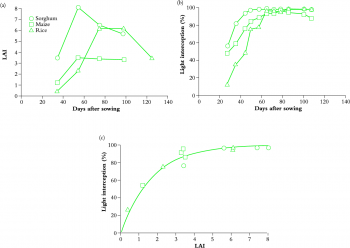
Figure 12.20 Changes in (a) leaf area index (LAI), (b) light interception, and (c) the overall relationship between light interception and LAI for all three species, sorghum, maize and rice. (All grown in southeast Queensland)
(Based on Inthapan and Fukai 1988)
The leaf area index (LAI) is the ratio of total projected leaf area (one side only) per unit ground area, and is widely used to characterise canopy light climate. A canopy where LAI equals 1 has a leaf area equal to the soil surface area on which it grows, but this does not mean all PAR is intercepted because some leaves overlap, leaving gaps. Moreover, not all leaves are positioned at right angles to incident radiation. A crop under favourable growing conditions increases LAI rapidly during early development to a maximum of 3 to 7. An example of LAI development of three tropical cereal crops grown under well-watered conditions in southeast Queensland is given in Figure 12.20. Sorghum showed a more rapid increase in LAI than did maize largely because of a higher sowing density (33 v. 5.6 plants m–2). A late maturing rice crop showed slowest leaf area development during early stages of growth, but maximum LAI was none the less higher in rice than in maize. As a general rule, maximum LAI is achieved just prior to flowering in cereal crops. By that stage, growing points are differentiating floral rather than leaf primordia, and initiation of new leaves has ceased.
Some cereal crops lose leaves and LAI declines during grain filling as crops mature. Differences in LAI development among the three crops (Figure 12.20a) are evident in PAR interception by respective canopies (Figure 12.20b); interception prior to 60 d was highest in sorghum and lowest in rice. However, in all three crops, canopy PAR interception increased rapidly during early stages of growth. Incident radiation was almost completely intercepted once high LAI had been achieved.
Despite wide variation in crop phenology, sunlight interception and LAI maintain a tight relationship (Figure 12.20c). Interception increases sharply with increase in LAI to about 90% once LAI exceeds 4, and approaches an asymptote at higher LAI. Such a relationship applies to many crops, and emphasises (1) the importance of a rapid increase in LAI during early stages of growth, and (2) a requirement for only moderate LAI to achieve effective interception. Indeed, excessive leaf area development can be counter-productive because reproductive development, and hence economic yield, may be reduced due to self-shading and resource allocation to leaf production (Section 12.5).
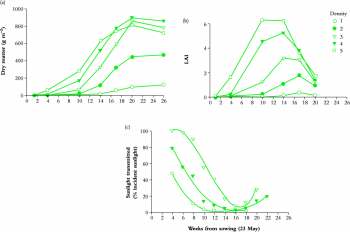
The time-course of radiation interception during crop growth can be manipulated to some extent by farmers. For example, seeding rate is an important management option which affects interception and subsequent crop growth and yield. A higher seeding rate would produce a higher plant population density and a higher LAI at crop establishment. This hastens canopy interception and hence biomass pro-duction would be promoted. Any advantage of a high plant density may disappear with time during crop growth because radiation interception of a medium plant density may eventually catch up with that of the high density (Figure 12.21). In this case, density 3 (35 plants m–2) was sufficient for radiation interception and plant dry matter production. If plant density is very low, shown as density 1 (1.4 plants m–2) or density 2 (7 plants m–2) in Figure 12.21, LAI never exceeded 2 and final biomass at harvest was much smaller than values returned from higher densities. Solar radiation was wasted at low planting density, and potential yield (dry mass produced per unit area) was never realised.
 [2]
Figure 12.21 Changes in (a) dry matter, (b) leaf area index (LAI), and (c) photon irradiance at ground level for wheat crops grown at five different planting densities, 1.4, 7, 35, 184 and 1078 plants m-2 for treatments 1 to 5 respectively. Some self-thinning occureed in plots sown at higher densities, and by 26 weeks after sowing treatment densities were 1.4, 7, 35, 154 and 447 plants m-2 respectively
(Based on Puckridge and Donald 1967)
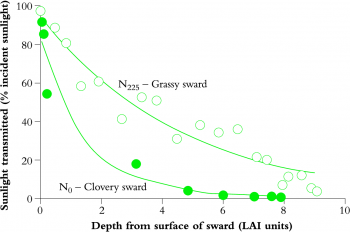
As solar radiation penetrates a crop canopy, PAR is intercepted by leaves and photon irradiance commonly declines exponentially with cumulative leaf area (i.e. depth in Figure 12.23), according to the simple relationship:
I = I0 exp (-kL) (12.5)
where I is horizontal photon irradiance within a canopy, I0 is horizontal photon irradiance above that canopy, L is LAI from the top of the canopy to the point where I is determined, and
k is an extinction coefficient (a more explicit formulation for PAR attenuation through a canopy appears in Section 12.4).
Large k values imply that photon irradiance decreases rapidly with depth, whereas a canopy with a small k would allow solar radiation to penetrate deeply, for a similar leaf area profile. Variation in k value is commonly associated with leaf angle. Canopies with more horizontal leaves, such as sun-flower or cotton, have large k values, often 0.7–1.0, whereas those with more erect leaves, such as barley and sugar cane, have small values, often 0.3–0.6.
Sunlight intercepted is not utilised with similar efficiency by different crops (Section 6.4). There are clear differences in light use efficiency between crop species, particularly between those with C3 and those with C4 photosynthetic pathways. The photosynthetic advantage of C4 species at a leaf level (Section 2.1) is evident here at a canopy level where efficiency is higher by 30–100%. Expressed in terms of dry mass formed (g) per unit of photosynthetically active energy absorbed (MJ), the efficiency of sorghum and maize (C4) in Figure 12.20 was 1.32g MJ–1, while that of rice (C3) was only 0.93g MJ–1.
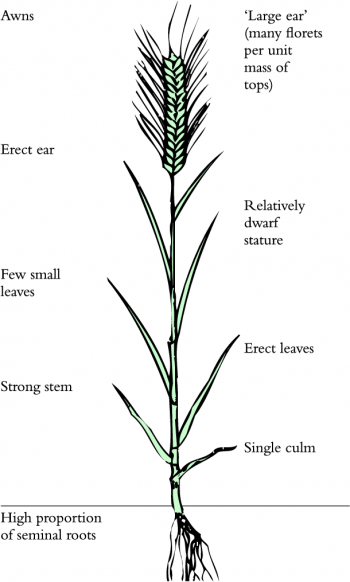
Canopy structure, and particularly the spatial distribution of leaf angles, has an important bearing on canopy light climate and energy conversion. Large leaf angles, with leaves close to vertical, ensure good PAR penetration when solar angle is high, and a high proportion of leaves receive similar photon irradiance. An even distribution of PAR at leaf surfaces is advantageous for canopy photosynthesis and improves light use efficiency over canopies where upper horizontal leaves intercept most solar radiation and lower leaves experience greatly attenuated levels. Small and erect leaves, particularly in top canopy layers, are thus a key feature of an ideal plant type, or ‘ideotype’ for high-density cropping.
 [3]
Figure 12.22 A hypothetical wheat ideotype with features presumed conducive to high grain yield as a crop community
(Based on Donald 1968)
One early wheat ideotype (Donald 1968) embodied several plant characteristics considered to be associated with a high productivity (Figure 12.22). These features included small erect leaves, a semi-dwarf stature, and a large ear on a single stem (i.e. few tillers). Setter et al. (1995, 1996) extended such concepts to rice, proposing a new plant type aimed at better interception of sunlight during grain filling by lower-ing panicle height relative to upper foliage. Topmost leaves actually protrude beyond the panicles. Breeding lines carrying lower panicles returned 15–40% greater yields compared with isogenic lines where high panicles shaded upper foliage.
Canopy radiation climate is especially complex in mixed crops and pastures where species with contrasting forms grow together. In grass–legume pastures, grass is generally taller than the legume component and is better placed to intercept incident radiation. Legumes then exist in permanent shade. Height is therefore an important determinant of light inter-ception within a mixed sward, and thus species composition. In such mixed swards, management options such as nitrogen fertiliser application, grazing time or cutting frequency all affect the relative height and hence radiation interception by component species. High-nitrogen fertiliser tends to favour grass, while clover may become dominant under nitrogen-limiting conditions.
 [4]
Figure 12.23 Photon irradiance declines with depth (cumulative LAI) in any plant communify. That rate of decline is accentuated by a preponderance of horizontal leaves. At moderate LAI, a clover-rich sward (no added nitrogen) will show stronger attenuation than a grass-rich sward (nitrogen added)
(Based on Stern and Donald 1962)
Light profiles within a pasture are therefore affected by LAI profiles of component species (Figure 12.23), and a clover-rich sward with more horizontal leaves (no added nitrogen) shows stronger attenuation of sunlight than a grass-rich sward with a preponderance of vertical leaves (nitrogen added). In common with monocultures, pasture productivity is enhanced by a species balance that ensures even distribution of sunlight within a mixed community.
Links:
[1] http://plantsinaction.science.uq.edu.au/edition1//?q=figure_view/619
[2] http://plantsinaction.science.uq.edu.au/edition1//?q=figure_view/620
[3] http://plantsinaction.science.uq.edu.au/edition1//?q=figure_view/622
[4] http://plantsinaction.science.uq.edu.au/edition1//?q=figure_view/623