
One broad approach to conferring longer storage life on any plant product is to slow metabolism by holding material at low temperature. Additional methods introduced since the 1960s have been superimposed on cool storage and fall into two general classes: specific gas atmospheres to slow fruit metabolism even further and pretreatments that bring tissues into a state that improves their subsequent storage life (Figure 11.18). Specific temperature management techniques are discussed below. Other examples of extended storage include drying in crops such as onions and wheat, ‘curing’ kumara (sweet potato) prior to storage and ‘pulsing’ cut flowers with sucrose to build up carbohydrates and thus prolong shelf life.
Fruit were originally held in cold caves at prevailing temperatures, but experience showed that a ‘best’ temperature can be sharply defined, and may differ between species or even cultivars (Wang 1991). At one extreme, freezing irreversibly damages a living product so that –0.5°C is generally the lowest temperature used. Apple cultivars are often best stored at or close to this minimum. In contrast, some fruits of tropical origin (avocado, banana) suffer chilling injury (Section 14.4) and store best between 7–10°C or 12–13°C respectively. Even persimmon, a temperate plant in many respects, has an optimum storage temperature of around 10°C, tolerating 0°C for only short periods.
 [1]
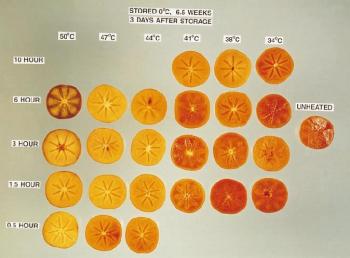
Figure 11.18 Paradoxically, heat treatment extends subsequent storage life of persimmons at low temperature (6.5 weeks at 0°C). Untreated fruit (far right) suffer from cold injury and disintegrate following removal from cold store. Fruit pretreated at 50°C for more than 2 h suffer heat damage and the polyphenols become oxidised (top left). However, there is a window of treatment intensity that allows fruit storage at 0°C without damage for a full term. This window is shown as a band of light-coloured fruit rising from the bottom left to the right (0.5-1.5 h at 50°C, 1.5-6 h at 47°C, and 3-6 h at 44°C).
(Original data courtesy A.B. Woolf)
At 0°C, respiration is reduced to a level that is just enough to maintain cell function. Sugar is slowly consumed during this process so that fruit with a low sugar content at harvest are less durable. Commodities such as kiwifruit, which are picked with large supplies of carbohydrate in the form of starch, have an additional source of sugar to utilise, giving longer storage lives than those entirely reliant on soluble reserves, such as grapes.
Low-temperature storage has played an important part in the development of successful fruit export industries in Australasia, because of the great shipping distances between orchard and consumer. The success of kiwifruit as a new fruit has been largely due to its ability to be stored at 0°C for six months or more with no detriment to flavour or texture (see Beever and Hopkirk 1990).
Associated with low-temperature storage is a wide range of techniques to manage temperature changes en route to storage (Kader et al. 1985; McDonald 1990). Again there are strong species differences. Speed of cooling and methods employed for heat extraction are both important. There can be passive or forced air cooling, evaporative cooling of leafy vegetables, use of dry air or moisture-laden air and harsh or gentle techniques. For example, kiwifruit packed into trays and held on standard pallets can take a week to cool from ambient temperatures around 15–20°C to their storage temperature of –0.5–0°C. Forced air cooling can do this in only 8–10 h, yielding fruit that are much firmer, easier to handle and longer lasting.
Temperature change can be usefully imposed as a sequence of steps. In ‘ramping down’, temperature is reduced to an intermediate point, held there for a brief time, then again reduced to the final storage temperature. In ‘preconditioning’, fruit is held for a longer time at a pretreatment temperature, then taken rapidly to its final storage temperature. This is becoming an important commercial method for increasing tolerance to low temperatures. Preconditioning temperatures may be elevated, as in heat preconditioning, or close to the temperature which normally causes chilling damage. In each case, the pretreatment is intended to increase uniformity of fruit behaviour and allow fruit to adjust metabolically to reduced temperatures.
One further variant that sometimes gives better storage behaviour is to pretreat fruit to a temperature as high as 47°C (Figure 11.18), or else impose ‘intermittent warming’ where fruit is occasionally brought back to room temperature (Paull 1990). High-temperature effects were uncovered during a search for alternatives to pest fumigation and are now used quite empirically to good effect.
Humidity levels are often combined with temperature manage-ment. Lowering temperature in coolstores generally lowers relative humidity because water condenses on heat exchangers during cooling. Storage problems may arise due to water loss rather than fruit temperature alone, and so it is generally desirable to maintain a high relative humidity (>95%). With kiwifruit, there is generally only a 1–2% water loss during six months’ storage if high-humidity conditions are maintained, compared to 4% or more when there is no effort to raise coolstore humidity.
Some fruits, flowers and vegetables are extremely susceptible to water loss (e.g. wilting of lettuce and deterioration of lychee), and in such cases the relative humidity needs to be held close to 100%. With valuable products like Cymbidium orchids, each flower stem may be fitted with a vial holding water to supply it throughout the storage period. The problem is compounded because flowers and leaves have a much greater surface area with many stomata whereas bulky fruit generally have a waxy coat and lack stomata. Their moisture loss occurs via calyces and fruit pedicels.
 [2]
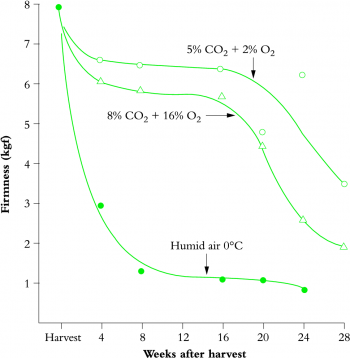
Figure 11.19 Storage life of kiwifruit can be greatly extended by controlled atmospheres. Under standard conditions (humidified air, 0°C) firmness declines exponentially over time, reaching limited acceptability by 8 weeks. Storage life ends once fruit firmness drops below about 0.9 kgf. Fruit are then soft enough to eat. Softening in cold store was slowed and storage life greatly extended by holding fruit in atmospheres containing either 5% CO2 + 2% O2 (top curve) or 8% CO2 + 16% O2 (middle curve).
(Based on McDonald and Harman 1982)
Rates of metabolism can be reduced and storage life further extended by modifying atmospheric composition during storage. Elevated CO2 and reduced O2, used either separately or together, can delay ripening and slow onset of senescence (Figure 11.19). These methods were originally developed on a commercial scale for apples, but have been progressively applied to many other fruits and vegetables. Container shipping helped their introduction because a sealed container makes it easier to maintain the required atmospheres along with reduced temperatures. Active control is achieved through sensors and scrubbers that help control flow and composition of recirculating atmospheres. Ethylene is also removed this way. Such storage using active control systems became known as controlled atmosphere or CA storage (Kader et al. 1985).
Another form of gaseous modification is achieved by passive methods. Fruit respiration is used to reduce the concentration of O2 and increase that of CO2 inside an enclosed space. The fruit is prevented from becoming anaerobic by making such enclosures out of plastic films that are partially permeable to O2 and CO2. In this way a balance is set up between removal of O2 by the fruit, and its replacement through inward diffusion from outside air. Such storage, known as modified atmosphere or MA storage, is very dependent on interaction between the rate of respiration (itself highly dependent on fruit temperature), film permeance, presence of any punctures in the film, and the surface to volume ratio of the container. Despite such problems, MA storage is potentially more flexible than CA storage, because fruit are in smaller independent packages that can usually be moved intact throughout handling and retailing.
How do these altered atmospheres delay ripening and retard senescence? Several routes are possible. One common obser-vation is that fruit respiration drops in response to the changed atmosphere (Knee 1991). This could occur via acidification of the cytosol, resulting from an elevated CO2 concentration redirecting metabolism towards alcohol or lactate/succinate or malate production rather than CO2 production. Another alternative is a direct effect of ultra-low O2 concentrations (<2%) on cytochrome c oxidase in the mitochondrial electron transfer pathway, preventing that enzyme from functioning properly. When both high CO2 and low O2 concentrations are combined then the beneficial effects may be additive.
Fruit differ with respect to critical values for tolerance to O2 or CO2 concentrations, and ideally we might make a model for predicting the tolerance limits for a new cultivar or fruit from our specific background information on its physiological behaviour. However, there is a key problem in manipulating atmospheres by static modelling approaches. The critical gas composition exists within the flesh of a fruit, not in the environment around it, while differences in genetic background cause each cultivar to behave differently with respect to metabolism and thus internal gas composition.
Conditions during storage are especially critical because optimum levels of CO2 and O2 teeter on a threshold between aerobic respiration (desirable) and anaerobic respiration (undesirable). Fruit differ in their sensitivities to anaerobic respiration, but are normally intolerant of prolonged periods (>3 d). Disorders and off-flavours then appear. Species vary in their response to the altered atmospheres of CA, and can even differ according to cultivar and harvest. This variation is seen in both the final concentration of CO2 and O2 within stored fruit, and in the time taken to equilibrate. Understandably, commercial enterprises operate under safe conditions, that is, close to an ideal atmosphere but with a margin of safety to avoid anaerobiosis. This in turn means that fruit storage is almost never completely optimal for that fruit. Normally, an internal 0.5% (0.5 kPa) partial pressure is the minimum O2 level tolerable, and 10% or 10 kPa is the maximum for CO2.
Kiwifruit tolerate a storage atmosphere of 8% CO2 and 1% O2 without detriment (see McDonald 1990). Atmospheres of 5% CO2 and 2% O2 are considered optimal for long storage in CA. These conditions delay fruit softening markedly, especially when combined with low temperature. When fruit are held in too high a concentration of CO2 (10–14%) there is a differential effect on core tissue and when that fruit is removed to air, cores fail to soften even though the green pericarp tissues ripen normally. If fruit remain for extended periods at 10–14% CO2, pericarp tissues also break down and off-flavours develop upon transfer to air.
 [3]
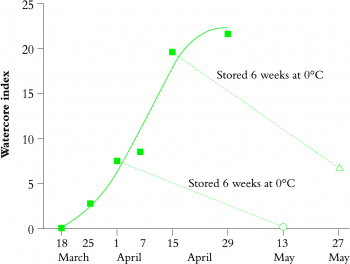
Figure 11.20 Postharvest incidence of the storage disorder watercore in Fuji apple is related to picking date (and thus fruit maturity). Watercore index represents the percentage fruit volume occupied by waterlogged tissue. Fuji is prone to this disorder, especially when fruit are picked mature. Early harvesting thus becomes an important control method.
(Original data courtesy F.R. Harker)
When fruit, vegetable or flower products are put into post-harvest storage, they are on a slow path to senescence and death, and a number of disorders can arise during that time. Several storage disorders have physiological origins, and are often highly specific to species, cultivar, season and even growing region. Fruit maturity at picking is one important factor (Figure 11.20) and four examples of postharvest physiological disorders in apple are listed below to illustrate our partial understanding of the problems that do occur, and to provide a glimpse of a large and complex area of postharvest physiology.
Bitter pit is a brown, bitter pitting of the skin in some cultivars, particularly Cox’s Orange Pippin. It is primarily a response to inadequate calcium content in the skin, and can be greatly reduced by spraying fruit on the tree with calcium-containing solutions during the later stages of fruit development.
Scald is a brown, sunburn-like discolouration of the skin surface, particularly in cultivars like Granny Smith. It appears to be connected with the nature of the cuticular wax and lipids and with the production of free radicals, and can be greatly reduced by application of a ‘free radical mop’ like diphenylamine.
Core flush is a browning of internal fleshy tissues sur-rounding the core of a fruit, and may have more than one cause. One factor seems to be the O2 supply to the core, since conditions potentially causing anaerobiosis (large size, a closed and airtight calyx and a low-O2 atmosphere) increase incidence.
 [4]
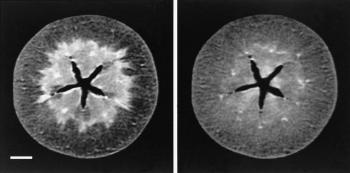
Figure 11.21 NMR images from the equatorial plane of an apple show watercore (waterlogging) as an intense white region. The first scan (left) was taken from a Fuji apple with severe watercore at the time of harvest. The second scan (right) was taken of the same fruit after cool storage for 15 weeks at 0°C, when symptoms had disappeared due to resorption of intercullar water. Scale bar = 1 cm.
(Original images courtesy C.A. Clark)
Watercore is a condition where there are glassy, water-logged sections of tissue towards the centre of the fruit, typically centred around the vascular bundles. Severe watercore leads to anaerobiosis, development of fermentation flavours, and core browning similar to core flush. Fuji is an especially susceptible cultivar. Watercore is more severe in sweet fully mature fruit (Figure 11.20) and involves a breakdown in transport of sorbitol across cell membranes. As outlined earlier (Section 11.3.3) sorbitol is the main soluble carbohydrate supply for early growth in apple fruits. Unlike other storage disorders watercore becomes less severe or even disappears during storage (Figure 11.21) presumably because pericarp cells eventually resorb intercellular water and sugar and allow airspaces to reform.
Links:
[1] http://plantsinaction.science.uq.edu.au/edition1//?q=figure_view/553
[2] http://plantsinaction.science.uq.edu.au/edition1//?q=figure_view/554
[3] http://plantsinaction.science.uq.edu.au/edition1//?q=figure_view/555
[4] http://plantsinaction.science.uq.edu.au/edition1//?q=figure_view/556