
 [1]
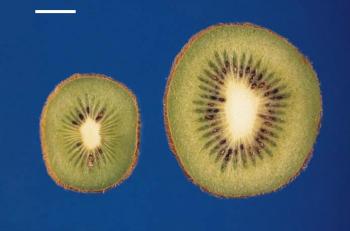
Figure 11.1 Poor pollination (left) compared with normal pollination (right) influences seed number and hence kiwifruit development. A fully pollinated fruit carries at least a 1000 seeds spread more or less evenly lengthwise, and in about 35 locules around its circumference. Faulty pollination causes big disparities in seed number per locule (from around 30 to near zero). There is a corresponding change in relative development of adjacent tissues. Scale bar = 1 cm.
(Photograph courtesy of M. Heffer and R.L. Bielski)
Pollination, followed by pollen tube growth and fertilisation, instigates fruit growth (Figure 11.1). If pollination does not occur, flowers are shed (only rare exceptions). Nevertheless, a developmental program of gene expression for fruit growth has already been established well ahead of floral biology. Primordia may have been initiated up to six months before a particular flower opens, and ovary development continues during flower growth with ovary tissues forming late in this process. As part of that outcome, homology between leaves and sepals is noteworthy and evident in many fruits (Gillaspy et al. 1993). Sepals show leaf-like cell layers, stomata and chloroplasts.
The generic term ‘fruit’ covers a wide range of structures, all supporting and protecting seeds, but where the various parts have developed from the original fertilised flower in various distinctive ways. In the simplest form, ovary walls grow along with seeds, and as they develop, the ovary walls dry out to become a pod (legume) or capsule (poppy). In others (particularly fleshy fruits), the main structure can arise by exaggerated development of a particular part of the original floral unit. These include ovary wall or central axis, the receptacle that supports anthers and ovary, or even petals and sepals. In morphological terms, fruits are structures that develop from fertilised or stimulated ovules, plus associated floral parts that originate from the parent plant.
Mechanistically, a fruit is a single dispersal unit which includes seeds and associated tissues, developed as a single body. This broad description includes structures derived from a single ovary (as in simple fruits such as apple, avocado and mango) as well as compound fruits where separate ovaries are joined (an aggregate fruit such as blackberry and cherimoya) or where separate flowers are collected into a single structure (pineapple and breadfruit). A detailed discussion on fruit structure and classification is given in Spjut (1994).
During fruit development, an ovary wall becomes a pericarp: either dry as in a dehiscent pea pod and the indehiscent caryopsis of barley, or fleshy as in berries (grapes). Three morphologically distinct strata are present and developed to varied degrees: exocarp (fruit skin), mesocarp (fruit flesh) and endocarp (inner cell layers).
An exocarp will develop a cuticle and may exhibit a variety of morphological features such as coarse hairs (kiwifruit) or fine hairs (peach). Exocarp plus cuticle restrict gas exchange, and determine general appearance of ripening fruit. Most cuticles are highly impermeable to gases, so that water vapour, O2 and CO2 diffuse mainly via either stomata or lenticels or by mass flow through cavities at the calyx and stem ends of fruit.
Mesocarp tissues usually represent the fleshy part of a fruit, and commonly hold chloroplasts and starch grains. In fleshy fruits such as berries (e.g. tomato, kiwifruit and grapes) this tissue typically comprises large parenchyma cells and contains the main vascular network.
Endocarps are less common, but typically develop as a dense hard case around a seed, as in peach, apricot or macadamia.
An ovary must be stimulated in some way for fruit growth to occur; this is normally by pollination and fertilisation. This important principle was established as early as the 1960s when Nitsch and others (Sections 9.2.2, 9.3.1) showed that gibberellins and auxins are involved in the pollination stimulus. Subsequent hormone production by the fertilised ovary is critical to stimulating fruit development (Nitsch 1970).
By implication, a suitable balance of growth regulators applied to unpollinated fruitlets can result in fruit set, and in practice gibberellins GA4 and GA7 are very effective in setting parthenocarpic (seedless) apple fruit (Dennis 1986). By contrast, parthenocarpy is rare in kiwifruit, although repeated appli-cations of napthaleneacetic acid (NAA) with benzyladenine (BA) and gibberellin have been successful (Hopping 1986). Such results confirm that growth regulators — alone or in combination — can trigger cell division in ovaries or related tissues that ultimately become fruits.
Seedless fruits have arisen via human selection of genotypes in which ovaries produce an adequate supply of growth regulators without any stimulation from the germinating pollen and developing seed (triploid banana), or where fertilisation is closely followed by seed abortion (stenospermocarpic, as in sultana grapevines; see Chapter 11 frontispiece). In the absence of pollination, levels of endogenous hormones such as auxins and gibberellins normally fall markedly (Nitsch 1970) and flowers abscise or fruitlets stop growing. The molecular signals responsible for this reduction are still not known.
Links:
[1] http://plantsinaction.science.uq.edu.au/edition1//?q=figure_view/526