
Plant growth regulators (PGRs) are a diverse group of chemicals classified by their ability to modify plant development and/or biochemical processes. They include not only the native plant hormones already discussed and their synthetic analogues, but also many other compounds that influence hormone phy-siology, especially inhibitors of hormone biosynthesis and compounds that block hormone action, perhaps by interfering with receptor binding.
From the preceding sections, it is clear that hormones are multifunctional, and responses depend on dose, site of ap-plication and developmental stage. In theory at least, we have the potential to influence almost any developmental process, and over the past 60 years probably just about every PGR on the shelf has been tried out. Controlling plant height, inducing flowering, increasing fruit numbers, generating seedless fruit, inducing seed germination — all worthy aims often with commercial success as reward for the ‘successful’.
But all is not so simple. For every 100 attempts, probably only one becomes regular practice in agriculture or biotechnology. Why? The multifunctionality, the variability of response between genotypes, between tissues of different age, modification of response by environmental factors — all these can thwart the best planned strategy even with the ‘right’ dose, timing and placement on the plant. In pharmacological terms, the side effects are often stronger and more undesirable than the targeted response. Here we select a few examples which have found commercial application.
 [1]
Figure 9.13 The effects of paclobutrazol, an inhibitor of gibberellin biosynthesis, on shoot growth and flowering of poinsettia, a popular ornamental pot plant. The treated plant on the right has shorter internodes, darker green leaves and slightly enhanced flowering, all characteristics of gibberellin depletion.
(Photograph copyright © ICI Australia, reproduced with permission)
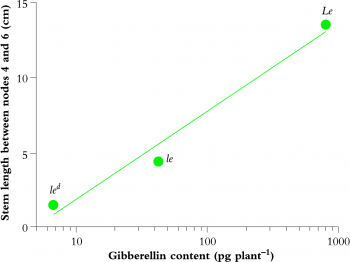
Gibberellins are well known for effects on dormancy, germination, flowering and fruit development, but one of their most studied roles is in modifying stem elongation. This is a ‘rate’ process rather than an ‘all-or-nothing’ on/off switch, so we predict graded changes in cell growth rates as gibberellin concentrations are modified upwards or downwards. The tools are gibberellin mutants (deficient either in the capacity to pro-duce active gibberellins or the capacity to respond to them; see Section 9.3.2), several gibberellins available in commercial quantities, and several compounds that more or less specifically inhibit gibberellin biosynthesis (Figure 9.13). Thus we have possibilities of examining the effects of genetically or chemically altering gibberellin levels. The almost universal result is that plants with low gibberellin concentrations end up shorter (more dwarfed) than those with higher levels. There are limits to the range over which this applies, that is, there is a ceiling growth rate beyond which no response is elicited by extra gibberellin, but in the best-studied examples, such as pea, the classic log dose–linear response relationship seems to hold quite well (Figure 9.14).
 [2]
Figure 9.14 Genetic and hormonal control of development are illustrated by the relationship between active gibberellin content and internode length in pea genotypes with different alleles at the Le locus, a gene which encodes an enzyme for synthesis of bioactive GA1. The wild-type Le has a normal enzyme and a tall stature, le is dwarfed with almost no enzyme activity. Note the linear relationship between internode length and log of gibberellin content, showing a very wide range of concentrations over which the plant can detect gibberellins. This graph is similar to the classical 'dose-response' plots used in early hormone research to test biological activity of exogenously applied compounds.
(Based on Ross et al. 1989)
One highly desirable characteristic in most fruit crops (though not in nut crops!) is seedlessness. This occurs spontaneously in banana because of its triploid genotype, and in certain kinds of citrus because of early embryo abortion. In some mandarin types, an auxin spray before or just after bloom induces fruit to set without seeds. In certain grape varieties such as sultana (known elsewhere as Thompson Seedless) the seed starts to develop but then aborts and added gibberellin is required to promote normal fruit development (see frontispiece to Chapter 11). In both cases, the applied hormone is thought to be substituting for what would normally be generated by the growing seed (Figure 9.6). This gives an insight into how fruit and seed development are intimately coordinated. Auxins can cause similar seedless fruit in other crops such as citrus, but later applications can lead to abscission, probably via induction of ethylene synthesis, and are useful for fruit thinning on trees that otherwise tend to bear excessive numbers of undersized fruits.
When a plant breeder or horticulturalist finds a new, potentially valuable plant, the first priority is usually to multiply it. Often the plant may be infertile or progeny may be genetically inferior. It then becomes necessary to use vegetative propagation. Remember that many plant cells have a remarkable property called totipotency (Section 10.2), so almost any fragment of a plant (or explant) can be used to regenerate new genetically identical plants, called clones. The most dramatic advances in plant propagation, resulting in the ability to generate millions from one, are due to tissue culture or micropropagation. Not all plants spontaneously enter into useful forms of regeneration when cultured: indeed most need some form of chemical persuasion. The most powerful control comes from use of two hormones, auxin and cytokinin. Auxin tends to promote cell expansion and, together with cytokinins, induces cell division. On top of these fundamentals of tissue growth, auxin causes cells to become organised, sometimes simply into vascular tissue but more importantly to form roots. Cytokinins on the other hand induce shoot formation. The ratio of concentrations of auxin to cytokinin, as discussed in Section 9.2.2, appears to determine the type of development that ensues.
 [3]
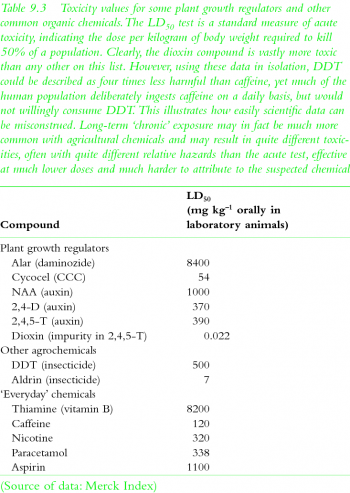
Table 9.3
In addition to the physiological issues, increasing awareness of environmental pollution and potential dangers of exposure to hazardous chemicals have led to critical examination of use of all types of chemicals, especially on food crops. Initial concerns were over pesticides, especially organochlorines, but then spread to include PGRs. A few of these have made news headlines.
The selective herbicide 2,4,5-T (2,4,5-trichlorophenoxy-acetic acid) is a synthetic auxin that kills dicotyledonous (broadleaf) plants but has relatively little effect on grasses (incidentally an excellent example of plants differing in sensitivity to the same dose of hormone), and therefore found widespread use for removing dicotyledonous weeds from lawns and cereal crops. Its inclusion in the chemical warfare substance Agent Orange is notorious, but in fact it was an impurity (a highly carcinogenic dioxin compound) in the commercial preparation which led to worldwide withdrawal of the chemical. 2,4,5-T itself is not particularly toxic (Table 9.3). Preparations of a related compound, 2,4-D (2,4-dichloro-phenoxyacetic acid) contain no dioxins and are still used as herbicides and in plant tissue culture.
Alar, also known as daminozide, is a plant growth retardant which was used widely on apples to modify fruit shape and skin colour. Some evidence in the 1980s suggested chronic toxicity symptoms were attributable to this chemical, and it was rapidly withdrawn from use. Sales of apples, even untreated ones, plummeted at the time, a dramatic example showing how a small amount of scientific data can have massive economic consequences. Subsequent investigations concluded that there were no substantiated toxic effects but, harmful or not, the lasting impression in the general public has meant Alar has not been widely reintroduced (Caswell et al. 1991; O’Rourke 1990). This treatment was never essential for fruit production because it was used mainly for cosmetic changes concerning size and appearance rather than to improve yield or nutritional quality. In general, legal restrictions, safety concerns and public perceptions are leading researchers and agrochemical companies to seek alternative means to achieve the same results, some of which are described next.
A more stable and permanent way to alter plant development is through genetic modification. Essentially we depend on mutations, which can be spontaneous or induced by mutagens (DNA-altering chemicals or high-energy radiation such as X-rays, g-rays or fast neutrons), and genetic engineering, which allows us to remove, add or modify the expression of specific genes. The colossal expansion of genetic engineering since the mid-1980s is the single most remarkable change in biological research, and is covered further in Chapter 10. Here we look at some successes, pitfalls and limitations of plant genetic manipulation of hormonal signalling.
Genes for a few hormone biosynthesis enzymes have been isolated: these include one cytokinin and two auxin genes from plant pathogenic bacteria such as Agrobacterium, whose gall or tumour symptoms on infected plants relate specifically to the extra auxin and cytokinin produced — another example of the delicate hormone balance required for normal development. Plant genes for the two final steps of ethylene biosynthesis (ACC synthase and ACC oxidase; see Sections 9.1.1 and 11.5.6) have been cloned, and there are now reports of isolation of ABA genes (Marin et al. 1996) and some of the many gibberellin biosynthesis genes (e.g. Phillips et al. 1995). There are impressive examples of applications of hormone biotechnology in retarding senescence of cut flowers (Figure 10.41) or controlling rates of ripening in stored fruit, but there are also significant gaps: we do not yet have isolated plant genes for auxin and cytokinin biosynthesis, or auxin- or cytokinin-deficient mutants, which hinders our interpretation of exactly which processes these hormones regulate. One view is that these two hormone classes are so essential to normal organised plants that deficiency would be a lethal character. Alternatively, multiple copies of biosynthetic genes may give plants a backup system for continuing hormone production. In both cases, it is likely to be very difficult to screen for such mutations. A better target might be leaky mutations with only a partial restriction of hormone production. On the positive side, the array of gibberellin-related dwarfs clearly demonstrates non-lethal phenotypic alterations due to single gene mutations. Plants hampered in gibberellin, ABA or ethylene biosynthesis or perception are altered in specific developmental or physio-logical characters, but otherwise develop quite normally and most are reasonably fertile.
Achieving suitably precise control of transgene expression is difficult and severity of mutations is unpredictable, leading to many undesirable phenotypes. For example, a recurring problem has been from overexpression of the IPT gene, leading to high cytokinin levels, which in turn strongly inhibit root initiation and prevent recovery of whole plants from tissue culture. Remembering how tightly regulated plant developmental signals are, there is a pressing need to have suitable promoters, usually developmental stage specific, tissue specific or inducible by simple external factors such as O2 concentration, copper ions or heatshocks, to drive gene expression in the right tissue, at the right time and to the right strength. Often, we have inadequate knowledge of hormone physiology to predict all these variables in advance, so research proceeds in a ‘trial and error’ fashion. Results often provide significant advances in basic understanding, even if the transgenic plants are not commercially useful.
The term ‘billion dollar genes’ has evocatively been given to genes that affect ripening and senescence, because this is a rough estimate of the value of the annual losses that occur worldwide due to fruit becoming overripe or too soft, or flowers wilting or foliage yellowing during the period from harvest to consumer. Most research has targeted high-value, perishable horticultural commodities rather than easier to handle grains and processed products. Since the 1980s, key achievements towards gaining genetic control of postharvest physiology include:
• isolation of the two plant genes necessary for ethylene biosynthesis;
• isolation of one bacterial gene for cytokinin biosynthesis;
• isolation of genes for enzymes catalysing pectin degradation, a major element of fruit cell wall softening;
• the ability not only to insert additional genes but to switch off existing ones with methods such as ‘antisense’ or ‘co-suppression’ technology.
Commercial genetically engineered products have now been released, such as the FlavrSavr tomato, in which the polygalacturonase gene that normally leads to rapid fruit softening has been switched off by antisense RNA (Figure 11.22). Many more products of this type are in development. Tomato was selected as suitable for first trials because it is a major crop around the world and it is in the family Solanaceae which is generally amenable to biotechnology. There are also non-ripening tomatoes that have greatly reduced ethylene biosynthesis in the fruit. These can be ripened by exposure to ethylene gas, but not until they reach the market. Ethylene ‘gassing’ has been used for many years on normal tomatoes, as well as on bananas and citrus.
Carnations have been developed whose flowers do not show the normal rapid senescence, characterised by rolling up and wilting of the petals (Figure 10.41). These either have one of the ethylene biosynthesis enzymes blocked or have the bacterial cytokinin IPT gene inserted, which affects the normal balance of senescence regulation, where ethylene is promotive and cytokinin is inhibitory. Many other ‘valuable’ genes are being sought, such as those which might give a novel flower colour (Figure 10.41), or confer disease or pest resistance without the need for chemicals or lengthy con-ventional breeding programs. Some of these are discussed in Chapter 10.
Agrobacterium tumefaciens, the causative agent of crown gall disease, generates its symptoms and harnesses the plant’s resources by inserting some of its own genes into the host DNA. This natural form of transformation has been exploited in many ways, and Agrobacterium remains one of the most popular means of inserting other genes into plant genomes. Pathogenic transformation involves the Ti (tumour-inducing) plasmid, a circular piece of DNA containing genes, two for auxin and one for cytokinin, necessary for biosynthesis of these two hormones. There are other plasmid genes associated with virulence and amino acid metabolism which we will not discuss here. Once the host is transformed, the bacteria are no longer required and symptoms persist due to the disruptive effect of excess auxin and cytokinin on plant cell devel-opment and organisation, very much akin to the callus seen in tissue culture or around a wound site on an intact plant. Other bacteria carry very similar genes, for example A. rhizogenes, Pseudomonas savastanoi and Corynebacterium fascians (Gaudin et al. 1994). Our notions of the respective roles of auxin and cytokinin in cell organisation are confirmed by experiments where one of the hormone genes has been deleted by mutation. The ‘rooty’ mutant phenotype is due to a non-functional cytokinin gene because preponderance of auxin is a root-inducing stimulus. Likewise ‘shooty’ tumours result from mutation of one or other of the auxin genes, because high cytokinin leads to shoot initiation.
Dwarf mutant plants of pea, rice and maize have helped enormously in defining the role of gibberellins in stem elongation. Many widely used commercial cultivars such as dwarf pea or short straw wheat contain reduced quantities of active gibberellins, or have an inability to respond to gibberellin. From mutations at different loci and alleles of different ‘strengths’, it has been possible to establish the relationship between endogenous gibberellin content and growth in pea (Figure 9.14). This shows a remarkable similarity to the plots of exogenous gibberellin and growth. Internode lengths, the final expression of what was a growth rate, vary linearly with the log of gibberellin concentration. Gibberellin deficiency in Arabidopsis is quantitatively related to stem growth too, but also to seed dormancy and fruit setting: the more severely deficient genotypes require added gibberellin to stimulate normal germination, and then a continued supply of gibberellin to support stem elongation and fruit development. Interestingly, most gibberellin-deficient genotypes are unaffected in time or extent of floral initiation, suggesting either that gibberellins are not involved in flowering control, or that this function is restricted only to some species, or that there are specific gibberellins for flowering that are different from those involved in stem elongation and dormancy.
ABA also appears to have a role in seed dormancy, but one that is to some extent opposite to the gibberellin effect. Tomato, wheat, pea and Arabidopsis mutants deficient in ABA synthesis or ABA response exhibit minimal seed dormancy (Leonkloosterziel et al. 1996; Ooms et al. 1993). Interestingly, added ABA does not usually prolong dormancy, so the role of ABA is probably in the entry into dormancy during seed maturation rather than in exit from dormancy prior to germination. In addition, ABA mutants are very sensitive to water stress because they have poor control over their stomatal apertures, normally an ABA-mediated process. These ‘wilty’ plants have to be nursed in high-humidity chambers to prevent desiccation. Plants with poor drought tolerance are unlikely to be commercially valuable, but they are useful tools for testing the role of ABA in stress physiology. In the future, ABA genes may be manipulated to give enhanced response to or levels of ABA, thus improving stress resistance and water use efficiency, two valuable attributes for cultivated plants in many parts of the largely dry Australian continent.
Links:
[1] http://plantsinaction.science.uq.edu.au/edition1//?q=figure_view/293
[2] http://plantsinaction.science.uq.edu.au/edition1//?q=figure_view/294
[3] http://plantsinaction.science.uq.edu.au/edition1//?q=figure_view/295