
Most plants enter a state of latent life at least once throughout their life cycle. This is dormancy, concisely defined as ‘the temporary suspension of visible growth of any plant structure containing a meristem’ (Lang 1987). It encompasses a wide-spread but remarkable phenomenon and is really a collective term covering a number of processes in different plant organs. This has led to problems with terminology, which Lang resolves into three types of dormancy based on their controlling factors:
These definitions are tailored towards woody perennials, but we are also interested in equivalent phenomena in seeds and vegetative storage organs. Indeed there are underlying similarities, for example in endodormancy release induced by chilling. A dormant bud on a perennial contains reduced leaves and floral and/or vegetative meristems, and relies on the rest of the plant for water and nutrients. A storage organ, such as a bulb or tuber, is also a plant propagule containing meristems (Figure 7.17e) and its own reserves of nutrients. Likewise, a seed contains a whole plant — the embryo — and associated storage reserves. Resumption of bud growth leads to shoot emergence through the bud scales, and seed germi-nation results in radicle then shoot emergence through a protective seed coat. These morphological differences may require variations in the physiological control of dormancy.
Plants are generally adapted to their natural environments but many economically important species are cultivated in other climates. Adaptations are genetically based and may be impossible to switch off, or at least difficult to overcome. Temperate fruit trees, such as peaches, eventually become endodormant even in the tropics. Without chilling or human intervention, they do not resume normal growth and may even die. Generally, though, plants will eventually dispense with dormancy-breaking requirements rather than die, often described as a conversion from an obligate to a facultative state. Although tropical perennials cannot tolerate cold temperate winters, they still exhibit endodormancy phases which alternate with dramatic ‘flushing’ of new vegetative shoots, often with striking red-coloured leaves, as in Syzygium and mango trees. Dormancy may also prevent or retard seed germination or sprouting of bulbs, thus reducing the number, quality and uniformity of plants in a crop.
For most plants, seeds are the primary means of reproduction. Dormancy allows seeds to separate from their mother plant and survive dispersal over distance and time before growth recommences. Developing embryos are growing tissues but enter dormancy late in maturation and seeds then dehydrate. This state of suspended animation enhances chances of survival. The torpedo-shaped seed of a mangrove (Rhizophora maritima) is an exception that germinates while still on the mother plant. When they fall, seed penetrate securely into soft mud flats. This adaptation aids speed of establishment in the unstable tidal zone.
Plant breeders often select seed for uniform, rapid germination but these characteristics are rare in nature. If all seed from a species or population germinated synchronously but was subsequently destroyed, say, by frost, the genome would be lost. Instead, we find that germination is usually staggered over a season or over years. Sometimes it is possible to harvest seeds or embryos before dormancy is induced and thereby germinate otherwise difficult species.
 [1]
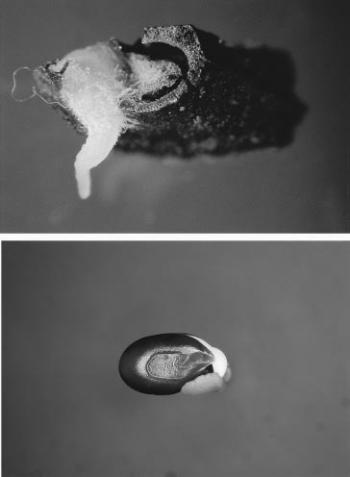
Figure 8.1 Long-lived seeds of species typical of Australian sclerophyll forests. (a) Eucalyptus erythrocorys radicle emerging from capsule; (b) Acacia coriacae with fleshy aril still attached.
(Photographs courtesy P.T. Austin and J.A. Plummer)
There are two main reasons why a seed does not germinate: it may be dead (not viable) or dormant (Mott and Groves 1981; Langkamp 1987). Vital stains can confirm viability of embryos (Bewley and Black 1982). Embryos may never develop due to post-zygotic incompatibility (Section 7.2.4), may abort during development or may die after seed dispersal. Endodormant or paradormant seed may be viable, but may not germinate even when supplied with water and O2 at an appropriate temperature.
Seed longevity often relates to a species’ natural environ-ment. In climates favourable for germination, many species have seeds which remain viable for only a few days, for example the Queensland umbrella tree (Schefflera actinophylla), which originates in subtropical rainforests, or a few months, for example water gum (Tristania laurina) and myrtle beech (Nothofagus cunninghamii), which come from cooler rainforests. In contrast, seed from sclerophyllous forests, such as Eucalyptus and Acacia (Figure 8.1), remain viable for many years.
There are two categories of seed, recalcitrant and orthodox, and appropriate storage can vastly extend longevity of both. Many tropical and subtropical species, such as Citrus, mango and rambutan, have recalcitrant seeds; these are not desiccation tolerant and survive best if stored at high water content (30%) and warm temperature (usually >15°C). Orthodox seeds, such as Eucalyptus and Brassica, are usually stored below 10% water content and below 10°C. Between these extremes are many intermediates, and optimum con-ditions for several important crop species have been deter-mined by empirical experiment. For example, wheat is best stored at 14.5% seed water content, peas at 14.0% and clover at 11.0%.
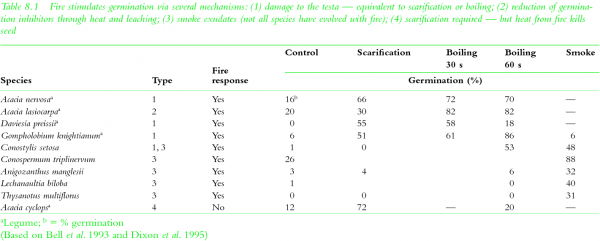
Cells of some testas have hard, thick walls and a waxy layer which prevents imbibition (uptake of water) and sometimes even gas exchange. Dormancy persists in the absence of water or O2 essential for germination. Seed-coat-imposed dormancy is a special case closely related to paradormancy of perennials. Seed coats resist embryo expansion but plant tissues can exert substantial turgor pressure, so mechanical resistance is not a common form of dormancy. Roses have a very hard seed coat with several sclerified (stony) cell layers and great pressure is required to break them. Hard seeds are found in many families and are particularly common in legumes such as Fabaceae (e.g. clover (Trifolium) and lucerne (Medicago)), Mimosaceae (e.g. Acacia) and Caesalpiniaceae (e.g. Cassia). The seed coat exerts force on the strophiole, a plug-like valve structure near the hilum with elongated malphigian cells that separate to permit water entry. These seed coats need to be weakened physically or chemically to permit imbibition. This may occur naturally as a result of temperature fluctuations, abrasion and microbial or insect damage. Artificial scarification is often achieved by scratching, nicking or by rotating seeds in barrels containing an abrasive. Alternatively, seed can be chemically scarified with concentrated H2SO4, which mimics the effect of acid in the stomach of animals. In many parts of Australia spontaneous fire is common and destroys most living tissue but enables germination of many hard-seeded native species (Table 8.1; Bell et al. 1993). In these plants, brief seed boiling is commonly substituted to effect break of dormancy. Heat from fires will damage the testa, but smoke, perhaps via ethylene and/or sulphur compounds (Dixon et al. 1995), is also effective in overcoming other dormancy mechanisms. In serotinous plants, such as Hakea, Banksia and Eucalyptus, seeds are stored on the mother plant until fires open the woody fruits, dispersing the seeds into the nutrient-rich ash bed when competition for light from other plants has also been reduced (Chapter 19).
 [2]
Germination inhibitors can be present in the embryo, endosperm, testa or the surrounding fruit tissues. Inhibitors present in seed of Iris, freshly harvested hazelnut (Corylus avellana) and desert ephemerals, and in fleshy fruit such as tomato, Persoonia and Lomandra, must be removed or in-activated before germination can proceed; this often happens inside an animal gut or by rain leaching.
 [3]
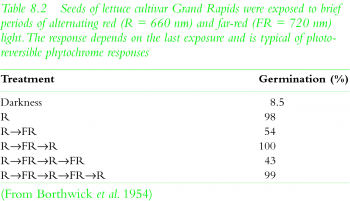
Many species germinate in response to light, but usually only become light sensitive after imbibition. Germination of Grand Rapids lettuce (Lactuca sativa), the weed species Bidens pilosa, some Australian daisies and many other small-seeded species is promoted by red light (R; 660nm) but inhibited by subsequent exposure to far-red light (FR; 730nm) — a classic photoreversible phytochrome response (Table 8.2 and see Section 8.4). Sunlight has a high R:FR ratio which signals to a seed that it is located in an unshaded position. However, chlorophyll in leaves filters out red light so that under a canopy there is relatively more far-red light; that is, a low R:FR ratio prevents germination where light quantity is likely to be insufficient for most species. These seeds use light spectral composition as an indicator of likely total photosynthetic radiation. This is an example of secondary dormancy because it is induced only after seed dispersal (seed that is dormant when shed from the mother plant has primary dormancy). Seeds may lie dormant for months or years, germinating only when a tree falls in a forest or after a disturbance such as ploughing a field. In the latter case, phytochrome is being used mainly to sense light quantity. Deep burial in soil prevents germination of small seeds with inadequate resources to grow to the surface. In contrast, germination of Spinifex hirsutus, which grows on sand dunes, is inhibited by light. Dark con-ditions exist deeper in the dune where there is likely to be more moisture, nutrients and stable sand.
 [4]
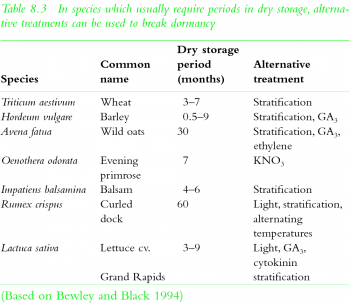
Many seeds will not germinate unless water content has been reduced by dry storage. This is a common adaptation in desert annuals, which experience a seasonal rhythm of water availability. In cereals such as barley and wheat, alternative treatments can be substituted (Table 8.3). Some seeds, for example Ranunculus and orchids, contain rudimentary embryos that must develop further before germination can occur. Symbiosis with a fungus supports embryo growth of many orchids, and inoculation is incorporated into in vitro propagation methods.
Stratification, or pre-chilling, the exposure of seeds to cool moist conditions, is in many ways similar to chilling of buds (see below). The optimum temperature is usually about 5°C for temperate species such as peach (Prunus persica) and apple (Malus sylvestris). Embryos removed from freshly harvested fruit can germinate but growth is slow and abnormal. Normal growth is restored by chilling or exposure to long photo-periods, conditions which seeds in nature would eventually experience. In Australia and New Zealand, many alpine species require stratification. Eucalyptus pauciflora seeds col-lected from high altitudes respond to chilling but those of coastal populations do not, suggesting that natural selection has occurred, creating two ecotypes. For tropical species, chilling may operate at a higher temperature range, usually above 10°C.
Single or multiple dormancy mechanisms can ensure germination at an appropriate time, depending on the species (Table 8.3). Despite all the complex entrainment to en-vironmental cues, many seeds will eventually germinate even without their normal signals, a failsafe mechanism ensuring some attempt at establishment before the seed’s longevity expires.
Ancestral wild wheats, the progenitors of modern bread and pasta wheats, were endemic to the eastern Mediterranean and possessed a number of mechanisms, including grain dormancy, which were requisite to their survival in that environment. Grain which ripened before the long, hot summer remained dormant, avoiding germination in response to chance rain, until the return of cooler, more rainy periods later in the year. Wheat is now cultivated worldwide in diverse environments, many of which have a high risk of rain and cooler weather during the harvest period. Unfortunately, during domestication and genetic improvement many of the mechanisms which reduced untimely germination have been inadvertently discarded or found to be incompatible with the requirements of large-scale commercial farming. Indeed, the relationship of grain dormancy to consistent grain quality has not always been taken advantage of by breeders.
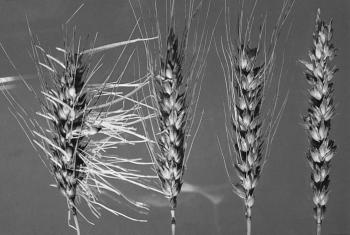
In the absence of protective mechanisms, rain falling on ripe wheat crops may induce preharvest germination of grain (Figure 1), rendering it unsuitable for commercial pro-cessing. Sprouted grain in Australia has resulted in losses to growers of hundreds of millions of dollars. Breeders are there-fore looking to reintroduce factors such as dormancy into new wheat cultivars to provide ‘insurance’ against preharvest rain. After first searching for dormancy characters in older cultivars held in the world wheat collections, the next hurdle is to transfer dormancy to elite cultivars which already possess all the other required agronomic, quality and disease-resistance characters.
 [5]
Figure 1 Lack of dormancy can lead to preharvest sprouting in wheat. Ripe spikes were subjected to a wetting treatment – an overhead spray for 2h – then maintained at high humidity and 20oC for 5 d. The spike on the left is from a susceptible non-dormant cultivar which sprouted readilty compared with three other more dormant, sprouting resistant cultivars.
(Photograph courtesy D.J Mares)
There is a well-known association between red seed coat and dormancy, but white-grained genotypes with significant levels of dormancy have also been identified (Mares 1987). To date, the dormancy from red wheats has not been successfully transferred, in its entirety, into a white-grained background. Red-grained wheat cultivars dominate world production except in Australia where only white-grained genotypes are cultivated. Dormancy in both grain types is a transient character which develops during desiccation of the maturing grain, then decays with time after ripeness. Dormancy appears to be deepest if the grain has ripened in a cool environment but can be eroded by rain in the 20 day period leading up to harvest ripeness (Mares 1993). To rank genotypes for potential depth of dormancy, all lines need to be grown in the same environment and tested at the same stage of maturity using standard wetting treatments or germination tests.
Dormancy in wheat grains is dependent on the presence of an intact seed coat. Damage to this structure through invasion by fungal pathogens, disruption during swelling and shrinkage caused by wetting/drying cycles or through physical abrasion during threshing results in a loss of dormancy. Segregation patterns obtained in inheritance studies are consistent with control by two independent, recessive factors and indicate that dormancy is only recovered when both factors are present simultaneously. With simple Mendelian segregation, dormancy would have been expected in the F2 generation. However, dormant segregants were not revealed until the F3, one generation later than expected. From this, we can infer that at least one of the factors is probably expressed in the seed coat which lags one generation behind the embryo.
Mares, D.J. (1987). ‘Preharvest sprouting tolerance in white grained wheat’, in Fourth International Symposium on Preharvest Sprouting in Cereals, ed. D.J. Mares, 66–74, Westview Press: Boulder, Colorado.
Mares, D.J. (1993). ‘Preharvest sprouting in wheat. 1. Influence of cultivar, rainfall and temperature during grain ripening’, Australian Journal of Agricultural Research, 44, 1249–1272.
 [6]
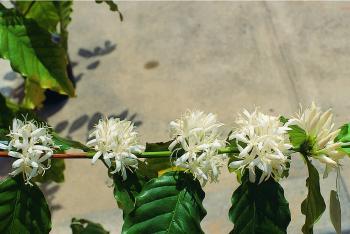
Figure 8.2 Synchronised anthesis of coffee (Coffea arabica), 10 d after restoring water supply to droughted trees. Endodormancy in coffee flower buds is broken by water stress, then buds remain in an ecodormant state until rain permits resumption of growth. This adaptation allows fruit development to coincide with periods of water availability. In cultivation, a drying-irrigation cycle can synchronise flowering which later leads to a shorter harvesting period.
(Photograph courtesy C.G.N. Turnbull)
Much of our knowledge of bud dormancy comes from temperate deciduous trees, especially fruit crops such as apples and stonefruit. Trees detect environmental signals, mainly shortening daylength and cold, which herald winter and trigger reductions in growth rate, onset of endodormancy, development of bud scales and leaf fall. As buds enter endo-dormancy, warm temperatures (>15°C) no longer promote growth. Several weeks or months of chilling (0–12°C) are required to overcome endodormancy. The plant then enters ecodormancy, when it will respond to warm temperatures with bud break. Note that break of endodormancy can therefore often occur weeks prior to growth resumption. In some tropical species such as coffee, water stress is an alter-native cue for breaking flower bud endodormancy (Drinnan and Menzel 1994). Buds then exist in an ecodormant state ready to respond by rapid floral growth as soon as the first rains fall at the end of the dry season (Figure 8.2).
Several models have been proposed to describe dormancy and to attempt to predict responses to different growing con-ditions. One problem is a lack of measurable indicators of endodormancy other than an inability to grow. Researchers typically quantify ‘depth’ of dormancy by the duration of chilling required to break dormancy, and then the ability of warm temperatures to ‘force’ bud growth on cut shoots, that is, after removing possible causes of ecodormancy and paradormancy. Entry into and exit from bud dormancy are often gradual transitions rather than abrupt events. Some researchers have represented these phases as sine wave oscillations, with measurable reference points (e.g. peak growth rate in summer and maximum dormancy in midwinter) which enable comparison of data from different sites (Fuchigami and Nee 1987).
 [7]
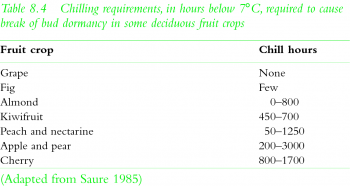
Table 8.4
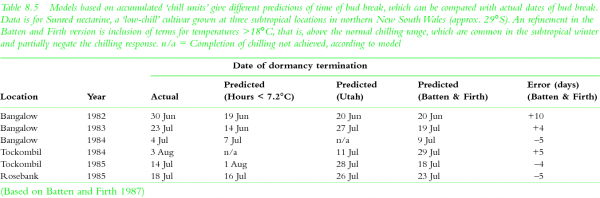
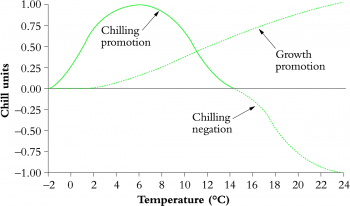
Temperate fruit crops are increasingly being grown at lower latitudes (15–30°) than where they originate (30–50°). If endodormancy is still being overcome by chilling, then how little chilling is enough? A good model can allow estimation of whether a new location is suitable for production of particular fruit varieties prior to expensive orchard planting. For example, peach and nectarine varieties have been bred with low and high chilling requirements, suited to subtropical and temperate climates respectively. Early models resulted in rankings based on number of chill hours (usually below 7.2°C). Chilling required can vary from less than 50 h below 7.2°C for some subtropical ‘low-chill’ peach cultivars, up to 3000 h for some cultivars of pear (Table 8.4). A modified version, called the Utah model, equates a chill unit to 1 h at 6°C; higher and lower temperatures between 0–15.9°C have proportional positive effects, but temperatures above 16°C are inhibitory (Richardson et al. 1974). This temperate model is less accurate in warmer areas where the Erez et al. (1988) model, as modified by Batten and Firth (1987), often provides a more reliable estimate of date of budburst (Table 8.5). According to this model, effectiveness of chilling is enhanced by day temperatures of 15°C or less but negated by temperatures above 18°C. None of these models quantify the growth-permitting periods of warm temperature required for subsequent bud break, so an additional measure quantifies thermal units: the Growing Degree Hour where 1h is allocated for each hour and degree above 4.5°C (Figure 8.3).
 [8]
Table 8.5
 [9]
Figure 8.3 In many species, progress through bud dormancy then resumption of growth depends on temperature. Two factors are involved: first, the satisfaction of chilling requirements depends on suitable periods at low temperature (measured as chill units), but can be negated by temperatures about 15°C; second, temperatures above 4.5°C have a growth-promoting effect, measured as thermal units.
(Based on Seeley 1996)
What are the consequences of insufficient chilling, and are there alternative treatments? Symptoms of inadequate cold periods include delayed and weak leaf growth, delayed and protracted flowering, poor fruit development and irregular ripening. Potassium nitrate (KNO3), thiourea and especially hydrogen cyanamide are simple chemicals that are effective substitutes for stimulating uniform budburst. The mechanisms by which these compounds work are not known, but growth regulators such as gibberellins, cytokinins and cytokinin analogues, in particular thiadiazuron, can also cause similar responses.
Apples are grown in the tropical and subtropical areas of Indonesia, peaches are grown in Venezuela and table grapes are grown in Thailand, Venezuela and southern India where no chilling occurs (Subhadrabandhu and Chapman 1990). Growth of buds is stimulated by chemical (sodium chlorate, copper sulphate or urea) or manual defoliation or pruning immediately after harvest thus breaking endodormancy before it enters its ‘deep’ midwinter phase. Cyanamide treatment has enabled out of season production of table grapes in tropical Queensland. Irrigation then promotes uniform budburst and cropping under otherwise dry conditions. At least two harvests are possible each year and cycles can be staggered, giving almost continuous fruit supply.
Currently we know more about the environmental factors that influence dormancy than about the physiological mechanisms of dormancy. Here we attempt to draw together common features of the diverse types of dormancy in buds and seeds, in particular examining whether inability to grow relates to hormonal factors (Dennis 1994).
Links between genome and physiological processes are illustrated by single-gene seed dormancy mutants, which are either abscisic acid (ABA) deficient (weak dormancy) or gibberellin deficient (extra-deep dormancy) (Karssen and Groot 1987). Induction of seed dormancy is clearly linked to ABA, and gibberellins are required for germination, so in a gross sense these hormones need to be present for normal processes to proceed. Applied hormone experiments lead to similar conclusions: although ABA does not usually prevent break of dormancy, it can inhibit germination and bud growth, often opposing the effects of gibberellins, cytokinins or ethylene. Seeds with various dormancy mechanisms may respond to one or more plant growth regulator (Table 8.3), but there are many reports of germination failure or abnormal seedlings. Light requirement of lettuce and dry storage requirements of barley are overcome by applied gibberellins, but antagonised by applied ABA. Likewise, budburst in peach and apple is promoted by a mix of gibberellin and cytokinin, but inhibited by applied ABA. Cytokinins promote some germination in lettuce but are less effective than gibberellins in most species. Ethylene stimulates germination in celery (Apium graveolens), peanut (Arachis hypogea) and cocklebur (Xanthium strumarium). One conclusion is that a complex balance of inhibitors and promoters regulates entry to and exit from dormancy. Put another way, there are at least two control points and meristem growth may be prevented by either high concentrations of inhibitors or insufficient promoters.
 [10]
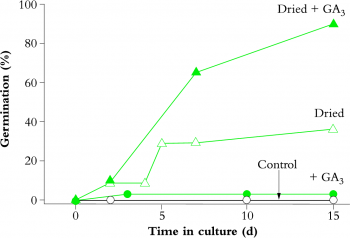
Figure 8.4 Responsiveness of sunflower embryos to applied gibberellin (GA) is seen only when dormancy has been partially released. Embryos were cultured on 5 µM gibberellic acid (solid symbols) or control medium (open symbols), before (circles) or after (triangles) a 3 d drying treatment which partially broke the endodormancy.
(Based on Le Page-Degivry et al. 1996)
 [11]
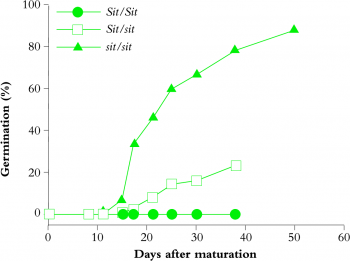
Figure 8.5 Vivipary in wild-type tomato (Sit/Sit, i.e. ABA-synthesising) and ABA-deficient tomato (sit/sit). No seeds germinated within ripe tomato fruits derived from self pollinated Sit/Sit plants. Juice of ripe Sit/Sit fruits contains 0.84 µM ABA and each seed contains 7 pmol ABA. In contrast, vivipary occurred in most sit/sit tomato fruits which have only 0.08 µM ABA and 0.8 pmol ABA per seed. Self-pollinated Sit/sit plants would contain seed of both phenotypes but the mother plants possess the dominant Sit, allowing ANA synthesis. A quarter of the seed (those carrying Sit/Sit and Sit/sit) would not be.
(Based on Groot and Karssen 1992)
However, data on endogenous plant hormone concen-trations do not always support the notion of control by changes in levels of active substances. Quantities of applied plant growth regulators required to cause a response usually vastly exceed normal endogenous content, for example the amount of applied gibberellin required to stimulate barley germination. Rightly, this has led to re-examination of the control mechanisms. Trewavas (1982) argued that tissue ‘sensitivity’ to hormones, that is, capacity to respond, changes with development and environmental stimuli, and that this sensitivity is a major controlling factor. Indeed, phases of sensitivity and insensitivity to applied gibberellins and ABA appear to operate during development, dehydration and dry storage of sunflower seed (Figure 8.4). Other supporting evidence comes from gibberellin- and ABA-insensitive mutants which fail to respond to these hormones regardless of endogenous or applied concentration. Alterations in hormone levels due to mutation are generally much more severe than changes that occur in wild-type plants as a consequence of environmental factors. ABA-deficient tomato (Figure 8.5) and Arabidopsis mutants fail to enter normal dormancy because of a lack of increase in embryo ABA. Surrounding seed tissues absorb most applied ABA without translocating it to the embryo, which may also explain failure of seed dormancy induction with applied ABA.
So what is the role of ABA in induction of seed dormancy? In late embryogenesis, ABA concentration increases as water potential decreases. Elsewhere in the plant, responses to altered water potential are also mediated by ABA, typically those associated with water stress (see Section 9.3). ABA alters transcription of a suite of genes, resulting in cessation of synthesis of reserve and other proteins, and modified transcription of some Lea genes (late embryogenesis abundant; see Chapter 10). In cotton, one class of Lea mRNAs increases coincidentally with ABA but another class responds only to drying. Lea genes code for a class of proteins found in many species including cotton, pea and cereals. These proteins are strongly hydrophilic, highly stable and are able to maintain a locally water rich environment at the subcellular level. This may be critical in desiccation tolerance associated with the dormant state.
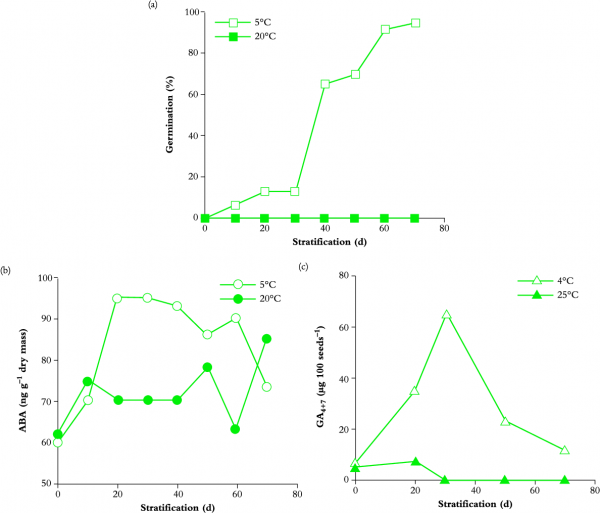
There is a tenuous association of endogenous inhibitors with release (as distinct from induction) of bud or seed dormancy. Early research suggested a close correlation of progress of dormancy with inhibitors including phenolics such as naringenin in peach and phloridzin in apple, and ABA in several fruit crops. However, endogenous ABA declines in chilled apple buds which burst to produce new shoots, but also in buds never exposed to chilling temperatures which remain dormant. In both chilled and non-chilled apple seeds, ABA levels do not change more than two-fold but only chilled seeds germinate (Figure 8.6). ABA content is similar in dormant and non-dormant wheat but ABA-responsive genes are more abundantly expressed in dormant wheat seeds, implying existence of alternative regulatory factors and perhaps non-transcriptional control of the relevant genes. Embryo endodormancy may therefore be maintained by ABA in only a few species, such as sunflower (Helianthus annuus), where treatment of dormant excised embryos with fluridone, an inhibitor of ABA synthesis, results in growth.
 [12]
Figure 8.6 Endogenous gibberellin and ABA levels during breaking of dormancy in apple seeds exposed to cold (4-5°C) or warm (20-25°C) temperatures. (a) Germination is dependent on cold treatment. (b) Embryoabscisic acid levels do not decline during cold treatment. (b) Embryo abscisic acid levels do not decline during cold treatment or during germination. (c) Seed gibberellin (GA4+7) levels increase transiently as seed start to germinate.
(Based on Subbaiah and Powell 1992 and Halinska and Lewark 1987; reproduced with permission of Kluwer Academic Publishers)
 [13]
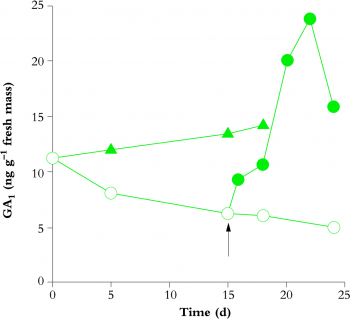
Figure 8.7 Bud dormancy in Salix pentandra is broken by long days, and results in a transient increase in active gibberellin (GA1) content of shoot tissue within one day of transfer from short days to long days (●). Arrow indicates day of transfer. Plants in continuous long days ( ) or short days (O) show only slow changes in gibberellin levels.
(Based on Olsen et al. 1997)
Can we instead assign control of dormancy break to promotive compounds? Gibberellins are probably the best candidates, based on widespread responses to applications of this class of hormone. In Salix pentandra, where short days induce dormancy and long days release it, a transient increase in active shoot gibberellin (GA) content is detectable within one day of transferring from short days to long days (Figure 8.7). In hazelnut, endogenous gibberellins are not modified by chilling but GA1 content rises 40-fold after transfer to warm conditions suitable for germination, suggesting a role in growth promotion as distinct from dormancy release. Like-wise, in wild oats (Avena fatua), ‘after ripening’ dry storage releases seed dormancy but has no effect on endogenous gibberellin levels until imbibition, when gibberellin bio-synthesis is substantially enhanced. Light requirements can often be replaced by applied gibberellins, and gibberellin-biosynthesis inhibitors can prevent light-stimulated germi-nation. Endogenous gibberellins increase with chilling and dry storage in Arabidopsis, and with light exposure in lettuce. Gibberellin-deficient Arabidopsis mutants do not germinate unless gibberellin is supplied, and this response is independent of ABA content. However, changes in endogenous gibber-ellins in wild-type Arabidopsis are less conclusive, suggesting that altered gibberellin sensitivity may contribute to normal germination control. We are just beginning to understand tissue sensitivity and hormone signal transduction pathways (Section 9.3.1). To conclude, there are some species where there is good evidence for ABA-induced dormancy and gibberellin promotion of meristematic activity but these are not necessarily universal mechanisms. Hormone turnover, conjugation, compartmentation, receptors and signal trans-duction systems all represent potential control points, and all merit greater attention.
The hormonal models described above have limitations and some researchers contend that they represent oversimplifications of a complex set of interactive cyclic processes including organogenesis, internode elongation and bud leaf expansion (Crabbe 1994). Biochemical markers such as nucleic acid metabolism and membrane permeability, rather than morphological or physiological characteristics, can also indicate relative depth of dormancy between tissues and organs, and between meristems and submeristems. Adenylic nucleotides are required to maintain basal metabolic activity and even dormant tissues supplied with adenosine increase their adenylic nucleotide (ATP) content. During dormancy break in buds of Helianthus tuberosus (Jerusalem artichoke) tubers, levels of both adenylic and non-adenylic nucleotides (NATPs = sum of guanylic (GTP), cytidylic (CTP) and uridylic (UTP) nucleotides) rise as tissues convert ATPs to NATPs, which are essential to sustain growth (Gendraud 1977).
In stems, trunks and developing tubers bearing dormant buds, storage parenchyma acts as a strong sink during metabolite accumulation while nutrient movement into bud meristems may be impeded. Breaking dormancy appears to remove this block and is part of the changes that permit resumption of growth. Water status also influences dormancy. Dormant seeds and sometimes buds have lowered water content which limits metabolism and often assists survival (Vertucci 1989; Faust et al. 1995). Metabolic activities for growth require free water (bulk cellular water) but cannot occur in the bound water associated with macromolecular surfaces. Water content therefore determines the possible types of reactions: at low seed water content (0–8%) only catabolic and non-enzymatic activity occurs, but >25% water content is required for integrated processes such as mito-chondrial electron transport and protein synthesis. Water content also determines the ability of seeds to perceive and respond to environmental cues. Apple seeds become sensitive to chilling temperatures only if hydrated to >8% water content, and many seeds such as the weedy coloniser species Bidens pilosa acquire light sensitivity only after imbibition.
Water content in bud tissue is generally higher and varies less but may still have a regulatory function. The state of water has been visualised in vegetative buds by using nuclear magnetic resonance imaging. Free and bound water content correlate strongly with bud dormancy release and chilling in low- and high-chill cultivars of apple, Anna (400–700 chill units, typical of subtropical regions) and Northern Spy (2600–3600 chill units, typical of the temperate zone). Very little free water (about 30%) is detectable in bud meristems at the beginning of endodormancy, but this increases to 70–80% after 400h at 4°C in Anna and 3000h in Northern Spy. Seed germination also requires free water, with metabolic activity suppressed in seeds having a water content below 30%. High osmotic potential of tomato fruit tissues may be partly responsible for seed dormancy by keeping seed water content low during late stages of development. With the exception of hard-coated species, most dormant seeds hydrate easily but this does not necessarliy lead to immediate germination.
Dormancy remains an intriguing but complex phenomenon. Clearly, plants are well attuned to making use of environ-mental cues. The ability to enter a period of latent life is remarkable in itself, all the more because plants in effect an--ti-cipate adverse conditions before their onset, and thus dormancy can be established in advance. However, there is no single hypothesis to account for induction, maintenance and breaking of dormancy which is consistent across all species. Interactions of many metabolic and cellular processes with many genes are probably linked to hormonal signals. We need to appreciate more that hormonal control is intrinsically complex, and directly and indirectly influences genome expression, while mediating some environmental cues. Dormancy is a prime example of genotype × environment interaction. Plants use external signals to time entry into a ‘shutdown mode’ (endodormancy, paradormancy), then transition to a ‘standby mode’ (ecodormancy), but have internal controls to prevent inappropriate exit, instead fore-shadowing future favourable conditions. Continuing studies with single-gene mutants and transgenic plants (Chapter 10) should unlock some of dormancy’s secrets.
Links:
[1] http://plantsinaction.science.uq.edu.au/edition1//?q=figure_view/263
[2] http://plantsinaction.science.uq.edu.au/edition1//?q=figure_view/265
[3] http://plantsinaction.science.uq.edu.au/edition1//?q=figure_view/267
[4] http://plantsinaction.science.uq.edu.au/edition1//?q=figure_view/268
[5] http://plantsinaction.science.uq.edu.au/edition1//?q=figure_view/516
[6] http://plantsinaction.science.uq.edu.au/edition1//?q=figure_view/517
[7] http://plantsinaction.science.uq.edu.au/edition1//?q=figure_view/518
[8] http://plantsinaction.science.uq.edu.au/edition1//?q=figure_view/520
[9] http://plantsinaction.science.uq.edu.au/edition1//?q=figure_view/521
[10] http://plantsinaction.science.uq.edu.au/edition1//?q=figure_view/534
[11] http://plantsinaction.science.uq.edu.au/edition1//?q=figure_view/522
[12] http://plantsinaction.science.uq.edu.au/edition1//?q=figure_view/524
[13] http://plantsinaction.science.uq.edu.au/edition1//?q=figure_view/525