
 [1]
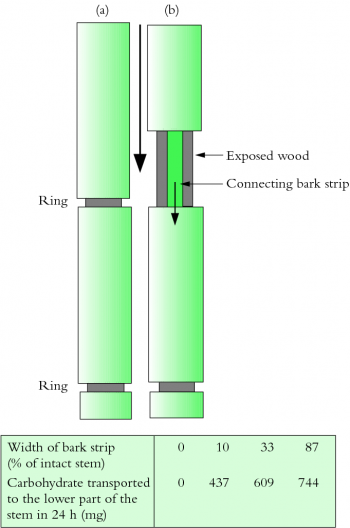
Figure 5.15 The role of bark (phloem) in sugar movement in plants. Mason and Maskell (1928) demonstrated that removing a complete ring of bark (a) while leaving the wood (xylem) intact prevented downward movement of sugars. When a strip of bark was retained between upper and lower stem parts (b), sugars flowed downwards in direct proportion to the width of the remaining bark
Bark of a woody plant contains phloem but not xylem and the transport function of that phloem can be demonstrated by ring-barking (Figure 5.15). Using this approach, Mason and Maskell (1928) showed unambiguously that sugar transport through stems of cotton plants was dependent on a continuity of bark but independent of contact with xylem. Phloem is thus a living tissue, and metabolic energy is needed for phloem to work.
Links:
[1] http://plantsinaction.science.uq.edu.au/edition1//?q=figure_view/312