
Water loss by plants accompanies photosynthesis and nutrient acquisition. In most plants, this water loss reaches a maximum during daylight hours, as gas exchange peaks. Leaves are the primary evaporating surfaces of shoots but stems, fruits and flowers can be important sites of water loss too. Roots must therefore extract large amounts of soil water and deliver it to heights of up to 100 m in a transpiration stream. This trans-piration stream carries with it nutrients into the shoot canopy (Section 5.1.5; see Case study 5.1).
Water is difficult to extract from plants in any quantity, but as Australian Aborigines found, long tree roots can be detected as raised soil contours and can be dug up fairly easily to yield water (White 1994). If such a root is cut or broken into short lengths and held vertically, watery sap runs from the lower end where it can be collected to drink. The tenacious hold of plant tissues on entrained water has been broken by wounding, allowing air to enter and displace the captive sap.
Such release implies water-filled conduits, but does not reveal the mechanism for long-distance movement of sap in plants. Xylem flow has been the subject of endless debate for experimentalists trying to identify forces involved. A summary below of the early history of experiments dealing with vertical lift of sap into shoots shows that some accord has been reached but details of the mechanism of sap transport are still being debated.
Around 1905 great plans were made to resolve the mystery of the ascent of sap in trees by Professor E.J. Ewart in Melbourne, using eucalypts as a model plant. At that time, Australian mountain ashes (Eucalyptus regnans) vied with American dawn redwoods (Sequoia gigantea) as the tallest trees in the world, being well over 100 m tall. Using special scaffolding, Ewart climbed eucalypt trees, removed lengths of branch and measured the pressures required to push water through these stems. These investigations led him to conclude ‘The ascent of water is, therefore, a vital problem in so far as it depends upon conditions which hitherto can only be maintained in living wood’. If water transport required living cells, it could not be supported by discovery of a pump akin to that in animals. Even roots, which sometimes could pump water by root pressure (Section 3.6), lacked the necessary positive pressures to push water so far aloft, especially around midday when water was most needed.
Suction from the shoots was an alternative explanation but manmade suction pumps could not fulfil the task without inducing formation of air bubbles (embolisms) in the xylem and blocking flow. One clue to the solution came from Dixon and Joly (1894) who claimed that very pure water molecules would be held together by powerful cohesional forces provided the water was especially clean (much cleaner than in manmade pumps).
Ewart did not agree with the unorthodox proposal that the suction of pure water through xylem vessels underpinned transpiration. However, Dixon (1914) ultimately postulated the Cohesion Theory, based on those properties of water which distinguish it as an ideal biological solvent — cohesion, adhesion to walls of the vessels and surface tension being central features. In short, in the absence of microscopic gas bubbles water could withstand quite enormous tensions. Through the evaporative power of the atmosphere, a continuous ‘chain’ or ‘catena’ of water, well below atmospheric pressure, could be drawn up to a leaf canopy. The tensions created in this way could even suck water from the surrounding soil. We now recognise that the evaporative energy is supplied as the latent heat of vaporisation ultimately derived from solar power. This cohesive property of water gave rise to the ‘Cohesion Theory for the Ascent of Sap’.
 [1]
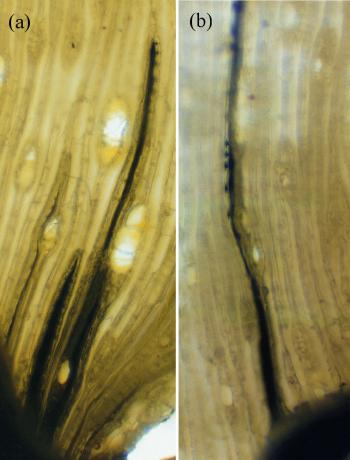
Figure 5.1 (a) Mercury sucked into tracheids of pine (Pinus radiata) by transpirational pull generated in the shoots. The water—mercury interface is powerful enough to hold this vertical column of mercury in stems. The height to which the dark column of mercury rises is used to calculate suctions created in xylem vessels. Note the generally small heights, reflecting the high specific gravity of inercury. About 2 MPa suction is produced in these xylem vessels. (b) Mercury enters bordered pits but remains connected to the vertical column of mercury in xylem vessels. While mercury can pass through the pit apertures, it cannot pass the finely porous ‘pit membranes’ because it is much more cohesive than water. Seen laterally, the half-aspirated bordered pits appear as discs
Two other properties of water are also essential for long-distance water transport: surface tension, and the adhesion of water to solid surfaces such as the xylem vessels within trees. Dixon claimed that if water could ‘hang together’, the enormous evaporative energy of the air (the same power which dries the washing hanging on a line) could be harnessed to lift sap, which is mainly water, vertically. This would entail no metabolic energy on the part of the plant. This theory of sap flow accorded with earlier experiments by Strasburger (1893) showing that a tall oak tree trunk, severed at the base, could draw poisons and dyes up to the leaves by some wick-like action. If metabolism energised sap flow, poison should have inhibited it. This was well illustrated in later experiments (Figure 5.1a) in which mercury was drawn through fine tracheids of pine stems purely through the suction created by transpirational water loss from the shoot above. The tension required to achieve this is about 2 MPa.
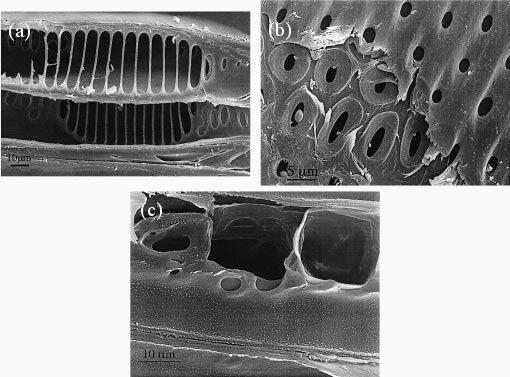
However, the physical properties of plants had to be more complex than those of simple pipes conducting water. As mentioned, manmade pumps failed through embolisms if used to suck water higher than 10 m, whereas hundreds of litres of water reaches the canopies of tall trees daily. Even overlapping sawcuts in tree trunks, which should allow a massive quantity of air to flow into xylem vessels when under suction and cause trees to die from embolisms, did not stop all water flow to leaves. If water was under such suction, how could trees keep air bubbles out of the sap when the trunk was cut? This additional problem was not resolved until the very complex anatomical structures of trunks were much better understood. Xylem (Figure 5.2) is not composed merely of pipes: it is made up of partially sealed units (technically vessels, tracheids and fibres, called collectively conduits) which most effectively limit the spread of introduced gases and thus maintain water flow in some conduits despite very severe disruption from embolisms in others.
 [2]
Figure 5.2 (a) Scanning electron micrograph (SEM) of the finely sculptored scalariform perforation plates in poplar (Populus italica) xylem. Water passes easily from one xylem vessel to another by this route. (b) SEM illustrating bordered pits connecting two vessels in Eucalyptus. The pits can be seen in surface view (top right) and the borders of pits can be seen when this surface is broken away (bottom left).The borders appear as cup-shaped depressions. (c) SEM of poplar wood illustrating the close connections between ray cells (note three adjacent cells) and xylem conduits (xylem wall with pits lie beside these ray cells). Simple pits can occur in fields allowing transfer of ions from xylem sap into ray cells or release of photosynthates into the xylem stream. Magnifications appear on the micrographs
For xylem sap to sustain tensions required in tall trees, there must be no gas bubbles in the system. Cohesion breaks down if there is a single ‘nucleation site’ on which bubbles can form and enlarge. On the other hand, sap normally contains dissolved gases which, surprisingly, do not disrupt the system provided there are no nucleation sites available. Even the rigid walls of xylem vessels are compatible with high xylem tensions, attracting water by adhesion, which is essential for transport.
Surface tension acts as an interfacial water–air stopper, preventing air from being sucked into the many millions of tiny pores present in all plant cell walls. For example, water delivered to leaf cells by xylem vessels passes through these tiny menisci, which act effectively as non-return valves, so preventing air from being sucked into the xylem (Section 5.2). Surface tension also explains how water in leaves remains under strain within an essentially porous system through which water flows.
Xylem anatomy seems to be highly significant. Vascular transport systems have evolved to become amazingly reliable despite the metastable condition of the sap. From primitive, thickened, hollow cells, increasing specialisation has produced greater elongation and thickening of the tubes. Xylem walls contain pits, in which zones of the primary wall known as ‘pit membranes’ allow water to be transmitted between vessels efficiently, while preventing a gas phase spreading through the interconnected system of vessels and blocking transport through embolisation (the blockage of a fluid channel with a bubble of gas). No living membrane is present in these wall structures. However, the efficiency with which pit membranes isolate adjacent vessels is shown in Figure 5.1(b) where mercury, a highly cohesive liquid, is drawn into specialised bordered pits of pine tracheids without being able to exit into neighbouring tracheids.
Vascular systems have evolved from plant species possessing only fibres and tracheids, for example the more primitive Tasmannia, to more advanced plants possessing vessels which resemble the unicellular tracheids in structure but are much wider and longer and originate from a number of cell initials fused together. Lignin thickening patterns have also evolved. Some thickening designs, such as annular and spiral, allow the tubes to extend longitudinally while supplying growing organs. When growth has ceased, an organ can be provided with more efficient pipes of larger bore and with stronger thickenings, in reticulate and scalariform patterns (Figure 5.2a). Pit fields which allow water transport across vessel walls can also be simple, unreinforced structures (simple pits) or more elaborate bordered pits in which secondary cell walls mechanically support the pit membrane. All these forms of pits can prevent air in an air-filled conduit from spreading to adjacent conduits which are conducting water under strong suction. Reinforcement of the walls around pits (Figure 5.2b) allows pit membranes to be as large as possible and thereby maximise water exchange between vessels.
A number of methods have been used to determine the speed of sap flow. This task is not easy because xylem is not a
uniform conduit supporting a single flow rate. Some of the main approaches are outlined below.
Dyes have been used to detect water flow for centuries. Such methods developed a poor reputation until dyes were selected for their ability to move freely in the xylem: dyes which associate with the negatively charged vessel walls move much more slowly than the sap in which they are dissolved. Modern dyes, generally negatively charged ions, have been especially useful to illustrate pathways of water flow (Section 5.2). However, if dyes are to be used to interpret flow rates, caution must be exercised. Applying a dye solution, at atmospheric pressure, to plant tissue with vessels under tension can lead to the dye being sucked into vessels artefactually. This will be most acute in water-deficient tissues. Interpreting the direction and rate of sap flow in this case will tell little about the steady-state condition. Also, when dyes are used to assess mass transfer, the capacity of a vessel (related to its width) will influence the amount of dye passing through that vessel. So, fine capillaries might transport only a small amount of dye but at a rapid rate.
Radioisotopes are useful tracers of water flow, but they suffer from the same problems as dyes. Cationic isotopes, especially divalent cations, tend to bind to the xylem walls. Radioactive phosphorus makes a good tracer because it is anionic and a strong emitter.
Heat-flow and heat-pulse methods are widely used for the non-invasive measurement of water flow in stems and tree trunks. One ideal approach introduces a steady source of heating to the stem or trunk. This is surrounded by temperature detectors (thermistors or thermocouples). If there is virtually no sap flow, say, late at night, temperatures around the heater adopt a symmetrical ‘zero-flow’ profile. When water flow occurs, the thermal profile is dragged upwards, providing a temperature shift which can be converted by appropriate computer circuitry into a continuous measurement of flow. Automatic devices of this kind are now being used widely for irrigation scheduling.
Xylem sap is very dilute when compared to both phloem sap and the contents of cells lining the transport pathway and for this reason it is often regarded as virtually pure water. Indeed, the osmotic pressure of xylem sap rarely exceeds 0.1 MPa (about 40 mOsmol L–1). This dilute sap effectively transports large amounts of inorganic nutrients by mass flow (see Case study 5.1), providing the supply of water and nutrients to roots can be maintained. In a rapidly growing plant such as an annual herb, powerful mechanisms for concentrating essential ions in the roots (see Case study 4.1) combine with transpiration of water from leaves to sustain nutrient supply to shoots.
 [3]
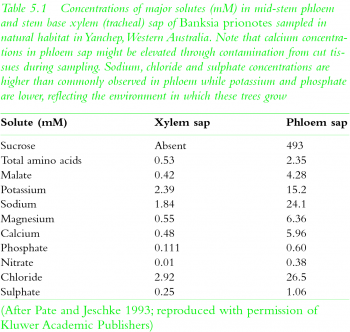
While most solutes in xylem sap are inorganic ions (e.g. nitrate, potassium, magnesium and calcium), other important solutes are also present (Table 5.1). Organic molecules in xylem sap can be present in substantial concentrations, sugars reaching 5mM in maize xylem sap (Canny and McCully 1989). Many trees including eucalypts are host to boring insects at particular times of the year when sugar and nitrogen content of the sap is nutritionally valuable. Even though sugar concentrations in xylem sap are much lower than in phloem sap, the high nitrogen to sugar ratios and low osmotic pressures make it a good substrate for many predators. More extreme examples of the carbohydrate content of xylem sap are temperate deciduous trees such as maple which have traditionally been tapped to yield a sugary solution in the period prior to budburst. This indicates that xylem can be a conduit for carbon remobilisation in addition to its central role as a pathway for water and nutrient transport. In secondary tissues, rapid transfer of solutes into and out of the xylem is partly achieved through close association of living ray cells and xylem vessels (Figure 5.2c).
Other organic molecules act to transport inorganic nutrients to the shoots. Nitrate and ammonium are assimilated into organic forms, such as amino acids, in the roots of many plants. In legumes, nodules deliver an even wider selection of nitrogenous compounds to the xylem, including ureides and amides. These often constitute the dominant form of nitrogen reaching shoots and are therefore a major component of the sap. Other examples of complexed forms of inorganic nutrients in xylem sap are metal ions such as zinc, copper and iron which are almost exclusively chelated to organic acids.
Phytohormones are also found in xylem sap but often in concentrations several orders of magnitude lower than those considered necessary to elicit a physiological response. This does not preclude xylem sap as a critical source of these sub-stances because delivery of solutes in the xylem must also take into account rates of sap flow. Mass transfer of phytohormones such as abscisic acid (Jokhan et al. 1996) and cytokinins (Nooden et al. 1990) is significant even though delivered in a dilute solution (Section 9.1.2).
Xylem sap composition is highly variable, and modified according to requirements of shoot tissues. Toxic ions can be removed from sap and essential nutrients recycled intensively as described in Case study 5.1. Unidirectional flow of sap in the xylem stream (although not invariably in the same direction) contrasts with bidirectional flow in the phloem and the two consort to deliver resources to where they are most needed. In particular, transfer from xylem to phloem provides a means of diverting essential elements from the main transpiring surfaces, the older leaves, to growing tissues where they are required (see Case study 5.1).
Discovery of transfer cells (Pate and Gunning 1972) showed how these specialised cells differentiate in order to effect a rapid transfer of solutes, in this case into and out of the xylem stream (see Case study 4.2). Transfer cells lie adjacent to xylem vessels and are highly modified to carry out rapid ion exchange of xylem and phloem elements. While exchange can occur in both directions, concentrations of most nutrients and organic solutes are much lower in the dilute xylem sap than in adjacent phloem elements, requiring active transport mechanisms for xylem to phloem transfer (Table 5.1). Such energetically ‘uphill’ transport is thought to be energised by proton pumps in the membranes of transfer cells. Solutes such as potassium in cereals and amino acids in soybeans are known to be transferred to the phloem by this route, particularly through nodes in the stem.
Xylem parenchyma cells, which are believed to participate in loading of ions into xylem vessels in roots (Section 3.6.4(a)), also contribute to modification of ion levels along the xylem pathway. Amino acids, potassium, calcium, magnesium and even micronutrients such as molybdenum are exchanged between xylem vessels and the accompanying parenchyma cells to achieve a xylem sap composition appropriate to shoots. This process is species dependent. For example, molybdenum is sequestered in the roots of beans and participates in nodule function, whereas tomato has less capacity to withdraw molybdenum from xylem sap (Hecht-Buchholz 1973). In secondary tissues, rapid transfer of solutes into and out of the xylem is partly achieved through close association of living ray cells and xylem vessels (Figure 5.2c).
Even weaker associations between ions and cell walls of both xylem vessels and surrounding cells can retard the up-ward movement of inorganic ions like cadmium, copper, zinc and calcium. For ions such as copper, this is not desirable un-less toxic quantities are likely to reach the shoot during brief periods of oversupply. Retarded translocation of cadmium and other heavy metals, on the other hand, might be ad-vantageous to a plant by preventing a rapid supply that cannot be diluted by growth.
Links:
[1] http://plantsinaction.science.uq.edu.au/edition1//?q=figure_view/208
[2] http://plantsinaction.science.uq.edu.au/edition1//?q=figure_view/209
[3] http://plantsinaction.science.uq.edu.au/edition1//?q=figure_view/210