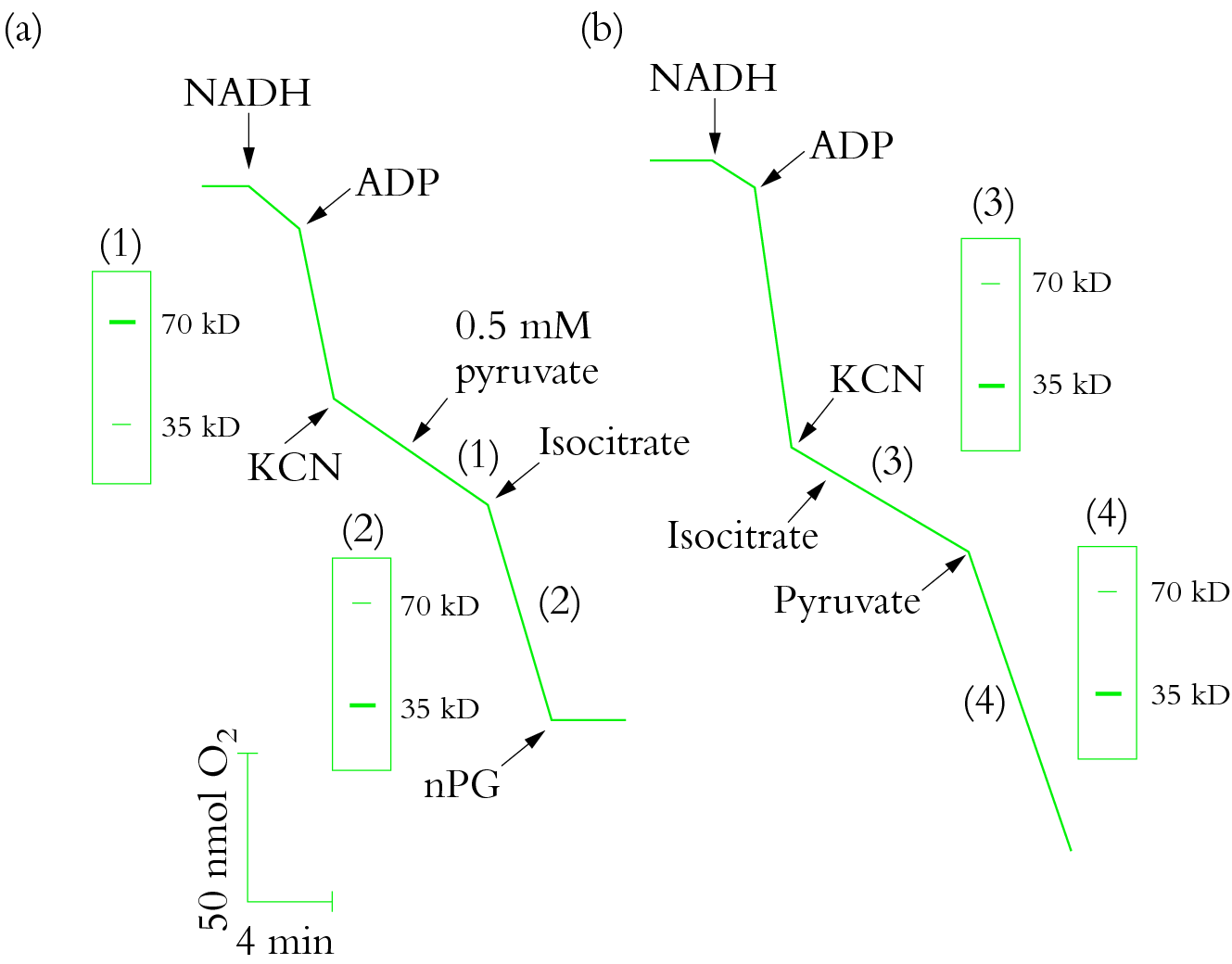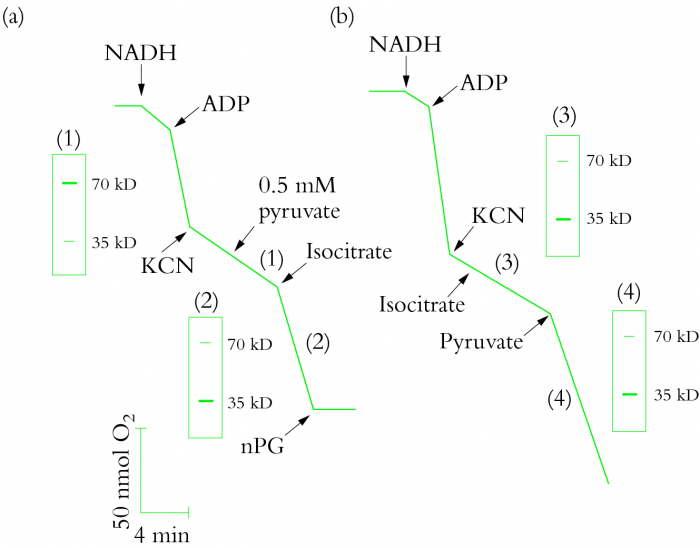
Figure 2.28 Experimental evidence for schemes in Figure 2.27. (a) and (b) represent oxygen electrode recordings obtained with a suspension of mitochondria isolated from tobacco leaves. NADH is added as the electron donor, and ADP ensures that electron transport is not restricted by the rate of oxidative phosphorylation. Addition of KCN inhibits cytochrome oxidase and thus allows alternative oxidase activity to be measured. At times indicated by (1)-(4), samples of mitochondria were taken from the reaction vessel, their proteins separated by SDS-PAGE in the absence of reductant, and alternative oxidase protein (AOX) bands visualised by immunoblotting (shown schematically as inserts). At (1), pyruvate has been added to the mitochondria but the rate of cyanide-sensitive respiration remains low because AOX protein is largely oxidised (the covalently linked dimer is evident at 70 kD in the blot); however, when isocitrate is added at (2) to generate NADPH in the mitochondrial matrix, AOX becomes reduced (major band at 35 kD is seen in the blot) and cyanide—insensitive O2 uptake becomes rapid as AOX is activated. At (3), isocitrate has been added and AOX is reduced, but respiration remains slow because pyruvate is not present to activate the enzyme fully. At (4), the redox status,of AOX does not change, but AOX activity increases dramatically upon pyruvate addition. Thus both a reductant such as NADPH and an activator such as pyruvate must be present before the alternative oxidase is fully engaged. In this case NADPH was generated from isocitrate via NADP-linked isocitrate dehydrogenase in the mitochondrial matrix. (Based on Vanlerberghe et al. 1995)