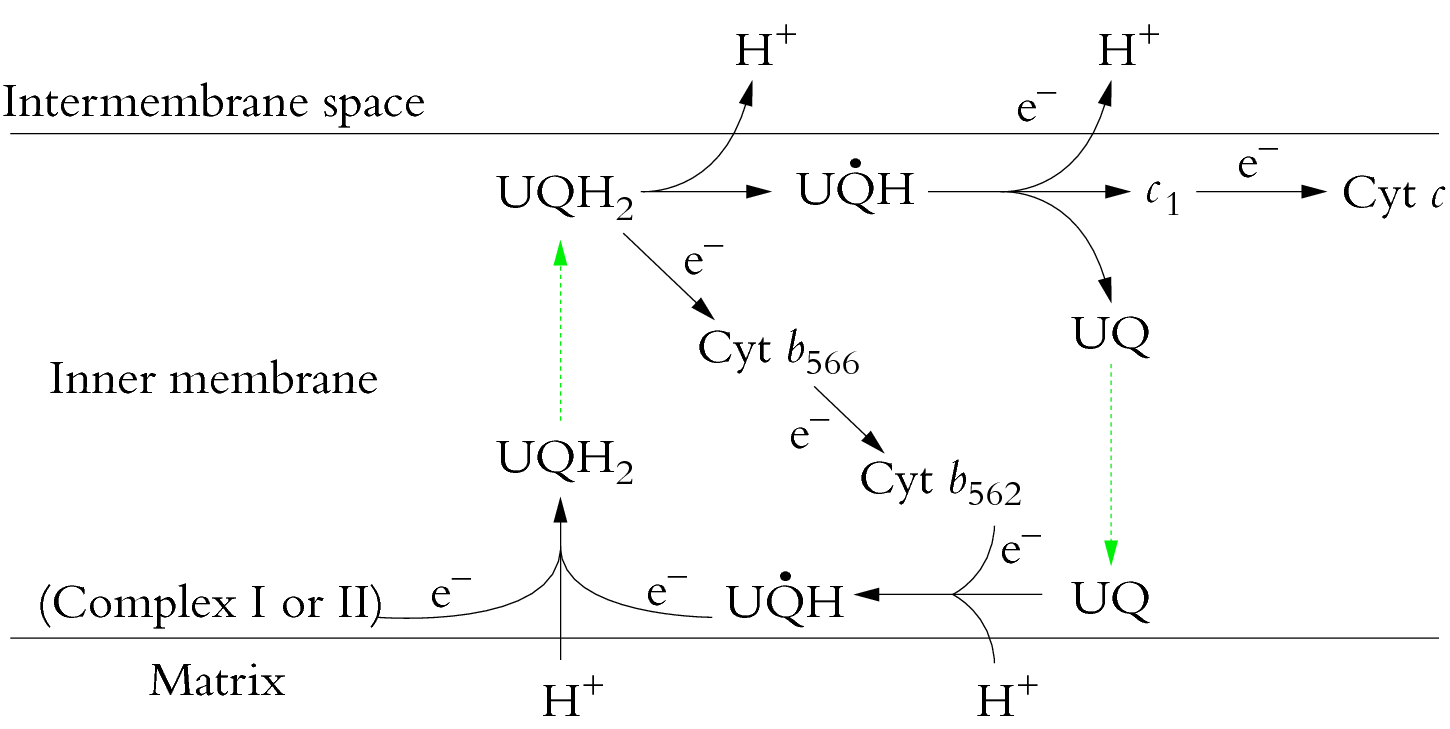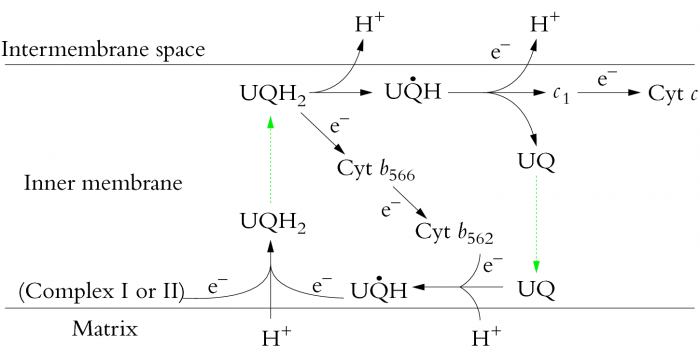
Figure 2.25 The protonmotive Q cycle mechanism of proton translocation at complex III of the respiratory chain. Oxidised quinone (UQ) accepts an electron from Cyt b562 of complex III and a proton from the matrix to form the semiquinone (UQH).The semiquinone accepts another proton from the matrix and an electron from complex I (or II) to form the quinol which then diffuses across the membrane (broken arrows) to interact with Cyt b566 and the FeS protein of complex III near the outside of the inner membrane. UQH2 is oxidised to the semiquinone by Cyt b566, losing a proton to the external medium in the process, which then reduces b562. The semiquinone is oxidised by the FeS protein (not shown), losing another proton which then reduces Cyt c1 and thence Cyt c. The quinone formed then diffuses back across the membrane to interact with Cyt b562. In this way, one electron is transferred from complex I (or II) on one side of the membrane to Cyt c on the other, with another electron and UQ shuttling back and forth across the membrane. Concurrently, two H+ are translocated from the matrix to the external medium for each electron flowing to Cyt c. Broken arrows indicate diffusion of both fully oxidised and fully reduced ubiquinone; unbroken arrows indicate electron flow. (Original drawing courtesy David Day)