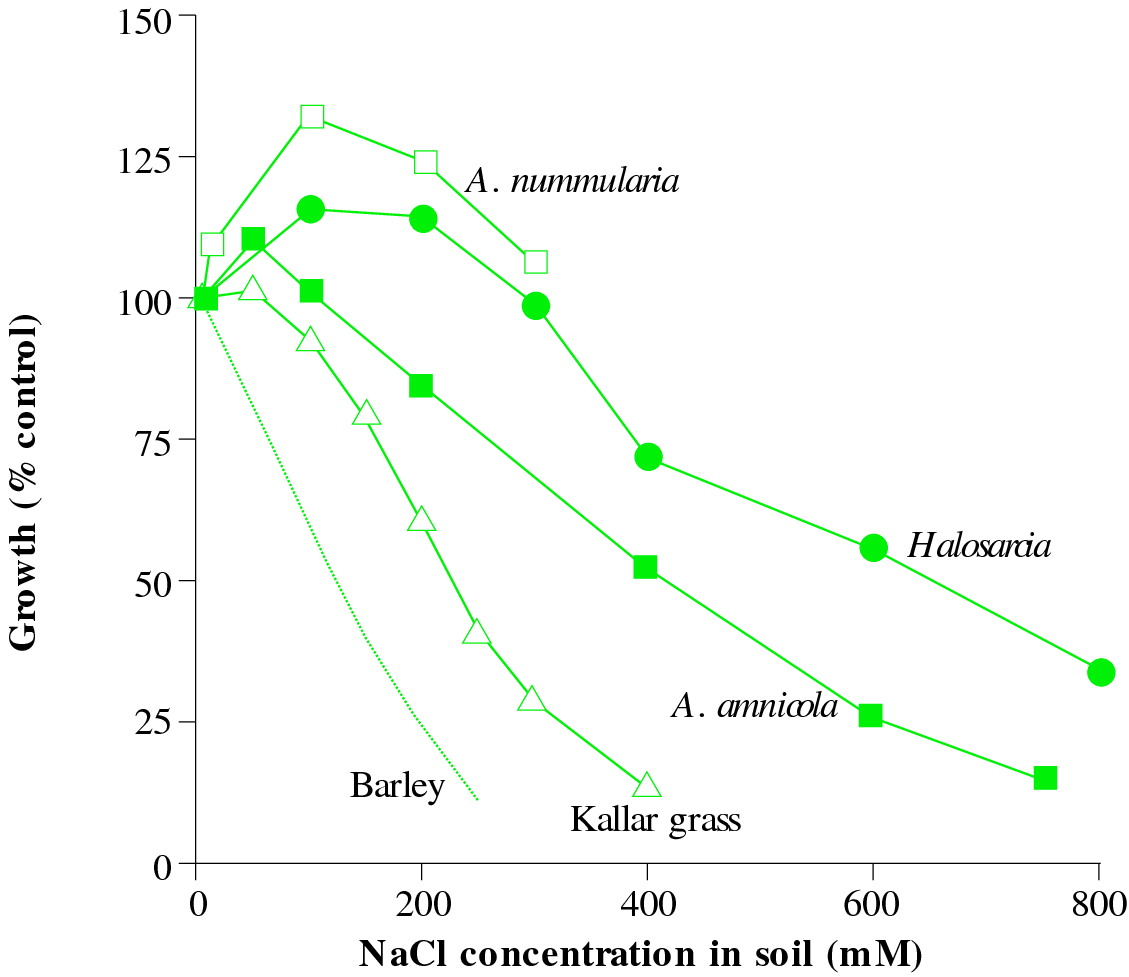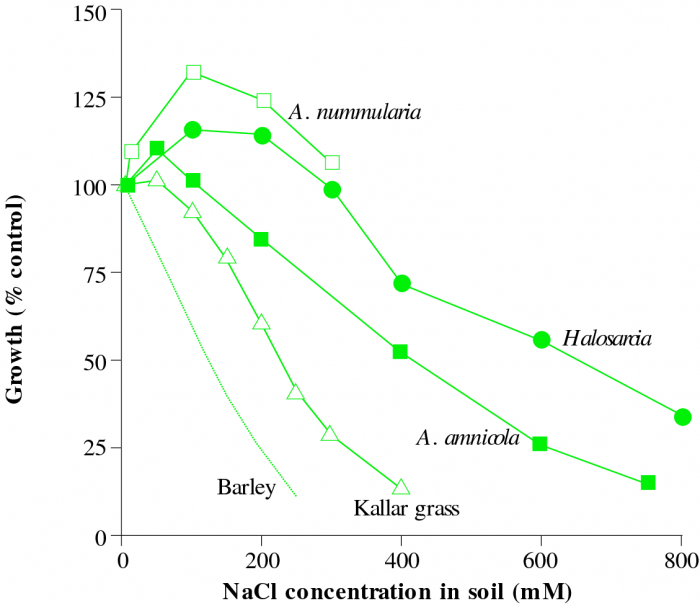
Figure 17.18 Growth responses for a range of halophytes, compared to one of the most salt tolerant cultivated plants, barley. Atriplex nummularia (old man saltbush) is one of the most tolerant inland species known (data from Greenway 1968). The samphire species is Halosarcia pergranulata subsp. pergranulata (P.G. Wilson) ‘black-seeded samphire’, a common samphire in southwestern Western Australia (data from Short and Colmer, unpublished). Compare these halophytes with species of agricultural importance in Figure 17.3.
Halosarcia (coll. samphires) is a genus comprising several species and subspecies, all of which are perennial shrubs or subshrubs with succulent stems (Figure 17.27). The genus is found only in countries bordering the Indian Ocean and is well represented within Australia (Wilson 1980). Halosarcia spp. inhabit a range of saline environments that are also prone to waterlogging, such as coastal saltmarshes, mud flats, estuaries, margins of inland salt lakes, brackish seepages and saline clay pans. Due to their high degree of tolerance to salinity and waterlogging, Halosarcia spp. have been used in the revegetation of salt-affected areas in the Western Australian wheatbelt.