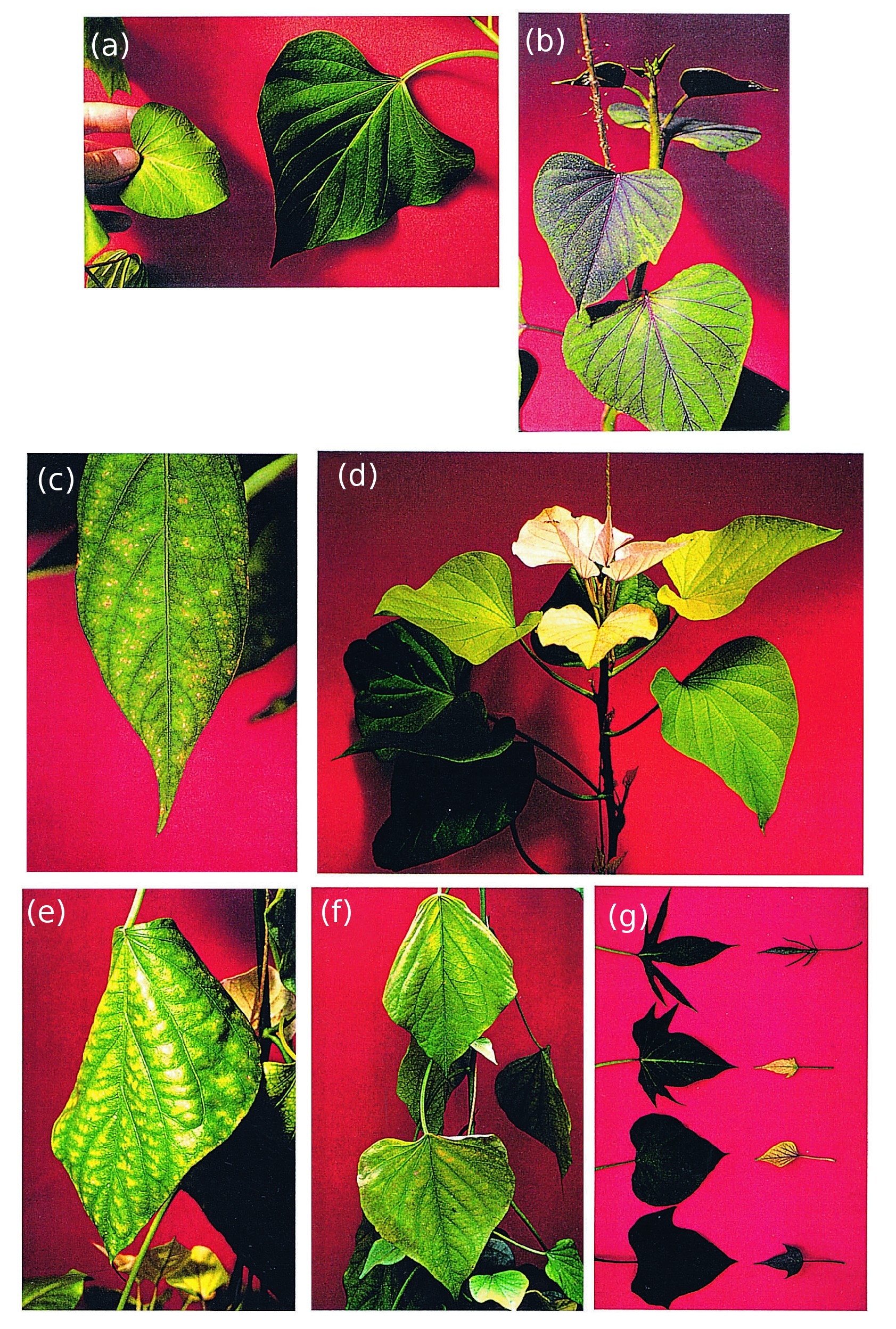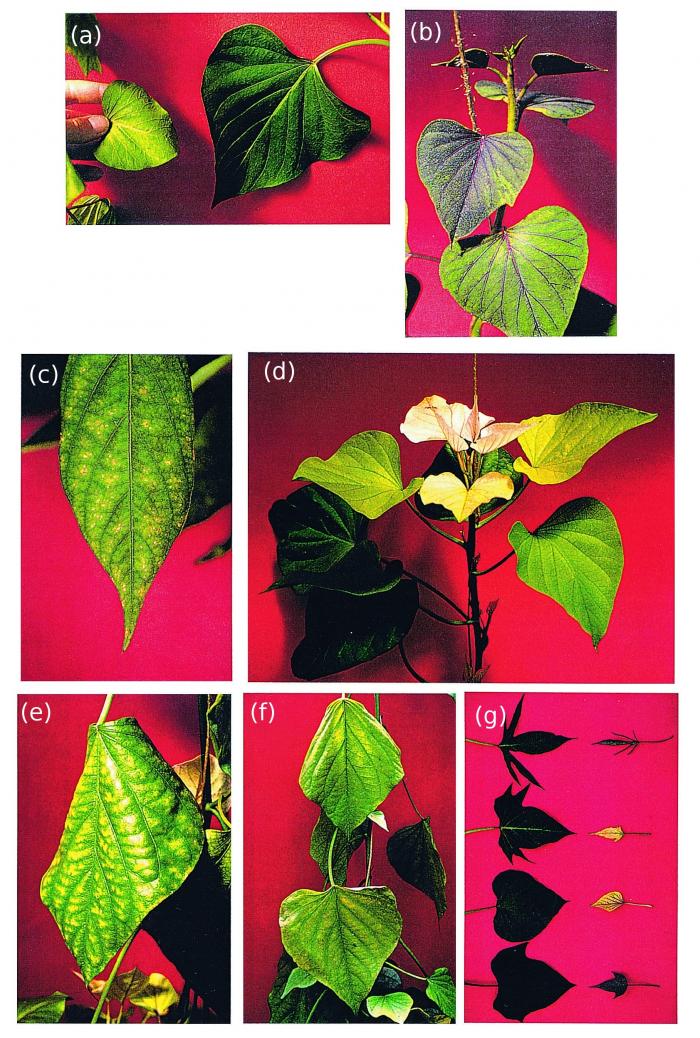
Figure 16.8 Visible leaf symptoms on sweet potato, representative of deficiencies in N, P, K, Fe, Mn, Cu and Zn. N deficiency (a) in cultivar Wanmum results in small pale leaves with a dull appearance (left side) compared with larger, deeper green and more lustrous full-nutrient control leaves (right side). P deficiency (b) on young leaves of cultivar Markham produces a characteristic red-purple pigmentation on upper surfaces. K deficiency (c) leads to interveinal chlorosis in mature leaves which becomes accentuated around leaf margins and finally necrotic lesions on oldest leaves. Fe deficiency (d) in cultivar Markham results in sever bleaching of young leaves while old leaves with adequate Fe remain deep green. Mn deficiency (e) results in chlorosis, leaf drooping, puckering and downward rolling of leaf margins, and eventually a development of interveinal pitting. Cu deficiency (f) in cultivar Wanmum produces a diffuse interveinal chlorosis and drooped appearance in deformed leaves which eventually form necrotic lesions. Holes sometimes form in older leaf blades due to uneven expansion. Zn deficiency (g) in four cultivars where young leaves from low-Zn plants (right side of picture) are compared with full-nutrient leaves of equicalent age on healthy plants. Cultivars top to bottom are Lole, Hawaii, Markham and Wannum. (Based on O'Sullivan et al. 1997)