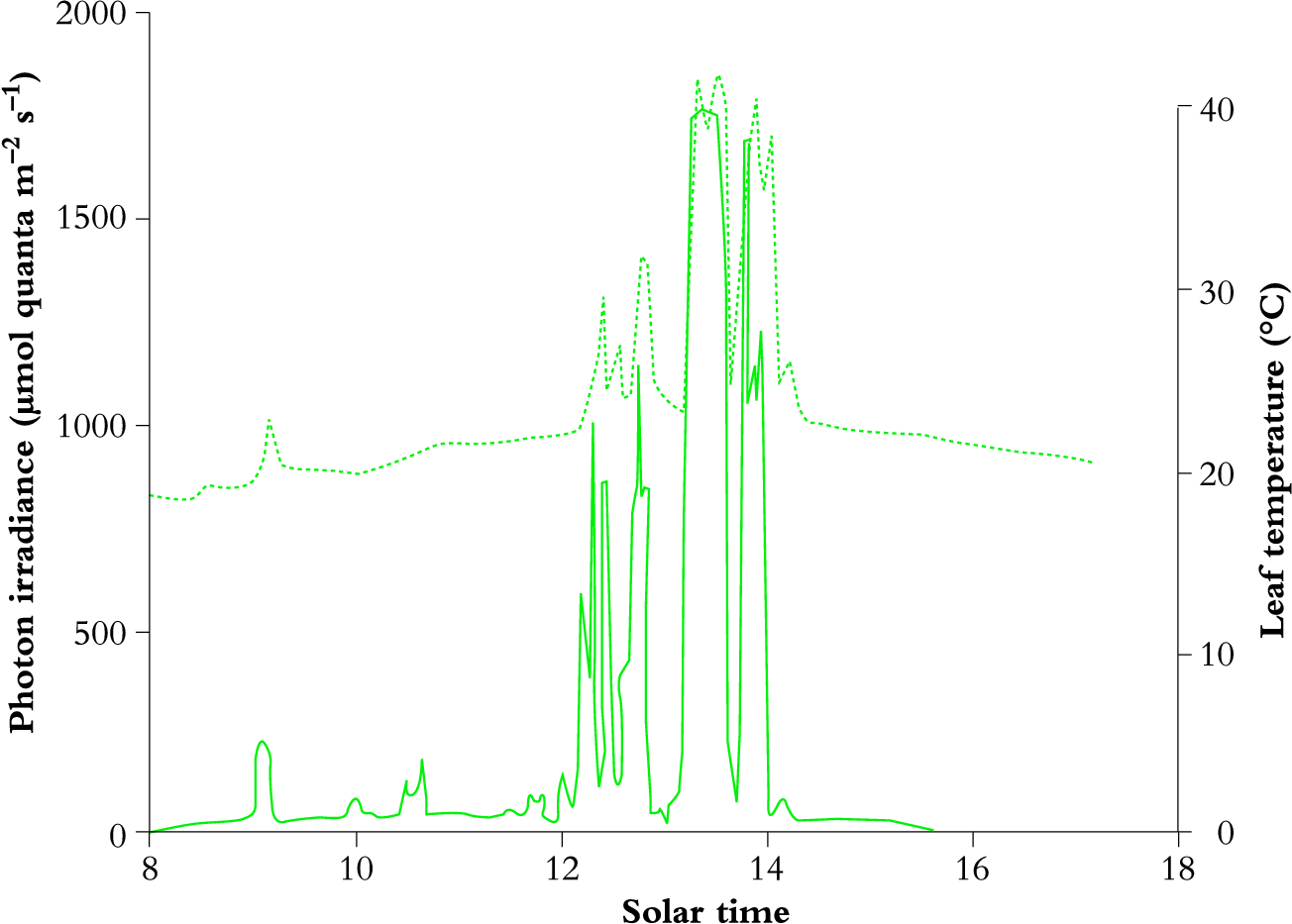
Figure 12.15 Natural variation in photon irradiance experienced by Alocasia macrorrhiza growing in the understorey of a North Queensland rainforest (cf. Figures 12.2, 12.3). Daily total photon irradiance on this occasion (from integration) was 6.033 mol quanta m-2 d-1). The abrupt increase from a background level of around 50 µmol quanta m-2 s-1 to to 1750 µmol quanta m-2 s-1 energises photosynthesis, but is counteracted by increased leaf temperature, especially during prolonged exposure. Transpiration cooling is a significant component of heat budgets for such large leaves, so that adequate soil moisture is a prerequisite for continuing leaf gas exchange during a sunfleck. However, sunfleck frequency will be an additional factor for carbon gain during exposure to strong photon irradiance. Photosynthetic induction state diminishes to a minimum after 30 min in low light (see Figure 12.16) and some minutes are required to reattain full capacity in strong light. Infrequent sunflecks are thus used at reduced efficiency
(Based on Watling et al. 1997a, b and additional unplublished data)