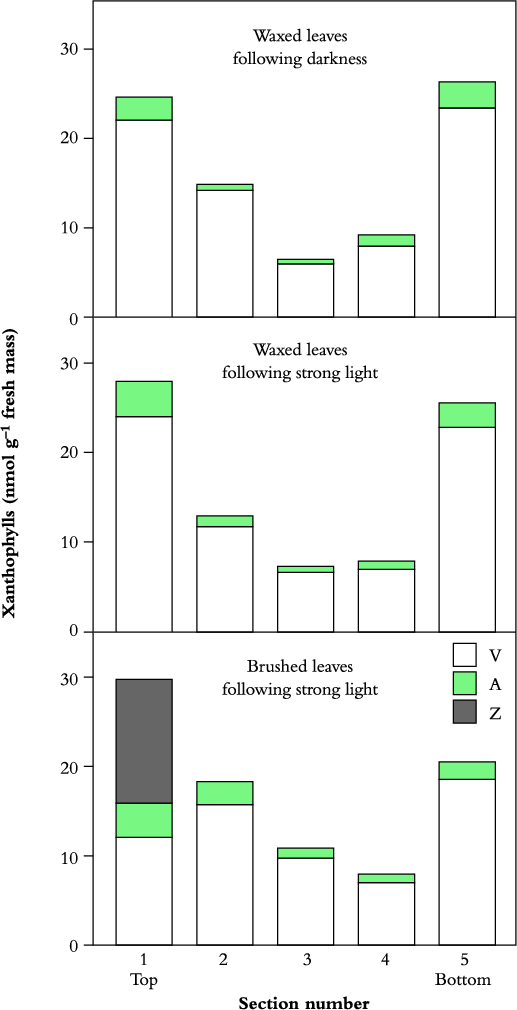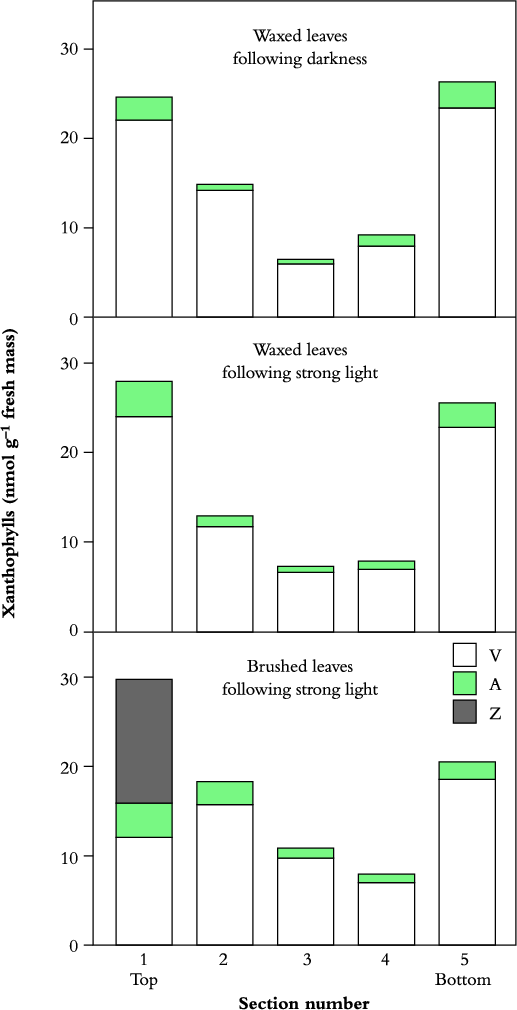
Figure 12.12 External and internal photoprotection in thick leaves of Cotyledon orbiculata (cf. Figure 12.5). Removal of protective wax from upper surfaces stimulates synthesis of zeaxanthin. Overall activity of the xanthophyll cycle (Figure 2.11) varies with mesophyll irradiance, while concentration of particular components also varies according to tissue depth. Changes in concentration of the various components of the xanthophyll cycle are shown here for successive (1 mm) layers in thick leaves of C. orbiculata, with and without their wax coating. In waxed leaves at the end of a dark period (top figure) xanthophyll cycle pigments are represented mainly by violaxanthin (V) with a small amount of antheraxanthin (A). After 6 h exposure to high light (middle figure) a small amount of violaxanthin is converted to antheraxanthin, but no zeaxanthin (Z) is formed, indicating that the natural wax coating on these leaves (see Figure 12.5) is protecting chloroplasts from excess light. Physical removal of surface wax (brushed leaves in bottom figure) results in zeaxanthin production within the uppermost layer of leaf tissue but not in deeper tissues or lower surfaces. Restriction of this xanthophyll cycle component to the top section confirms that zeaxanthin accumulation is a response to excess light
(Based on Robinson and Osmond 1994)