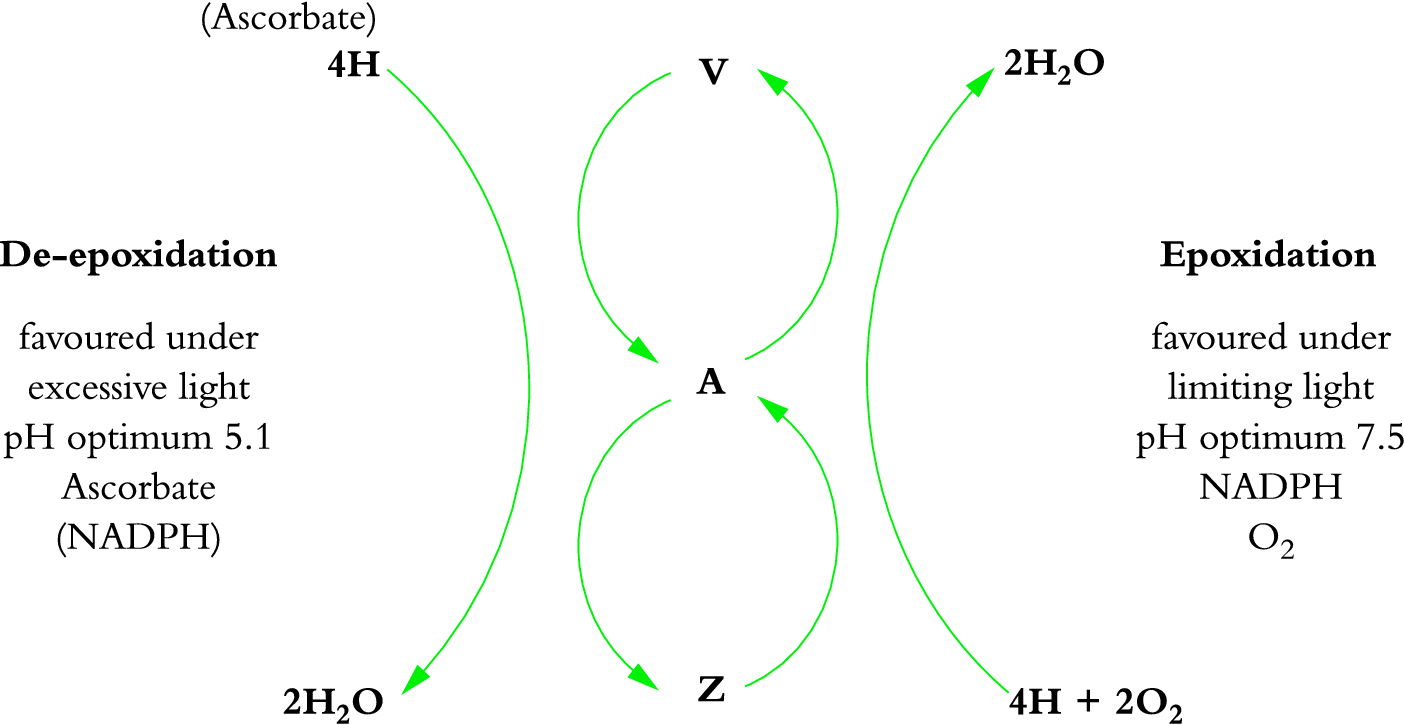
Figure 12.11 The xanthophyll cycle summarsied here contributes to dissipation of excess light energy, and involves three pigments, violaxanthim (V), antheraxanthin (A) and zeaxanthin (Z). All occur in chloroplast thylakoid membranes. This special group of carotenoids undergoes interconversion in response to high light. In low light, viloaxanthin predominates but excess light levels produce chloroplast condition which are conducive to de-epoxidation of violaxanthin to seaxanthin (conditions summarised on the left hand side). Zeaxanthin, and possibly antheraxanthin, provide phtotoprotective thermal dissipation of excess light energy. When light levels are no longer excessive, chloroplast conditions favour epoxidation of zeaxanthin back to violaxanthin (summarised on the right-hand side).
(Original drawing courtesy S.A. Robinson)