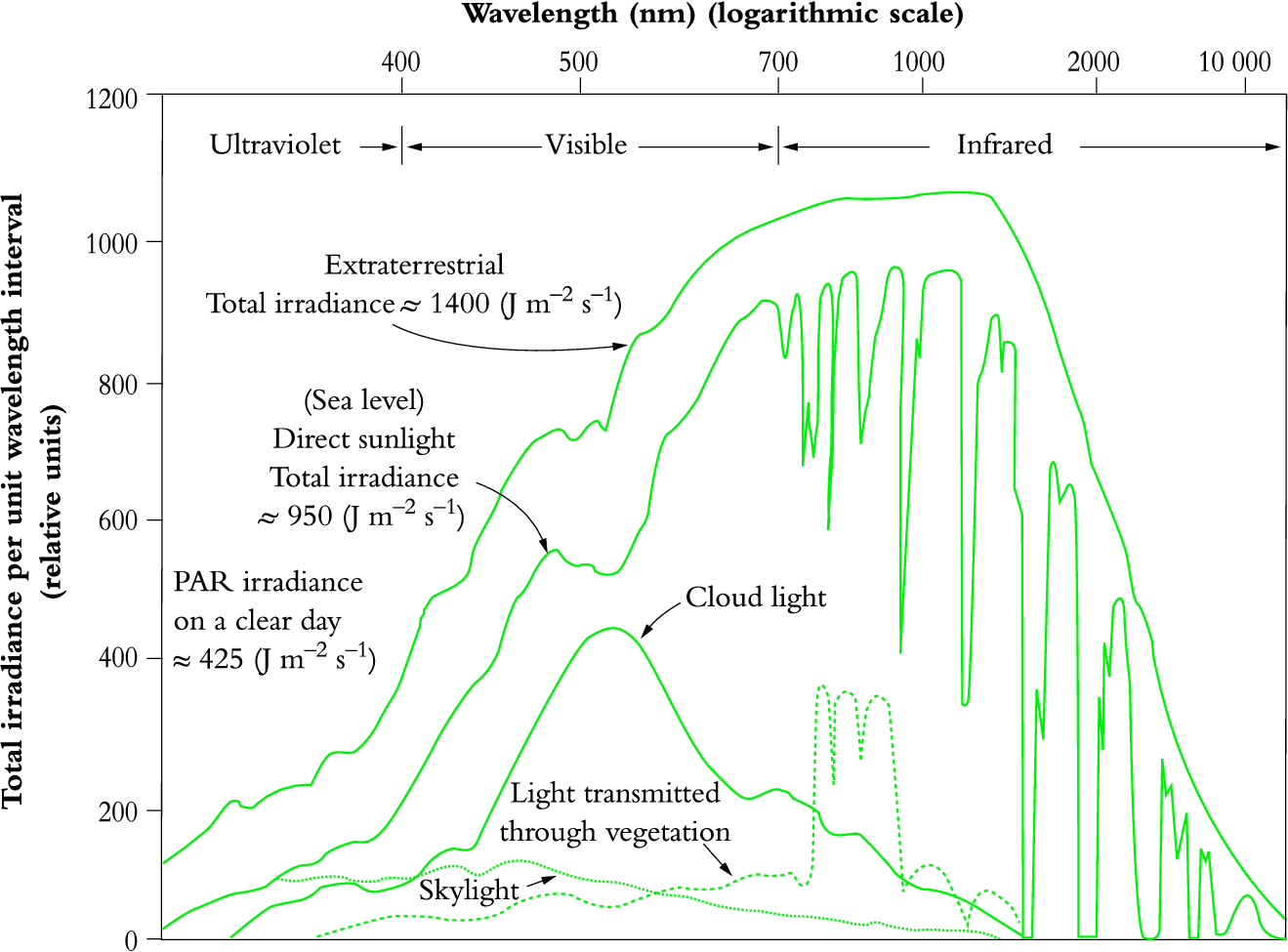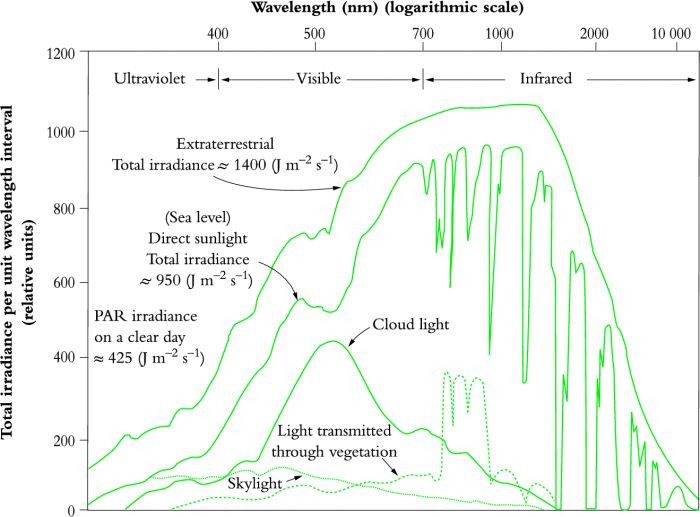
Figure 12.1 Sunlight passing through the earth's atmosphere is altered in both quantity and spectral composition. Attenuation of descrete wavebands of infrared radiation by water vapour is especially noticeable (right side of figure), while absorption of ultraviolet by stratospheric ozone is also of special significance for terrestrial organisms. Cloud light is especially rich in visible wavelenghts with a peak around 500µm which coincides with the maximum spectral sensitivity of our eyes. Plants have also evolved with spectral properties that match biological necessities. Vegetation shows strong attenuation of visible wavelengths that drive photosynthesis, but transmit near-infrared radiation that would otherwise heat leaves.
A note on units: Visible wavelengths of sunlight can be represented as either a quantum flux or a radiant energy flux. Quantum flux is regarded here as synonymous with 'photon irradiance' (Q) and has units of µmol quanta m-2 s-1 ('µmol quanta' rather than 'µmol photons' because the quantum energy derived from photons drives photosynthesis). For the sake of making a clear distinction from quantum flux, radiant energy flux is simplified to 'irradiance', and for present purposes, irradiance coincides with photosynthetically active radiation (PAR). Irradiance is then expressed as joules (J) per square metere per unit time. Depending on the application, time can span seconds, days or years, and is then coupled with either joules, megajoules (MJ) or gigajoules (GJ)
(Based on Gates 1965)