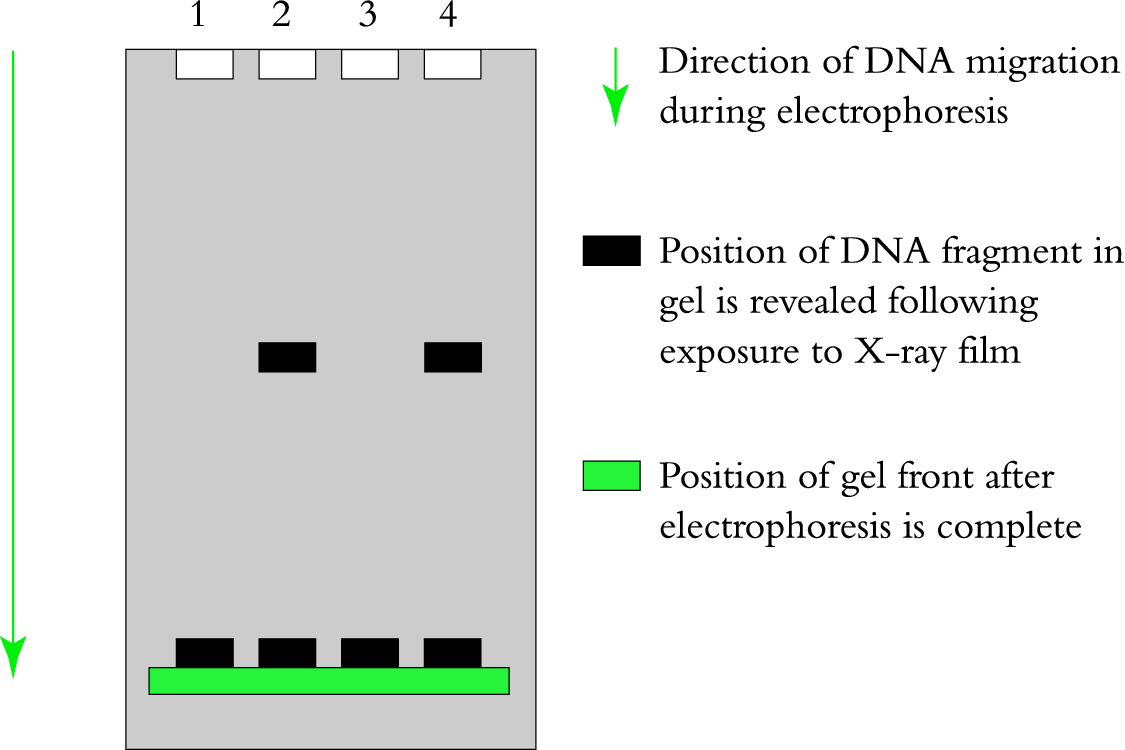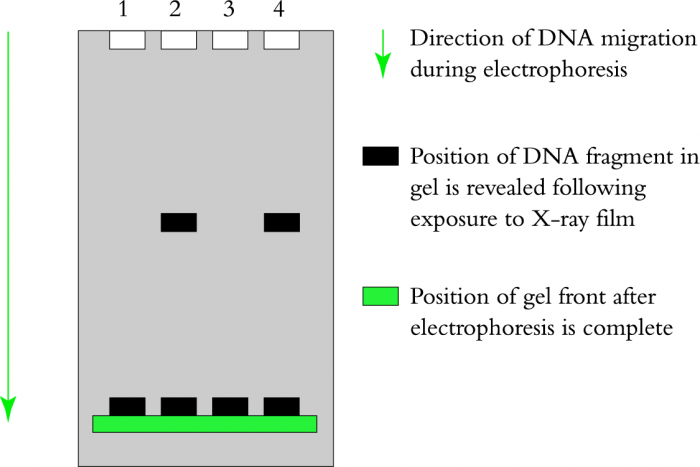
Figure 10.30 Mobility shift or gel retardation assays are used to test for interactions between DNA fragments and putative DNA-binding proteins. Speed of migration through the gel is inversely proportional to the molecular weight of the fragment. Track 1 contains only a radiolabelled DNA fragment suspected of having a sequence enabling specific interaction with transcription factor proteins. The DNA migrates freely through the gel matrix close to the gel front. Track 2. contains the same DNA fragment, but which is now mixed with nuclear protein extract prior to loading onto the gel. Some of the DNA molecules have bound to specific protein molecules, giving them an increased molecular mass, and so causing slower movement ('retardation') through the gel. Track 3. contains the same ingredients as in Track 2 but now mixed with an excess of of unlabelled ('cold') DNA of the same sequence. The cold DNA competes with the radiolabelled DNA for binding to the protein, and because the cold DNA is in excess, the radiolabelled DNA is displaced from the protein and so migrates again at the gel front. Track 4. contains the same ingredients as Track 3 except that the cold competing DNA contains a mutation in the region to which the binding protein attaches. This prevents it from interacting effectively with the protein, so the radiolabel is able to bind normally, and show the same retardation as in Track 2. By changing the position of the mutation, the exact binding protein site can be deduced.