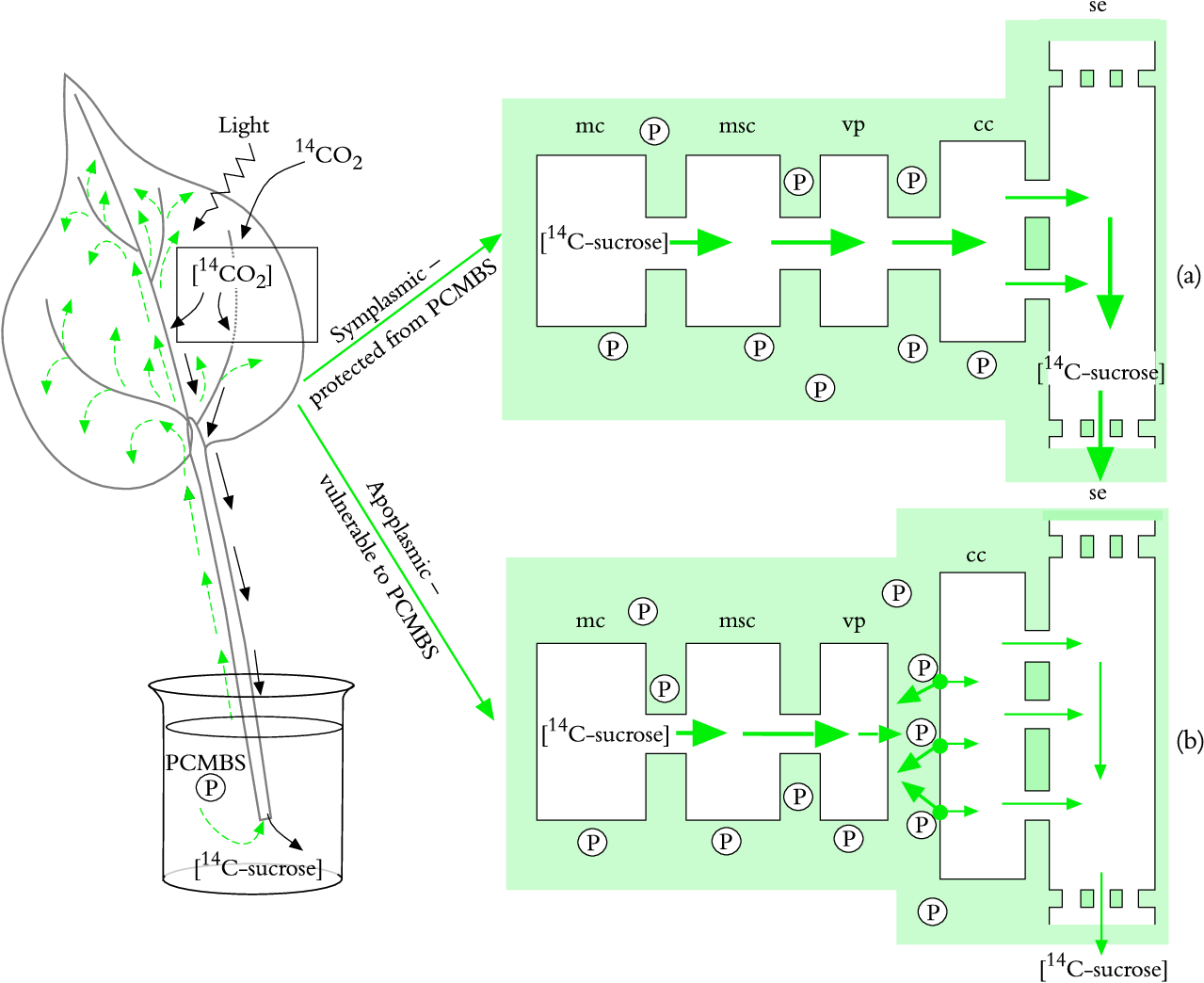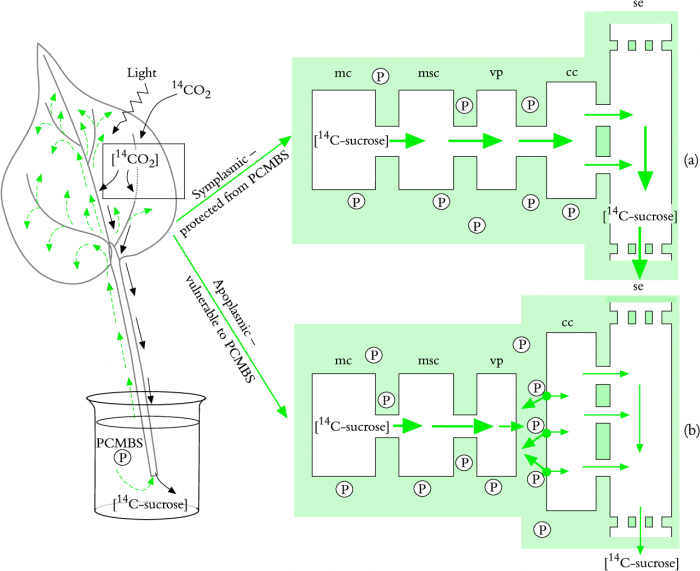
Figure 5.24 Testing whether photoassimilates move from mesophyll cells to se-cc complexes through (a) an entirely symplasmic route or (b) a route with an apoplasmic step. The approach is to use PCMBS as an inhibitor of membrane transport. PCMBS does not cross membranes but binds to the apoplasmic face of plasma membranes. Therefore, it blocks apoplasmic transport while symplasmic phloem loading is unaffected. PCMBS was introduced into the leaf apoplasm through the transpiration stream of excised leaves. Leaves were then exposed in a closed illuminated chamber to 14CO2. The 14C photoassimilate exported from labelled leaf blades was used to monitor phloem loading. PCMBS only reduced photoassimilate export (i.e. phloem loading) from those leaves with few plasmodesmata interconnecting se-cc complexes with surrounding cells. Thus, photoassimilate flow included a membrane transport step from the leaf apoplasm in certain plant species while others loaded via a symplasmic route. cc, companion cell; mc, mesophyll cell; msc, mesophyll sheath cell; PCMBS (para-chloromercuriben-zenesulphonic acid, also abbreviated to P); se, sieve element; vp, vascular parenchyma (Based on van Bel 1993)