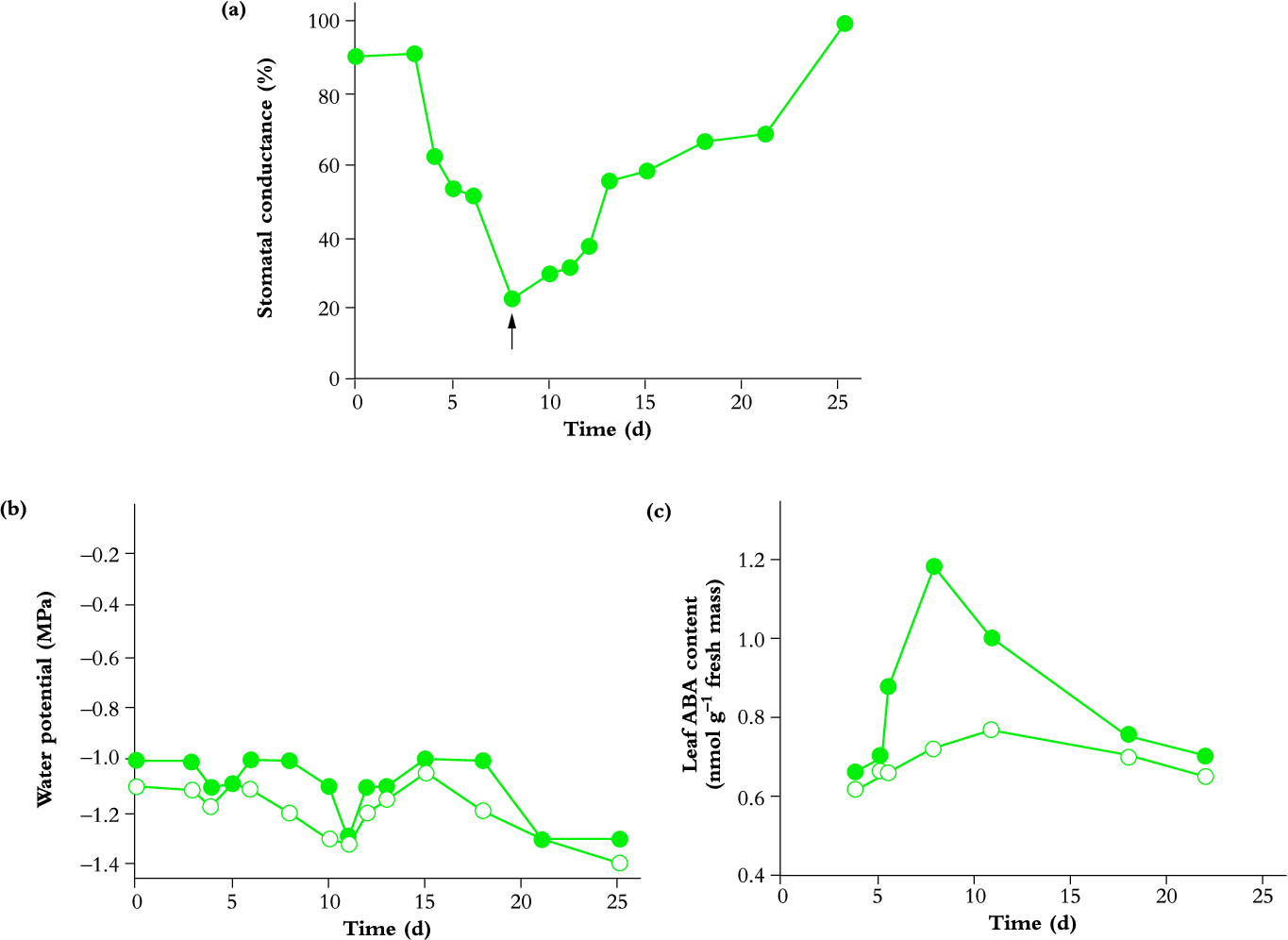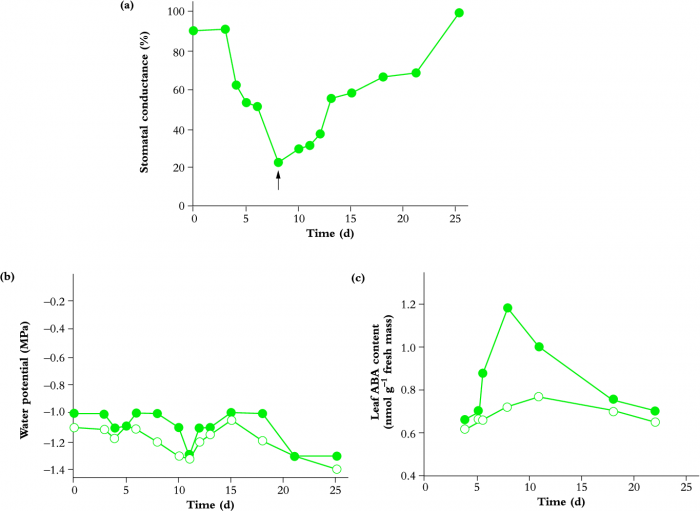
Figure 9.7 ((a), (b), (c)) Response of grapevines to hydraulic and non-hydraulic signals during water stress applied to split root systems. Root systems can be split vertically (surface v. deep) or horizontally (left-right, as in this experiment (d)) and different water stresses applied to each half. If one half is kept well watered, this is sufficient to maintain normal shoot water status and no leaf water potential difference is detected (solid circles) compared with control fully watered plants (open circles) (b). If the other half root system is dry, any drought signal induced may be transmitted to the shoot. A prime candidate for this root signal is ABA, which is detected either chemically (c), or by its effects on stomatal aperture (a). In many species, root-generated ABA can cause stomatal closure in the absence of any water deficit in the shoot. This is interpreted as an early warning system, enabling plants to reduce water use under imminent drought conditions. In nature, during periods without rain, surface roots would normally become dry before deep roots.
(Diagram courtesy B.R. Loveys)