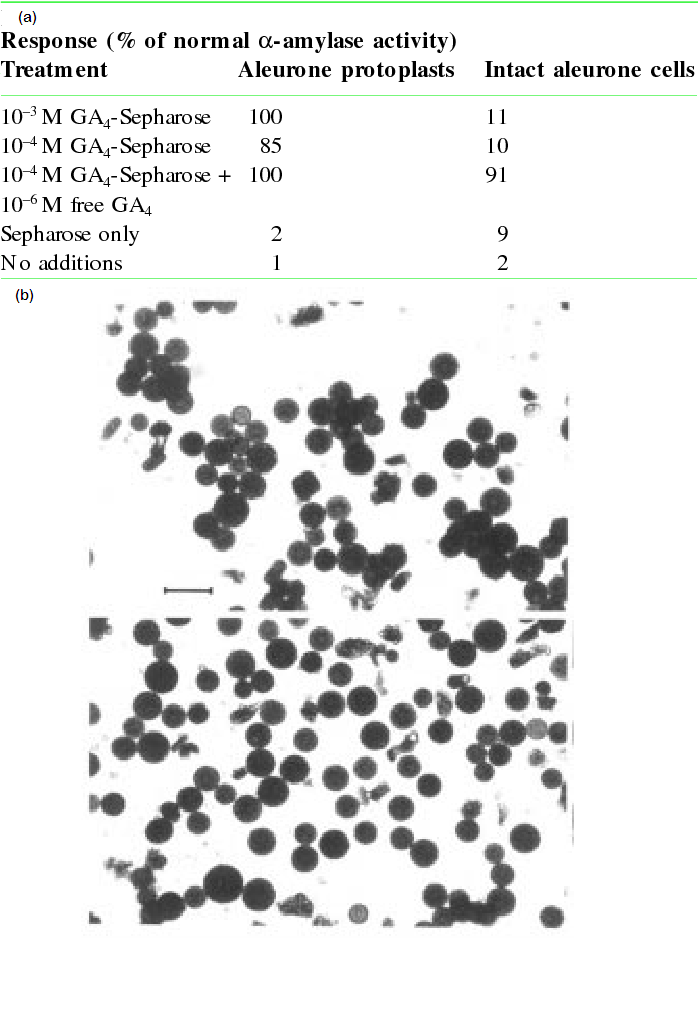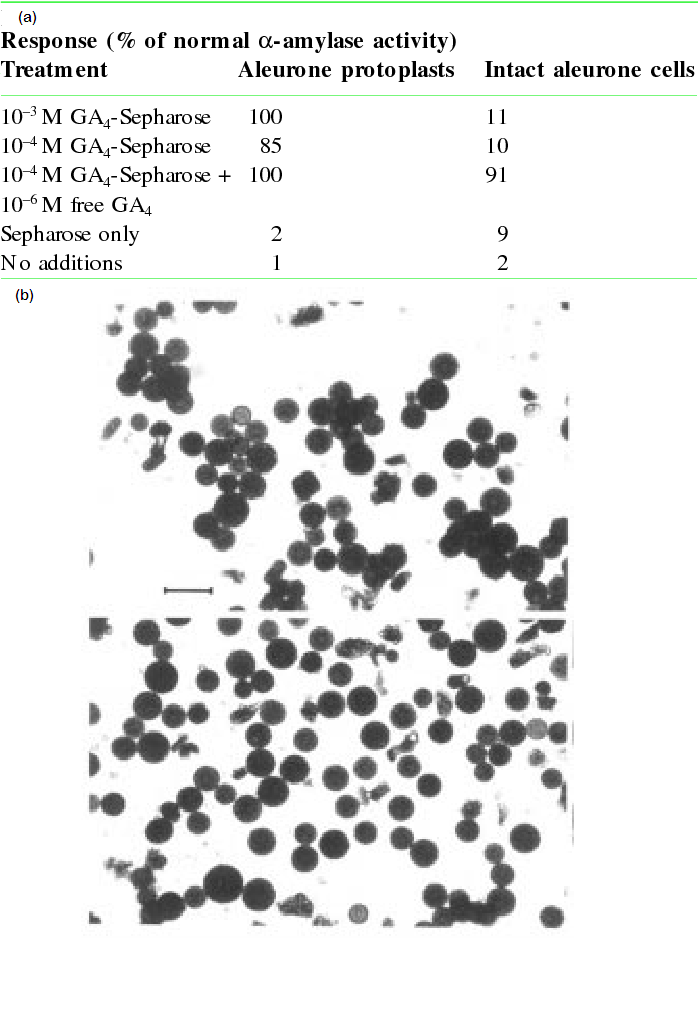
Figure 9.4 Gibberellin receptors in cereal aleurone cells are almost certainly located on the plasma membrane, facing outwards. Two lines of evidence support this view, both making use of protoplasts, that is, cells with their walls enzymatically removed. (a) Data showing that gibberellin molecules covalently anchored onto Sepharose (a polysaccharide gel) beads were still effective at inducing α-amylase synthesis. The Sepharose beads were much too large to enter the protoplast. The conclusion is that aleurone cells have receptors that can perceive gibberellin arriving from outside the cell. (b) Antibodies generated that mimic the shape of gibberellin molecules, known as anti-idiotypic antibodies, caused protoplasts to agglutinate (top). The explanation is that the antibodies are sticking to outward-facing gibberellin receptor binding sites on the plasma membrane. Because each antibody molecule has two binding domains, they can cross-link between cells, so forming aggregates of cells. Scale bar = 100um.
((a) Based on Hooley et al. 1991 and (b) based on Hooley et al. 1990)