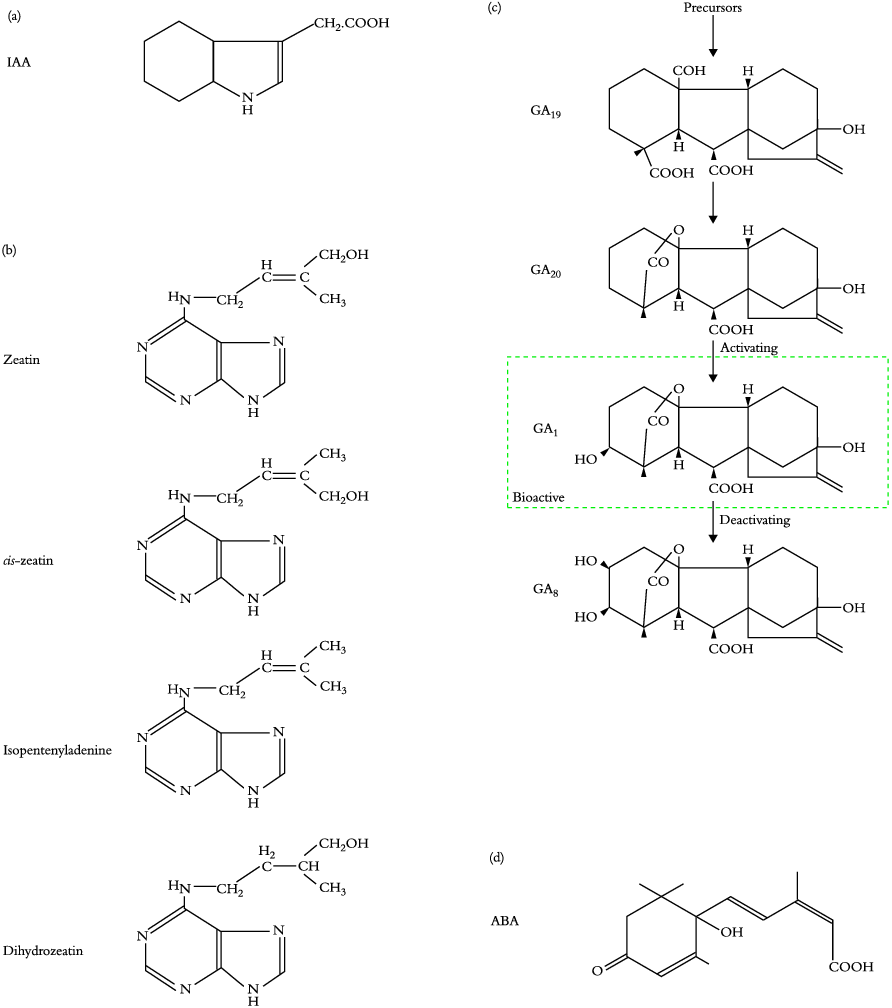
Figure 9.1 Structures and some partial biosynthetic pathways for common members of the five major groups of native plant hormones. (a) The most common natural auxin, indole-3-acetic acid (IAA). (b) Four classes of natural cytokinin: zeatin and its cis isomer, dihydrozeatin, isopentenyladenine. (c) Late stages of gibberellin biosynthesis pathway, showing some key points of genetic and environmental control of amounts of bioactive GA1.
(i) The GA19 -> GA20 step is under photoperiod control in some long day plants; for example, spinach shows a greater rate of metabolism under long days, and hence production of bioactive GA1, correlating with developmental transition from rosette form to stem elongation.
(ii) GA20 -> GA1 is blocked in many dwarf (short internode) mutants, such as le in pea, d1 in maize and dy in rice. GA20 itself is inactive but becomes active after addition of an hydroxyl (-OH) group to the 3ß position, thus forming GA1. In some other dwarf mutants, the pathway is blocked at steps well before GA19, and shoots of these plants contain almost no detectable gibberellins.
(iii) GA1 -> GA8 is a key reaction regulating amounts of active gibberellins. In this case, addition of an -OH group to the 2ß position inactivates almost every gibberellin, including GA1.
(d) Structure of abscisic acid (ABA)