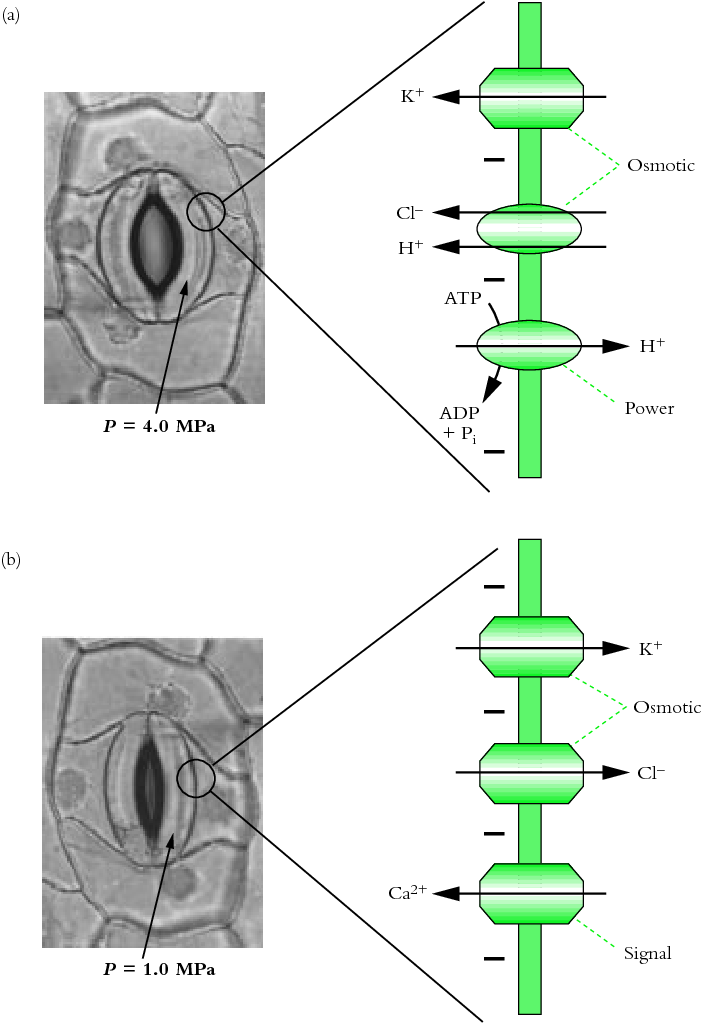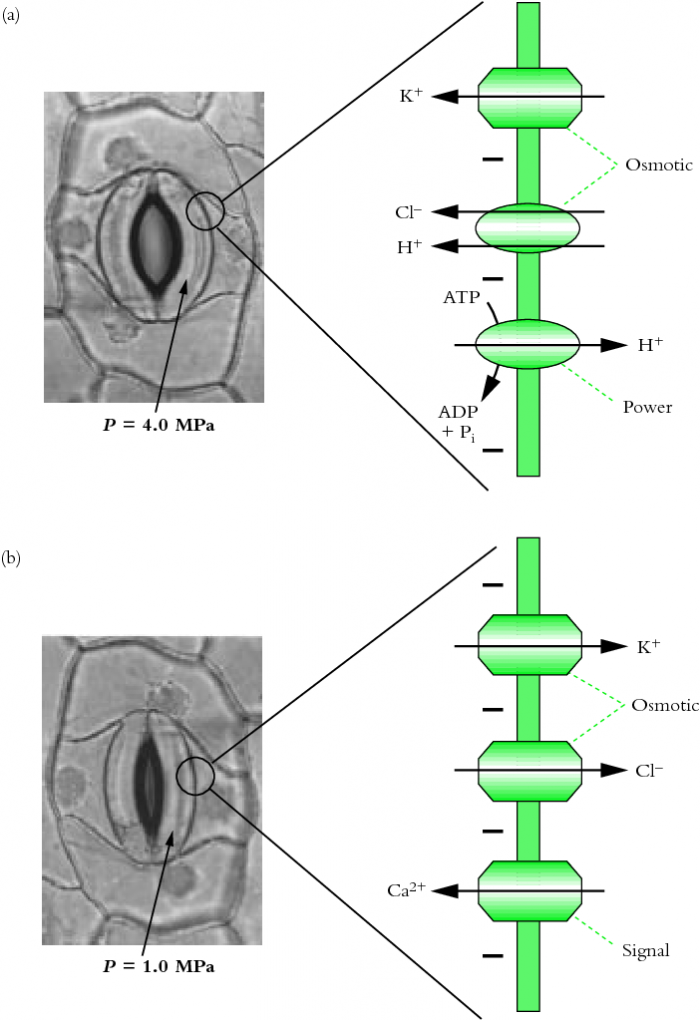
Figure 4.11 Transport systems in plasma membranes that are essential for volume change in guard cells driven by net flux of potassium chloride (KCl). (a) An open stoma, in which the proton pump generates a large negative membrane potential. Blue light and red light stimulate proton pumping in guard cells. Negative potential drives K+ influx through a K+ inward-rectifier channel. The pH gradient developed by proton pumping drives Cl--proton symport that must exist on the plasma membrane, although it has yet to be demonstrated. (b) A closing stoma where Ca2+ influx is a signal that initiates closure. Influx of Ca2+ depolarises the membrane (makes it less negative). An anion channel turns on, allowing Cl- to escape, further depolarising the membrane to the point that membrane potential becomes more positive than the Nernst potential for K+. The K+ outward-rectifier channel then opens, allowing K+ to leave the cell. Overall, a small amount of Ca2+ enters, followed by efflux of equal amounts of K+ and Cl-, causing an osmotically significant change.