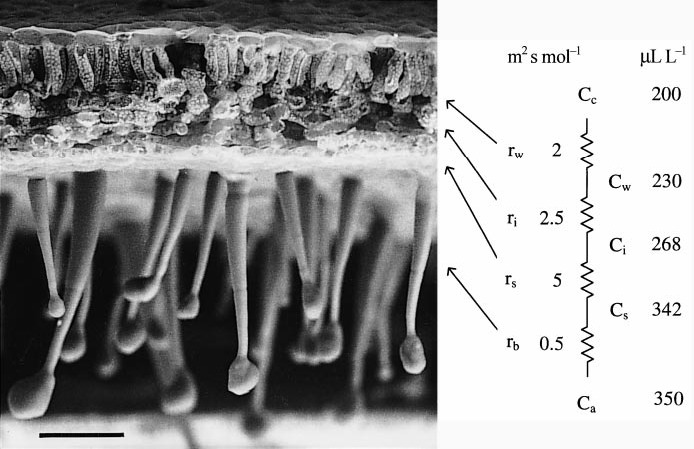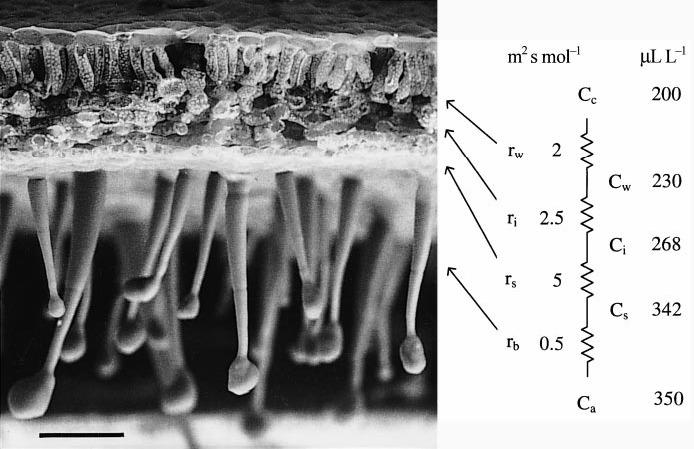
Figure 1.1 A scanning electron micrograph of an uncoated and rapidly frozen piece of tobacco leaf showing a hairy lower leaf surface and cross-sectional anatomy at low magnification. Epidermal outgrowths (hairs) offer some protection against insects, and contribute to formation of a boundary layer (unstirred air) adjacent to lower leaf surfaces. An electrical analogue (right side) shows a series of resistances (r) that would be experienced by CO2 molecules diffusing from outside (ambient) air to fixation sites inside chloroplasts. Subscript ‘b’ refers to boundary layer, ‘s’ to stomatal, ‘i’ to intercellular airspaces, ‘w’ to cell wall and liquid phase. Notional values for these resistances are given in units of m2 s mol-1, and emphasise the prominence of stomatal resistance within this series. Corresponding values for CO2 concentration are shown in µL L-1, and reflect photosynthetic assimilation within leaves generating a gradient for inward diffusion. In that case, subscript ‘a’ refers to ambient air, ‘s’ to leaf surface, ‘i’ to substomatal cavity, ‘w’ to mesophyll cell wall surface, ‘c’ to sites of carboxylation within chloroplasts. ci is routinely inferred from gas exchange measurements and used to construct A:ci curves for leaf photosynthesis. Scale bar = 100 µm. (Original illustration from Jian-Wei Yu and John Evans, unpublished)