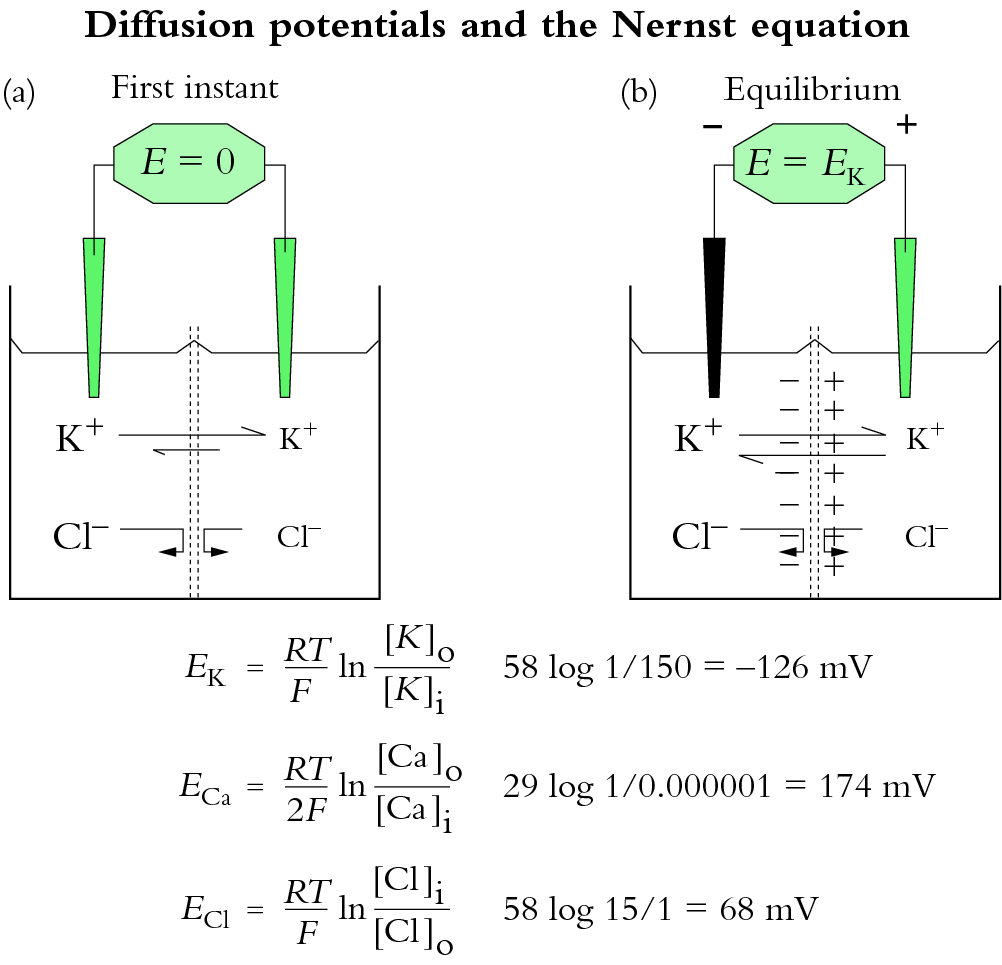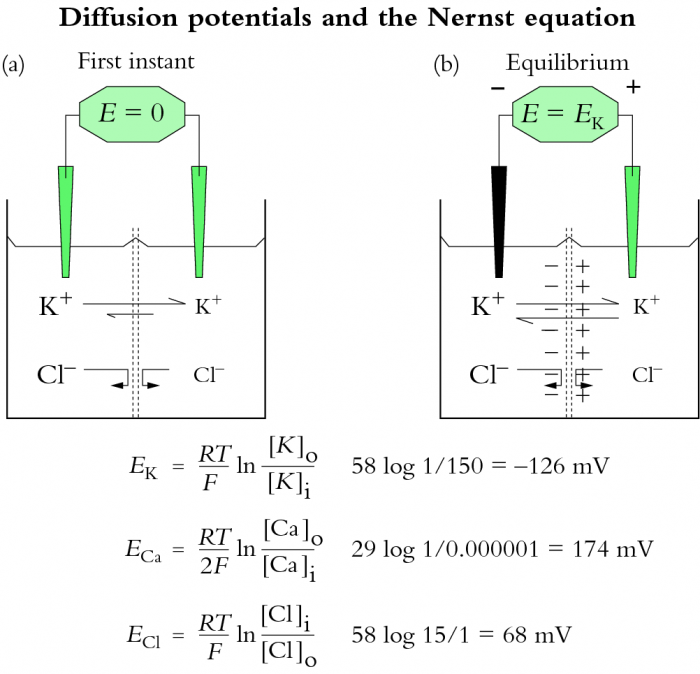
Figure 4.7 How a diffusion potential develops through differential movement of an ion across a membrane. This is achieved here by separating a concentrated KCI solution from a dilute KCI solution by using a membrane which is permeable to K+ but not Cl-. Letter sizes indicate concentrations. Initially (a), a minute amount of K+ crosses the membrane along its concentration gradient.This K+ movement creates a positive charge in the right-hand compartment as K+ concentration there rises above Cl- concentration. At equilibrium (b), a diffusion potential is established, reflecting movement of charge (as K+) to the right-hand chamber. Further inflow of K+ is prevented. Concentrations never equalise on both sides because K+ is the only species able to move through the membrane. itfusion potentials of K+, Ca2+ and Cl- in typical plant cells, calculated using the Nernst equation, are shown below. Energised transport must be invoked to explain the large disparity between actual membrane potentials (normally around -100 mV) and the diffusion potentials of Ca2+ and Cl-