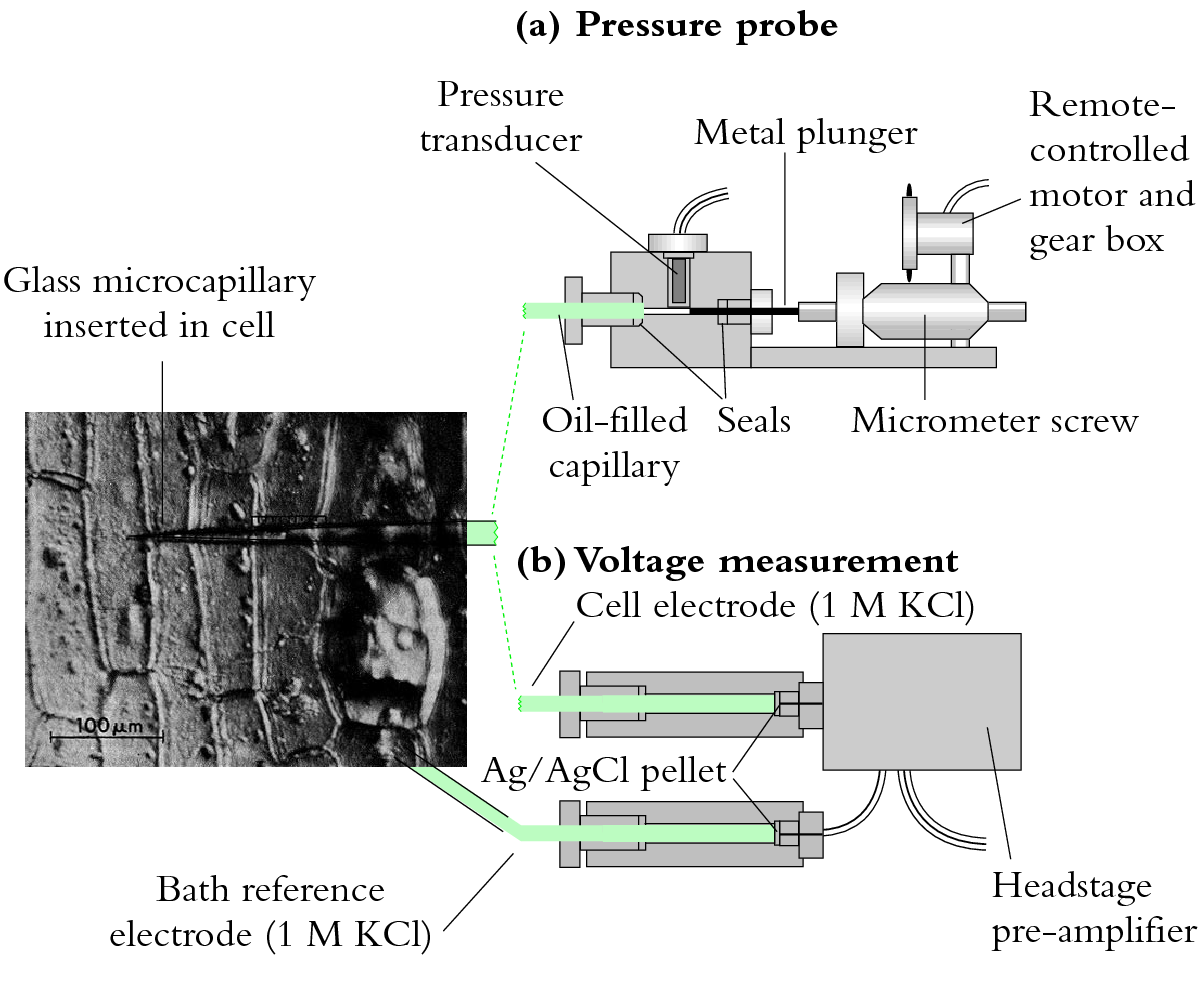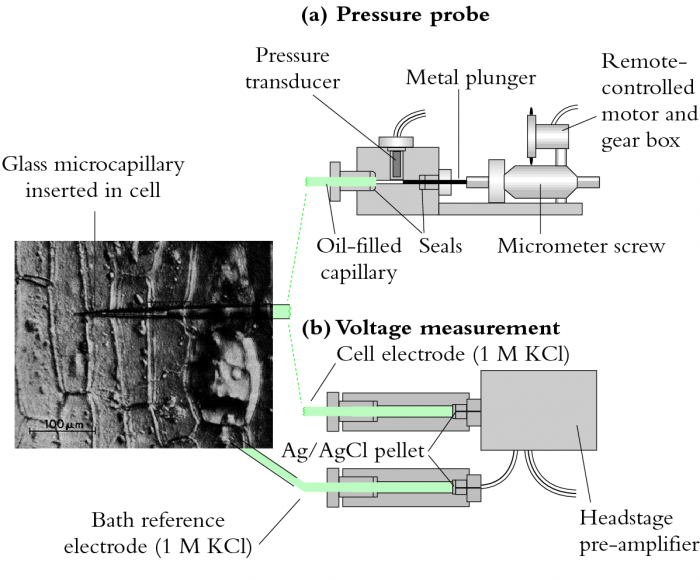
Figure 4.5 Techniques employing fine glass capillaries to probe plant cells. Glass capillaries are heated and pulled to a fine point with an opening as small as 1 µm. (a) A miniaturised pressure probe. An oil-filled capillary is inserted into a cell whose turgor pressure (P) is transmitted through the oil to a miniature pressure transducer. The voltage output of the transducer, which is proportional to P, can be read off on a computer or chart recorder. A metal plunger acting as a piston can be used via remote control to vary cell P. (b) A probe for measureing membrane voltage. The capillary is filled with 1 mol L-1 KCl and connected to a silver/silver chloride electrode that acts as an interace between solution voltage and input to the amplifier. A voltage is always measured with respect to a reference (in this case, a bath electrode). The headstage amplifier is close to the electrodes to minimise noise.