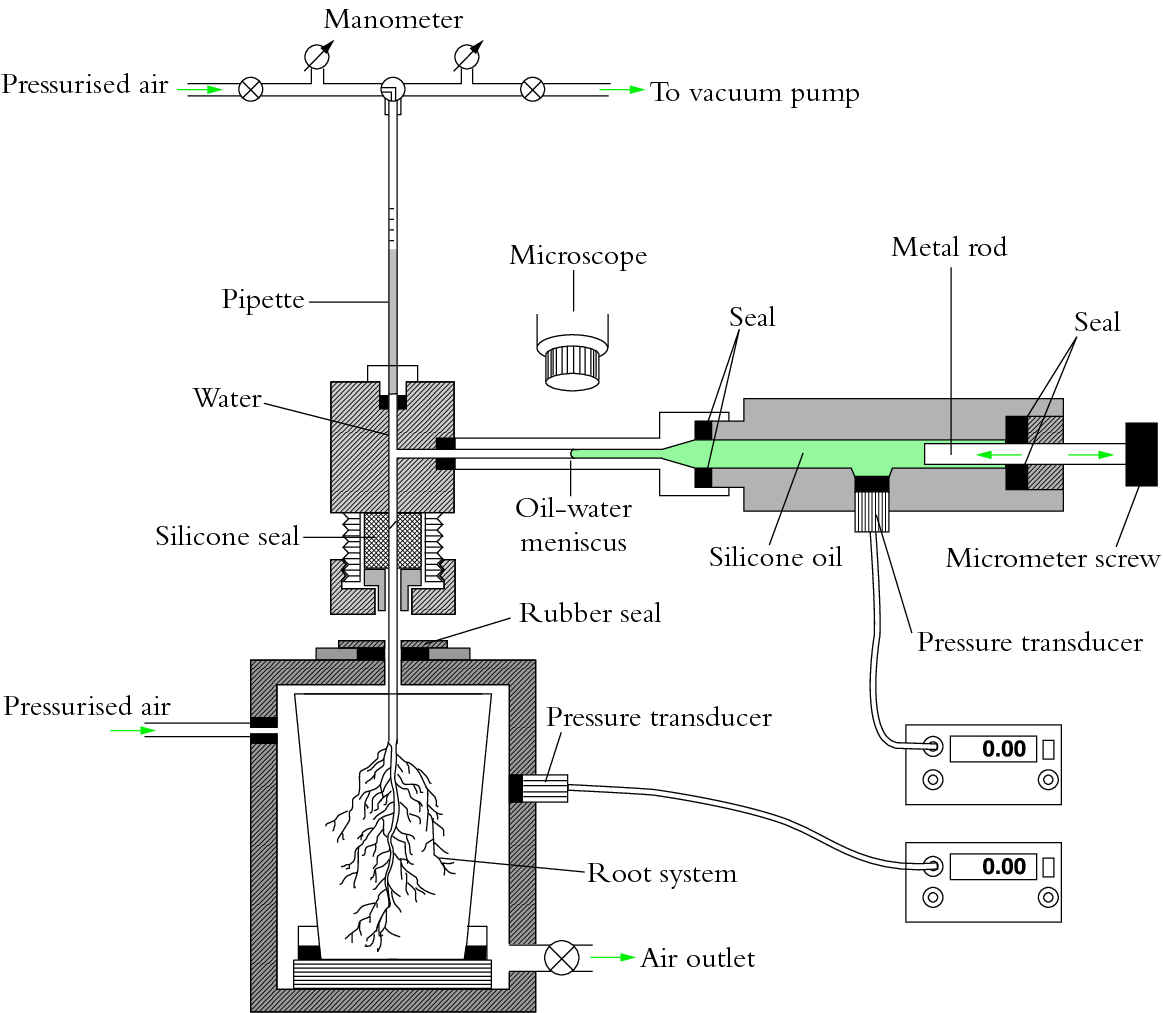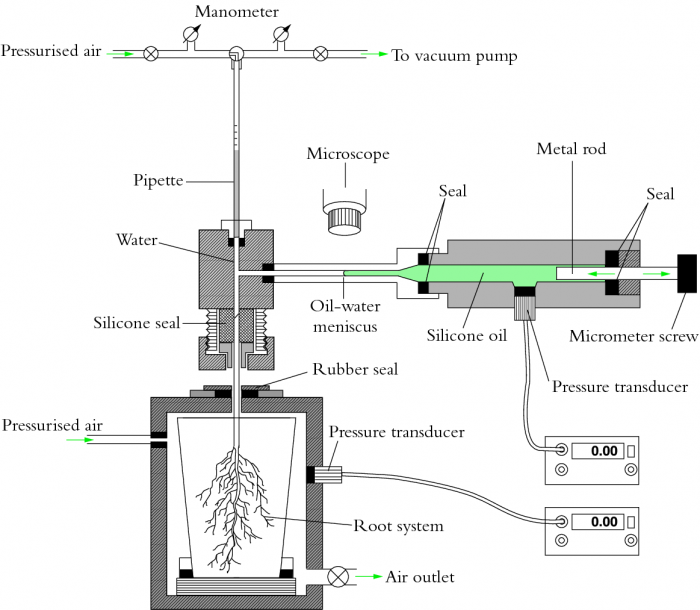
Figure 3.29 Root pressure probe for measuring water and solute relations of roots. The living root system is enclosed in a chamber which can be pressurised. After excising the shoot, a water-filled capillary is sealed to the cut stump with silicone; xylem sap can therefore flow directly into this capillary. The capillary connects to a pipette (top) and an oil-filled chamber (right) in which pressure can be monitored by following the oil-water meniscus. Roots in this apparatus remain alive and physiological for long periods, allowing water flow through the root system to be measured in a number of ways. (1) When the pipette is open to the atmosphere, roots under pressure exude sap providing a pressure-flow relationship from which root hydraulic conductivity (Lp) is derived. Unpressurised roots exude at a rate determined by solute uptake (giving ‘root pressure’). (2) Suction can be applied to the cut stump to mimic ‘transpirational pull’, so providing another measure of Lp. (3) The cut stump can even be pressurised, forcing water out through root tissues and generating another pressure—flow relationship. This direction of flow is rare but not unknown in nature. If pressure is applied fairly briefly, osmotic pressures in xylem sap are constant and Lp in (1) to (3) agrees closely. Finally, transient flows can be induced with the aid of the probe to estimate pressure relaxations. In this case, the pipette has to be removed and the system closed. The apparatus also gives information on solutes, in particular reflection coefficients (Equation 4.4) in whole root systems for a range of solutes (Drawing courtesy E. Steudle)